A supply chain dashboard can contain many updates without answering the planner’s most important question: what can the business rely on, and what still needs investigation? A carrier location, a supplier promise and a warehouse receipt describe different facts. Combining them into one shipment status can hide the uncertainty that matters.
Visibility is difficult because the evidence crosses organizations, identifiers, physical handoffs and time. The challenge is not only receiving more data. It is connecting the right event to the right object, preserving its meaning and knowing where the record is incomplete.
For an operations leader, the useful objective is decision-grade visibility: enough trustworthy information to support a defined action, with the limits made explicit. That is more demanding than placing all available feeds on one screen.
Identify the decisions the business needs to improve. A planner may need to know whether a specific component can support a production commitment. Customer service may need to explain a delivery exception. A receiving team may need to prepare for an inbound load.
These decisions require different information. The location of a vehicle may help receiving preparation but may not establish which order lines are on it. A supplier’s estimated completion date may support planning while remaining uncertain.
State the relevant object, required event and acceptable evidence for each decision. Include the action the team can take when the evidence indicates a problem. More frequent updates have limited value if no one can interpret or respond to them.
Avoid beginning with a broad promise of end-to-end visibility. Define a useful scope, such as a critical product flow or a particular handoff, and establish whether the evidence actually supports the intended decision.
A planned despatch date is a commitment or intention under the agreed process. An observed loading event is evidence that a defined activity occurred. An estimated arrival time is an inference about what may happen next.
Show those categories distinctly. A forecast should not silently become an actual milestone, and a missing scan should not automatically become proof that a shipment has stopped moving.
Record the source and the meaning of the event. A carrier’s arrived status might refer to its own depot, a customer gate or another location. The receiving organization may still need to inspect or record the goods before treating them as available.
Define how conflicting reports are handled. The newest message received is not always the newest event, and a later forecast does not necessarily override a confirmed physical observation.
The dashboard should make uncertainty understandable rather than remove it through an overly simple green or red label.
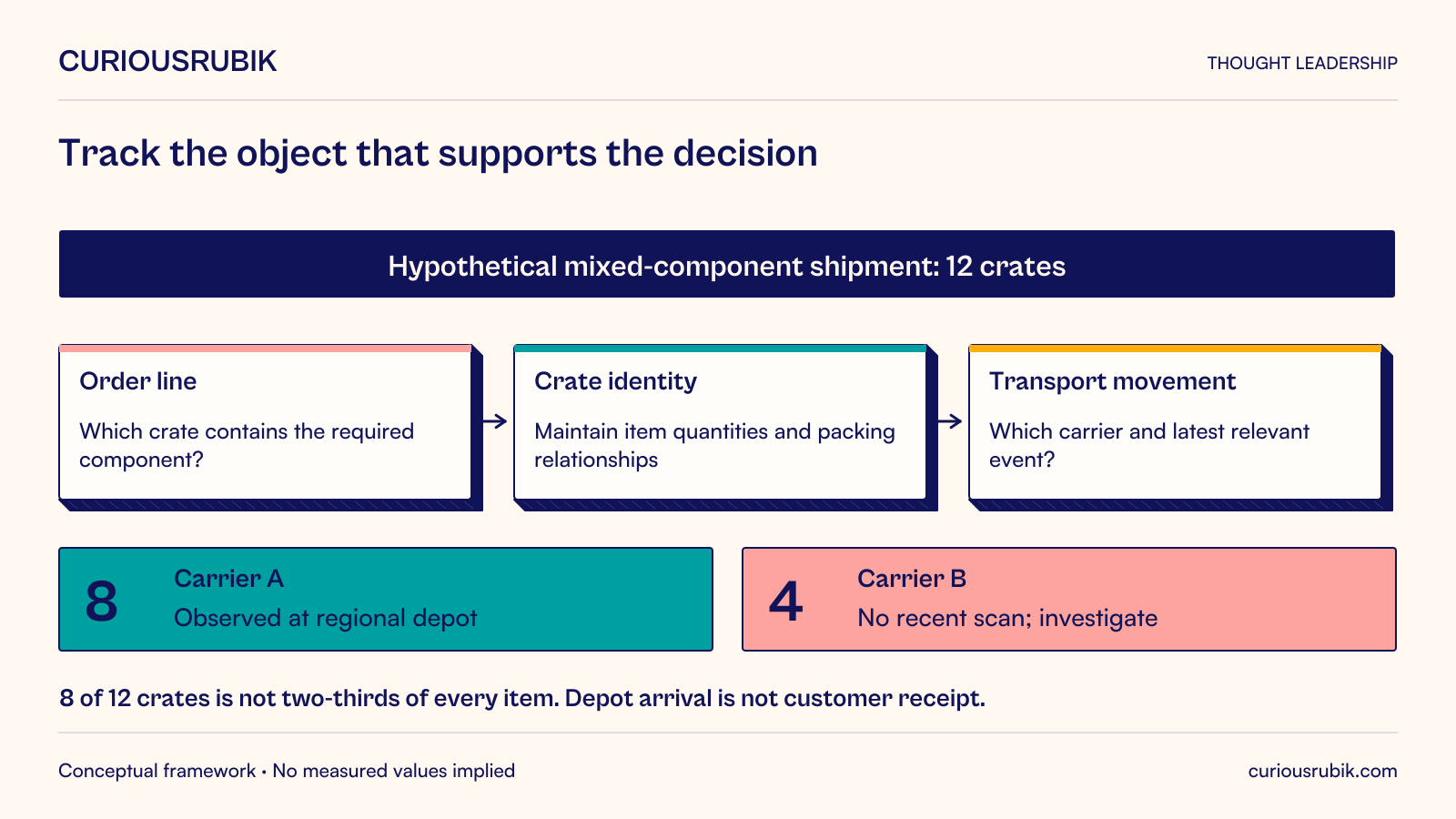
Consider a hypothetical industrial-components shipment containing twelve crates with several different order lines. At a cross-dock, eight crates move with one carrier and four with another. A tracking feed reports that the first eight have arrived at a regional depot; the second movement has no recent scan.
The business cannot infer that two-thirds of every ordered part is available. The crates may contain different quantities and products, and arrival at a depot is not receipt at the customer’s warehouse.
A production planner waiting for a particular coupling needs to know which crate contains it, which transport movement carries that crate and what the latest relevant evidence says. A single order-level in transit status cannot answer that question.
The missing scan on the second movement also needs careful interpretation. It could reflect a delayed data feed, an uncaptured handoff or a physical delay. The planner needs an investigation route and an appropriately qualified planning assumption, not a fabricated location.
The example shows why object relationships are part of visibility infrastructure. The organization must maintain those relationships as goods are packed, split, combined and handed over.
A shared model helps parties express events consistently. It should identify what was involved, when the event occurred, where it occurred and the business context needed to interpret it.
GS1’s EPCIS 2.0 standard, ratified in June 2022, defines a model for sharing visibility events. It distinguishes event time from the time an event is recorded through the capture interface. That distinction helps explain why the arrival of a message and the occurrence of the physical event are not the same thing. GS1, EPCIS 2.0.
A standard format does not guarantee that the source observation is complete or correct. The implementation still needs identity mapping, validation, permissions and operating ownership.
Use agreed vocabularies where appropriate, but confirm the actual process behind a label. Two partners can send technically valid events while applying a business step differently. Test representative examples with the people who create and consume the data.
The purpose is shared meaning that supports action, not conformance paperwork detached from the physical operation.
An event may occur before it is transmitted or captured. A dashboard refreshed seconds ago can therefore display a much older observation.
Show timestamps with clear meanings. Users may need the physical event time, the time the information became available and the time of the latest successful feed. Those values answer different questions.
Account for time zones and clock quality where they affect interpretation. A sequence that appears impossible may reflect inconsistent time representation rather than the movement of the goods.
Measure delay at the points relevant to the decision. If a handoff is only recorded at the end of a shift, improving the integration transport will not make the physical observation immediate.
Define what happens when evidence exceeds an acceptable age. The response may be to request confirmation, qualify a forecast or route an exception. Avoid applying one universal stale-data threshold to every product, lane and operating decision.
A feed’s successful-message count does not establish visibility over the full supply chain. The business needs to know which expected objects and handoffs have usable evidence and which do not.
Define the population before calculating coverage. Include relevant shipments or milestones with no received event, not only records that successfully entered the platform. Otherwise, the most invisible work disappears from the denominator.
Segment coverage by partner, location, product flow or handoff where useful. A high overall result can conceal a critical gap in one supplier or lane.
Distinguish missing evidence from missing activity. The coverage measure describes what the information system can establish. It should not automatically become a performance accusation against the party moving the goods.
Use the gap to direct investigation and process improvement. The remedy may be capture practice, master data, integration reliability or a clearer agreement about what the partner can provide.
Visibility creates value when an identified condition leads to an appropriate response. Define which exceptions matter, who reviews them and what authority they have.
Separate a data exception from an operational exception where possible. A missing identifier mapping may need data stewardship; a confirmed missed handoff may need logistics intervention. Combining them in one undifferentiated alert queue can slow both.
Provide the evidence needed to act: affected item or order, relevant commitment, latest observation, uncertainty and available options. Avoid alerts that require the reviewer to reconstruct the entire history before understanding the issue.
Track the response and outcome. Did the team obtain confirmation, change a plan, correct a mapping or resolve a physical delay? Without that record, it is difficult to determine whether improved visibility changed anything useful.
Do not let a dashboard automatically expand decision authority. Visibility into a supplier or shipment does not by itself authorize changing an order, rerouting goods or making a new customer commitment.
Partners may need to change capture practices, integrate systems or provide information they consider commercially sensitive. Understand those costs and concerns before assuming that a data request will be fulfilled reliably.
Agree the purpose, scope and access conditions for shared information. Provide feedback when data is unusable and make the benefit to the contributing party clear where possible.
Avoid asking for detail that the receiving organization cannot use. Excessive requirements can increase effort without improving the decision. Conversely, a minimal feed may be insufficient for a critical commitment even if it is easy to implement.
Maintain an escalation path for recurring data problems. A technical integration owner may not have authority to change warehouse practice or a partner agreement. The operating relationship needs to support the information flow.
Choose a flow where the decision and evidence gaps are clear. Trace representative objects through real handoffs using authorized data, and compare the system’s view with the operating record.
Test splits, late messages, missing scans and conflicting reports. Verify that the user can distinguish known facts from assumptions and identify the appropriate next action.
Measure the quality of decisions and the effort required to resolve uncertainty, not just the volume of events collected. A useful result might be fewer unsupported promises or faster identification of a missing handoff, but the evidence should establish the actual effect.
Supply chain visibility remains challenging because physical work and information do not automatically stay aligned. The strongest approach connects identities, event meaning, coverage and accountable action so that the business knows both what it can rely on and where it still needs to ask a better question.