Technical debt becomes a leadership issue when the organization repeatedly pays for the same constraint but nobody has authority to change the conditions that preserve it. Delivery teams absorb extra work, business teams experience delay and each project treats the problem as someone else’s background concern.
The response should not be an unrestricted engineering cleanup budget. Leaders need a way to distinguish a real continuing obligation from an aesthetic preference, decide which obligations matter and fund a proportionate treatment.
The useful question is how a technical condition affects business options. What work becomes harder, which risks remain, who owns the tradeoff and what evidence would justify acting now rather than later?
A debt item should describe a specific condition, not simply label a system old or complex. Examples might include an unsupported dependency, duplicated business logic, a fragile release process or missing automated checks around a frequently changed capability.
Connect the condition to a recurring consequence. Does it require repeated investigation, increase the chance of an incorrect change, prevent a useful upgrade or make recovery dependent on one specialist? The mechanism matters more than the size of the codebase.
The Software Engineering Institute describes technical debt in terms of expedient design or construction choices that can make later work more costly, while recognizing that consciously managed debt can support exploration. That framing helps distinguish an intentional tradeoff from an unmanaged obligation. SEI, Managing Technical Debt in Complex Software Systems.
Do not treat every defect, missing feature or operational issue as technical debt. Clear categories help the business understand whether it is correcting a fault, adding capability or changing a condition that affects future work.
Some consequences appear as engineering effort. Others appear as waiting, failed changes, support investigation or a business opportunity that cannot be pursued within the required time. Keep those effects distinct.
A team waiting for a specialist is experiencing elapsed delay, not necessarily continuous labor. A risk scenario is not an incurred loss. A projected future enhancement is not guaranteed demand for the affected capability.
Collect evidence from real work where available: changes that needed the same workaround, incidents with the same contributing condition or upgrades blocked by the same dependency. Record alternative explanations rather than assigning every problem to the debt item.
The goal is a credible pattern, not an impressive aggregate estimate. A small amount of well-understood evidence can support a better decision than a large unverified total of supposed developer hours lost.
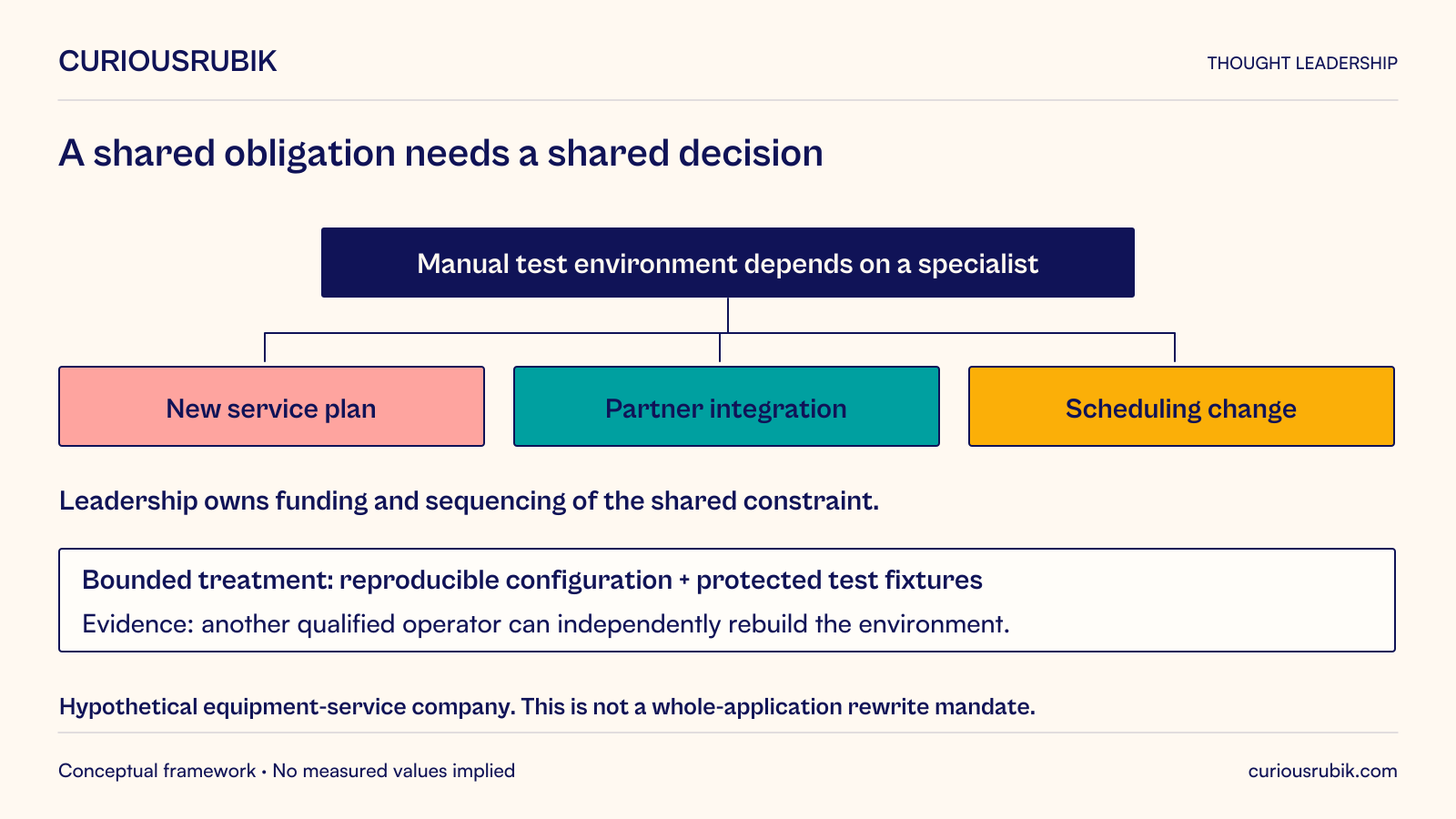
Consider a hypothetical equipment-service company whose application team must rebuild a representative test environment before significant changes. The process depends on a specialist restoring a database, applying undocumented configuration and manually constructing several customer variants.
The next roadmap contains a new service plan, a partner integration and a change to field scheduling. Each initiative needs the same environment. Project estimates include preparation effort, but no project owns making the environment reproducible.
A leadership discussion framed as features versus technical cleanup misses the shared dependency. The environment work can affect the reliability and timing of all three initiatives, while its benefit depends on how often those initiatives actually proceed and how much preparation can be eliminated.
The team might propose a bounded improvement: document and automate the environment build, create protected representative fixtures, assign an owner and demonstrate that another qualified person can reproduce it. That is a testable capability, not a request to rebuild the application.
The business should also ask what remains manual and whether the fixtures cover the relevant behavior. Automating an unrepresentative environment can produce a faster process with weak assurance.
Estimate what happens if the condition remains over a stated horizon. Include the expected work that encounters it, the uncertainty in that workload and the relevant risk consequences. Avoid assuming that every possible future project will occur.
Then estimate the treatment itself: investigation, implementation, testing, transition and ongoing maintenance. A refactoring or tooling change can introduce defects or require skills the team does not yet have.
Compare alternatives rather than only full remediation against doing nothing. The organization may contain the issue, improve documentation, add a protective test, replace one dependency or redesign a narrow boundary. Each option changes a different part of the obligation.
Some risks may require action regardless of an attractive effort-payback calculation. Applicable obligations, unacceptable exposure or an imminent support deadline need their own decision path. Do not force every issue into a single monetary score.
The word debt is a metaphor. It does not imply a known financial interest rate or a universally correct repayment schedule.
Engineering teams should explain the condition and possible treatments. Business leaders should own the consequences for priorities, service commitments and funding. Neither group can make the whole decision in isolation.
Assign an accountable owner for each material item. That owner should be able to maintain the evidence, coordinate affected teams and bring the issue back when its assumptions change.
A central register is useful only if it connects to decisions. A long list with no owner, trigger or treatment option can become a permanent archive of frustration.
For the test-environment example, the owner needs authority to coordinate the teams using it and maintain the shared capability after the initial project. Funding the first automation without assigning ongoing ownership can recreate the same problem in another form.
Make acceptance criteria explicit. The work is complete when the agreed capability is demonstrated, not merely when a set of engineering tasks is closed.
Deferring a debt item can be reasonable when the affected capability changes rarely, the risk is tolerable and more valuable work is available. The deferral should include a review trigger.
Triggers might include a planned change that crosses the fragile boundary, repeated failures from the same cause, an approaching support deadline or loss of a key operating skill. Choose triggers that the organization can observe.
Record what the business accepts while deferring. That may include longer lead time, limited functionality or a specific residual risk. This makes the tradeoff visible to the people making commitments based on the system.
Avoid repeatedly resetting the review date without reconsidering the evidence. A sequence of local deferrals can accumulate into a strategic constraint that nobody consciously chose.
When conditions improve or the business no longer needs the capability, close or revise the item. A debt register should not preserve obsolete concerns simply because they were once difficult.
Some improvements fit naturally alongside a feature that already changes the affected area. That can reduce repeated investigation and make the benefit immediate. It still needs clear scope and acceptance criteria so that the feature does not become an open-ended cleanup exercise.
Other items require dedicated work because their benefit spans projects or because continuing change is unsafe. Leaders should recognize that a shared obligation may not be fundable through one product team’s local priorities.
Use a portfolio view to expose common dependencies. If several initiatives depend on the same release, data or testing capability, compare the sequence that addresses the shared constraint with the sequence that repeatedly works around it.
Do not assume a fixed percentage of every sprint is the right answer for every organization. A reserved capacity policy can help, but it does not replace evidence about which work should use that capacity and why.
The objective is an intentional investment pattern, with visibility into the value and tradeoffs of the work selected.
Choose measures tied to the original mechanism. For the test environment, the team could examine reproducibility, specialist intervention, time to a usable environment and defects attributable to missing representative conditions.
Compare similar work where possible and record other changes. A shorter release cycle after a staffing increase does not establish that an architectural improvement caused the result.
Look for displaced cost. An automation may reduce preparation effort while creating substantial maintenance or support work. A shared component may reduce duplication while increasing coordination. The net effect matters.
Retain evidence of the treatment and the remaining limitations. Some obligations can be reduced without being eliminated, and reporting that honestly helps the next team make a sound decision.
Do not measure success by the number of debt tickets closed. Small items can be easy to close while the main business constraint remains untouched.
Review how the organization makes tradeoffs during delivery. Tight deadlines can justify shortcuts, but the decision should identify the assumption, owner and follow-up condition. Otherwise, temporary measures become permanent without a deliberate choice.
Reward accurate reporting of future obligations rather than penalizing teams for making them visible. At the same time, expect clear evidence and proportionate treatment proposals, not blanket claims that the architecture must be rewritten.
Make operating and maintenance responsibilities part of project completion. A team that delivers a capability without a support path transfers an obligation to the rest of the organization even if the launch appears successful.
Technical debt is a leadership problem because its consequences cross project boundaries and time horizons. Leaders do not need to choose implementation details themselves. They need to create a decision process that makes the obligations visible, assigns ownership and funds the changes that preserve the business’s ability to operate and adapt.