The technical team is ready to switch a performing-arts organization to its new ticketing service. One venue still cannot reconcile a set of existing bookings. The launch date is close. Delaying everything may waste a useful opportunity; launching everywhere may expose customers to inconsistent records. A percentage-complete report cannot decide between those options.
This hypothetical situation shows the practical purpose of transformation governance. It establishes who can make the release decision, what evidence they need, and which operating commitments must follow. The executive’s task is to make that decision path fast enough for the work while preserving control over consequences that are difficult to reverse.
Governance deserves priority over speed when speed would turn an unresolved assumption into a customer-facing commitment. That does not justify universal delay or more committees. Clear delegation and proportionate evidence can shorten decision time. The operating design below aims to preserve that useful speed while making the release boundary explicit.
A team can complete configuration rapidly while leaving unresolved questions about data ownership, customer communication, or support. The visible delivery rate then creates pressure to launch before the operating conditions are established. More completed tasks do not remove those dependencies.
Identify the decisions that change risk or commitment. Examples include accepting an incomplete migration, retiring the old service, widening a release population, or sending customers information based on the new system. These choices deserve more attention than routine adjustments inside an approved design.
Assess reversibility. A draft configuration can often be changed cheaply. A customer notification, a completed transaction, or the retirement of a recovery route can have consequences that persist after a technical rollback. Governance should recognize those boundaries.
Do not make every choice equally formal. If minor interface edits and irreversible operating commitments enter the same approval queue, important decisions compete with routine work and teams learn to avoid the process. Proportionate governance begins with meaningful distinctions.
Create a practical map of local decisions, cross-team decisions, and reserved commitments. Local decisions remain within an approved scope and risk boundary. Cross-team decisions affect shared dependencies or operating responsibilities. Reserved commitments require the designated executive or specialist authority.
For each class, specify the evidence, decision owner, response expectation, and escalation route. A deadline alone is insufficient if the person receiving the request cannot decide. A named owner is insufficient if the evidence arrives too late to compare alternatives.
Delegate repeatable choices where the policy is clear. A release manager may be able to exclude an unready location under an approved rule without waiting for the next steering meeting. The business should define that authority before the first urgent case.
Preserve specialist responsibilities. Security, finance, legal, operations, and other functions may hold decisions that cannot be overridden casually by a delivery deadline. The governance design should make their involvement timely and specific rather than treating them as an unspecified final approval stage.
Imagine a hypothetical performing-arts organization replacing the ticketing service used by several venues. The rollout is planned before a new season goes on sale. The technical build is ready, but one venue cannot reconcile a defined set of existing customer bookings between the old and new records.
The release dashboard shows most work complete. A speed-focused response would launch every venue and ask support to resolve discrepancies afterward. The consequence is that customers may receive inconsistent booking information during a commercially important period.
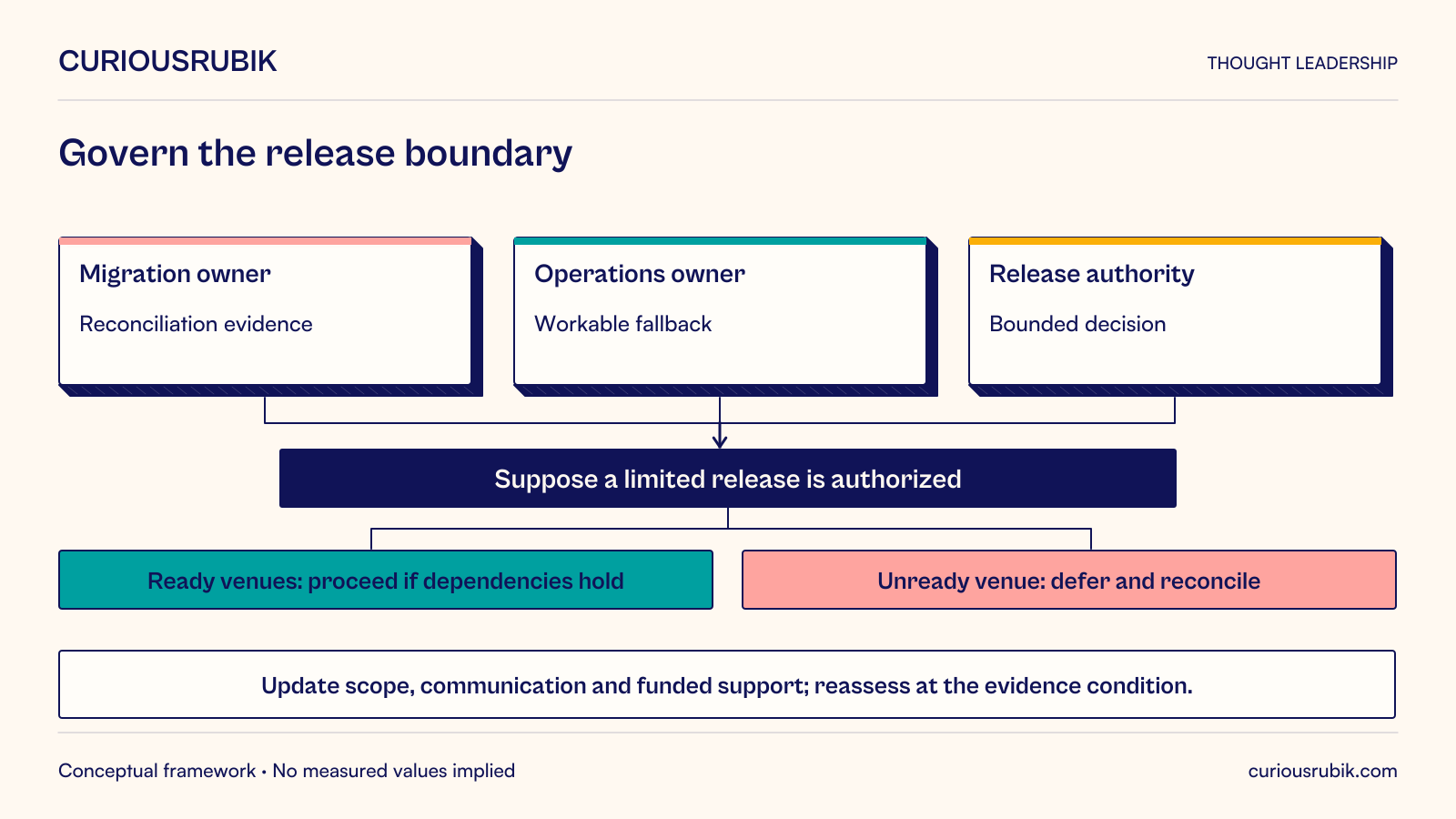
The governance model has already separated the decisions. The migration owner establishes the reconciliation evidence. The venue operations owner assesses whether the proposed fallback can serve affected customers. The release authority can defer an unready venue within a pre-approved boundary while allowing ready venues to proceed, if shared dependencies remain intact.
The decision packet presents three options: delay the full release, release only the ready venues with a controlled split operation, or proceed with the affected venue under a specifically assessed temporary arrangement. It shows customer impact, support capacity, cost, and the conditions that would invalidate each option.
Suppose the authorized decision is a limited release. That choice becomes a revised release population, an explicit customer-communication plan, a funded support arrangement, and a reconciliation condition for the deferred venue. It is not complete merely because a meeting records agreement.
The team also identifies the point after which rollback becomes more complex because new transactions exist in the replacement service. Recovery must account for those effects rather than assume that switching a technical route back restores the prior business state. This is a hypothetical operating scenario, not a claim about a particular ticketing product.
A useful decision packet states the observed condition, consequence, options, recommendation, unresolved uncertainty, and latest useful decision time. Include what happens if no decision is made. This helps the owner understand the real choice without reading every project artifact.
Distinguish evidence from confidence. “The team is comfortable” may summarize judgment, but the record should identify what was tested and what remains unknown. A reconciliation result or a demonstrated fallback is more actionable than a percentage-complete indicator.
Use representative exceptions. A ticketing cutover should include the cases that challenge the operating model, not only new clean transactions. The required evidence should follow the business’s actual risk rather than an arbitrary test-count target.
Keep the packet current. If scope, assumptions, or operating conditions change after it is prepared, identify the delta before the decision. A well-presented recommendation based on outdated facts can be as misleading as an incomplete one.
Measure how long material decisions wait and why. A delay may reflect missing evidence, unclear authority, conflicting priorities, or an unavailable decision-maker. Each cause needs a different correction. Scheduling more meetings does not necessarily address any of them.
Establish delegated cover and an urgent route for defined situations. Teams should know how to obtain a decision when the usual owner is unavailable, without interpreting silence as approval. The fallback authority should be legitimate and visible.
Require escalation early enough to preserve options. If the first notice of a reconciliation issue arrives after customer communications are scheduled, the organization has fewer choices. Governance should reward timely exposure of uncertainty rather than only confident delivery forecasts.
GAO’s IT investment-management guidance includes control and evaluation after selection. Applied here, governance continues as operating evidence changes; it is not exhausted by the original funding approval. GAO-04-394G, IT Investment Management, 2004
Reserve decision capacity around known commitment points. A major release should not depend on finding an available executive after the final evidence arrives. Arrange the relevant owners and qualified deputies in advance, and make clear which unresolved conditions will prevent the decision. This protects both speed and judgment without requiring every ordinary project question to wait for the same group.
Record the decision, conditions, owner, affected scope, and required follow-through. Update plans, configurations, support instructions, and communications consistently. An approval that exists only in meeting notes can leave teams operating under conflicting assumptions.
Check conditional approvals. If a release is permitted only after support cover is confirmed, someone must verify that condition before execution. Do not treat a conditional yes as an unconditional launch authorization because the calendar has advanced.
Identify which decisions expire or require reconsideration when facts change. An accepted temporary operating risk may no longer be acceptable if demand increases or the fallback fails. Record the trigger and the person who can stop or narrow the affected work.
Preserve a readable decision history. Operators investigating a problem should be able to establish which assumptions and authority applied. The record should support accountability and learning without becoming an indiscriminate archive of every conversation.
Remove reviews that do not change a decision or establish necessary evidence. A committee that repeatedly receives status without authority to act may add delay without control. Clarify its purpose or replace it with a more useful route.
Keep technical choices with qualified technical owners within the approved boundaries. Escalating every implementation detail to executives slows work and can weaken decision quality. Executives should focus on business commitments, competing priorities, and risks that exceed delegated authority.
Examine whether incentives encourage premature certainty. A supplier milestone, internal target, or performance measure may reward launching even when a critical assumption remains unresolved. Governance should expose that tension and ensure the acceptance decision reflects the business’s interests.
Use urgency intelligently. A verified deadline can justify a smaller release, additional capacity, or a controlled temporary process. It does not automatically justify ignoring the condition that makes the service safe and workable. Explain which tradeoff is being accepted and by whom.
Review whether decisions arrive in time, use credible evidence, reach execution, and produce the intended operating result. Include cases where the correct decision was to stop, narrow, or defer. A governance process should not be judged solely by how many approvals it issues.
The transformation executive’s next step is to select one upcoming consequential commitment and trace its decision path. Confirm the owner, evidence, deadline, fallback authority, and follow-through. Then remove unnecessary steps while strengthening the missing ones. Governance matters because it lets the organization move quickly on decisions it can defend, and pause precisely where speed would otherwise turn uncertainty into an expensive commitment.