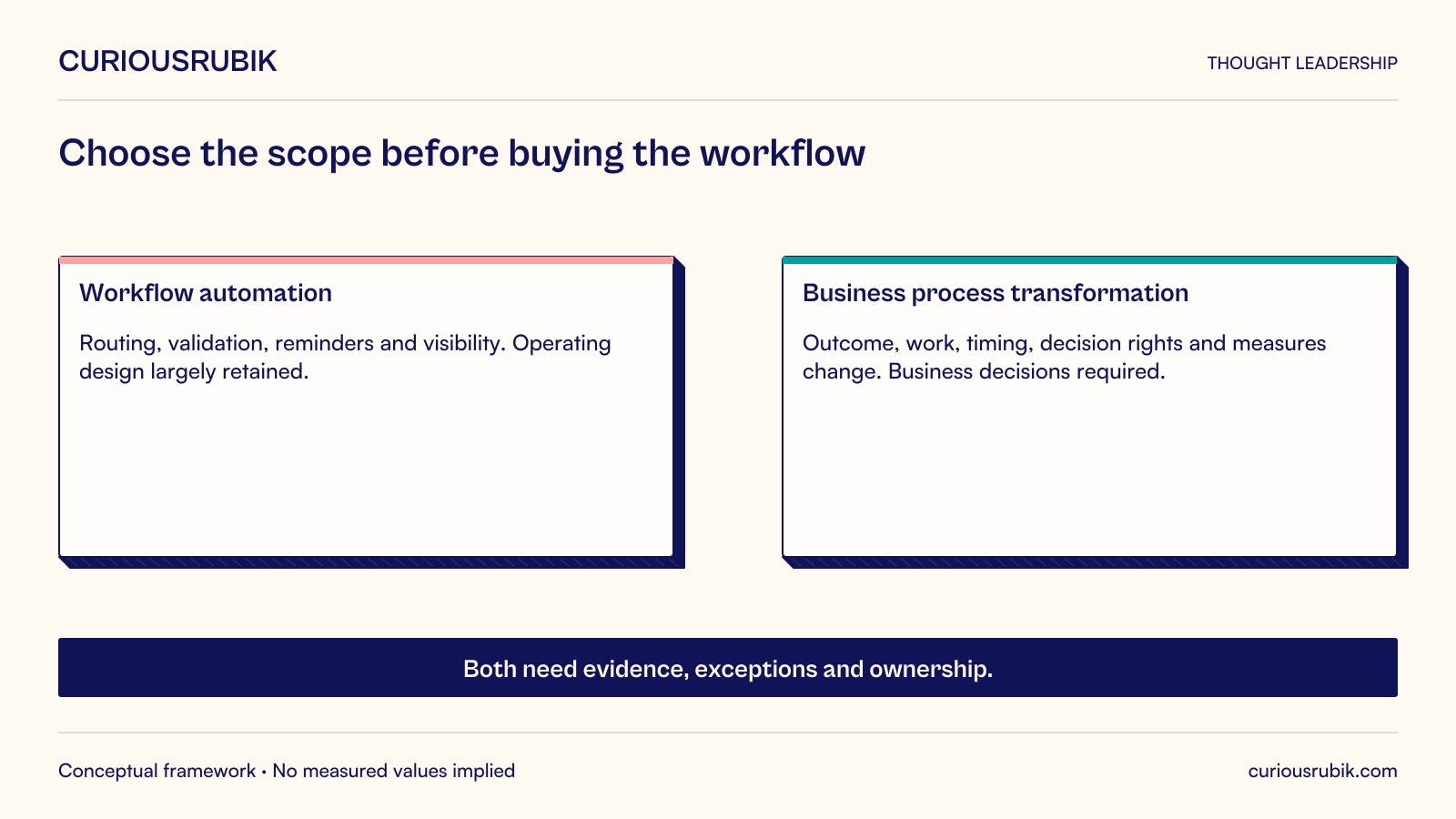
A digital form can replace an email request, route it to the right people, and record every approval. That can be a worthwhile improvement. It does not necessarily change why the request exists, when the decision is made, or who is accountable for the outcome.
Business process transformation changes those underlying choices. It may remove a request, move a decision earlier, redistribute authority, or alter the service the organization provides. Workflow automation implements and coordinates work within a chosen design.
The distinction matters because the two investments require different sponsorship, evidence, and expectations. Calling every workflow project a transformation inflates the promise. Treating a genuine operating-model change as a configuration exercise understates the decisions the business must make. Leaders need to choose the appropriate scope deliberately and be clear about how the two forms of change support one another.
A workflow project usually preserves the process’s basic purpose and allocation of responsibility. It may replace manual routing, add validation, send reminders, or make status visible. The business still asks broadly the same questions and makes the same decisions.
A transformation can change the unit of work itself. Instead of approving each routine service request separately, the organization may establish a governed service entitlement. Instead of correcting incomplete projects after a sale, it may require operational readiness before accepting the commitment.
Neither scope is inherently superior. A stable process with unreliable routing may need a modest workflow improvement. A process whose structure conflicts with the business model may need deeper redesign before automation can produce the intended result.
Ask what would remain unchanged if the technology disappeared. If the answer is the same roles, decisions, policies, and sequence carried out manually, the proposal is primarily automation. If the organization would still operate differently, the proposal contains transformation. This is a working diagnostic question, not a formal classification test.
Examine five questions: does the proposal change the service outcome, eliminate a category of work, move a consequential decision, change decision rights, or alter how performance is managed? This author-proposed heuristic helps expose scope that a software feature list can conceal.
A change in service outcome might replace a series of internal transactions with a clear customer entitlement. Eliminating work might remove repeated checks by making a reliable decision once. Moving a decision might establish feasibility before a commercial commitment rather than after it.
Changing rights means more than assigning a new task. A local manager may gain authority within defined limits, or a central owner may take responsibility for a cross-team result. Performance management may then need to reward the shared outcome rather than each team’s local throughput.
If several answers are yes, the project needs explicit business design and executive decisions. If the answers are no, keep the scope honest and evaluate the workflow on the reliability and effort it improves.
Consider a hypothetical engineering consultancy. Once a proposal is accepted, an administrator collects scope, staffing, billing terms, and project codes from several teams. Work sometimes begins before setup is complete, leaving time entries and invoices to be corrected later.
The workflow option introduces a structured request with validation, parallel tasks, reminders, and an exception queue. It provides a clear view of what remains outstanding. The delivery and finance teams retain their existing responsibilities and approval rules.
That option may be entirely appropriate if the main problem is missing information and poor coordination. Its business case should focus on setup effort, completeness, and fewer corrections. It should not claim that the firm has redesigned how it accepts work.
The transformation option asks why operational feasibility and billing assumptions are confirmed only after the client commits. The firm introduces a pre-acceptance readiness decision for defined project types. Delivery confirms the relevant capability and capacity assumptions; finance reviews unusual commercial terms; the authorized commercial owner resolves exceptions before the agreement is finalized.
Standard project types use approved patterns so routine work does not require a bespoke review each time. Nonstandard work receives a targeted assessment. The firm also changes performance discussions so winning work that cannot be delivered responsibly is not treated as an unqualified success.
The transformation has tradeoffs. It may slow proposal acceptance and consume senior attention earlier, including on opportunities that are never won. It may also reduce later disruption. Those effects need measurement; they cannot be settled by a workflow demonstration.
The pilot compares defined project categories and records proposal delay, readiness exceptions, post-acceptance corrections, staffing changes, and project-start reliability. It preserves the distinction between a genuine commercial exception and an incomplete request. The hypothetical case does not claim realized margin or utilization gains.
A common diagram helps teams inspect sequence, responsibilities, and exceptions. BPMN provides standardized process notation, including constructs for events and activities. It can make a proposed workflow easier to discuss across business and technical roles. OMG, BPMN 2.0.2.
The diagram does not grant authority or resolve a policy dispute. A box labeled “approve readiness” is incomplete until the organization defines the evidence, decision owner, limits, and response to disagreement.
Maintain a decision record beside the model. Identify which rules are existing policy, which are proposed changes, and which remain unresolved. Do not allow a technical team to convert an unmade business choice into a default configuration simply to maintain schedule progress.
Use different levels of detail for different decisions. Executives need to understand changed commitments and rights. Operators need usable instructions. Developers need precise state transitions and failure behavior. One crowded diagram rarely serves all three audiences well.
A workflow improvement can often be owned by a process manager with appropriate technical and control support. It still needs business acceptance, but it may not require broad organizational redesign.
Transformation requires authority across the affected functions. If a new readiness gate changes how sales accepts work, a delivery manager alone cannot implement it. The sponsor must resolve competing objectives, resource commitments, and performance measures.
GAO’s reengineering guidance includes strategic goals and organizational change alongside implementation. That broader scope is a useful reminder that changing the way a business operates requires more than automating its documented activities. GAO, Business Process Reengineering Assessment Guide.
Keep governance proportionate. A small workflow fix should not be delayed by a transformation board that has no relevant decision to make. Conversely, a consequential policy change should not slip through as a minor configuration request.
Workflow automation often creates value through reduced coordination effort, better consistency, fewer lost requests, and clearer status. Transformation may create value through different decisions, fewer categories of work, improved service design, or changed capacity allocation.
Document those mechanisms separately. In the consultancy example, automated reminders may reduce administrative chasing. Earlier readiness decisions may prevent unsuitable commitments. Counting all later improvement as a software saving hides the role of changed policy and management behavior.
Also separate timing. An automated workflow may produce a visible benefit quickly, while a changed project-acceptance model may need several project cycles to evaluate. Set review points around the actual outcome rather than the go-live date.
Include transition costs. During redesign, teams may need to maintain old and new processes, retrain managers, revise agreements, or rebuild reports. A transformation can be attractive despite these costs, but it should not borrow the simpler cost profile of a workflow configuration project.
There are three reasonable sequences. The business can repair the operating design first and automate it afterward. It can use a limited workflow to collect evidence and stabilize work before a wider redesign. Or it can combine the changes where the new operating model cannot function without the technology.
Choose according to dependency and reversibility. If policy remains uncertain, avoid hard-coding it into a large solution. A lightweight pilot may make the decision easier. If the existing manual process is unsafe or unsustainable, a bounded stabilization step may be justified even if it is later replaced.
Define the temporary boundary. Specify what the interim workflow will support, which assumptions remain open, and what event will trigger redesign or retirement. Otherwise, the temporary solution can become the architecture through inertia.
Do not insist on transformation where a smaller improvement solves the problem. The opportunity cost of a broad program includes management attention and delayed delivery of straightforward benefits.
Transformation creates cases that straddle the change. A project accepted under the old process may reach billing under the new one. A request already in an approval queue may not contain the evidence the new process expects.
Decide which rules apply to in-flight work, who can make exceptions, and how records show the applicable version. Avoid retroactively treating a case as noncompliant with a rule that did not exist when the decision was made.
Train people on changed authority and rationale, not only new screens. If a manager’s approval is no longer required for routine work, explain the conditions that make delegation safe. If a new gate exists, explain what decision it protects and what happens when evidence is missing.
Test recovery. If the new workflow fails, the fallback must preserve the redesigned responsibilities. Reverting to email should not silently restore a policy the business intended to replace.
A proposal should distinguish business design, decision facilitation, configuration, integration, migration, training, and ongoing ownership. Otherwise, the buyer may expect transformation while the supplier has priced only workflow delivery.
Request demonstrations of both normal work and a policy exception. Ask which decisions the supplier assumes the business has already made. Identify where the implementation plan depends on executive agreement or changes to other teams’ work.
The final choice should be expressed plainly: automate a stable process, investigate a redesign, or implement a defined operating-model change with supporting workflow. Each can be valuable. The important discipline is matching the promise, authority, and evidence to the scope the organization is actually undertaking.