Reconcile Australian Payroll with NetSuite Finance and Cash
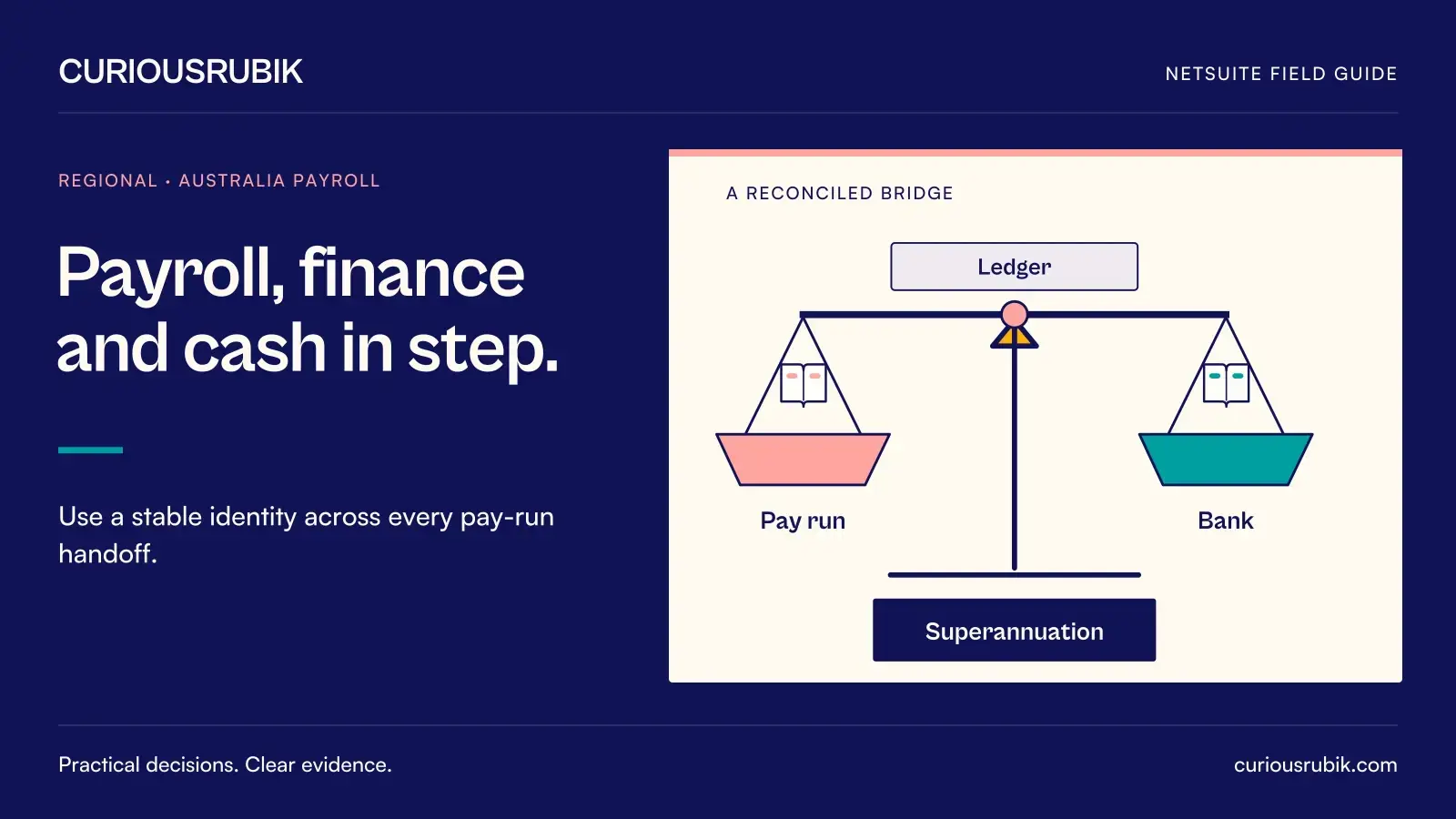
A payroll journal can balance while still putting costs in the wrong subsidiary, leaving an unexplained clearing balance or hiding a rejected superannuation payment. Finance needs more than a successful import message.
Design the payroll-to-NetSuite handoff around three reconciliations: the approved pay run to the ledger, the ledger to payment activity, and the payment activity to the final outcome. Each answers a different question. Together they make corrections easier to trace without unnecessarily exposing employee data.
Establish the payroll system boundary
State where payroll calculation, employee records, statutory reporting and payment preparation occur. Then define which information enters NetSuite and why. The ERP interface may support financial accounting without taking over the payroll provider's reporting role.
Choose the minimum detail needed for cost allocation and control. Summary data by entity, account and department may be sufficient for some processes. Other requirements need more granular records. Agree access and retention before transferring employee-level information simply because the source can export it.
Record who approves the pay run, who releases the accounting interface and who reviews the result. A technical operator should not have to infer whether a payroll file is final from its filename.
Give every pay run a stable identity
Use a reference that remains consistent across the payroll approval, exported file or message, NetSuite journal and payment reconciliation. Record the run type, entity, pay date and accounting period separately.
Distinguish an original run from an adjustment or reversal. Reusing the same file with changed values can make it difficult to tell whether the ledger holds the approved version. A controlled sequence should show what changed, who approved it and which earlier record it corrects.
The interface should also recognise an already processed run. A retry after a timeout must not create another payroll journal. Check the destination for the business result before resubmitting, and retain the outcome against the pay-run reference.
Map accounting categories deliberately
Document how earnings, employer costs, withholding, deductions and liabilities map into the ledger. Identify the required entity and cost dimensions for each line. Have finance approve the mapping and payroll confirm that the source categories mean what the mapping assumes.
Use separate clearing or liability accounts where they support the control design. Do not combine amounts solely to reduce the number of journal lines if that removes the ability to explain an unpaid obligation.
Test unusual but realistic cases: an off-cycle payment, a terminated employee, a department change and a correction to an earlier run. The relevant accounting and payroll specialists should determine the treatment. The interface test then demonstrates that the approved treatment is applied consistently.
Reconcile a simple illustrative pay run
Assume an illustrative approved run has gross wages of AUD 80,000, withholding of AUD 16,000 and other deductions of AUD 1,000. Net wages are therefore AUD 63,000. Separately, assume employer superannuation expense of AUD 9,600 for this example. These figures demonstrate reconciliation and do not define the correct calculation base or treatment for any employee.
The accounting handoff must preserve the relationship between the AUD 80,000 wage expense, AUD 63,000 net-pay obligation, AUD 16,000 withholding liability and AUD 1,000 other deduction liability. It must also record the separately approved employer cost and corresponding liability.
Finance should reconcile the imported totals to the approved pay-run summary and check allocation by entity and cost centre. A journal can have equal debits and credits while charging an entire department to the wrong subsidiary.
Next, reconcile the AUD 63,000 net-pay obligation to the payment batch and bank outcome. If AUD 1,500 is rejected and AUD 61,500 settles, the outstanding AUD 1,500 needs a named owner and a controlled retry. It should not disappear through a manual clearing entry.
Track superannuation beyond the bank debit
The superannuation process needs evidence of the applicable contribution obligations and the outcome of each payment. A bank debit or a submission to an intermediary is not the same as confirming that the required amount reached the intended destination and can be allocated correctly.
Australian payday super requirements changed from 1 July 2026. Your payroll owner should confirm the current rules, relevant exceptions and provider process that apply to the business. The finance design should support prompt reconciliation and correction rather than relying on an old quarterly operating calendar.
Keep the contribution reference, expected amount, payment status and any returned or unallocated items connected. Define who investigates mismatched employee details, rejected contributions and returned funds. Those issues may require payroll action even when the NetSuite ledger posting is correct.
Do not clear a liability merely because cash left the bank. Reconcile the obligation, payment and final outcome under the approved accounting policy, with appropriate treatment for returned or unresolved amounts.
Design corrections before the first live run
Agree what happens when payroll changes after the accounting file has been posted. The answer may involve a controlled reversal and replacement or a separate adjustment, depending on the approved process. Preserve the connection to the original run.
Test the accounting-period boundary. A correction relating to an earlier pay run may arrive after finance closes the period. Payroll, finance and the responsible advisers should determine the appropriate treatment; the interface should not silently backdate it.
Also test a partial failure. If a multi-entity run posts for one entity and fails for another, the retry must target the missing result without duplicating the successful portion. The reconciliation should show the original intended population and the final ledger result.
Make the recurring review short and decisive
For each run, review the approved source totals, imported ledger totals, allocation exceptions and payment outcomes. Age unresolved clearing items and identify the next action. Focus attention on differences rather than manually rebuilding every calculation already controlled in payroll.
At month end, reconcile payroll-related balance-sheet accounts and explain remaining liabilities. Compare the exceptions with the payroll provider's outstanding items. This catches situations where finance considers a run complete while payroll is still resolving a rejected payment.
Questions about the payroll handoff
Is a balanced journal sufficient evidence?
No. Reconcile it to the approved pay run and inspect entity, period and cost allocation. Then reconcile related payments and unresolved liabilities.
Should employee-level data always enter NetSuite?
Only where the business need and access controls justify it. Use the minimum detail required for accounting, reporting and reconciliation.
How should a failed import be retried?
First establish whether any destination records were created. Retry only the missing result using the stable pay-run reference and the approved recovery process.
Can finance clear superannuation when the bank is debited?
Follow the approved accounting policy and confirm the payment outcome. A debit alone may not establish that a rejected or unallocated contribution has fulfilled its purpose.
CuriousRubik can discuss the payroll accounting boundary and reconciliation design with your finance and integration teams. Payroll and tax obligations should be confirmed by the specialists responsible for your business.