A NetSuite Integration Plan with Clear Data Ownership and Reconciliation
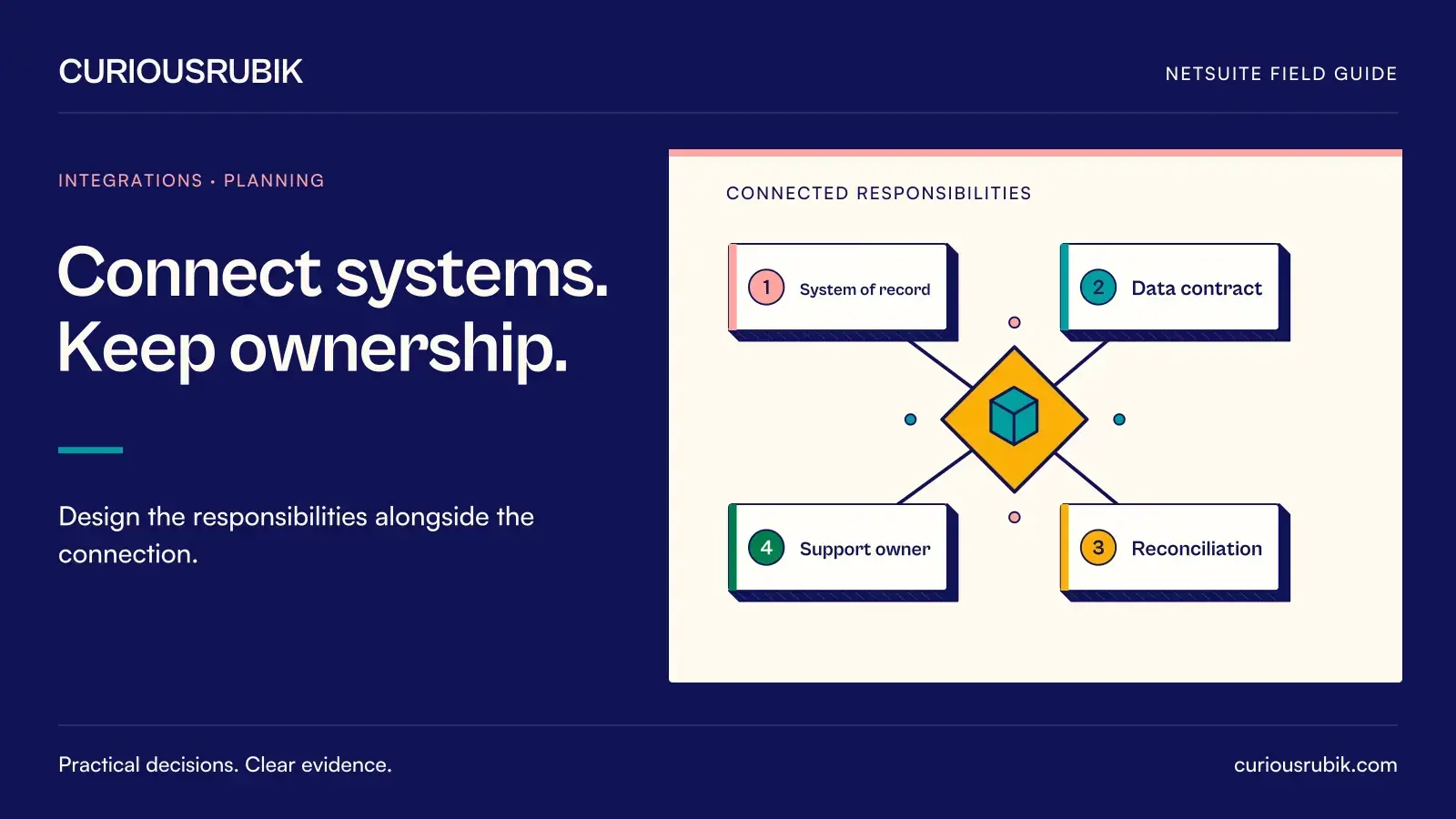
An integration plan should explain how the business knows its work is complete. Architecture diagrams and field mappings help, but they leave a gap if nobody can identify a missing order, approve a conflicting customer change, or reconcile an interrupted payment update.
Build the NetSuite integration plan around business events, accountable owners, and verifiable results. Technical details then support a shared operating agreement. This approach is useful whether the delivery method is a native connector, middleware, or custom development because the business still needs the same answers about authority and completeness.
Map flows in the language of the business
Begin with a short catalog of events: customer approved, order released, goods shipped, invoice posted, payment applied, or return accepted. Give each event a producer, consumer, expected result, timing need, and exception owner.
Separate commands from notifications. “Create an approved order” requests a change. “Order created” reports a completed fact. Confusing the two can cause consumers to treat an unapproved request as a finalized transaction.
For a hypothetical service-and-parts business, the initial scope contains three flows. Sales sends approved orders to NetSuite. A warehouse returns shipment confirmations. Finance publishes invoice status for customer-facing staff. The scope excludes automatic refunds and changes to credit terms; those decisions remain within the company's approved finance processes.
Document the exclusions alongside the flows. They prevent a later discussion about “full integration” from silently expanding the authority or data exposed by the design.
Establish the system of record for each decision
A system-of-record map identifies where a value is authoritative and who can approve changing it. It should be more precise than assigning every customer field to one application.
The hypothetical business adopts this map:
- Sales owns contact preferences and opportunity status in its customer system.
- Finance owns the approved legal customer, currency, credit terms, and accounting classifications in NetSuite.
- Operations owns item fulfillment attributes and the mapping between commercial products and operational items.
- The warehouse owns physical execution events; NetSuite remains the approved inventory transaction record.
- The integration owns cross-system identifiers, event status, and processing evidence, without acquiring authority to approve financial exceptions.
For shared information such as addresses, document the purpose. A delivery address, billing address, and registered address can differ legitimately. A generic “address” mapping may destroy that distinction.
Assign conflict behavior at the same time. The consumer may reject an unauthorized change, preserve the authoritative value, or open a review case. Silent overwriting makes the system-of-record map ineffective.
Write a contract that covers meaning and failure
The event contract describes more than a payload format. Include the business identity, event identifier, schema version, occurrence time, effective business date, source system, permitted action, and expected acknowledgement.
Specify units, currencies, time zones, null handling, and allowed values. Explain whether an omitted field means “leave unchanged,” “unknown,” or “clear the value.” Define whether quantities represent an increment or a cumulative total. These distinctions become critical during retries and corrections.
Use this contract checklist for each flow:
- A stable business key and separate event key are defined.
- Required references can be resolved before processing.
- Field ownership and permitted transitions are explicit.
- Validation failures have a review path.
- Duplicate events produce the same intended business outcome.
- Out-of-order events are deferred or rejected predictably.
- Ambiguous outcomes are investigated before another write.
- Sensitive fields and retention rules are documented.
- The destination result can be reconciled independently.
Verify record and operation coverage against the current target account. NetSuite REST metadata and analytics catalogs serve different purposes; neither should be treated as proof that every business action is available through every integration channel.
Plan capacity around peaks and recovery
Daily averages hide the periods that strain an integration. Estimate the burst after a campaign, the backlog after an outage, and scheduled activity near financial close. Account for other integrations sharing resources and any account-specific service limits.
Prioritize work deliberately. New orders may require faster processing than a historical reporting refresh. Avoid a retry storm in which failing requests consume the capacity needed for healthy work. Use bounded retries, delayed reprocessing, and a quarantine path for records needing human correction.
Define a backlog age threshold in business terms. The warehouse may need an order before a dispatch cutoff. Finance may require invoice status before a collections review. The threshold should come from those commitments, not an arbitrary technical preference for immediate synchronization.
Design reconciliation before the first production event
A useful reconciliation checks identity, quantity, value, and status where appropriate. Transport logs establish that messages moved; they do not establish that the business result is correct.
Consider a synthetic batch of 40 approved orders. Thirty-eight create accepted sales orders. One fails because the customer reference is unresolved. One times out after creation. The correct reconciliation shows 39 unique destination orders, one unresolved business exception, and one acknowledgement requiring recovery. Simply counting 38 successful responses would understate completed work. Retrying both failures indiscriminately could introduce a duplicate.
For shipments, compare ordered, confirmed, and posted quantities at order-line level. For financial exports, compare agreed posting periods, books, currencies, and account totals. Avoid adding amounts in different currencies into a meaningless grand total.
Give every difference an owner, reason, and next action. Establish when a difference is expected timing and when it becomes an exception. Retain evidence of the resolution, including who approved any financial correction.
Make support part of the design
The support runbook should let an authorized operator answer four questions: what happened, what remains uncertain, what action is permitted, and how will the result be checked? Include examples for partial completion, expired authentication, missing references, and stopped processing.
Record responsibility across application administration, integration engineering, finance, and external providers. A provider's technical support team may identify an error but lack authority to choose the correct customer or accounting period. Escalation must reach the person who owns that decision.
At handover, ask a backup operator to recover a synthetic failure using the runbook. This tests whether the documentation is usable without the original implementer explaining every step.
Frequently asked planning questions
How detailed should the first integration plan be?
Detailed enough to define scope, ownership, contracts, acceptance tests, and operational responsibility. Defer low-level implementation decisions that depend on discovery, but give unresolved questions owners and decision dates. An unresolved requirement should remain visible.
Is a field mapping spreadsheet sufficient?
It is useful but incomplete. Add event meaning, change authority, error handling, sequencing, reconciliation, and support ownership. A technically correct mapping can still move unapproved or duplicated business data.
Who signs off reconciliation?
The relevant process owner approves the business controls, with finance reviewing accounting outcomes and technology validating the implementation. The integration developer should not be the sole judge of whether the business result is acceptable.
Should every flow run in real time?
Only where the process benefits from that timing and can support it reliably. Scheduled or event-driven batches may meet the requirement with simpler recovery. Select timing using business deadlines, source behavior, capacity, and operating cost.
Turn the plan into a working agreement
CuriousRubik can help scope a planning workshop around your most important flows. The useful starting deliverables are a system-of-record map, an event-contract checklist, and a reconciliation design that process owners can approve before implementation expands.