The First NetSuite Close After an Acquisition
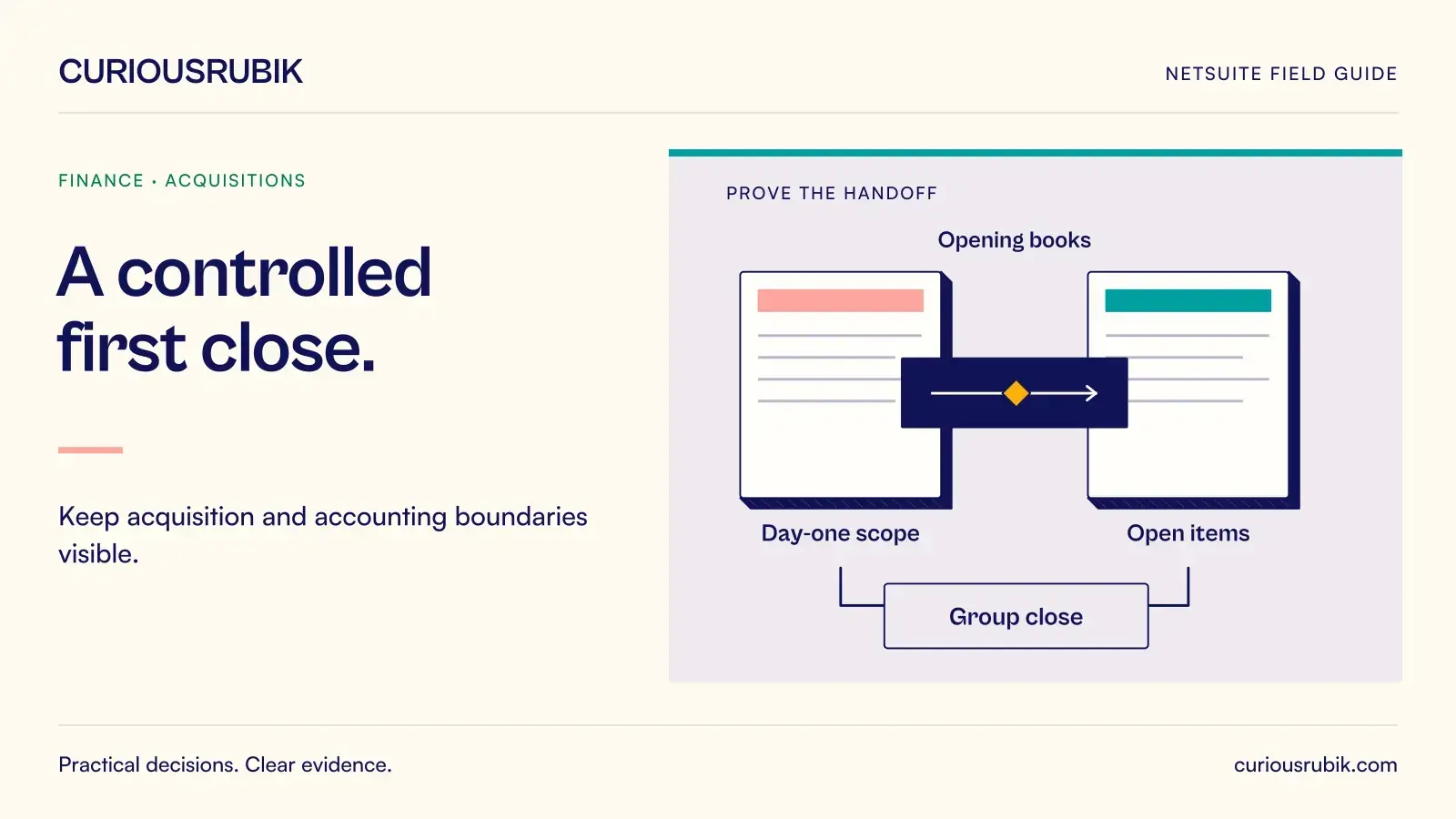
The first close after an acquisition brings together several clocks. The legal transaction has an effective date. The acquired business has its own operational cutoff. Data moves on a migration schedule. Group finance needs a consolidation result. Treating those dates as interchangeable creates gaps and duplicate activity.
A practical NetSuite acquisition integration plan gives each clock an owner and a reconciliation. The first objective is a defensible opening position for the new subsidiary, followed by a complete movement bridge into the first reporting period. A fast close is useful only when the balances can be explained.
Keep four boundaries visible
Start with a boundary document that distinguishes legal completion, accounting recognition, operational switchover, and reporting submission. Confirm the appropriate accounting treatment with the responsible advisers and group accounting team. System design should follow those decisions.
For each boundary, record the date and time, timezone, responsible person, source system, and transactions allowed on either side. Identify operations that continue during migration, such as customer collections, warehouse dispatches, and supplier invoices.
An operational switchover does not have to coincide with legal completion. A phased integration may be appropriate, but it needs a clear method for capturing interim movements. Avoid assuming that a standard implementation sequence determines the legal or accounting cutoff.
Define what day one must support
Prioritise activities whose interruption would create immediate risk: taking orders, receiving money, paying critical suppliers, shipping stock, and producing a controlled ledger. Other reporting detail can be phased if the business approves the limitation and retains the source evidence.
Agree the subsidiary structure, currency, fiscal calendar, chart-of-accounts mapping, reporting dimensions, and access roles before loading balances. Confirm the relevant NetSuite account capabilities and entitlements, especially where multiple entities, books, or currencies are involved.
Make an explicit decision for each data category: migrate transaction detail, migrate opening balances with supporting schedules, retain accessible history, or defer. A decision to retain history elsewhere requires a retrieval and retention plan, not merely a promise that somebody has an export.
Prove the opening books
Freeze an approved source trial balance and record its version. Map every account to the destination, including accounts with zero balances but active open transactions. Review signs, currencies, and dimensions as well as totals.
Acquisition accounting adjustments should be separately identified and approved. Do not blend a valuation adjustment into operational migration data without preserving its origin. The appropriate treatment depends on the transaction and reporting framework; the implementation team should not infer it from an account name.
Use three checks on the opening load:
- Total debits equal total credits.
- Each mapped balance agrees with its approved source or adjustment schedule.
- Control accounts agree with their underlying migrated detail or supporting schedules.
A balanced trial balance satisfies only the first check. It can still contain duplicated receivables, missing inventory, or postings to the wrong entity.
Carry open items without recreating the entire past
For receivables, preserve the customer identity, invoice reference, remaining amount, currency, due date, and relevant application information. For payables, retain equivalent supplier detail and payment status. Decide how credits, deposits, partially settled documents, and disputed balances will be handled.
Reconcile both record counts and amounts. Ten omitted invoices and one duplicate invoice can create an apparently small net difference while materially affecting collection work.
Bank balances need their own bridge between the ledger, bank statement, and outstanding reconciliation items. Avoid treating an opening cash balance as proof that uncleared payments and deposits have been carried correctly.
Document responsibility for transactions arriving after the source extract. Without a delta process, the acquisition team can reconcile yesterday's dataset perfectly while today's operational activity remains outside both systems.
A hypothetical first-close bridge
Assume the approved opening receivables balance is 240,000 currency units. During the first operating period, invoices add 80,000, credit notes reduce the balance by 5,000, and applied customer receipts reduce it by 60,000.
Expected closing receivables are therefore 255,000: 240,000 plus 80,000 less 5,000 less 60,000. The team compares that amount with both the receivables detail and the ledger using the same cutoff and currency basis.
Suppose the detail shows 252,000. Investigation finds a 3,000 invoice posted in the source system after the migration extract and omitted from the delta load. The team verifies whether it belongs in the first reporting period, corrects the approved migration process, and reruns both reconciliations.
The lesson is operational: an opening balance can be accurate while the first close is incomplete. Keep a separate movement bridge instead of repeatedly changing the opening load to absorb later activity.
Inventory needs quantity and value evidence
Acquired inventory can involve stock in transit, supplier-held materials, goods on customer premises, and production in progress. Establish ownership and cutoff before deciding where each balance belongs.
Reconcile quantity by item and relevant location, lot, or serial detail. Separately reconcile value under the approved opening measurement. Physical units and accounting values answer different questions and may need different evidence.
Check unit conversions, incomplete work orders, negative balances, and inventory transactions entered during the cutover window. If warehouse operations continue, use controlled movement logs and reconcile them before accepting the opening position.
Do not assume a valuation adjustment automatically changes every operational cost field appropriately. Test the intended transaction and costing behaviour with the accounting owner.
Consolidate only after local reconciliation
Group consolidation should begin from a subsidiary pack with signed balances and identified exceptions. Match intercompany counterparties, currencies, and balances before elimination. An unmatched amount needs an explanation even when a group-level adjustment can make the final presentation balance.
Review translation and consolidation settings using a small expected-result example. Distinguish local-book movements, acquisition-related adjustments, translation effects, and elimination entries in the reporting bridge.
A useful first-close pack includes the opening trial balance, migration controls, open-item reconciliations, inventory evidence, cash reconciliation, intercompany matching, and a log of approved unresolved matters. Assign one person to confirm that all schedules use the same reporting version.
Frequently asked questions
Must every historical transaction be migrated?
No single approach fits every acquisition. Decide based on operational needs, reporting requirements, retention obligations, source accessibility, and migration risk. Preserve enough detail to support opening balances and ongoing processes.
Can acquisition adjustments be posted after migration?
The timing and method require approval from the accounting owners. Preserve a clear distinction between source balances, migration corrections, and acquisition accounting so later reviewers can reconstruct the opening position.
What should delay consolidation sign-off?
Unexplained material control-account differences, incomplete cutoff evidence, and unresolved entity or currency mappings warrant escalation. Apply the organisation's close policy rather than hiding these issues in group adjustments.
How long should the first close take?
Set the timetable from the transaction's complexity, data quality, operating continuity, and review requirements. A duration from another implementation is not evidence that this acquisition can meet the same schedule.
Build the first close around the boundaries
Discuss a scoped acquisition integration workshop with CuriousRubik to define the opening-book controls, migration movement bridge, and first-close evidence. The useful output is a plan with clear ownership and acceptance criteria for the subsidiary's actual circumstances.