HubSpot and NetSuite Integration That Protects the Closed Won Handoff
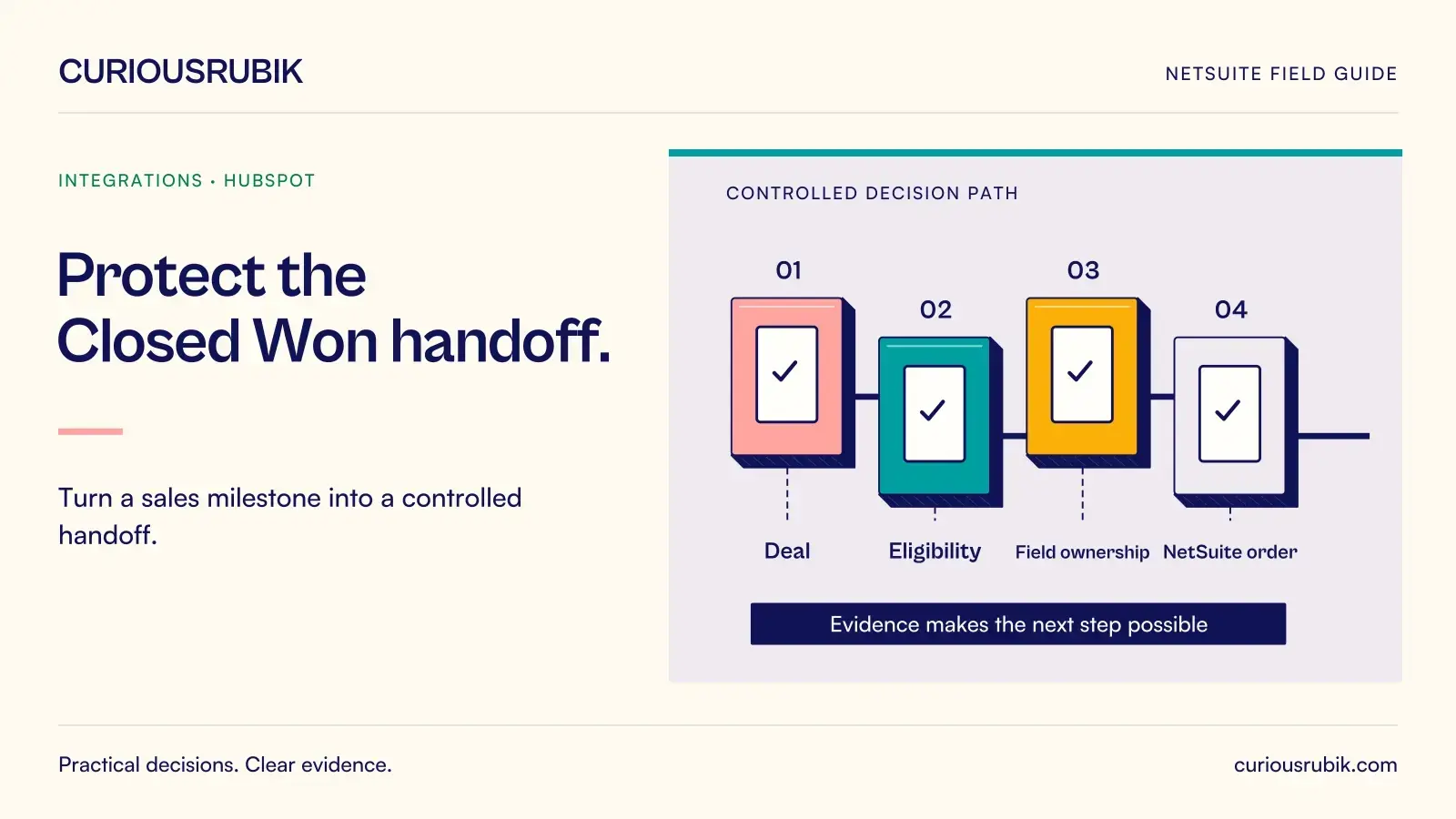
A deal reaches Closed Won, the sales team celebrates, and finance discovers that the customer has the wrong subsidiary, the order uses an inactive item, or the same deal has created two sales orders. These failures often begin with an unanswered ownership question rather than a broken connection.
A dependable HubSpot NetSuite integration defines which system can change each field, what makes an order eligible for creation, and how a failed handoff is recovered. Start with those decisions before selecting a connector. The practical goal is a traceable path from an approved commercial agreement to the correct operational record, with finance retaining control over accounting decisions.
Identify the objects behind the sales process
Avoid treating a HubSpot deal and a NetSuite sales order as interchangeable records. A deal describes a sales opportunity. A sales order carries the detail required for fulfillment and billing. The relationship may be one to one, but amendments, separate subsidiaries, or phased deliveries can make it more complicated.
List the objects each flow needs: company, contact, opportunity or deal, product or item, sales order, and invoice. For every relationship, write down the matching key and expected cardinality. Decide whether one commercial company can correspond to several legal customers and whether a single deal may produce several approved orders.
HubSpot's documented NetSuite integration supports several CRM and transaction sync relationships, with configuration and subscription requirements affecting the available options. Treat its supported object list as a discovery starting point. Confirm the exact mappings and actions in your accounts, especially custom fields and sales-order creation. An object appearing in a connector does not prove that every required field, amendment, or exception is supported.
Build a field ownership matrix
Assign ownership at field level. A general statement that both systems synchronize customers leaves too much room for contradictory updates.
A proposed matrix for a hypothetical equipment seller could read:
- Company display name: sales operations maintains the commercial name in HubSpot; finance reviews changes that affect the legal customer name.
- Legal entity and subsidiary: finance approves them in NetSuite; HubSpot receives the approved values for visibility.
- Contact email: HubSpot owns the sales contact value, subject to the business's consent and data-quality rules.
- Item identifier and operational availability: NetSuite owns them; the integration prevents unsupported items from entering the order handoff.
- Agreed quantity and quoted price: the approved deal snapshot supplies them; pricing exceptions follow the company's approval process.
- Payment terms, credit status, and tax treatment: finance owns the decision and the permitted downstream representation.
- NetSuite order identifier: NetSuite generates it; the integration records it against the originating deal and handoff event.
Add a conflict rule and a named approver to each row. “Latest update wins” is unsuitable when a later sales edit can overwrite approved payment terms. Shared fields need an explicit review path, not an assumption that timestamps express authority.
Compare connector options using the same transaction
A native connector can be a suitable starting point when its supported records, mappings, synchronization rules, and operating controls match the process. Evaluate its diagnostic visibility and recovery behavior as carefully as its setup experience.
Middleware may suit flows that require several systems, branching approvals, transformations, or a shared operations console. It also introduces another configuration layer, deployment process, and support boundary. Establish who owns failures occurring between the connector and NetSuite.
Custom integration gives the team direct control over event handling and business rules. That control brings responsibility for authentication, testing, monitoring, maintenance, and recovery tooling. It should solve a documented requirement that the other routes cannot satisfy economically or safely.
For all three options, ask a demonstrator to process the same synthetic deal, reject an invalid item, recover from a timeout, and explain the resulting record trail. A polished first-run demo is weak evidence if nobody can show what happens on the second attempt.
Make Closed Won an eligibility checkpoint
A status change should initiate validation rather than authorize every downstream financial action. Before creating an order, check that the deal contains an approved customer relationship, valid item references, quantities, currency, delivery details, and the required commercial approval.
Store a versioned handoff snapshot. If the salesperson edits the live deal after submission, the submitted payload should remain identifiable. Define which changes create a new amendment request and which may update an unprocessed submission.
For a hypothetical test, deal CW-104 contains two items and an approved customer. Event CW-104-V1 creates one NetSuite sales order. The response then times out before HubSpot receives the order identifier. On retry, the integration looks up the recorded business identity and confirms the existing order rather than creating another.
Next, reopen the deal and close it again without changing the approved commercial version. The expected result is still one order. Then change a quantity after the order has progressed. The expected result is an amendment exception routed to its owner, unless a separately approved amendment process permits a specific update. These are proposed acceptance outcomes, not claims about default connector behavior.
Resolve conflicts without losing the audit trail
Separate technical retry from business correction. A temporary connection failure can often be retried within a bounded policy. An invalid subsidiary, disputed price, or changed credit status needs the responsible person's decision.
Each exception should show the source deal, event identifier, attempted action, destination record if known, error category, and next owner. Keep sensitive commercial detail out of broadly accessible logs. Provide authorized staff with enough context to diagnose the problem without exposing entire records unnecessarily.
Reconciliation should compare eligible handoffs with accepted NetSuite outcomes. Count missing orders, duplicates, rejected lines, and unresolved amendments. A green connector dashboard cannot substitute for this business comparison. Review exceptions at a frequency that reflects fulfillment deadlines and transaction volume.
Before launch, require evidence for duplicate delivery, missing customer references, inactive products, partial validation failures, conflicting field updates, and credential interruption. Assign someone to approve corrected financial data and someone to verify the recovered result.
Questions teams ask before connecting
Should every field synchronize in both directions?
No. Start with the minimum fields needed for the agreed process. Two-way synchronization is appropriate only where ownership, conflict handling, and permitted changes are clear. Finance-controlled fields usually need a more restrictive design than ordinary sales-contact details.
Does Closed Won need to create an invoice immediately?
That depends on the approved order-to-cash process. Fulfillment, billing schedules, customer acceptance, or finance review may intervene. Do not equate a commercial stage change with permission to post an invoice or recognize revenue.
How should existing customer duplicates be handled?
Define matching and review rules before enabling broad synchronization. Use stable identifiers where possible and route ambiguous matches for review. Merging records or selecting a legal customer solely from a similar name can attach an order to the wrong entity.
What should a pilot prove?
It should prove successful handoff, correct rejection, safe replay, and reconciled recovery for representative cases. Include the actual subsidiary, currency, item, and approval variations the business needs. A single uncomplicated deal proves very little about those boundaries.
Plan the handoff around ownership
Bring one representative deal, the required fields, and the hardest known exception to a CuriousRubik integration workshop. The scope can focus on a field ownership matrix, connector-fit questions, and a Closed Won acceptance test that RevOps and finance can review together.