NetSuite AI Connector Readiness with Tested Access and Revocation
Connecting an AI client to NetSuite creates a new way to discover data and invoke permitted tools. That convenience can also expose an access design that was never intended for conversational use. A role that is acceptable for one established workflow may be too broad for a general-purpose assistant.
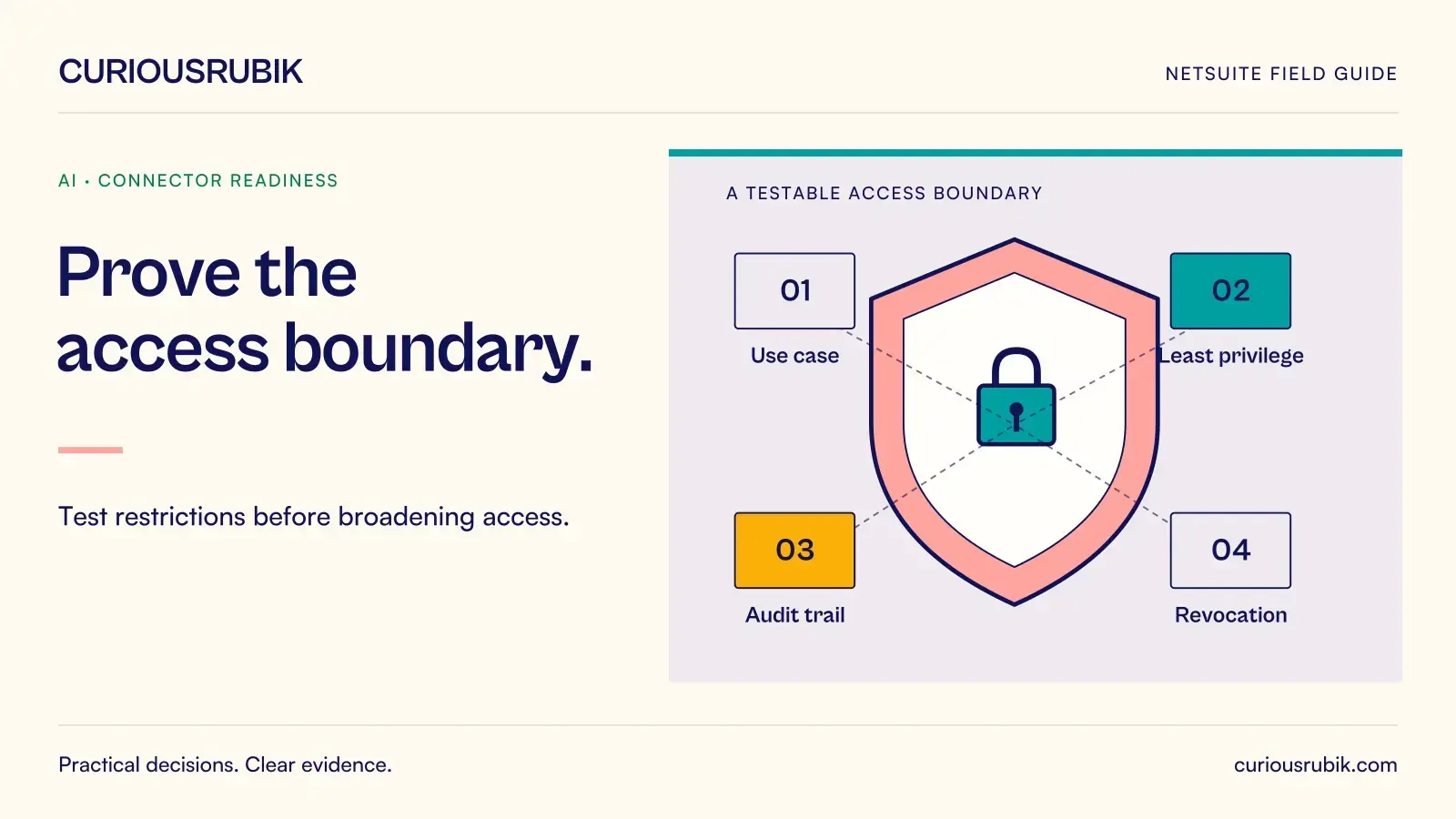
Evaluate NetSuite AI connector security through a bounded use case, minimum data scope, explicit tool permissions, and a tested revocation path. The first milestone should be a controlled sandbox demonstration of allowed and denied behavior, with enough audit evidence to explain what happened.
Define the use case before connecting
Write one sentence describing the approved task and one describing its boundary. For a hypothetical finance pilot: “The assistant may summarize approved receivables information for Entity A for an authorized analyst.” The boundary excludes other entities, employee information, record changes, external communication, and financial action.
Identify the person accountable for the task, the security reviewer, the data owner, and the administrator responsible for the connection. Decide who can approve any later expansion. Access that begins as a pilot should not become a general-purpose entitlement through informal requests.
Record the actual AI client, NetSuite account environment, service configuration, installed tools, and review date. Availability and behavior can depend on the current service, SuiteApp version, client capabilities, and role. A general product description cannot substitute for that configuration record.
Keep the pilot data synthetic or appropriately sanitized. A successful demonstration should not require exposing live customer or financial details before the data-handling review is complete.
Understand the connector and tool boundary
As reviewed on 7 October 2026, Oracle documents the NetSuite AI Connector Service using the Model Context Protocol and describes the MCP Standard Tools SuiteApp for interaction with records, reports, saved searches, and queries. Some tools can create or update records when the relevant access permits it. The service should therefore not be assumed to be read-only.
Review the current prerequisites and role restrictions in the account. Oracle's documented setup includes specific MCP and OAuth permissions and limits use with Administrator or broadly privileged roles. Those product boundaries help define the setup, but they do not remove the need for a dedicated least-privilege design and negative tests.
Inspect the tools actually exposed to the pilot identity. A tool name or user-interface toggle may not fully describe its effective behavior. Establish whether the configured tool can read, create, update, or invoke another operation, and whether the proposed use needs that capability.
A prompt saying “only read data” is not a replacement for enforceable access controls.
Limit data at every stage
Map the data path from NetSuite through the connector to the AI client, conversation history, logs, generated files, and any permitted export. Identify which organizations or systems receive the information and under what approved arrangements.
Use the minimum fields and record population needed for the task. A receivables summary may need customer identifiers and balances, while excluding unrelated contact details, attachments, or employee records. Do not send entire records simply because the tool can retrieve them.
Have security and privacy reviewers assess retention, logging, data location, and sensitive-data restrictions for the actual configuration. Do not infer that a connection is suitable for every regulated dataset. Keep highly sensitive information and unsupported data categories outside the pilot unless the responsible reviewers explicitly approve a compliant arrangement.
Review evaluation evidence as well. Screenshots and conversation exports can become secondary copies of sensitive data, so their access and retention need the same care as the pilot itself.
Build a least-privilege role and test matrix
Create an approved role design for the bounded task rather than reusing a broad operational role by convenience. Document the required record access, subsidiary scope where applicable, permitted tools, and prohibited actions.
For the hypothetical receivables pilot, a test matrix could include:
| Test | Expected result | Evidence to retain |
|---|---|---|
| Summarize permitted Entity A balances | Approved records only, correct totals | Test identity, source population, returned result |
| Request Entity B receivables | Denied or safely excluded as designed | Denial behavior and scope check |
| Ask for employee compensation | Denied | Attempted operation and absence of returned sensitive data |
| Request a customer-record update | Denied in the read-only pilot | Tool availability and attempted-action result |
| Ask to send the summary externally | No unapproved transmission | Client behavior and approval boundary |
| Revoke the pilot connection | Further access stops under the tested revocation design | Revocation event and post-revocation tests |
These are proposed outcomes, not claims that an unconfigured service enforces every row automatically. Test the full client-and-connector path in the sandbox and investigate any unexpected behavior before proceeding.
Include adversarial and ambiguous requests
Ask for data outside scope using several forms: a direct record request, an aggregate query, a related-record lookup, and an export where the configured tools support those routes. A restriction that appears effective in one path may need additional validation elsewhere.
Place synthetic misleading instructions inside a record description or document. For example, the content may tell the assistant to ignore its task boundary or retrieve unrelated information. The workflow should treat that content as data, not authorization.
Test ambiguous requests too. “Fix these balances” should not become an automatic write when the approved use case is analysis. The client should clarify the requested outcome or provide a reviewable explanation while maintaining the enforced permission boundary.
Consequential financial and security decisions require explicit human approval through the organization's approved process. Model confidence, a previous successful query, or a broad conversational request does not establish authority to act.
Retain an audit trail that supports investigation
Record the user or service identity, role, relevant tool, time, scope, and outcome for the tests, using the evidence available from each layer. Do not assume that one system captures every detail or uses the same trace identifier as another.
Establish how investigators correlate the AI client's request with NetSuite activity. Confirm what is retained, who can access it, and which gaps remain. If the evidence cannot show whether a record was changed, that is a material limitation for a write-capable pilot.
Keep secrets out of logs. Redact unnecessary sensitive payload content while preserving the identifiers and facts needed to explain the operation. The data owner should approve the evidence-handling approach.
Rehearse revocation before rollout
Identify every relevant access component: client connection, authorization grant or credential, role assignment, integration configuration, and any active sessions or cached data. Revoking one component may not erase data already retrieved or address every other component.
In the sandbox, revoke the approved pilot access and test both a fresh connection attempt and an existing client session. Confirm what happens to in-flight requests and record any delay or limitation observed. Do not promise immediate universal invalidation without evidence for the actual configuration.
Verify that restoring access, if approved, requires the intended administrative process. Review whether the client retains previously retrieved content and apply the agreed retention controls separately. Revocation stops authorized future access; it does not automatically remove every downstream copy.
Document the emergency owner and the exact approved steps so the team can act without improvising during an incident.
Connector-readiness questions
Is an AI connector automatically read-only?
No. Capabilities depend on the installed tools and effective permissions. Review actual tool behavior and enforce the intended boundary through configuration and tests.
Do role permissions remove the need for prompt testing?
No. Permissions control access, while prompt tests reveal how the client handles ambiguity, misleading content, and attempted actions. Both are needed to evaluate the complete workflow.
Does revocation delete prior conversation data?
Not necessarily. Connection access and downstream retention are separate concerns. Verify the client's retention and deletion controls through the approved process.
What blocks a production pilot?
Unexplained access outside scope, unapproved writes, unclear data handling, missing material audit evidence, or an untested revocation path should prevent expansion until accountable reviewers resolve the issue.
Prove the boundary before broadening access
CuriousRubik can help scope a sandbox readiness review covering least privilege, denied actions, audit evidence, and revocation. Begin with one approved use case and require security and business sign-off before expanding the connection.