A NetSuite API Error Playbook That Reconciles the Business Result
An API error message tells you where to begin investigating. It does not always tell you whether the business transaction happened. A timeout may follow a committed order, while an apparently successful call may leave the order with an unexpected status or an incomplete downstream handoff.
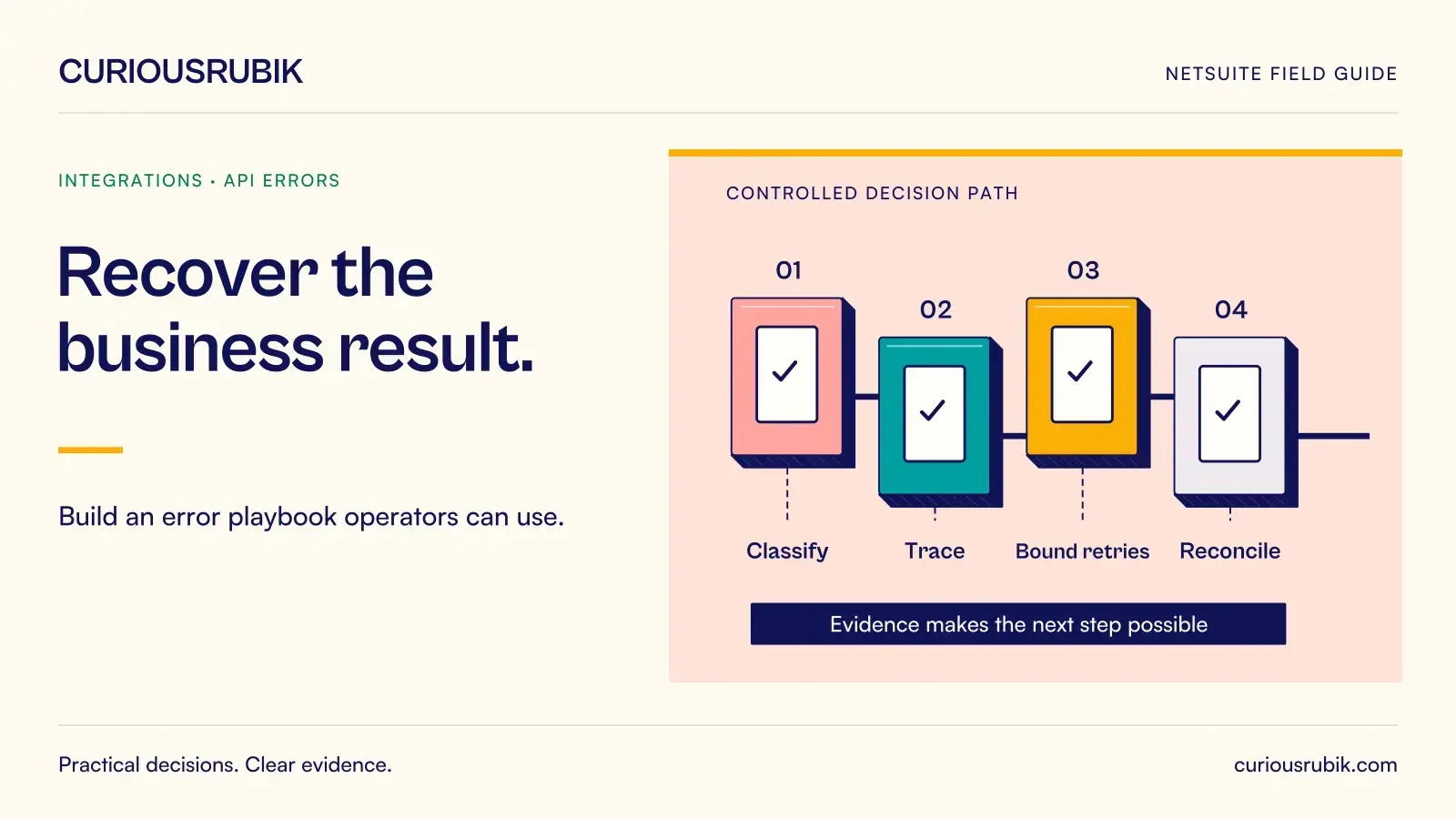
A practical NetSuite API error playbook classifies the failure, chooses a safe response, and reconciles the intended outcome. The operator should be able to see what is known, what remains uncertain, and who is allowed to decide the next action. This matters most when automated retries touch inventory or financial records.
Classify errors by the action they require
Use the response status, structured error detail, request context, and destination evidence together. A status code alone is too coarse to drive every recovery decision. Error semantics can also differ by service and operation, so verify the current NetSuite documentation for the channel in use.
A workable classification has six groups:
- Authentication: the application cannot establish the expected identity.
- Authorization: the identity is valid but the requested action or record is outside its access.
- Validation: the payload or business state does not satisfy requirements.
- Capacity or temporary availability: processing may succeed later under a controlled retry policy.
- Ambiguous outcome: the request may have committed, but the caller lacks reliable confirmation.
- Business mismatch: the technical operation completed, but the reconciled result is wrong or incomplete.
Keep unknown failures in an explicit investigation category. Guessing a category merely to keep automation moving can be more damaging than holding a small queue for review.
Create a retry and severity matrix
Severity should reflect business impact, breadth, and urgency rather than the emotional force of an error message. A failed low-priority export and a stopped order-release flow need different escalation even if they share a technical cause.
| Failure class | Initial response | Retry condition | Decision owner |
|---|---|---|---|
| Authentication | Preserve work and inspect approved configuration | After the identity problem is resolved | Integration and security owners |
| Authorization | Stop the denied operation | After an approved access or design correction | Application and data owners |
| Validation | Quarantine the affected event | After authorized data correction | Relevant process owner |
| Temporary capacity | Reduce pressure and delay | Within a bounded retry policy | Integration operations |
| Unknown write outcome | Reconcile destination state | Only when replay is demonstrably safe | Integration and process owners |
| Business mismatch | Investigate affected records | After the intended result is established | Business control owner |
Add business-specific severity thresholds. For a hypothetical distributor, an order awaiting release near a shipping cutoff may need immediate attention, while a historical analytics refresh can wait for the normal support window. These thresholds should be agreed with operations rather than copied from a generic template.
Use trace identifiers that connect the evidence
Give each business event a stable identifier and each attempt its own trace context. Preserve the relationship between source record, event version, integration execution, and destination record. This lets support distinguish repeated delivery from several legitimate transactions.
A useful incident record includes environment, timestamp with time zone, operation, sanitized error detail, event identifier, attempt count, and the last known processing state. Record any service-provided request identifier when available. Avoid promising that every layer will expose the same identifier; the integration may need to maintain the cross-reference.
Do not log authorization headers, private keys, complete payment details, or unnecessary personal data. Error visibility should be sufficient for diagnosis and limited to authorized operators. Keep detailed payload access separate from broad operational dashboards when the data requires stronger protection.
Bound retries and protect healthy traffic
Retries need a stopping rule. Define increasing delays where appropriate, a maximum processing window, and a quarantine route. Account for shared capacity so a failing flow does not consume the resources required for healthy work.
Treat missing references and invalid accounting periods as business problems until evidence shows otherwise. Repeating the same invalid request will not make a closed period open or choose the correct customer. Any change to those conditions needs the responsible person's approval.
For a write whose result is uncertain, use stable identity and destination checks before retrying. If the platform cannot establish the outcome reliably, alert the owner and preserve the event. Clearing uncertainty by creating another transaction is not a safe recovery method.
Reconcile a success that failed the business
Consider a hypothetical integration submitting order ERR-310. The API reports a successful record creation, and the integration marks the event complete. However, the agreed acceptance condition was an order ready for the next approved operational step. A validation workflow places the order into review because a required commercial approval is missing.
The technical request succeeded. The business handoff did not. The reconciliation compares expected eligible orders with destination status and identifies ERR-310 as awaiting approval. It routes the exception to the commercial owner rather than sending the create request again.
Now consider a shipment update that contains three source lines. The destination record exists, but the mapping omitted one line before submission. An HTTP success cannot reveal that omission unless the integration compares intended and accepted quantities. The right control checks line identities and quantities, not merely the presence of a destination identifier.
These examples show why recovery needs both transport monitoring and business reconciliation. Each answers a different question about completion.
Escalate with a usable evidence packet
Before escalating, state the business impact, first observed time, affected flow, scope, and whether new work continues to arrive. Describe recent changes and the last known successful case. Include sanitized evidence and the precise uncertainty requiring help.
Distinguish the requested decision. Engineering may need to diagnose a parser defect. Security may need to review a denied permission. Finance may need to approve a corrected transaction. A support provider cannot responsibly choose an accounting treatment merely because it owns the ticket.
After recovery, reconcile the backlog and confirm that no records were duplicated or omitted. Capture the root cause, control change, and retest evidence. Close the incident when the business outcome is verified, not when the error counter stops increasing.
Troubleshooting questions
Can all server errors be retried automatically?
A temporary server-side failure may justify retry, but an uncertain write still needs duplicate protection and reconciliation. Use the operation's semantics and processing state alongside the error category. Avoid a blanket rule based only on status range.
Should permission errors trigger an automatic role expansion?
No. Investigate whether the request is valid and within the approved purpose. The application or security owner must approve any access change. Sometimes the correct remedy is to remove an inappropriate operation from the flow.
How long should an event remain in quarantine?
Set a review expectation based on business deadlines and consequence. Give every event an owner and an escalation path. A quarantine queue without ownership becomes a hidden backlog rather than a control.
What should a support ticket omit?
Omit credentials, unnecessary personal data, and unrestricted copies of sensitive payloads. Share the minimum authorized evidence needed to reproduce or diagnose the issue, using the organization's approved support channel.
Build a playbook operators can use
CuriousRubik can help review one integration's error categories, trace trail, and recovery tests. Begin with an actual failure pattern and define the evidence needed to confirm the business result before expanding automation.