Test the Local Boundaries of a NetSuite Australia Implementation
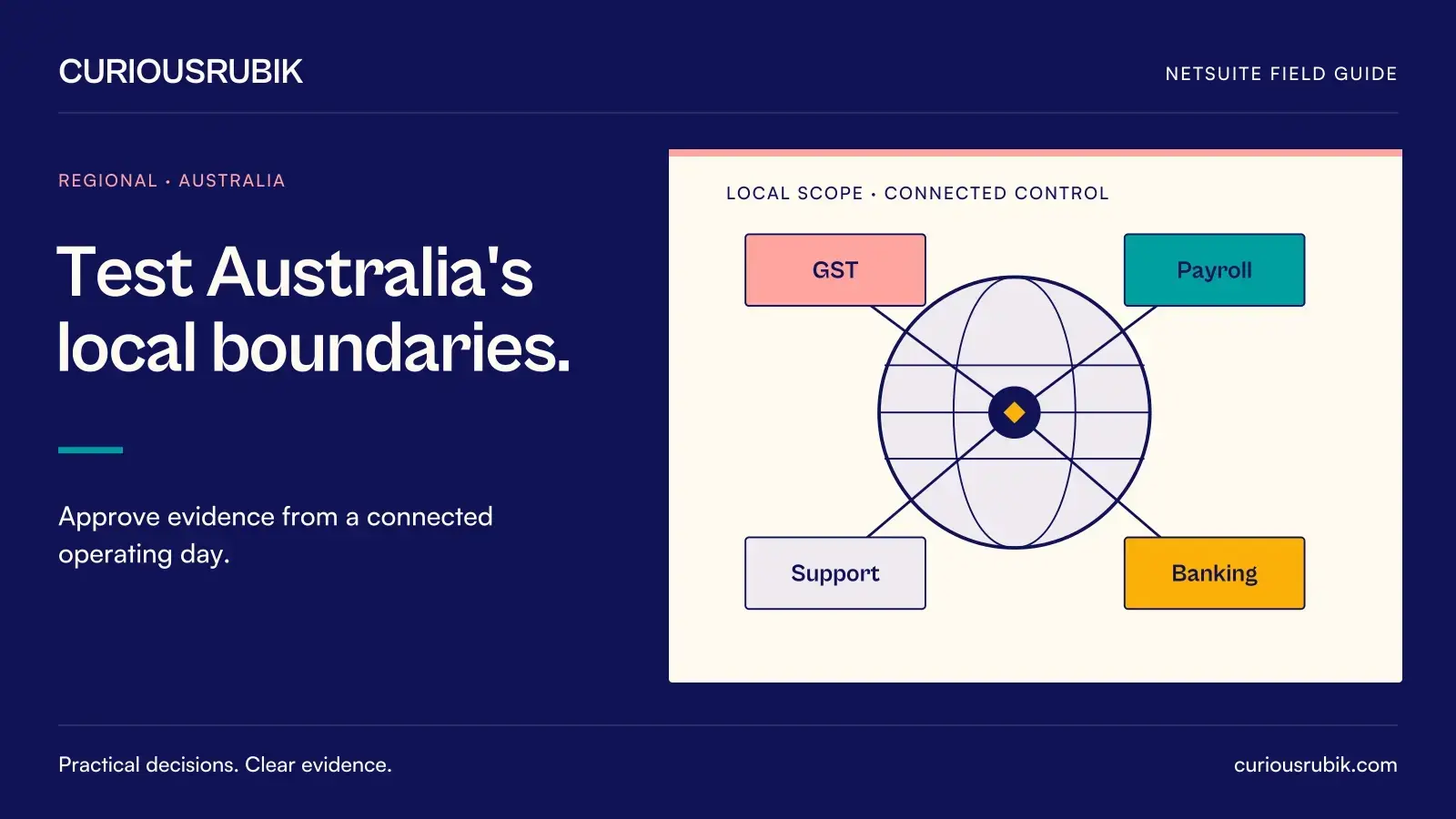
Australian NetSuite readiness depends on how finance, payroll, banking and local reporting work together. A project can configure the general ledger successfully while leaving an unresolved payroll journal, an unsupported bank format or a reporting adjustment that only one person understands.
Use discovery to identify those boundaries, then test them with actual business scenarios using safe sample data. The result should show what NetSuite handles, what another service handles and who owns the gap between them. That is a more useful scope than a broad promise of Australian localisation.
Begin with a capability and responsibility map
For each important process, record the intended solution, required components, configuration owner and acceptance evidence. Keep confirmed capability separate from a proposed design that still needs validation in your account.
For GST, identify the tax configuration and reporting route. For payroll, state where the pay calculation and statutory reporting occur. For banking, distinguish payment creation, bank authorisation, statement retrieval and reconciliation. For electronic invoicing, identify the selected service route and the messages each party receives.
Record separately purchased services and cross-product support ownership. Define each integration's transactions, direction, timing and exception process.
A capability and responsibility matrix
Use these illustrative rows to structure discovery. Each route remains subject to confirmation in the chosen account and service configuration.
| Process | Proposed boundary | Business owner | Acceptance evidence |
|---|---|---|---|
| GST reporting | NetSuite tax/report route and approved lodgement handoff | Australian finance lead | Transaction-to-report bridge and submission responsibility |
| Payroll accounting | Payroll provider calculates; approved interface supplies finance data | Payroll owner and controller | Pay-run totals, allocation and correction reconciliation |
| Supplier payments | ERP prepares approved payment data; bank controls release | Accounts payable and treasury | Accepted, rejected and settled payment test |
| Bank reconciliation | Selected statement import or supported connection | Treasury | Complete statement population and explained unmatched items |
| Electronic invoicing | ERP records plus selected service route | Billing and integration owners | Required exchange and reporting outcomes with recovery evidence |
Add the exact component, provider, licence assumption and support contact to each row during discovery. These are capability boundaries to validate, not claims that every listed service is native or included in a NetSuite subscription.
Test GST with the reporting team
Choose representative sales, purchases and corrections, then trace them into the reporting output. Confirm the entity's reporting basis and the dates used to select transactions. Include a transaction near the reporting boundary because that is where assumptions about periods become visible.
The finance team should reconcile the tax report population with the ledger and explain adjustments. If the business uses a separate submission route, include that handoff in testing. Generating a report and successfully lodging an activity statement are different outcomes.
Do not approve tax treatment because a demonstration uses a familiar rate or a plausible total. Have the appropriately qualified reviewer confirm the company's relevant classifications, special cases and reporting obligations. Test the configuration against those approved decisions.
Define what crosses the payroll boundary
A payroll interface may transfer a summary journal, detailed employee-level data or a controlled combination. Choose the detail based on reporting needs and confidentiality. Finance usually needs cost allocation and reconciliation evidence; it does not automatically need every personal payroll field.
Specify how the pay run maps to the legal entity, period, accounts and cost dimensions. Include employer costs, withholding, deductions and clearing balances as relevant to the approved payroll design. Test a normal pay run and a correction to a previously processed run.
Australian payroll requirements can change. Confirm the current calculation, reporting and superannuation payment responsibilities with the payroll owner and provider. Do not retain a quarterly superannuation operating assumption simply because it appears in an older integration specification. The interface and exception process must support the obligations applicable at launch.
Prove each bank connection separately
List the bank accounts and the exact services required for each. A downloadable payment file does not prove that payment authorisation is configured at the bank. A successful statement import does not prove that a continuous feed is available for the account type.
Use a test that follows an approved payment through file or message creation, bank acceptance, settlement and reconciliation. Retain the business reference across the steps. Test a rejected payment and a duplicate submission attempt, with an agreed recovery procedure.
The account owner should also confirm operational access. Who can prepare a payment, who can release it and who can reconcile it? NetSuite roles and bank permissions must support the control design together. A separation of duties inside the ERP is incomplete if one person can bypass it at the bank.
Walk through one connected operating day
Consider an illustrative Australian distributor. During a rehearsal, the team invoices a customer, records a supplier bill, imports an approved payroll journal and processes a payment batch. The bank statement arrives the next day.
The rehearsal should show the ledger effect of each transaction and the outstanding items expected overnight. The payroll journal must agree to the approved pay-run totals. The payment batch must reconcile to the bank outcome, including any rejected item. The customer invoice must appear in the correct reporting population.
Suppose one payment for AUD 2,400 is rejected. The business should still be able to explain why the supplier remains unpaid, whether cash was debited and whether the payment should be retried. Clearing the error without checking those facts risks either a missed liability or a duplicate payment.
Record detection time and the correction approver for the rejected item.
Make support coverage concrete
Ask for support hours in the time zones your teams use, including how daylight-saving differences are handled. Identify the contact for a blocked payroll import, a failed bank interface and a reporting error close to a deadline. The same issue may need both technical and finance review.
Define severity by business consequence. A failed interface that affects one low-value test record is different from a production failure that blocks every supplier payment. Agree what information starts the response clock and what escalation occurs if the first owner cannot resolve the issue.
Assign post-launch owners for failed messages, recurring workarounds and change approval, then test their handoffs.
Approve evidence rather than completion percentages
Before go live, require reconciled finance scenarios, accepted local reporting, proven bank outcomes and payroll corrections that can be processed safely. Record outstanding issues and the sponsor's decisions about their effect on launch.
Repeat the highest-risk tests after a relevant configuration or interface change. Local readiness is a property of the implemented design and its operating team, not a permanent label attached to the software.
Common implementation questions
Does NetSuite automatically replace Australian payroll software?
That depends on the selected products and architecture. State explicitly where payroll calculation, reporting and payments occur, then test the finance handoff and ownership boundaries.
Is one successful bank test enough?
No. Validate the banks, account types and services in scope. Payment files, authorisation and statement connectivity may have separate requirements.
What belongs in the localisation scope?
The requirements relevant to your entities, documents, reporting and interfaces. Record the intended solution and evidence for each, including separately purchased services.
Who should approve the tax setup?
Your qualified tax reviewer should confirm treatment and reporting assumptions. The system team should demonstrate that the approved design is configured and tested correctly.
CuriousRubik can help turn these boundary questions into a focused Australian NetSuite discovery and acceptance plan for your finance and operations teams.