NetSuite Bank Reconciliation from Missing Data to a Proven Balance
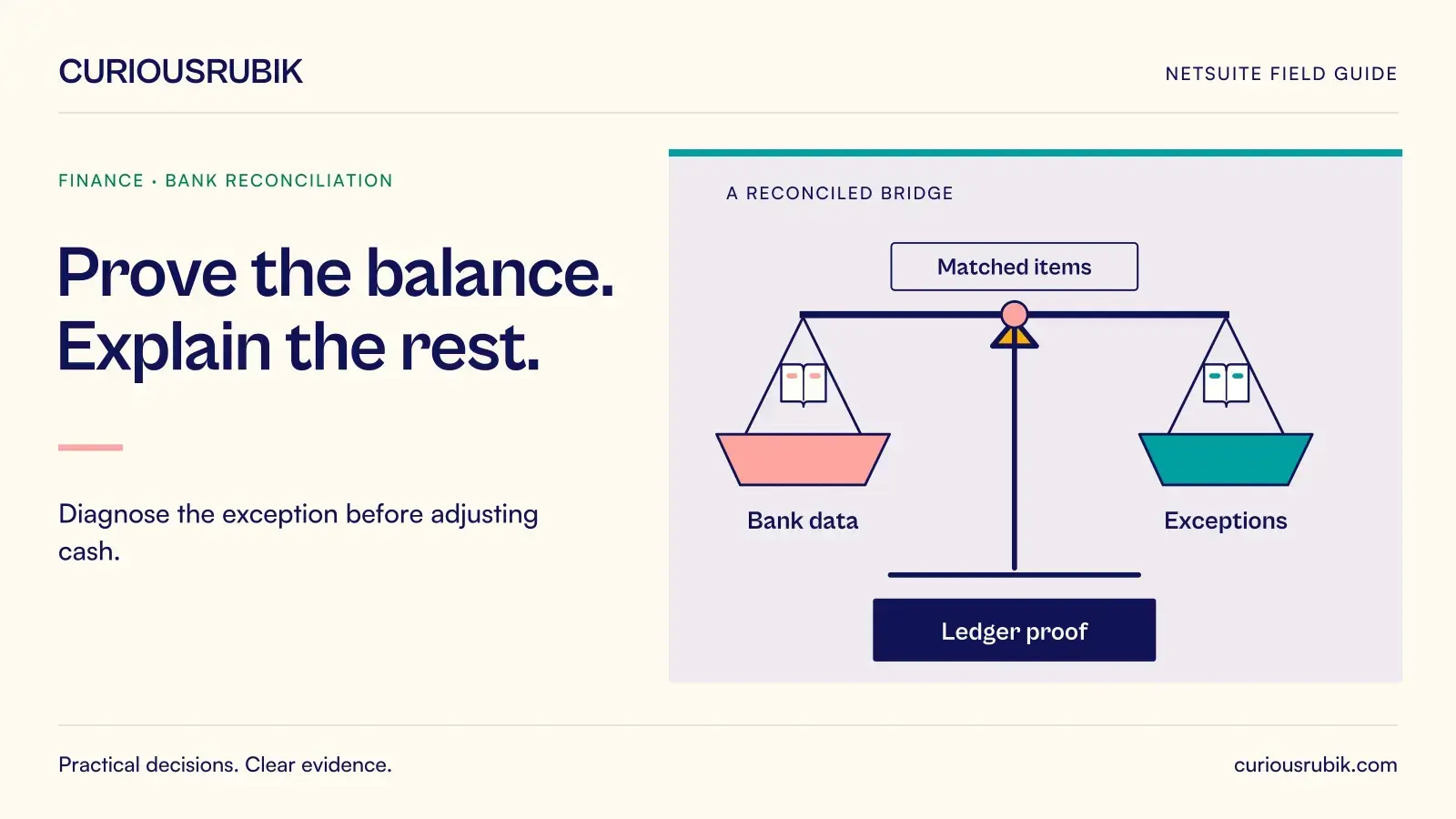
An unmatched bank transaction does not always mean the ledger is wrong. The imported line may be duplicated, the corresponding posting may fall outside the selected dates or a receipt may combine several customer payments. Creating a new journal before identifying the cause can make the reconciliation harder.
NetSuite bank reconciliation is easier to diagnose when four questions stay separate: Did the bank data arrive completely? Is the ledger activity correct? Can the two populations be matched? Does the final statement reconciliation agree?
This guide gives controllers and cash accountants a practical decision tree and a hypothetical numerical proof. Account configuration, bank connectivity, permissions and available features must be verified in your environment.
Prove bank-data completeness first
Start with the bank statement or other authoritative account record for the period. Confirm the account, currency, date range, opening balance, closing balance and transaction population.
Compare that coverage with the imported data. A successful connection or file-import message does not necessarily establish that every required date and transaction is present. Review import history, rejected lines and any gaps between batches.
A synthetic bank-file control record might contain the account identifier, statement dates, line count, total inflows, total outflows and file identifier. These fields allow the cash accountant to compare successive imports and spot missing or overlapping coverage.
Protect the original file or statement used for review. If a corrected file arrives later, retain enough version information to explain which population supported the reconciliation.
Use a small synthetic bank file
Assume fictional account TESTBANK01 in one currency has an opening statement balance of 48,000. This authoritative three-line fixture deliberately contains a fee that has not yet reached the ledger.
| Bank reference | Statement date | Signed amount | Expected classification |
|---|---|---|---|
| BNK001 | 30 September 2026 | 5,000 | Customer receipt already posted |
| BNK002 | 30 September 2026 | -2,800 | Supplier payment already posted |
| BNK003 | 30 September 2026 | -200 | Bank fee awaiting approved posting |
The file has three lines, inflows of 5,000, outflows of 3,000 and a net increase of 2,000. Closing statement cash is 50,000. These are test records, not a bank-specific upload format.
Now construct a faulty import containing BNK001 once and BNK002 twice, with BNK003 missing. The count is still three, but the net movement is minus 600. Reference-level comparison exposes both the duplicate and the missing fee. Correct the import population through the supported process before assessing whether any ledger entry is required.
The later statement-to-ledger bridge uses the same closing bank balance. Its deposit in transit and outstanding payment are legitimate ledger items absent from this statement, while the fee is a genuine unrecorded ledger item.
Investigate duplicates before creating matches
A transaction can appear twice because the same file was imported again, overlapping date ranges were retrieved or a source system supplied duplicate data. Similar amounts on the same date can also represent legitimate separate events.
Compare bank references, dates, amounts and source-batch details. Identify whether the duplication exists only in imported bank data, only in the ledger or in both. The correction route differs for each situation.
Do not delete or exclude a candidate solely because its amount resembles another line. Confirm the bank's actual transaction population first. Follow the supported account procedure and authorization requirements for any correction, preserving the evidence needed to explain it.
A duplicate import line should not cause a second ledger posting merely to make every bank line appear matched.
Use a decision tree for unmatched items
For each unmatched line, work through these questions:
- Is the bank line valid and inside the intended account and statement period? If not, resolve the data or scope issue first.
- Does the corresponding ledger transaction already exist? Search using amount, reference, counterparty and nearby dates.
- Is the expected relationship one-to-one, one-to-many or many-to-one? A settlement or deposit may combine several records.
- Is the ledger transaction posted to the correct bank account, currency and period? A misclassification may explain why matching cannot find it.
- Is a genuine posting missing, such as a validated bank fee? Obtain the required evidence and approval before creating it.
- After correction, does the final statement reconciliation agree with supported outstanding items?
This sequence reduces the temptation to treat every unmatched line as a new accounting event.
Separate matching from reconciliation
In the supported NetSuite bank-data workflow, matching imported lines and reconciling the account statement are distinct steps. The proposed process should make both visible to the cash accountant.
Review suggested matches before accepting them, especially for repeated amounts and grouped settlements. A plausible match can be wrong when several transactions share the same value.
After matching or clearing the appropriate transactions, complete the statement reconciliation with the correct end date and balance. Retain the reconciliation report and review outstanding items. A fully processed matching queue does not necessarily prove that the statement balance and ledger reconcile.
Confirm that the account uses the intended supported pages and that the user's role has the necessary permissions. Avoid troubleshooting a missing account through uncontrolled permission expansion.
Work through a hypothetical statement-to-ledger proof
Assume a fictional bank statement closes at 50,000 currency units. The ledger initially shows 52,200. The accountant identifies a valid bank fee of 200 that has not yet been posted.
After the approved fee posting, the ledger balance is 52,000. The remaining difference is explained by a deposit in transit of 3,000 and an outstanding payment of 1,000. Starting with the statement balance, 50,000 plus 3,000 minus 1,000 equals 52,000, matching the adjusted ledger.
The proof requires evidence for all three items. The fee needs the bank record and approved accounting treatment. The deposit needs the underlying receipt or deposit record and subsequent clearing evidence when available. The outstanding payment needs a valid payment record and confirmation that it has not cleared by the statement date.
These numbers are illustrative. The signs and classifications in a real reconciliation depend on the transaction facts and report presentation.
Age the reconciling items
An outstanding item should have an expected resolution, owner and age. A deposit in transit that remains open long after its expected clearing date may indicate a missing bank receipt, an incorrect posting or a matching problem.
Review recurring items separately from new exceptions. If the same amount appears each month, investigate the underlying process rather than carrying it forward indefinitely.
For corrections to previously reconciled transactions, follow the supported procedure and assess the effect on completed statements and reports. Changes can alter reconciliation status or require renewed review. Retain the reason, approval and revised evidence.
Do not overwrite a prior reconciliation merely to make the current period look cleaner. The audit trail should explain the change.
Measure the causes of reconciliation effort
Track missing imports, duplicate candidates, incorrect account postings, grouped settlements and genuine unrecorded activity as separate categories. Each points to a different improvement.
A feed issue needs connectivity or source investigation. Repeated coding mistakes need training or entry controls. Frequent settlement aggregation may need a better matching design. Broadly labeling everything a bank-reconciliation error makes it difficult to choose the right fix.
Use exception age and recurring cause alongside completion time. Speed is useful only when the final balance has credible support.
Common bank reconciliation questions
Should every unmatched line create a journal?
No. First determine whether the ledger transaction exists or the imported line is duplicated, grouped or outside the expected scope. Create accounting entries only for validated events under the approved process.
Does an active bank feed prove completeness?
No. Compare imported coverage with the authoritative statement, including dates, counts and control totals where available. Review rejected or missing data.
Can matching be complete while reconciliation remains open?
Yes. Matching and statement reconciliation answer different questions. Confirm the end balance and supported outstanding items before signing off.
What evidence should the reviewer retain?
Keep the statement, import coverage, correction approvals, reconciliation report and outstanding-item schedule. The reviewer should be able to reproduce the balance bridge.
Diagnose the exception before adjusting cash
CuriousRubik can help scope a review of your NetSuite bank imports, matching exceptions and statement reconciliation. Bring one unresolved period and its supporting bank and ledger evidence.