NetSuite Change Control That Keeps Go Live Decisions Clear
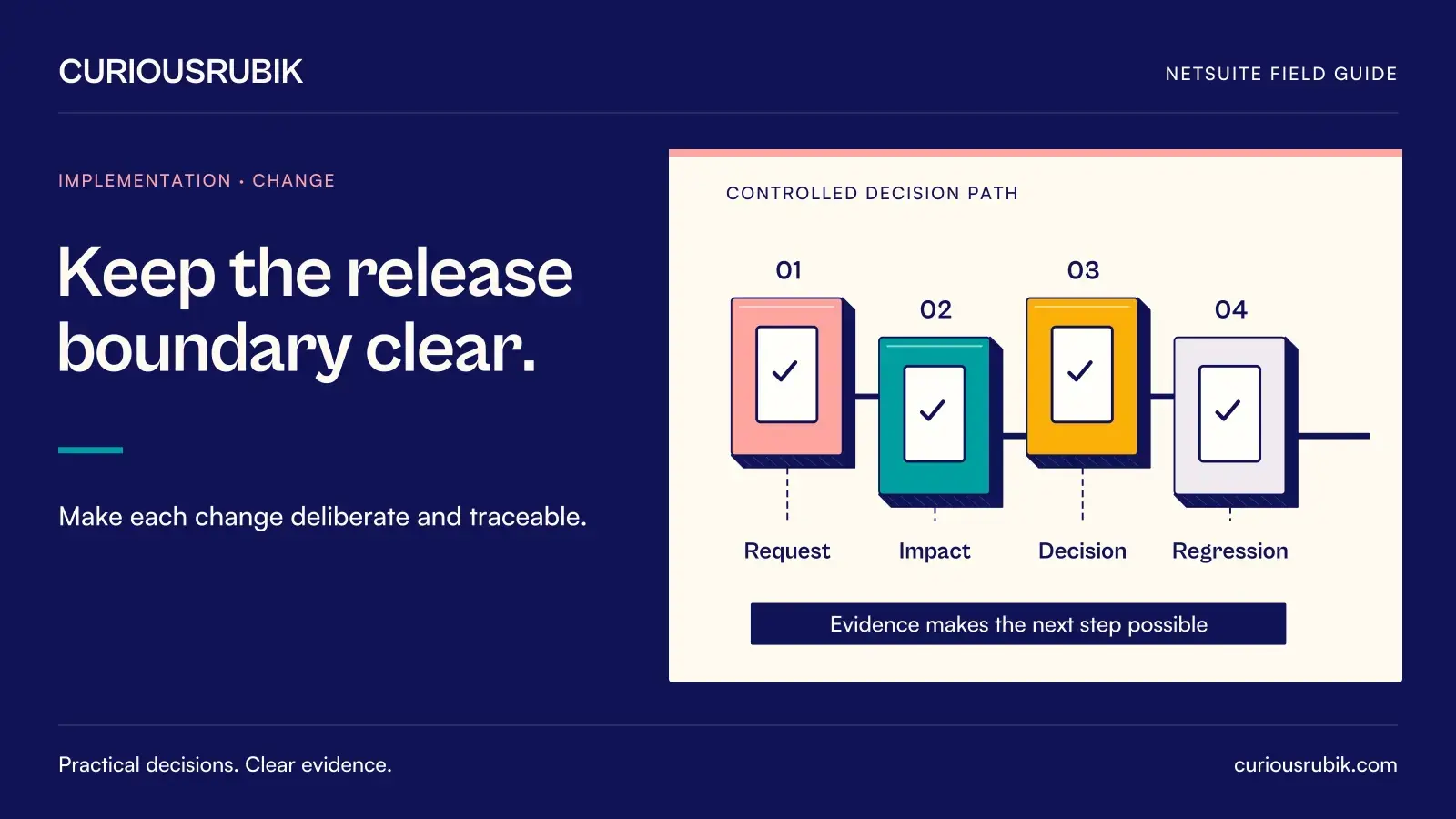
A new requirement is not automatically scope creep. It may expose a missing control, respond to a legitimate business change or improve an inefficient design. The problem begins when requests enter a NetSuite implementation without a clear decision about their effect on cost, schedule, testing and operating risk.
Change control should help the team make those decisions quickly and visibly. It should distinguish a defect against agreed requirements from a new request, identify the alternatives and give the right person authority to approve the consequences.
Require enough evidence to understand the request
Start with the business problem and the proposed outcome. Ask who needs the change, which transactions it affects and what happens if it is not delivered before launch. Include a representative example and the requirement or design decision it relates to.
Avoid accepting a solution label as a complete request. “Add a custom field” may conceal a reporting requirement, an integration dependency or a control that belongs elsewhere. Understand the purpose before deciding the design.
Classify the item provisionally as a defect, clarification, new requirement or changed assumption. Allow the classification to be reviewed when evidence emerges.
Assess impact across the whole workflow
Every material request needs an assessment of design, data, financial treatment, interfaces, permissions, training and testing. The assessment can be brief for a small change, but it should consider the connected process rather than the screen where the request first appeared.
Ask whether historical or migrated data needs updating, whether reports will change and whether an integration must carry a new attribute. Identify the effect on downstream scenarios and cutover activities.
State uncertainty openly. If the team needs a short investigation before estimating the change, define that investigation and its output. An unsupported estimate is less useful than a bounded decision to gather the missing evidence.
Use a compact change record
Record the following:
- Request ID, date, requester and business owner.
- Problem, example and required outcome.
- Relationship to the approved baseline.
- Options, including deferral or a controlled workaround.
- Impact on ledger, data, interfaces, schedule and testing.
- Estimated effort and unresolved assumptions.
- Decision authority, decision and rationale.
- Acceptance evidence, release target and completion owner.
Record approval before work that creates a material commitment begins. Make emergency routes explicit for urgent operational issues, with the appropriate retrospective documentation. An informal conversation should not become an invisible authorization to change the release.
Three hypothetical requests
The following examples are illustrative. They show how the same decision framework produces different outcomes without assuming a particular NetSuite configuration or contract.
Request one: add a management reporting category
Finance asks for a new category to analyze margin by business line. The ledger account totals are not intended to change, but the request affects transaction classification, migration mapping, report filters and possibly incoming interface data.
The team identifies two options: include the category in the first release or introduce it later with a defined reporting limitation. Including it now requires an approved definition, ownership of missing values and regression tests for reports and relevant transactions. Deferring it may make historical reconstruction difficult if the attribute is not captured elsewhere.
The sponsor asks the CFO to confirm whether the view is needed for the first reporting cycle. The decision records the data-capture requirement separately from the timing of the final report. This avoids treating the entire request as either an urgent build or a complete deferral.
Request two: change an approval threshold
Operations wants to raise a purchasing approval threshold to reduce delays. The apparent configuration change is small, but the business policy and control implications need review. The change may have no direct ledger effect at the approval step while still affecting which transactions are authorized downstream.
The accountable policy owner reviews the proposal. If approved, testing includes values below, at and above the threshold, relevant user roles, delegated approval and changes after approval. Training materials and the authority policy must remain consistent with the configured process.
The decision needs business authority and evidence that the revised control works.
Request three: automate an additional order source
Sales requests an interface for another order channel shortly before integrated testing. The change affects customer and item mappings, transaction creation, duplicate handling, exception monitoring and reconciliation. Depending on the design, it also affects financial postings and the population used in first-day controls.
The team compares a first-release integration with a tested temporary process and a later release. It estimates the build and joint test work, confirms external-system availability and checks whether users can operate the temporary process at expected volume.
If the interface is deferred, the decision includes an owner, capacity limit, daily reconciliation and a trigger for escalation. “Manual for now” becomes a controlled operating choice rather than an unexamined gap.
Give decision authority clear boundaries
Define who can approve routine design clarifications and who must approve changes to cost, launch timing, financial controls or business scope. Include the customer and delivery-provider responsibilities under the actual agreement.
Use thresholds appropriate to the organization, but do not rely solely on monetary size. A low-cost change can have significant accounting, security or operational consequences. Specialist approval may be necessary even when the effort is small.
When a request crosses several areas, identify one decision owner and the required advisers. Otherwise, it can circulate among teams without anyone integrating the consequences.
Protect the regression test scope
An approved change is not complete when the configuration is saved. Update the design, data mappings, procedures and relevant tests. Identify which previously passed scenarios must be rerun and why.
For a reporting-category change, regression may include imports, interface payloads, transaction entry and report reconciliation. For an approval change, it may include roles, routing and downstream release conditions. For an interface, it should include failure and replay behavior as well as normal processing.
Store evidence against the change record. Before release, confirm that the agreed acceptance conditions have been met and that unresolved defects have an approved disposition.
Keep the release boundary visible
Review the change log with the sponsor at a cadence that matches the project. Show approved changes, pending decisions, deferred requests and the cumulative effect on the plan. Several individually modest requests can consume the same testing capacity or cutover window.
Give deferred items an owner, a reason and a trigger for reconsideration when business conditions change.
Questions project managers ask
Should every request require a formal meeting?
No. Use a proportionate process with clear authority. Small, well-understood clarifications can be handled efficiently, while material changes need the appropriate cross-functional decision.
How do we distinguish a defect from a change?
Compare the observed behavior with the approved requirement and acceptance criteria. If the baseline is ambiguous, document the ambiguity and resolve it through the agreed governance and commercial process.
Can we freeze scope completely?
A baseline is useful, but legitimate issues can still arise. A freeze should define the evidence and authority needed for exceptions rather than prevent necessary decisions.
Who owns deferred requests?
The relevant business owner should retain responsibility, with the application or project team maintaining the agreed backlog. Record the next decision point so deferral does not become accidental abandonment.
Make changes deliberate
Bring your pending requests and release constraints to CuriousRubik. Clear NetSuite change decisions can protect the launch while preserving improvements that deserve a later place in the plan.
Related reading