NetSuite Cutover Rehearsal That Measures Time Reconciliation and Recovery
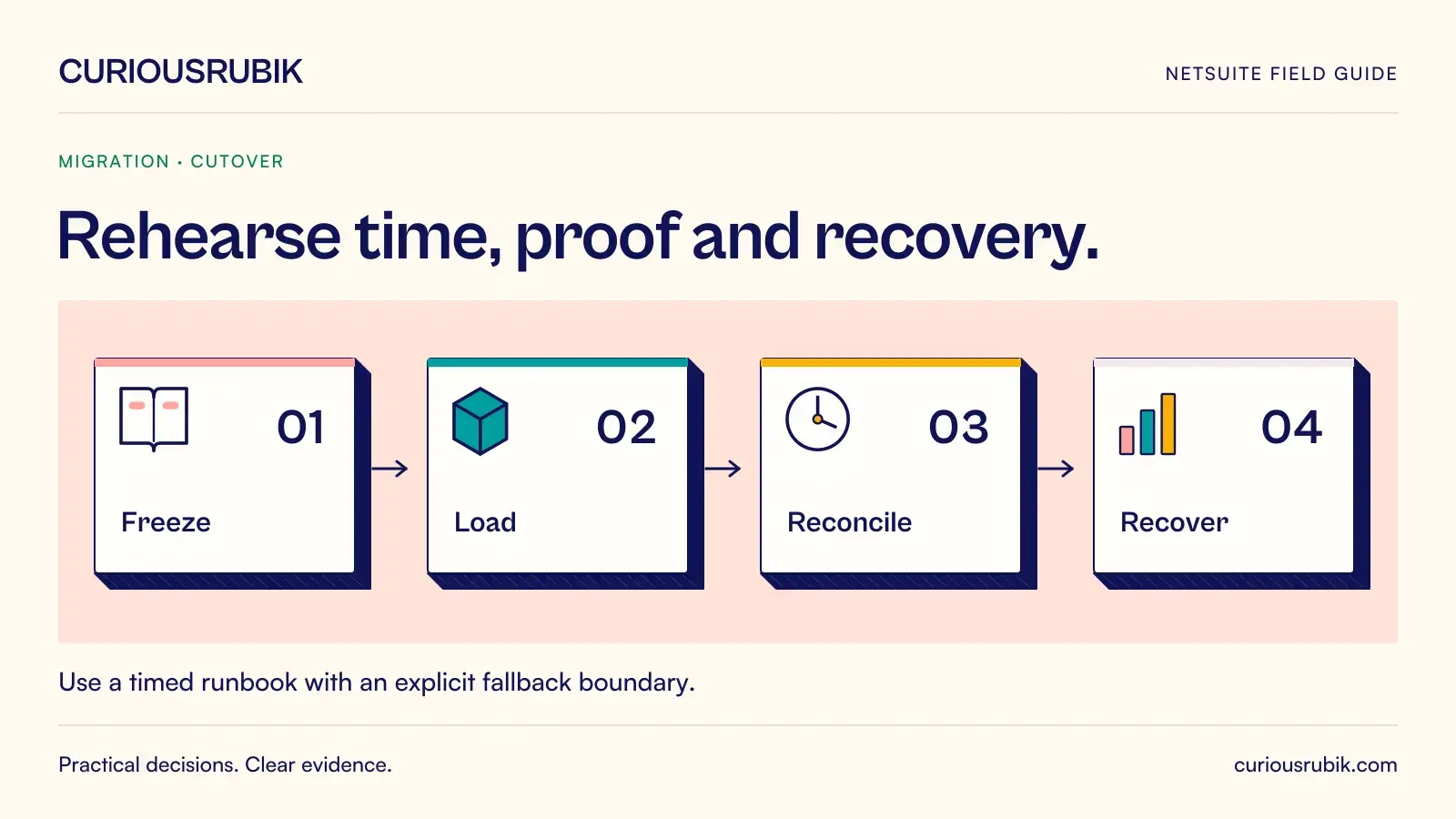
A cutover rehearsal is useful when it changes the go-live decision. If the team finishes a practice import but cannot explain elapsed time, missing records or recovery options, the rehearsal has produced activity rather than readiness evidence.
For a NetSuite cutover rehearsal, measure the complete path from source freeze to business release. That includes extracting data, transforming it, loading dependencies, resolving exceptions, reconciling balances and obtaining approval. The clock does not stop while the finance lead waits for a report.
The objective is a credible runbook that another authorized team member could follow. It should identify who acts, what proves a step passed and when the team must stop. The hypothetical schedule in this guide illustrates that discipline; it is not a recommended duration for every implementation.
Define the decision before scheduling the test
Agree what the rehearsal must establish. Examples include whether the load fits the available shutdown window, whether finance can reconcile before trading resumes and whether integrations can restart without replaying old transactions.
Select a representative dataset with realistic volumes and difficult records. A small clean sample may validate mapping logic but cannot establish production timing. Conversely, a full-volume import is a poor use of time if basic dependencies have not been tested.
Document known differences between the rehearsal and production environments. Different scripts, permissions, integrations, data volumes or infrastructure conditions can invalidate timing assumptions. Where equivalence is impossible, explain the limitation and build a justified allowance into the decision.
Entry criteria should include approved mappings, versioned transformation logic, reconciled source totals, named reviewers and a usable recovery plan. Otherwise the rehearsal becomes a workshop for unfinished design decisions.
Build a timed runbook with evidence columns
A hypothetical team has an eight-hour business interruption window. Its rehearsal runbook uses the following checkpoints:
- 18:00 to 18:20: Freeze source activity and record the final transaction boundary. Evidence is the signed cutoff report and integration queue snapshot.
- 18:20 to 19:00: Extract and validate files. Evidence is file counts, control totals and checksums or equivalent file-integrity records.
- 19:00 to 19:40: Load required master data. Evidence is accepted and rejected populations, with crosswalk completeness.
- 19:40 to 21:10: Load opening balances and open transactions. Evidence is batch results and transaction identifiers.
- 21:10 to 22:20: Reconcile subledgers, stock and the general ledger. Evidence is reviewer-approved schedules.
- 22:20 to 23:00: Run critical user and integration tests. Evidence is completed scripts under intended roles.
- 23:00: Hold the release decision, leaving the remaining window for the approved contingency.
These are planning assumptions, not performance claims. Record actual start, finish, active work and waiting time separately. Waiting for an unavailable approver may consume more contingency than the import itself.
Track dependencies rather than a flat task list
Some steps can run in parallel; others cannot. Customer records may need to exist before invoices. Opening stock checks may depend on both item data and inventory detail. Consolidated reporting may require completed entity-level accounting work.
Show those dependencies in the runbook. Assign a single owner to each handoff and define what the receiving team needs. “Files sent” is insufficient if finance requires a transformed control report and only receives raw exports.
Track shared constraints too. Two technically independent jobs may compete for the same reviewer or processing capacity. A realistic rehearsal should reproduce these conflicts rather than allocating the same person to simultaneous critical tasks.
Use the longest dependency chain to assess the cutover window. Summing every task duration overstates parallel work, while ignoring dependencies understates the true elapsed time.
Deliberately fail one step
A useful failure exercise is an interrupted open-invoice batch. Suppose the target accepts 720 of 1,000 hypothetical invoices before the process stops. The team must identify accepted records, preserve the original source population and determine how the remaining 280 will be processed.
The recovery test should prove that a retry cannot create another copy of the 720 accepted invoices. Validate identifiers, import behavior and reconciliation logic in the actual selected method. Do not assume a retry is safe because the file name is unchanged.
Record the time needed to diagnose the failure, authorize the correction, rerun and reconcile. If this consumes the entire contingency, the team has learned something important even if the final numbers agree.
Introduce failures safely in the rehearsal environment. Do not simulate an outage by making uncontrolled security or production changes.
Draw the recovery boundary explicitly
“Roll back if needed” is not a recovery plan. NetSuite configuration, imported records, external integrations and newly entered business transactions may have different recovery options.
Define the last decision point before ordinary users and downstream systems create new activity. Explain what can be reversed through approved procedures, what requires compensating transactions and what would require a different recovery approach. Test the selected method rather than assuming a universal restore button exists.
After business release, reverting to the old system can create competing records of truth. The contingency must therefore cover communications, transaction capture and reconciliation across both environments if the team needs to change course.
Name the person authorized to stop the cutover and the people required for a release decision. An escalation path is only useful if those people are available during the actual window.
Turn defects into release criteria
A defect log should contain the failed step, business consequence, affected population, evidence, owner, correction and retest result. Severity should reflect business impact. A missing field on an internal report is different from a receipt process that cannot preserve serial numbers.
Use explicit exit criteria: all critical workflows passed; financial differences resolved or formally accepted within policy; no unowned rejected records; recovery exercise completed; and actual timings support the available window with a justified contingency.
Track deferred issues separately. Each needs an accountable owner, a workable interim procedure and a clear reason it does not block release. “Fix after go-live” without those details merely transfers uncertainty to operations.
Questions before the final rehearsal
Must every rehearsal use full production volume?
Early tests can be smaller. The rehearsal used for timing and readiness decisions should represent the expected workload closely enough to support those decisions, with differences explicitly assessed.
Should we include finance sign-off time?
Yes. Reconciliation and approval are part of the cutover, even when imports are already complete. Excluding them creates an unrealistic release forecast.
Is one rehearsal sufficient?
The number depends on evidence. Material mapping changes, failed critical workflows or an unproven recovery method justify another relevant test. Counting rehearsals is less useful than closing readiness gaps.
Who owns the final go-live decision?
The project should name an accountable business decision-maker supported by finance, operations and technical owners. The person running imports should not carry the entire release decision by default.
Make the next rehearsal decision-ready
Ask CuriousRubik to review a scoped cutover runbook, timing record or failure exercise. Bring the actual rehearsal evidence so the discussion can focus on the remaining release risks.
Related reading