NetSuite ERP Evaluation Through Consolidation Inventory and Ownership
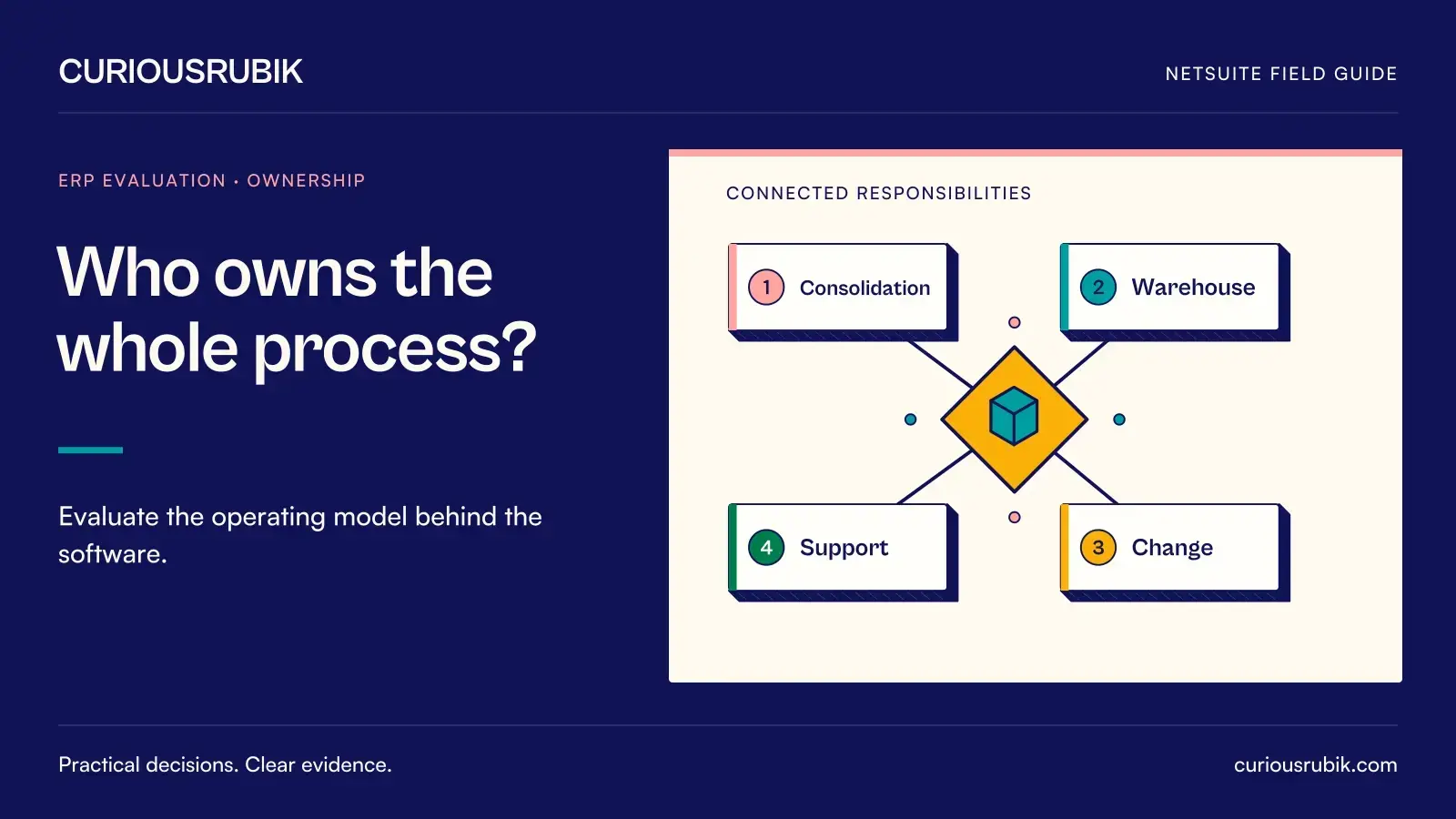
ERP ownership extends beyond the software contract. Someone must maintain extensions, investigate integration failures, test changes and explain why a consolidated result differs from the entity ledgers. Those responsibilities can determine whether an otherwise capable solution works well for the business.
When evaluating NetSuite against another ERP approach, compare the complete delivery model. A vendor-managed cloud suite, a partner-operated environment and a solution with several specialist extensions create different responsibility boundaries. The exact proposal matters more than a broad architectural label.
For a CFO and operations director, three tests are especially useful: consolidation, inventory execution and ownership after implementation. This guide turns those tests into an evaluation process without assuming that one deployment model suits every organization.
Draw a responsibility map before the demo
Ask the proposed delivery team to identify every organization involved. Depending on the architecture, the map may include the software vendor, implementation partner, hosting provider, extension supplier, integration team and your internal administrators.
For each layer, record who owns configuration, availability, support triage, defect correction, change testing and commercial renewal. A shared responsibility is acceptable when the handoff is explicit. “Contact support” is too vague when three support desks can reasonably say the issue belongs elsewhere.
Include ownership of the data model. Someone must decide which system is authoritative for items, customers, prices and financial dimensions. If each application can change the same field independently, an integration can move data accurately while spreading inconsistent decisions.
Use the map to identify unanswered questions before commercial negotiations make the architecture harder to change.
Demonstrate consolidation with an actual difference
A clean consolidation demonstration proves relatively little. Use a hypothetical parent and two subsidiaries, with an intercompany service invoice recorded in one entity before the corresponding bill is posted in the other.
Ask the presenter to locate the mismatch, explain its timing and show the approved resolution route. Then inspect entity results, relevant elimination activity and the consolidated report. The demonstration should distinguish transaction pairing, accounting correction and elimination.
Add different base currencies if your group needs them. Require an explanation of the rate context and the report filters used. Do not accept a consolidated total without a route back to its source balances.
For the proposed NetSuite design, confirm which OneWorld and related features, records and configuration are included. For any other architecture, confirm whether consolidation occurs inside the ERP or through an additional application and how that changes reconciliation ownership.
Put warehouse exceptions into the inventory test
Use a scenario that resembles the operating day. A hypothetical buyer orders one hundred units, receives sixty, rejects five for damage and later receives the balance. The warehouse transfers stock between locations while sales requests a partial shipment.
The evaluation should show quantities by relevant status and location, the relationship between physical events and financial records, and the handling of returns or corrections. Include units, lot detail or serial tracking where required by your business.
Ask warehouse staff to perform key steps using their intended roles. A demonstration run entirely by a consultant can hide excessive navigation, missing permissions or unclear exception messages.
Capture any work outside the core application. A scanner, shipping service or warehouse extension may be appropriate, but the proposal must identify its licensing, integration and support obligations. The practical question is whether the complete workflow is reliable and supportable.
Test a change across the ownership boundaries
Request a hypothetical change exercise: add a new item attribute that must appear in purchasing, warehouse execution and management reporting. Ask each delivery team to describe the affected records, interfaces, reports and tests.
Then ask what happens during a platform or extension update. Which environments are used for regression testing? Who maintains the test pack? Who decides that a business-critical integration remains fit to run? How are issues escalated before production users are affected?
Do not assume automatic platform updates mean zero customer work. Configuration, extensions and connected applications still need appropriate validation. Conversely, a customer-managed deployment is not automatically unmanageable if the organization has a capable, clearly funded operating model.
The selection should reflect your team's actual capacity, including the periods when key people are unavailable.
Use a responsibility register as a decision instrument
For every critical workflow, complete five fields: business owner, technical owner, external supplier, failure-detection method and recovery approver. Add the response expectation stated in the proposal or contract, without inventing one.
A hypothetical inventory interface might have the warehouse manager as business owner, an internal application lead as technical owner and an integration supplier as the external resolver. Detection could be a monitored exception queue reconciled against source shipments. Recovery approval might sit with operations and finance when postings are affected.
If any field is blank, the workflow is not ready to be called fully owned. Assigning every field to “the partner” is also weak unless the partner's scope explicitly covers those responsibilities.
Use this register during proposal review. It converts broad promises of support into questions that can be answered and priced.
Assess lifetime effort as well as implementation cost
A three-year ownership model should include subscriptions or licenses, implementation, hosting where relevant, extensions, support, integration maintenance, testing and internal administration. Separate mandatory costs from optional enhancements.
Model at least one realistic business change: a new warehouse, acquired entity or additional sales channel. Ask what must be reconfigured, integrated, licensed and retested. A design that fits today's transaction volume may carry a different burden when the operating structure changes.
Record uncertainty rather than forcing every cost into a false point estimate. The aim is to understand exposure and responsibility, not to create an artificially precise total.
The recommendation should name the trade-offs accepted by finance and operations, with evidence from the demonstrations and responsibility register.
Questions buyers frequently overlook
Who should own integration failures?
Name both the business owner and technical resolver. Business ownership determines priorities and acceptable recovery; technical ownership determines diagnosis and correction. One does not replace the other.
Should hosting model decide the shortlist?
It is one factor. Evaluate security, availability, support and change responsibilities for the exact proposal alongside workflow fit and organizational capacity.
Can a partner extension be a sound choice?
Yes, where it demonstrably solves the requirement and has clear maintenance, support and commercial terms. Treat its ownership as part of the ERP decision.
What should survive after the selection project?
Keep the test pack, architecture map and responsibility register. They become useful inputs to implementation acceptance, support handover and later regression testing.
Evaluate the operating model behind the demo
CuriousRubik can help scope a NetSuite comparison workshop focused on consolidation, warehouse exceptions and long-term ownership. Bring the proposed architecture and its unresolved responsibilities alongside the feature list.
Related reading