NetSuite Fixed Assets Implementation Starts with a Proven Opening Register
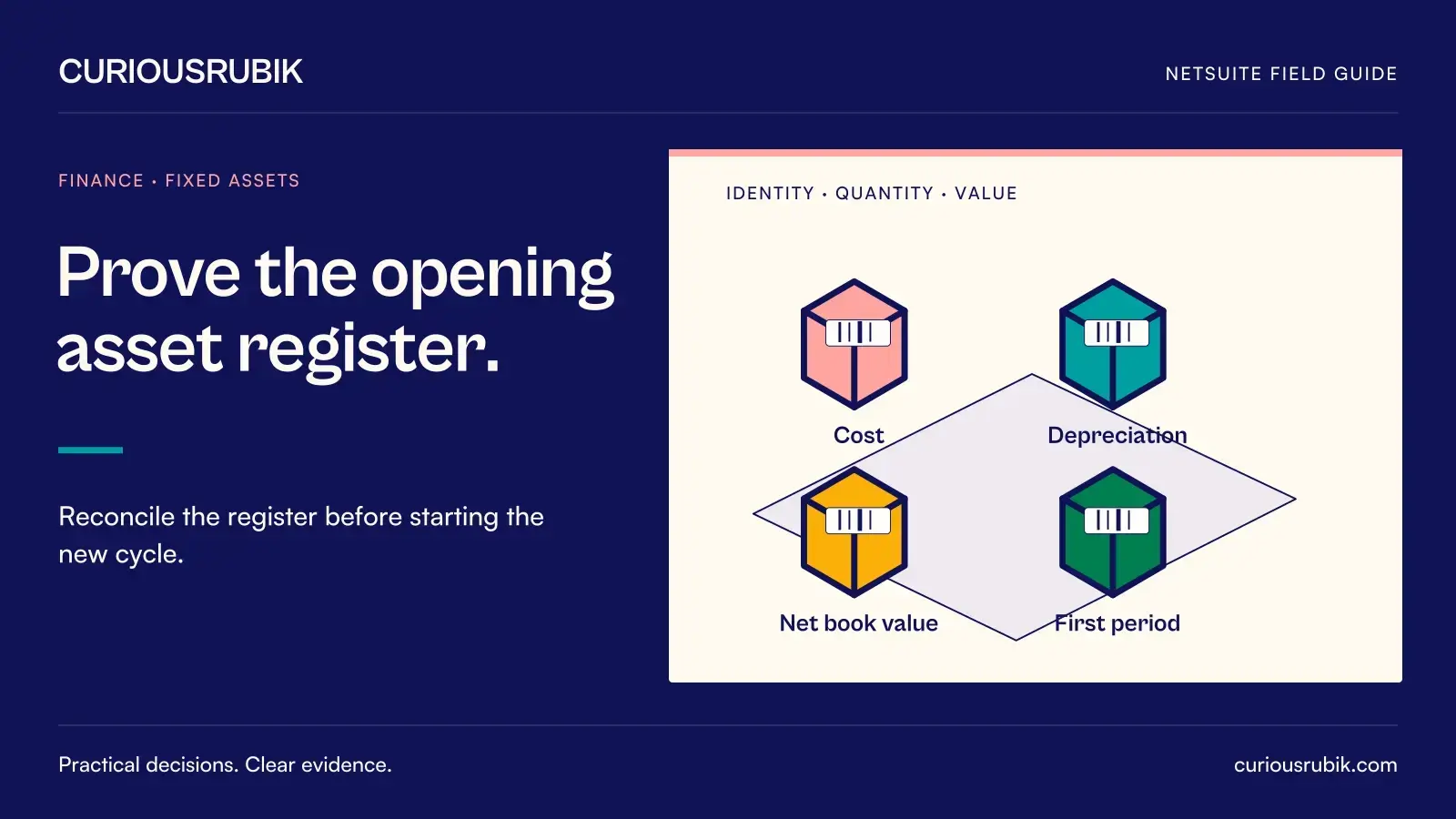
A fixed-assets implementation becomes dependable when the opening register explains the ledger and produces the expected next depreciation charge. Importing asset records is only one part of that result. Missing acquisition dates, inconsistent useful lives, and assets already disposed of can survive a technically successful migration.
For a fixed-assets accountant, the practical starting point is a controlled register with reconciled cost, accumulated depreciation, and net book value. This guide shows how to establish that opening position, test subsequent movements, and decide whether the NetSuite fixed assets implementation is ready for production use.
Agree the accounting scope before configuring asset types
List the entities, asset classes, currencies, and accounting books in scope. Identify which policies determine capitalisation, depreciation, residual value, impairment, transfers, and disposal. Financial reporting and tax schedules may differ. Their treatment needs an approved policy and a supported configuration rather than a shared assumption.
Confirm access to the Fixed Assets Management SuiteApp and its installation requirements in the intended account. Verify required platform features, roles, version compatibility, and any additional capabilities used by the design. Availability of a menu or an asset form does not prove that every required process is enabled.
Record the migration boundary. Will the register contain active assets only, fully depreciated assets still in service, and historical disposals? Which historical transactions must remain accessible for review? Answering these questions prevents scope expansion during the final load.
Clean the register at the asset level
Each asset needs a stable identifier that survives migration. Keep the legacy identifier alongside the new record reference so supporting invoices, physical labels, and prior schedules remain traceable.
For each record, review acquisition cost, acquisition date, depreciation start date, original and remaining useful life, residual value, method, accumulated depreciation, last depreciation date, asset class, entity, location, and status. Add the account mapping and ownership details required by your process.
Look for patterns rather than inspecting only the largest assets. Duplicate identifiers, negative remaining lives, zero-cost assets with depreciation, and disposed assets marked active are useful exception categories. A fully depreciated asset may legitimately remain in service; its presence is not automatically a data-quality error.
Separate missing information from policy disagreements. An unknown start date calls for evidence gathering. A disagreement over useful life requires an accounting decision. Filling both with a default merely moves the problem into the new system.
Reconcile three opening balances
Reconcile gross asset cost, accumulated depreciation, and net book value separately by asset class and relevant entity or book. Agreement in net book value alone can hide equal errors in cost and accumulated depreciation.
A hypothetical opening register contains these assets, stated in currency units:
- Press: cost 120,000, accumulated depreciation 30,000, net book value 90,000
- Packaging equipment: cost 60,000, accumulated depreciation 12,000, net book value 48,000
- Office equipment: cost 20,000, accumulated depreciation 8,000, net book value 12,000
The totals are cost of 200,000, accumulated depreciation of 50,000, and net book value of 150,000. The asset cost and accumulated depreciation ledger accounts should reconcile to the same approved opening population, with any differences explained individually.
If the ledger holds 202,000 of cost, do not add 2,000 to a convenient asset. Identify the purchase, reclassification, disposal, or historical adjustment behind it. Retain an unresolved bridge until its disposition is approved.
Prevent duplicate opening accounting
Distinguish importing asset information from posting opening ledger balances. The migration design should state exactly which action creates accounting entries and which only establishes register data or depreciation history.
This is especially important when the general ledger migration already includes asset cost and accumulated depreciation. A second posting from the asset process can duplicate the opening position. Rehearse the complete load sequence in a test environment, including any asset generation or depreciation-history steps the chosen approach requires.
After the rehearsal, inspect the actual ledger impact. A successful import message confirms that records were accepted; it does not establish that opening accounting is correct.
Prove the first depreciation period
Use a calculation prepared independently of the system as the expected result. Select assets that exercise policy differences, including a mid-period addition, a residual value, a fully depreciated asset, and a useful-life change where relevant.
For the hypothetical opening register, assume all three assets use straight-line depreciation, have no residual value, and follow a full-month convention. The press has an original life of 120 months, giving monthly depreciation of 1,000. The packaging equipment has a 60-month life, also giving 1,000 per month. Office equipment has a 40-month life, giving 500 per month.
The expected next month's total is therefore 2,500, provided the recorded history and remaining lives support those charges. Closing accumulated depreciation becomes 52,500 and net book value becomes 147,500, assuming no other movements.
These figures are illustrative policy assumptions, not a statement of the treatment every business should use. Compare rounding, period conventions, and posting dates in your configuration before approving the result.
Test disposal and other changes separately
Extend the rehearsal with a disposal after the first depreciation period. Suppose the office equipment now has accumulated depreciation of 8,500 and net book value of 11,500. If it is sold for 10,000, the illustrative loss is 1,500 before taxes, fees, or other considerations.
The review should confirm removal of the 20,000 gross cost and 8,500 accumulated depreciation, the treatment of proceeds, and the 1,500 difference under the approved policy. Inspect the actual transactions rather than assuming the disposal record alone proves every entry.
Also test a transfer, partial disposal, or asset split if those occur in normal operations. Check whether the selected features support the required workflow and what manual controls remain necessary.
Use a readiness gate with named evidence
Approve production use only when the following are available:
- Signed register-to-ledger reconciliation by relevant class and entity
- Documented policy and account mapping decisions
- Verified opening load sequence without duplicate postings
- Expected and actual first-period depreciation results
- Disposal and change scenarios with reviewed accounting impact
- Exception list with owners and approved treatment
- Role access tests and an operating calendar for routine processing
Retain the test dataset and expected calculations. They provide a useful regression pack when asset policies, configuration, or processes change later.
Frequently asked questions
Should fully depreciated assets be migrated?
Often they remain operationally important while still in use. Decide according to reporting, physical control, retention, and migration scope. Their remaining depreciation should be consistent with policy and history.
Can opening net book value be imported without the history?
That may be insufficient for the required depreciation and reporting process. Determine which cost, accumulated depreciation, dates, and history records the selected migration method needs, then test the next period.
Does the asset module determine useful lives?
Useful lives are accounting estimates governed by the organisation's policies and applicable requirements. Configuration should implement an approved decision rather than substitute for one.
What is the strongest acceptance test?
A reconciled opening register followed by correctly calculated and posted subsequent movements. Include both normal depreciation and a change such as disposal, rather than relying on record counts alone.
Scope the implementation around evidence
CuriousRubik can discuss a scoped NetSuite fixed-assets readiness review covering register quality, opening balances, and the depreciation test plan. Bring the asset policies and reconciliation exceptions so the discussion starts with the decisions that need resolution.