NetSuite Implementation in the UAE Starts with Entity and Invoice Boundaries
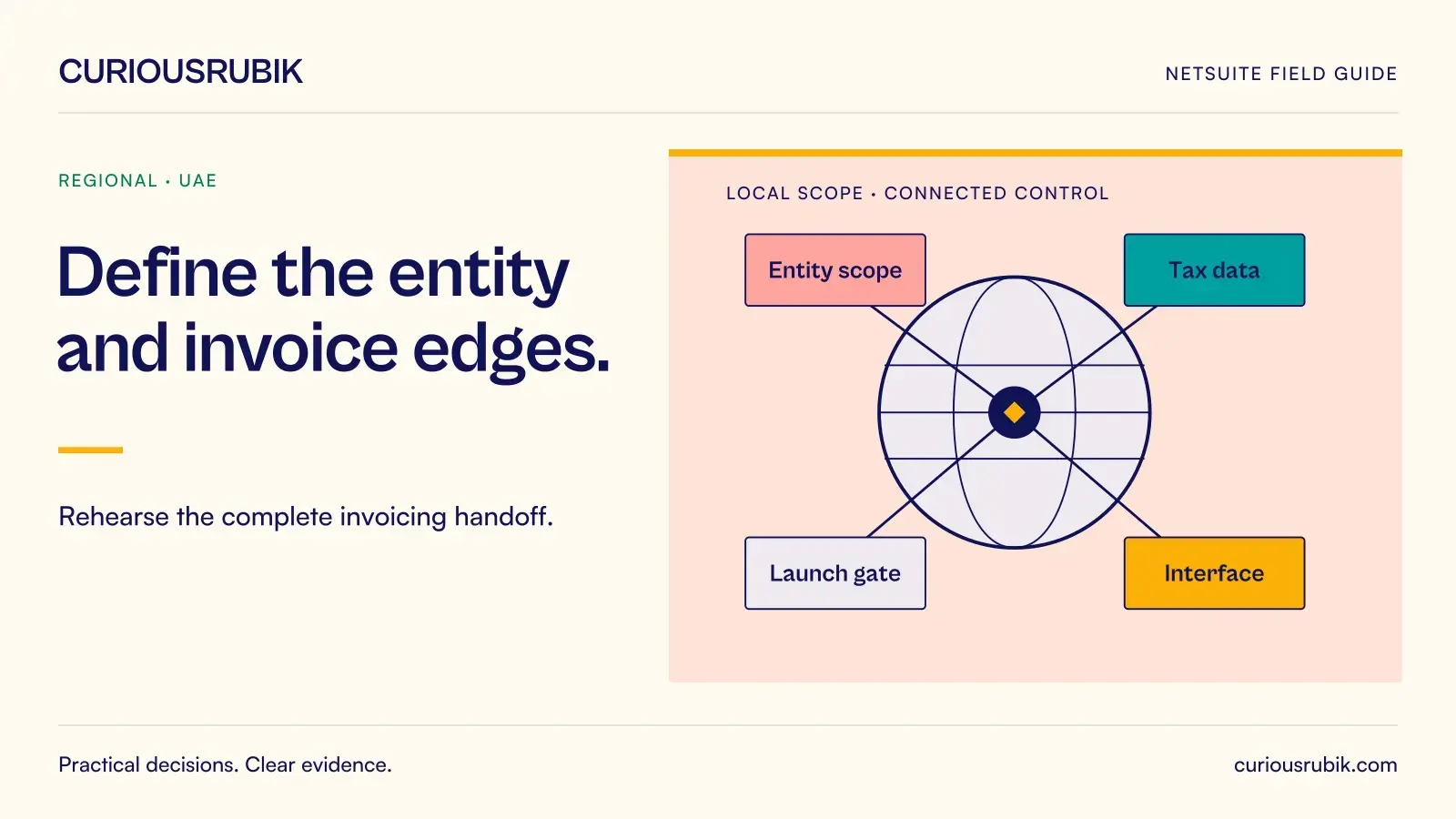
A UAE NetSuite implementation can appear ready while a crucial question remains unanswered: which legal entity is responsible for each invoice, tax record and interface message? A group structure, a tax registration and an electronic invoicing endpoint describe different relationships. Treating them as interchangeable creates defects that often surface when finance begins reconciling real transactions.
Start the programme with an entity-and-interface workshop. Its output should connect the business that makes a sale, the NetSuite records that describe it, the approved tax treatment and the service that exchanges the invoice. This gives the CFO a concrete basis for scope, budget and acceptance before configuration becomes expensive to change.
Build a scope register around actual business activity
For every participating entity, record its legal name, operating locations, registration details, accounting currency, invoice issuer and finance owner. Identify which entities enter NetSuite at launch and which remain in another system. Add the effective date of each decision so later acquisitions or registration changes do not silently inherit an outdated setup.
Next, list the transactions that make the entity distinctive. A distributor may need inventory, imports and customer returns. A services business may need milestone billing, expense recovery and project profitability. Shared services may process both businesses' transactions without becoming the contracting party.
For each transaction family, ask four questions:
- Who contracts with the customer or supplier?
- Which entity owns the receivable, payable or inventory?
- Who approves its tax treatment and supporting evidence?
- Which system creates the authoritative business document?
Resolve these questions with finance and operations together. An organisation chart alone cannot establish the complete transaction design.
Make tax data a managed workstream
Assign responsibility for registration records, customer classifications, item treatment and transaction exceptions. The implementation team can configure approved decisions, but local tax judgements need an appropriately qualified reviewer. A project should never use a convenient default tax code to close an unresolved design question.
Review the existing account's tax engine, enabled features and relevant localisation components before promising a reporting outcome. Confirm the route available in that account and the configuration needed for each entity. A generic product demonstration does not establish that the required components are installed, licensed or appropriate for this implementation.
The data-cleaning plan should distinguish missing values from disputed values. A blank registration field can be assigned for collection. Two conflicting registration values require a decision and evidence. Track both conditions separately so a high completion percentage does not conceal unresolved ownership.
Design electronic invoicing as an end-to-end process
Structured electronic invoicing requires more than generating a readable invoice and attaching it to an email. Define how approved transaction data moves from NetSuite through the selected Accredited Service Provider and how the resulting statuses return to the business.
Keep invoice exchange and tax-data reporting visible as separate outcomes. An outbound request accepted by an interface is not sufficient evidence that every downstream step has finished. Finance needs to distinguish a locally queued document, a validation failure, an exchange acknowledgement and a reporting acknowledgement using the statuses actually supported by the agreed route.
Record the provider assumption date, proposed service, supported document types, onboarding dependencies and accountable commercial owner. Reconfirm these before contracting and before launch. Programme phases and appointment requirements can change; the project schedule should use the requirements that apply to the specific business when its readiness decision is made.
Provider selection should examine exception handling as carefully as successful delivery. Ask what identifiers return, which errors can be corrected in master data, how unavailable services are handled and how an operator retrieves evidence after the original session has ended.
Use an interface contract that finance can read
Every interface needs a short contract describing its input, output, owner and reconciliation control. Technical specifications can sit behind it, but the finance version should explain what a successful business event means.
For an invoice interface, include the originating entity, document identifier, currency, document version, message identifier and expected status milestones. State whether a retry reuses the same business document and how duplicate requests are detected. Describe who can correct source data and who can authorise a new document or credit note.
Apply the same discipline to bank, commerce, procurement and payroll connections. A payroll journal interface, for example, must define which totals and dimensions enter the ledger; it does not by itself establish payroll calculation or statutory filing coverage. Name these boundaries in the statement of work rather than leaving them for the last integration meeting.
Rehearse a realistic two-entity operating day
Consider a hypothetical UAE group with a trading entity and a consulting entity. Both use one shared finance team. During the rehearsal, the trading entity issues an AED 20,000 invoice with AED 1,000 tax under the example's approved treatment. The consulting entity issues an AED 8,000 invoice with AED 400 tax. Neither amount represents tax advice for a real supply.
The two receivables are AED 21,000 and AED 8,400, giving an aggregate AED 29,400. Finance should still be able to reconcile the entities separately. A combined total cannot reveal that the consulting invoice accidentally used the trading entity's identifier.
Now introduce a missing buyer endpoint on the consulting transaction. The trading document completes the required exchange and reporting steps; the consulting document remains unresolved. The operational population contains two invoices, with one complete and one awaiting correction. The ledger still records the approved business transactions according to the accounting design; the status defect must not create a second receivable when repaired.
After correction, verify both original invoice identifiers, the separate entity totals and the returned status evidence. This small rehearsal tests ownership, mapping, monitoring and duplicate prevention in one connected sequence.
Turn workshop findings into launch conditions
Write acceptance conditions that identify evidence and an approver. “UAE localisation complete” is too broad. A usable condition says that the entity register has been approved, representative transactions reconcile to the agreed reports and required invoice outcomes can be traced by document identifier.
Before cutover, require these decisions:
- Finance approves entity, registration and transaction-treatment scope.
- The technical lead confirms the account and integration configuration used in testing.
- Operations demonstrates rejected-document recovery without duplication.
- Support accepts named owners, escalation contacts and coverage for the launch period.
- The sponsor reviews unresolved defects and their business consequences.
Include a controlled contingency procedure for service disruption. Its legal acceptability must be reviewed for the business; an improvised PDF or manual workaround should not be assumed to satisfy an electronic invoicing obligation.
Questions UAE sponsors should ask
Does one NetSuite account mean one invoice issuer?
No. Map each issuing entity explicitly and prove how its identity appears in transactions, electronic messages and finance reports. Shared users and common branding do not remove legal-entity boundaries.
Can the service provider correct our tax decisions?
Provider validation can identify certain data and format problems. The business still needs accountable approval of tax treatment, source data and corrections. Define who resolves each error category.
Should every interface launch at once?
Sequence by business dependency and risk. An optional management-report feed may be phased later, while an interface essential to lawful invoicing or cash collection needs an approved launch solution.
What should a UAE implementation proposal include?
Ask for entity scope, transaction families, tax and invoicing assumptions, named interfaces, acceptance evidence and post-launch responsibilities. Price comparisons become meaningful only when these boundaries match.
Bring your entity list and two representative invoice journeys to a scoped CuriousRubik implementation workshop. Use the discussion to clarify delivery responsibilities and the local decisions that require specialist approval before configuration begins.