Choosing a NetSuite Integration Platform by Recovery and Lifetime Cost
The most revealing integration question is often asked after the demo: who restores the business process when a record was created but the response disappeared? A connector list rarely answers it. Neither does an estimate covering only the initial build.
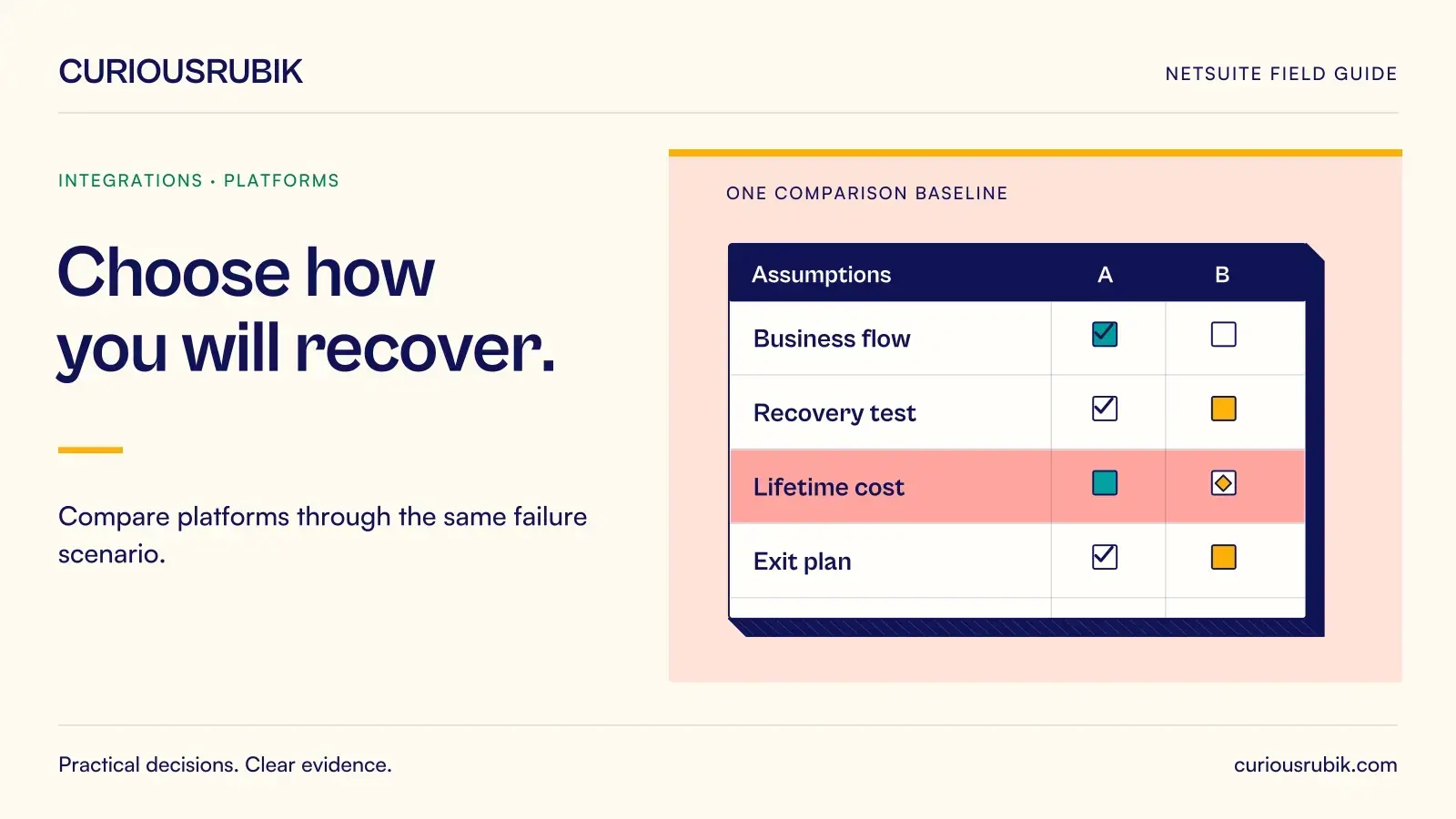
Selecting a NetSuite integration platform means selecting an operating model. A native connector, an integration platform as a service, and a custom application allocate responsibility differently. Evaluate them against the same business flow, failure conditions, change requirements, and exit plan. This creates a comparison that an IT director can defend without relying on vendor slogans or invented cost benchmarks.
Describe the business flow before comparing tools
Define the event that starts the process, the records it creates or changes, and the business outcome that proves completion. Include approvals and exceptions. “Connect the CRM to NetSuite” is too broad to estimate or test.
Consider a hypothetical distributor. An approved sales agreement should create a customer when necessary, create a sales order, return the order number, and later expose fulfillment status. The flow must handle two subsidiaries, item substitutions, customer credit review, and delivery amendments. The customer and order steps can succeed independently, so recovery must preserve progress without duplicating either record.
Write down expected daily volume, peak bursts, acceptable delay, and how long operations can tolerate a stopped flow. Specify the people available to support it. A technically capable solution may be a poor fit if the only person who understands it is unavailable during the business's processing window.
Understand the three operating choices
A native connector offers a predefined route between applications. It can reduce initial configuration work when its object model and supported rules fit the requirement. The evaluation must establish how it exposes errors, controls field ownership, handles matching, and supports changes to existing transactions. Ask which functions depend on account configuration or additional entitlement.
An integration platform as a service provides a broader environment for orchestration and transformation. It may centralize several flows and give an operations team a common way to inspect them. Its value depends on the usable controls in the chosen configuration, the team's skills, and the contractual support boundary. A large catalog of connectors does not prove the required recovery procedure exists.
A custom integration lets developers implement a narrowly defined contract and specialized behavior. It also leaves the organization responsible for deployment, authentication lifecycle, dependency updates, documentation, tests, and operational access. Custom work is reasonable when its additional control addresses a real constraint and the maintenance owner is funded.
Hybrid designs are possible. Keep their boundaries visible. If a native connector manages customers while a custom service manages orders, decide how each service learns that the customer is ready and which team investigates a mismatch.
Run the same recovery exercise for every option
Give each candidate the distributor scenario and inject five failures:
- The customer succeeds but the order fails validation.
- NetSuite creates the order, but the caller times out.
- An event arrives twice with the same business identity.
- A correction arrives before the original event has completed.
- Authentication becomes unavailable while approved work accumulates.
For each failure, require a demonstration or a clearly bounded proof plan. Identify where state is stored, what the operator sees, and which action is safe. A retry button should have a documented meaning. It should not blindly repeat a financial write whose outcome is unknown.
Judge recovery by the final business state: one intended customer relationship, one intended order, preserved amendments, and an explainable exception trail. Also measure operator effort. A flow that recovers through a twenty-step manual procedure may be acceptable at low volume but unsuitable for a busy order desk.
Build a lifetime cost model with explicit assumptions
Use cost categories rather than unsupported price claims. Request actual quotations and internal effort estimates for the comparison period your organization uses.
Include acquisition or subscription charges, implementation, data cleanup, testing, security review, ongoing administration, release testing, monitoring, incident response, and business interruption. Add the cost of ordinary change: a new field, a new subsidiary, or a changed approval rule. Distinguish charges tied to users, transactions, environments, connections, or capacity where the applicable contract uses those measures.
For custom work, include the cost of maintaining developer knowledge and replacing dependencies. For middleware, include training, deployment controls, and any extra production or test environments. For a native connector, include workarounds that remain necessary outside the connector.
Keep assumptions visible. For example, the hypothetical distributor expects one significant mapping change per quarter and needs a named backup operator. Those are planning inputs, not industry averages. Test the decision again with higher transaction volume and the departure of the primary maintainer. Sensitivity analysis often reveals risks hidden by a single total.
Use a selection matrix with evidence gates
Score only after defining what a passing result means. A practical matrix can use these criteria:
- Functional coverage: required records, fields, actions, and approval boundaries work in the target account.
- Recovery: duplicate, ambiguous-outcome, and partial-success cases have tested procedures.
- Observability: operators can follow one business event across systems without exposing unnecessary data.
- Change control: mapping and logic changes can be reviewed, tested, deployed, and reversed safely.
- Ownership: support responsibilities and escalation routes are assigned.
- Capacity: expected bursts and recovery backlogs fit demonstrated behavior.
- Exit readiness: mappings, identifiers, history, and configurations can be retained or transferred appropriately.
Treat essential controls as gates. A candidate that cannot prevent duplicate orders should not compensate for that failure by scoring well on user interface design. Use weighted preferences only for candidates that clear the mandatory requirements.
Record the evidence behind each score and distinguish demonstrated behavior from contractual commitments and untested assumptions. This prevents an optimistic sales explanation from acquiring the status of a completed acceptance test.
Decide how the integration can be replaced
Exit planning is relevant at selection time. Ask who owns the source code, mapping specifications, deployment configuration, and operational records. Confirm what can be exported and what remains proprietary. Check retention rules for processing history and how in-flight work would be drained.
A replacement should preserve business identities and reconciliation continuity. Otherwise, a new platform may mistake previously processed events for new work. Define how credentials will be revoked, queues retired, and monitoring transferred after the last accepted event.
Common evaluation questions
Is an integration platform always cheaper than custom development?
No universal answer is credible. The result depends on subscription terms, complexity, change frequency, support capability, and the comparison period. Use actual quotations and a common scope rather than comparing a complete service with a build-only estimate.
When is a native connector sufficient?
It is a strong candidate when required mappings, actions, controls, and recovery behavior fit the documented business flow. Verify the unusual cases before selecting it. A connector can be sufficient even if another option offers more features.
Can the business support a custom integration without a large team?
Possibly, if the flow is bounded and ownership, documentation, automated tests, and backup support are explicit. The important question is whether support continues when the original developer is unavailable, not the nominal size of the team.
What belongs in the final decision record?
Include the chosen scope, rejected alternatives, evidence gates, cost assumptions, known gaps, support owner, and review triggers. Preserve the recovery test results so future teams understand why the option was selected.
Make the decision testable
A CuriousRubik comparison workshop can use one representative flow to build a recovery test pack and lifetime-cost model. Agree the evaluation scope first, then compare options against the same evidence and operating responsibilities.