NetSuite Intercompany Reconciliation from Transaction Pair to Elimination
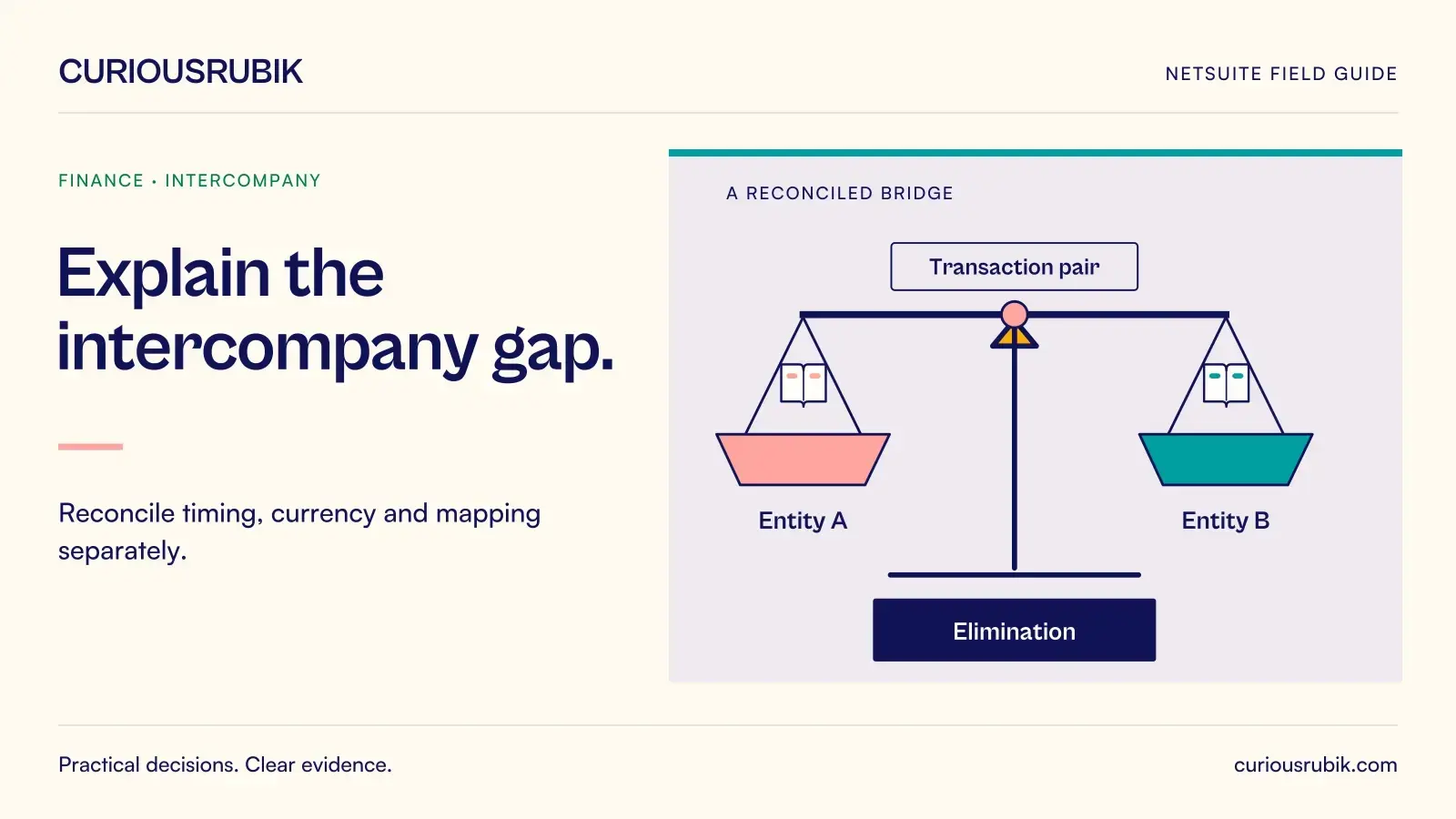
An intercompany difference rarely explains itself at the consolidated report level. The cause may be a missing bill, a different posting period, an incorrect counterparty or a currency assumption. Posting a balancing adjustment before understanding the source can move the problem without resolving it.
NetSuite intercompany reconciliation should follow a transaction through both subsidiaries, its approved accounting treatment and the relevant consolidation process. The group controller needs evidence that explains the relationship between entity balances and the consolidated outcome.
The examples below are hypothetical. They simplify accounting to make the control logic visible and require adaptation to your transaction types, currencies, enabled features and approved policies.
Define the expected transaction pair
Start with the business event. Which entity supplied goods or services, which entity received them, and what document should each side record? Identify a shared reference that both teams can use.
Capture the selling entity, buying entity, document currency, amount, transaction dates, posting periods and relevant accounts. Also record the status of each document. A draft or pending-approval record may explain why one team sees activity that has not reached the expected accounting population.
NetSuite provides different intercompany workflows and reporting routes depending on the configured process. Stand-alone document pairing and purchase-order-to-sales-order flows should not be assumed to use identical reconciliation mechanisms.
Choose the appropriate evidence for the workflow in use. A linked pair helps locate records, but the link alone does not prove matching amounts, periods or accounting treatment.
Resolve timing before investigating translation
Consider a hypothetical service charge of 10,000 currency units from Entity North to Entity South. North records its invoice in June. South records the corresponding bill in July.
At June close, North shows an intercompany receivable while South's corresponding payable population is missing the bill. The first explanation is a period difference. Comparing exchange rates before identifying that timing issue would waste effort.
The entities should confirm the underlying event, document dates and approved cutoff treatment. Finance then determines the appropriate correction or other accounting response. The migration or system team should not change posting periods solely to make a report agree.
Retain both the original difference and the approved resolution. The group controller needs to know whether the mismatch was corrected, accepted under a documented treatment or deferred with a clear reporting consequence.
Reconcile in transaction currency and base currency
Where the two entities have different base currencies, start by comparing the common document currency. If both records represent the same EUR 10,000 charge, confirm that amount before comparing the entities' base-currency values.
Different base-currency values are not automatically errors. They may reflect different currencies, approved transaction rates, revaluation or other relevant accounting facts. The reconciliation should identify the rate context and distinguish those effects from missing or duplicated activity.
A hypothetical invoice and bill may both show EUR 10,000, while their respective base values are USD 10,900 and GBP 8,600. These amounts cannot be subtracted directly to measure a mismatch. Translate and compare within the appropriate reporting context under the approved design.
Document the rate date, currency direction and applicable accounting period. An inverted rate or a report using a different period can look like an operational discrepancy until those details are checked.
Inspect account and counterparty mapping
Even matching documents can reach the wrong accounts. One entity may classify an amount as intercompany receivable while the other uses an ordinary vendor payable account or an incorrect counterparty relationship.
Review the account mappings and elimination-related configuration applicable to the transaction. Confirm that both entities are inside the intended reporting population and that the relevant report filters include their activity.
Do not solve a mapping issue by moving the entire difference to a miscellaneous account. Trace the record that caused the misclassification and choose an approved correction that preserves the audit trail.
Test mappings with new counterparties and unusual transaction types. A configuration that works for one familiar entity pair may not cover a newly added subsidiary or a different account combination.
Explain the elimination bridge
A simplified hypothetical example uses two entities with the same base currency. North records an intercompany receivable of 10,000 and South records an intercompany payable of 10,000. Before elimination, both balances appear in the combined entity population.
Under the approved consolidation design, the relevant elimination offsets those internal balances so they do not remain as external group receivables and payables. The controller should reconcile the source balances, elimination entries and resulting consolidated balances.
If only North's receivable exists because South's bill is missing, an elimination report cannot establish that the underlying business event was recorded correctly. Resolve or account for the source difference through the approved process before treating consolidation as complete.
Income, expense, inventory profit and other intercompany effects may require additional analysis beyond this balance-sheet illustration. Do not extend the simple example into a universal elimination rule.
Use a difference register with accountable counterparts
Create one row per unresolved relationship or document pair. Include the source documents, amount in document currency, entity base values, periods, difference category, owner on each side, proposed treatment and group reviewer.
Useful categories include missing counterpart, timing, amount, currency context, account mapping, duplicate record and scope or filter issue. These categories guide investigation; they do not replace evidence.
Set an escalation point before the group close deadline. The entity that issued a charge and the entity that received it should both participate in resolution. Assigning every difference to group finance can conceal weak local ownership.
After correction, refresh the affected reports and retain the new evidence. A defect marked resolved should point to the actual transaction or approved entry that changed the result.
Questions group controllers ask
Does pairing documents guarantee reconciliation?
No. Pairing establishes a relationship within the supported workflow. Amounts, periods, currencies, statuses and accounting treatment still need review.
Should every currency difference be eliminated?
Do not assume so. Identify whether the difference arises from transaction accounting, revaluation, translation or a genuine error, then apply the approved accounting treatment.
Can we reconcile only at group level?
Group-level review is necessary, but entity and document-level evidence usually explains the causes. A consolidated total alone can hide offsetting errors between counterparties.
What should the final sign-off contain?
Include the reconciled population, elimination bridge, unresolved items and approved treatments. The reviewer should be able to trace a material balance from source documents to the consolidated result.
Review one difficult entity pair
CuriousRubik can help scope a NetSuite intercompany review around a specific counterpart relationship, reconciliation difference or elimination bridge. Start with the documents and period evidence that explain where the two sides diverge.