NetSuite Landed Cost Allocation with a Worked Reconciliation
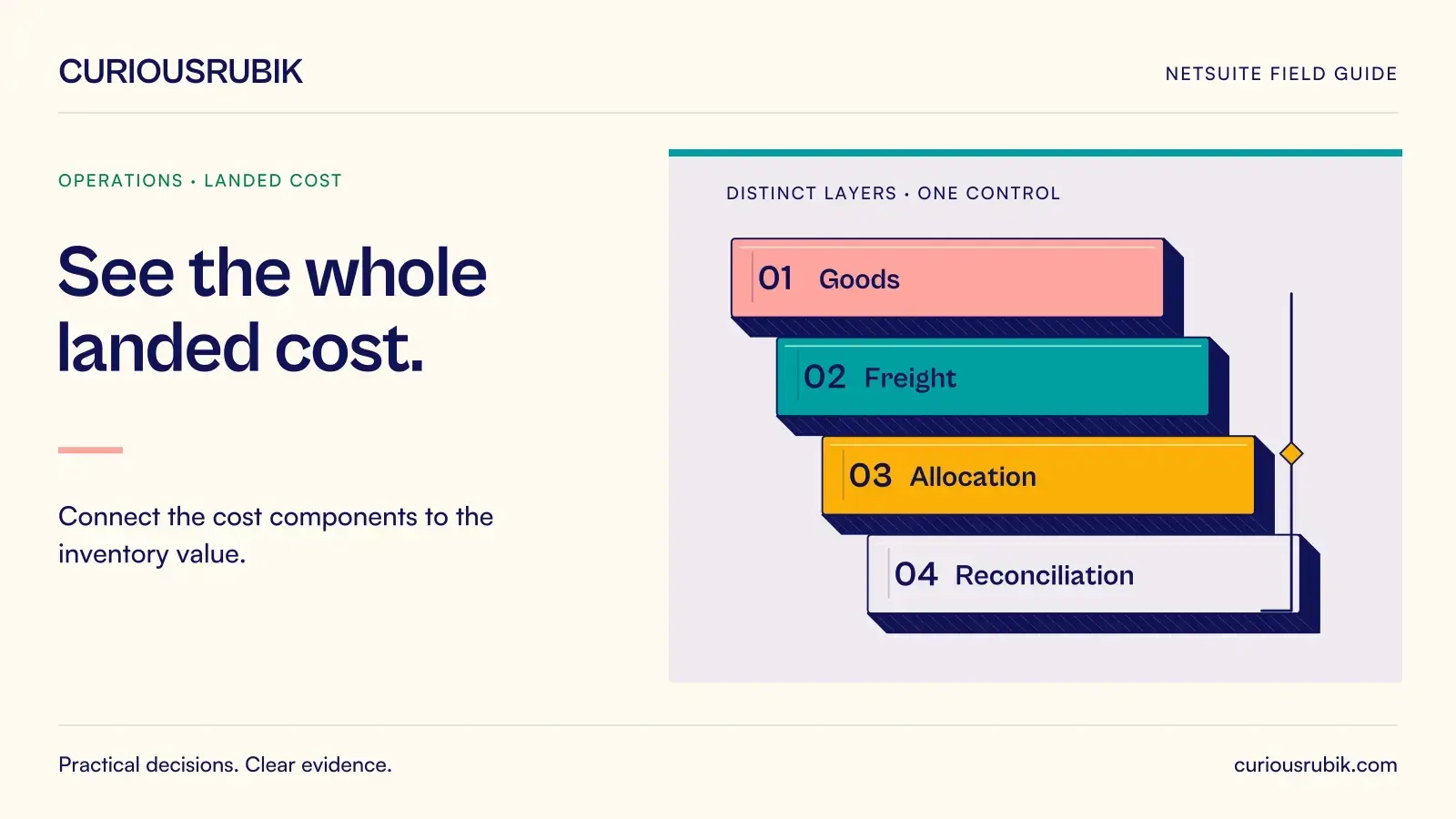
The purchase price on an item receipt may explain only part of the cost of bringing stock into the business. Freight, duty, insurance, and handling can materially change the economics. If those amounts are omitted, duplicated, or allocated using an unsuitable driver, item margins become harder to trust.
A reliable NetSuite landed cost process links each charge to eligible inventory, explains the allocation method, and reconciles later changes. The controller should be able to move from a supplier invoice to a shipment, from the shipment to item values, and from those values to the relevant accounting result.
Decide which charges belong in the calculation
Create a cost-category policy before configuring categories. Identify which acquisition-related costs are eligible for inclusion in inventory under the applicable accounting policy and which should be treated elsewhere.
Recoverable taxes require particular care. Do not assume that a tax amount belongs in inventory merely because it appears on a supplier document. Recovery, jurisdiction, and the nature of the transaction affect the treatment and need local accounting review.
For each category, define its source document, allocation basis, responsible owner, expected timing, and clearing or accrual treatment where applicable. The same charge should not be capitalised once through the item purchase price and again through a separate landed cost allocation.
Match the allocation driver to the charge
Quantity, weight, and value can produce substantially different results. Quantity may be suitable where handling effort follows unit count. Weight may reflect transport economics. Value may be appropriate where a charge is proportional to the goods' value.
NetSuite supports landed cost approaches whose availability and behaviour depend on enabled features and preferences. Transaction-level allocation and per-line allocation are different designs. Confirm which one is being used, which items are eligible, and whether the selected workflow supports the required category-level treatment.
A policy using different drivers for freight and duty may require line-level calculations or another supported design. Do not assume a transaction-level allocation can apply a separate driver to every category simultaneously.
A hypothetical two-item shipment
Assume a shipment contains two items, measured in a common currency:
- Item A: 100 units at a purchase cost of 20 each, total 2,000; weight two kilograms per unit
- Item B: 50 units at a purchase cost of 40 each, total 2,000; weight six kilograms per unit
Total purchase cost is 4,000. Total weight is 500 kilograms: 200 for A and 300 for B. Eligible freight is 500 and eligible duty is 400. For this illustration, the approved policy allocates freight by weight and duty by purchase value.
Freight allocates 200 to A and 300 to B. Duty allocates 200 to each because their purchase values are equal. A receives total landed charges of 400; B receives 500. Total allocated charges are 900, agreeing with the freight and duty total.
A's total acquisition value becomes 2,400, or 24 per unit. B's becomes 2,500, or 50 per unit. The combined shipment value is 4,900.
These are expected calculations for a test. Validate the supported transaction design and accounting treatment in the actual account before using them as posting instructions.
Show why another driver changes margin
If the same 500 freight charge were allocated by purchase value, A and B would each receive 250. With duty unchanged, A's total value would become 2,450, or 24.50 per unit. B's would become 2,450, or 49 per unit.
The shipment total remains 4,900, but the item-level costs change. Agreement at shipment level therefore cannot prove the allocation is economically appropriate.
Document the reason for the selected driver and review it when shipping methods or product characteristics change. A driver that worked for small uniform cartons may become unsuitable when the product range includes bulky or heavy items.
Check receipt eligibility and source timing
Confirm that each intended item is set up to track landed cost and that quantities, weights, and units are correct. Missing weights or mixed measurement conventions can invalidate an otherwise reasonable method.
Match partial receipts to the appropriate share of shipment charges. Decide whether an estimate is used before the final invoice arrives and how the estimate is replaced or adjusted. Keep estimated and actual amounts distinguishable in the supporting schedule.
Inspect the transaction relationship. Depending on receiving configuration and the chosen landed cost method, the allocation may belong on a particular receipt or other supported transaction. A charge appearing on a supplier bill is not, by itself, proof that it has reached the intended inventory value.
Reconcile a later freight change
Suppose the final freight invoice for the hypothetical shipment is 600 rather than the estimated 500. The increase is 100. Using the same weight basis, A receives an additional 40 and B an additional 60.
The revised total values are 2,440 for A and 2,560 for B, giving unit values of 24.40 and 51.20 respectively. Total shipment value becomes 5,000: purchase cost 4,000, final freight 600, and duty 400.
Now assume half of each item's quantity remains on hand when the cost change is processed. As an economic illustration, half the additional 100 relates to remaining units and half to units already sold. The expected split is 50 to remaining stock and 50 associated with sold stock.
The actual posting path, timing, and cost-of-sales effect depend on costing method, period status, and the supported adjustment workflow. Inspect the resulting valuation and ledger entries. Do not force the illustrative split through a journal without understanding how the inventory costing process handles the update.
Use three linked reconciliations
First, reconcile source charges to allocated charges by shipment and category. This identifies missing invoices, duplicate allocations, and estimates awaiting final amounts.
Second, reconcile allocated charges to item and receipt values. Confirm eligible quantities, allocation ratios, and rounding. Retain the total rounding difference and its treatment instead of burying it in a line.
Third, reconcile inventory valuation and relevant clearing or expense balances to the ledger at the chosen cutoff. Include stock already sold, returns, and late changes. A clearing balance may be a valid timing item, but it needs an owner and an expected resolution date.
Review ageing by shipment so old estimates and unallocated bills do not remain hidden in a net total. Opposite-sign errors can cancel at account level while individual shipments remain wrong.
Frequently asked questions
Is weight always the best freight allocation method?
No. The appropriate driver depends on how the charge arises and the approved policy. Volume, flat fees, or other commercial terms may require a different supported approach.
Should recoverable tax be included in landed cost?
Its treatment requires jurisdiction-specific accounting review. Separate the tax question from the software's ability to allocate an amount.
Can a shipment reconcile while item margins are wrong?
Yes. Different allocation drivers can produce the same shipment total and different item costs. Review both total agreement and the rationale for distributing the cost.
What happens when the invoice arrives after goods are sold?
Review the supported late-cost process, costing method, and period implications. Reconcile the actual effect on remaining inventory and sold units rather than assuming the entire change stays in inventory.
Review one shipment end to end
Ask CuriousRubik about a scoped landed cost diagnostic using one multi-line shipment, its source charges, and later adjustments. A complete quantity-and-value bridge is a practical starting point for improving margin confidence.