Which NetSuite Modules Do You Need Before You Sign
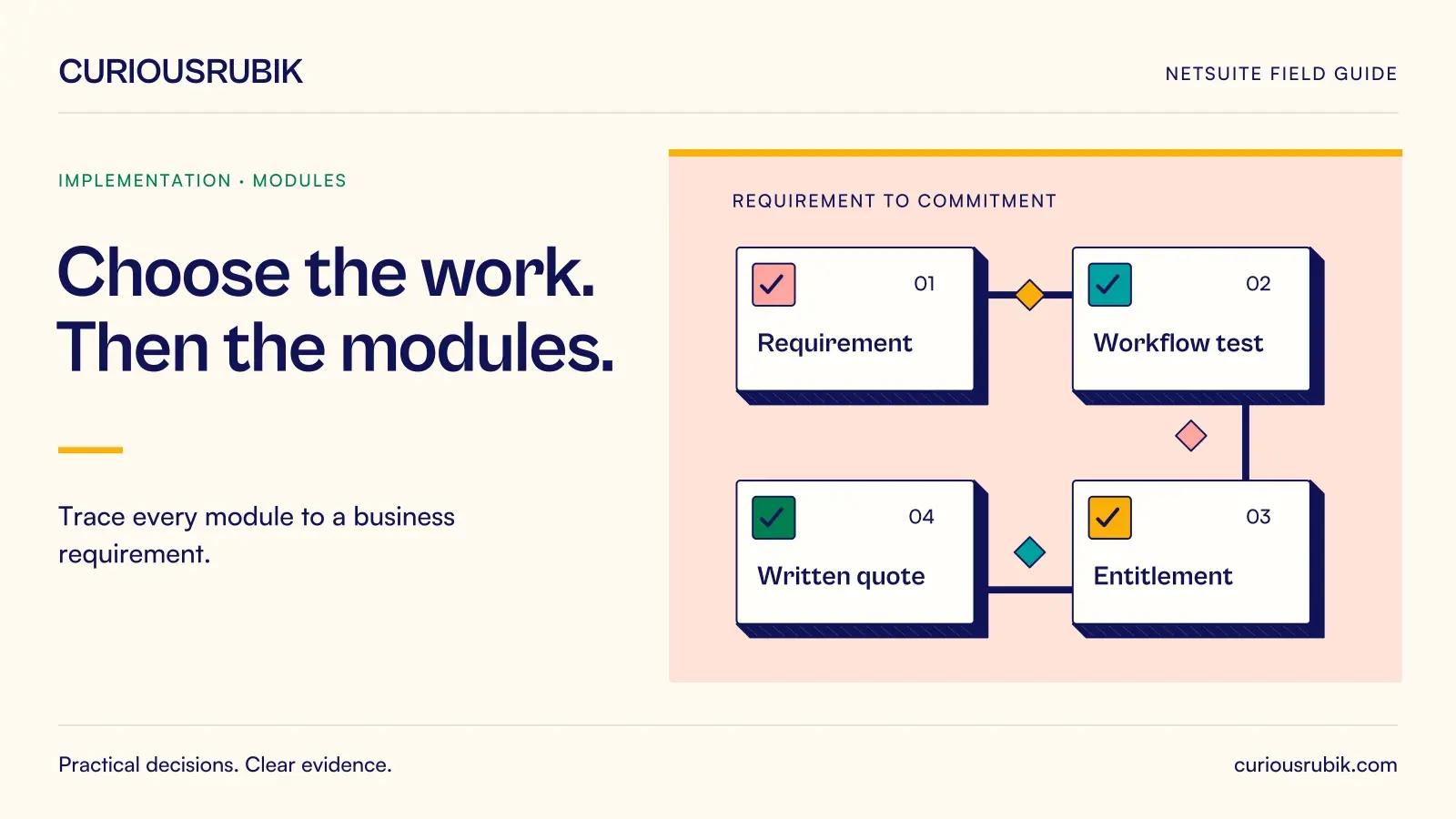
A module becomes a sensible purchase when the business can name the requirement it serves, the people who will use it and the evidence that will prove it works. Buying from a feature list reverses that order. It can leave a team paying for functionality while the real process bottleneck remains unresolved.
For a CFO and solution owner, NetSuite module selection should connect requirements to the current commercial proposal. Build a requirements-to-license checklist before treating any demonstration, product label or recommended package as settled scope. The result should support both a purchasing decision and a practical acceptance plan.
Define the operating core first
Start with the transactions that must be completed correctly on the first day and at the first close. These might include customer invoicing, supplier bills, cash application, journals, financial reporting and approval responsibilities. The exact core depends on the business, its edition and its contractual entitlements.
Do not equate an important process with a need for an additional module. Some requirements may be satisfied by the proposed base scope, a process change or an existing system that remains in place. Others may require separately licensed functionality, configuration, an extension or integration. Ask the solution team to distinguish those routes explicitly.
Describe requirements in business language. “Show committed stock across our selling locations before confirming an order” is more useful than “buy advanced inventory.” The former can be tested; the latter is a product assumption.
Use a requirements-to-license record
Create one record for every material requirement. Include:
- A unique requirement ID and a plain-language business outcome.
- The process owner and the people who perform the work.
- Transaction volume, exception types and relevant entities.
- The proposed capability and exact quoted commercial line item.
- Dependencies, prerequisites and configuration assumptions.
- An acceptance scenario, expected result and approving owner.
- The proposed purchase phase and reason for that timing.
Add a status such as verified, provisional or unresolved. A line should become verified only when the requirement, proposed design and entitlement have all been checked. This avoids a common mismatch: the consultant understands the process, procurement understands the price, but nobody has reconciled the two.
Look for business triggers rather than attractive features
A useful trigger is an observable problem or requirement with a responsible owner. Examples include repeated manual allocation work, entity-level reporting that cannot be reconciled reliably, or warehouse exceptions that delay order processing.
For each trigger, ask how often it occurs, what it costs operationally and what happens if it remains unchanged. A rarely used feature can still be essential if it supports a critical control. Equally, a visually impressive dashboard may have little value if nobody can explain the decision it will change.
Separate today’s needs from an anticipated future. Future requirements belong in the architecture discussion, but they do not automatically justify buying every related entitlement immediately. Establish what would trigger the next purchase and how much lead time adoption would require.
A hypothetical selection workshop
Consider a growing distributor with two sales channels and a small finance team. This is an illustrative business, not a CuriousRubik client example. Its initial wish list contains enhanced inventory planning, automated revenue-related processing and a broader analytics package.
The workshop examines three requirements rather than accepting those labels.
Requirement A: prevent avoidable order commitments
Operations needs staff to assess available stock before confirming selected orders. The owner supplies ten recent exception cases, including a partial delivery and a location transfer. The solution team must show how the proposed design handles those cases and identify the corresponding entitlements.
Acceptance requires a user with the intended role to complete the scenario and explain the resulting stock position. The purchasing decision remains open until the team verifies the workflow, required setup and quote. A generic inventory demonstration is insufficient.
Requirement B: support an unusual billing arrangement
Finance has one contract category whose accounting treatment requires review. Before recommending a module, the controller documents the accounting policy and expected results for a sample transaction. The solution architect evaluates the process against that policy.
If the arrangement is material and active at launch, it may be a first-phase requirement. If it is only a possible future offering, procurement can ask for a separately priced option and implementation prerequisites. The distinction is based on business evidence rather than feature enthusiasm.
Requirement C: produce a management margin view
The CFO wants margin by channel. The team discovers that channel ownership and item cost data are inconsistent. Buying an analytics capability alone would not resolve those definitions.
The first action is to establish the data model, ownership and reconciliation rules. The reporting solution is then tested against those definitions. A purchase can be justified once the team knows whether the quoted scope supports the required view and what additional work is necessary.
Trace the dependencies before deferring a module
“Buy it later” can be a sound decision, but only when later has been designed. Ask whether deferral changes master data, transaction capture, integrations or reporting dimensions. Data that was never captured may be expensive or impossible to reconstruct accurately.
Record foundational work that should happen now even if the capability launches later. That could mean adopting consistent item identifiers, preserving a required transaction attribute or documenting an interface contract. Confirm the technical feasibility with the implementation team rather than assuming a future addition will be seamless.
Also identify people dependencies. A capability that needs regular maintenance must have an owner with enough time and training. The subscription can start immediately; organizational readiness may take longer.
Reconcile the checklist to the quote
Before contracting, walk through the current Oracle quote line by line with the appropriate commercial and technical contacts. Confirm the exact products, user types, quantities, applicable scope and contractual conditions. Product names and package descriptions alone are insufficient evidence of entitlement.
Attach each quoted line to a requirement or an explicitly approved foundation. Investigate orphan lines with no requirement, and requirements with no confirmed delivery route. Record whether configuration and implementation effort appear in the services proposal or remain customer responsibilities.
Repeat the reconciliation when the quote changes. A revised package, entity assumption or user mix can invalidate an earlier decision even when the total price looks similar.
Questions buyers ask
Should every department select its own modules?
Departments should own their requirements and acceptance evidence. Final selection needs cross-functional review because shared data, licenses, integrations and financial controls affect the whole implementation.
Can a demonstration prove that a module is included?
No. A demonstration can support functional fit, but entitlement needs confirmation against the actual proposal and agreement. Record those as two separate checks.
Is unused functionality always wasted spending?
Not necessarily. It may be required for a control or an agreed near-term rollout. Ask for a clear reason, an accountable owner and an adoption date before treating it as a justified commitment.
How do we decide between buying now and later?
Compare the current requirement, implementation dependencies, ongoing ownership and cost of deferral. A later purchase is easier to defend when its trigger and prerequisites are documented.
Bring requirements to the commercial conversation
Good module selection leaves a visible chain from business need to entitlement, configuration and acceptance. Use that chain to discuss your proposed NetSuite scope with CuriousRubik before the module list becomes an expensive substitute for requirements.
Related reading