NetSuite Month End Close Checklist with Reconciliation Evidence
A period can be locked while important questions remain unanswered. The bank balance may reconcile only after an unexplained adjustment. An intercompany difference may have no owner. A late supplier bill may be sitting outside the ledger with no documented cutoff decision.
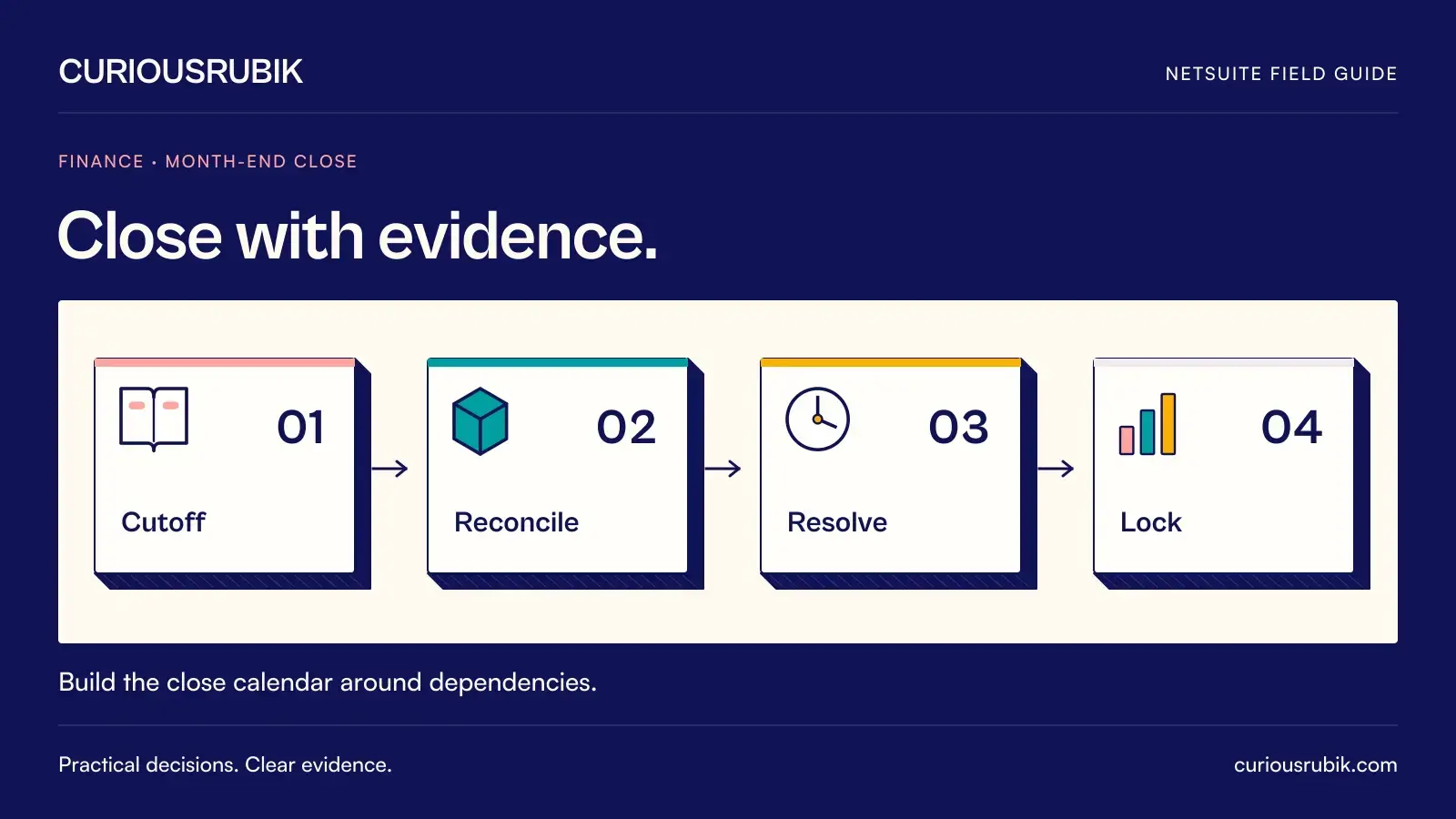
A useful NetSuite month end close checklist connects each task to evidence, dependencies and approval. The objective is a reliable financial result and a clear record of unresolved items. Closing faster is valuable only when the process remains controlled.
This guide provides an adaptable close calendar and exception framework for controllers and finance managers. Actual accounting treatment, thresholds and deadlines should follow your organization's approved policies and the features configured in your account.
Establish the cutoff before the reporting deadline
Define what belongs in the period and how late information is handled. Sales, purchasing, warehouse and payroll teams need specific instructions about their final submissions and the evidence required for exceptions.
Capture transactions that have occurred operationally but are not yet fully reflected in accounting. Examples may include receipts awaiting bills, delivered work awaiting billing and bank activity awaiting posting. The appropriate accounting response depends on the facts and approved policy.
Assign each population an owner. A generic instruction to “check accruals” is weaker than a named purchasing owner providing the unbilled-receipt population for finance review.
Preserve the cutoff report used for close. If the underlying system continues changing, reviewers need to know which population supported the decision at the time.
Use a dependency based close calendar
The following hypothetical calendar is a planning example, not a promised close duration:
- Before period end: Finance confirms cutoff instructions, recurring entries, reconciliation owners and known exceptional transactions.
- First working day: Operational owners confirm completeness of sales, receipts, bills and payroll inputs; treasury validates bank data coverage.
- Second working day: Account owners reconcile receivables, payables, inventory and cash, with differences entered in the exception register.
- Third working day: Finance completes approved adjustments, relevant foreign-currency processes and intercompany reconciliation.
- Fourth working day: Group finance reviews consolidation and management reports; account owners update their evidence after material changes.
- Final approval point: The controller signs off the result and unresolved items before authorized period-close actions.
For each task, record its predecessor, preparer, reviewer, expected evidence and actual completion time. Adapt the timing to measured experience. A task waiting on another team should remain visibly blocked rather than appearing late without explanation.
Reconcile the balance and the population
An account total can agree while the underlying detail is wrong. Receivables should be checked by customer, currency and aging where relevant. Payables should preserve supplier and due-date visibility. Inventory needs quantity and valuation evidence at appropriate operating dimensions.
For cash, separate bank-data completeness, posted ledger activity and outstanding reconciling items. For fixed assets or revenue schedules, reconcile the relevant supporting records to the ledger under the approved configuration.
Avoid using an unexplained journal merely to make a reconciliation equal zero. The adjustment should follow an identified cause, approved treatment and supporting evidence. A small recurring difference can reveal a persistent process defect even when it is below a reporting threshold.
Review unusual movements as well as ending balances. A balance that returns to the same number after large unexplained transactions still deserves investigation.
Keep currency and intercompany work in sequence
Confirm that entity-level records are complete before relying on group-level results. Where foreign-currency revaluation, consolidated rate review or eliminations are relevant, document their dependencies and rerun requirements.
A late adjustment can invalidate a previously reviewed report. The close checklist should identify which reports and calculations need refreshing after that change. Otherwise the final sign-off may refer to an earlier, superseded version of the financial statements.
Intercompany differences require counterpart ownership. Each entity should identify the document, currency, period and accounting classification involved. Pairing records or agreeing a net balance does not by itself prove that the underlying accounting and elimination treatment are correct.
For every material difference, record whether it is timing, mapping, currency, missing activity or another identified cause.
Give unresolved items an explicit decision
Consider a hypothetical close with three exceptions. A missing supplier bill requires an approved estimate supported by receipt evidence. A bank fee requires a validated posting. An intercompany timing difference requires counterpart confirmation and an approved period treatment.
Each exception should show the amount, affected entity and account, cause, proposed treatment, owner, reviewer and resolution date. Add a clear statement of the reporting consequence if it remains open.
The controller can then distinguish a supported estimate from an unexplained difference. The organization may accept some open items under its policy, but acceptance must be a conscious decision with evidence, not the accidental result of a deadline.
Track accepted items into the next period. The next close should begin by checking whether the expected resolution occurred and whether any estimate needs review.
Lock the period through authorized controls
NetSuite period-close steps and available controls depend on the enabled features and the account's configuration. Confirm the correct sequence and permissions for your environment before treating the checklist as an executable procedure.
Restrict close and reopening authority appropriately. If a closed period must be reopened, document the reason, approval, affected transactions and reports that require regeneration. Communicate the change to anyone who already received the earlier results.
Separate task completion from review completion. A preparer ticking a box does not establish that the reviewer examined the evidence. Keep approval records and final report versions together so the close can be reconstructed later.
Measure a baseline you can improve
Track elapsed close time, waiting time, late adjustments, recurring exceptions and rework caused by incomplete submissions. Use several periods to understand normal variation rather than promising a fixed improvement from one cycle.
Choose a specific bottleneck to address. If purchasing repeatedly submits receipt evidence late, improving that handoff may matter more than automating a report that already runs quickly. Measure the change against the same definition used for the baseline.
A close calendar you can copy
Use this illustrative relative-day calendar as a starting structure, then replace the timing with your approved close schedule. Day zero means the period boundary. Actual dates, evidence locations and approvals are completed during execution; the rows below are a proposed sequence rather than a record of completed work.
| Timing | Activity | Owner | Dependency and evidence | Sign off |
|---|---|---|---|---|
| Day 0 | Confirm transaction cutoff | Finance lead | Agreed cutoff and open interface queue | Controller |
| Day 1 | Reconcile cash and open items | Treasury and ledger owners | Bank outcomes and receivables/payables bridges | Finance reviewer |
| Day 2 | Review inventory and accruals | Operations and finance | Accepted movements and supported estimates | Controller |
| Day 3 | Resolve intercompany differences | Entity finance leads | Matched counterparty balances and exception log | Group finance |
| Day 4 | Review final reporting and period status | Controller | Reconciled schedules and accepted open issues | Close approver |
Add an actual completion date and evidence reference to each row when using the calendar. A dependency that remains unresolved should move the affected activity or trigger an explicit approval decision; it should not disappear because the planned day has arrived.
Common close checklist questions
Is the system period-close checklist sufficient?
It supports the configured close process, but the organization still needs business evidence, ownership and review for its balances and exceptions. Connect system tasks to those controls.
Should every account be reviewed the same way?
No. Tailor evidence to risk, activity and policy. High-volume or judgment-heavy balances generally need different review from stable, low-activity accounts.
Can unresolved items remain after close?
Only through the organization's approved decision process, with clear treatment, ownership and reporting implications. An unresolved item should never be hidden by marking its task complete.
What should be measured first?
Measure actual completion and waiting time, then identify recurring rework. A credible baseline is more useful than an arbitrary target chosen before the dependencies are understood.
Review the evidence behind your close
CuriousRubik can help scope a review of your NetSuite close calendar, reconciliations and exception handoffs. Bring one completed period's evidence to identify the controls and dependencies that most need attention.
Related reading