Build an AUD Total Cost Model for Your NetSuite Decision
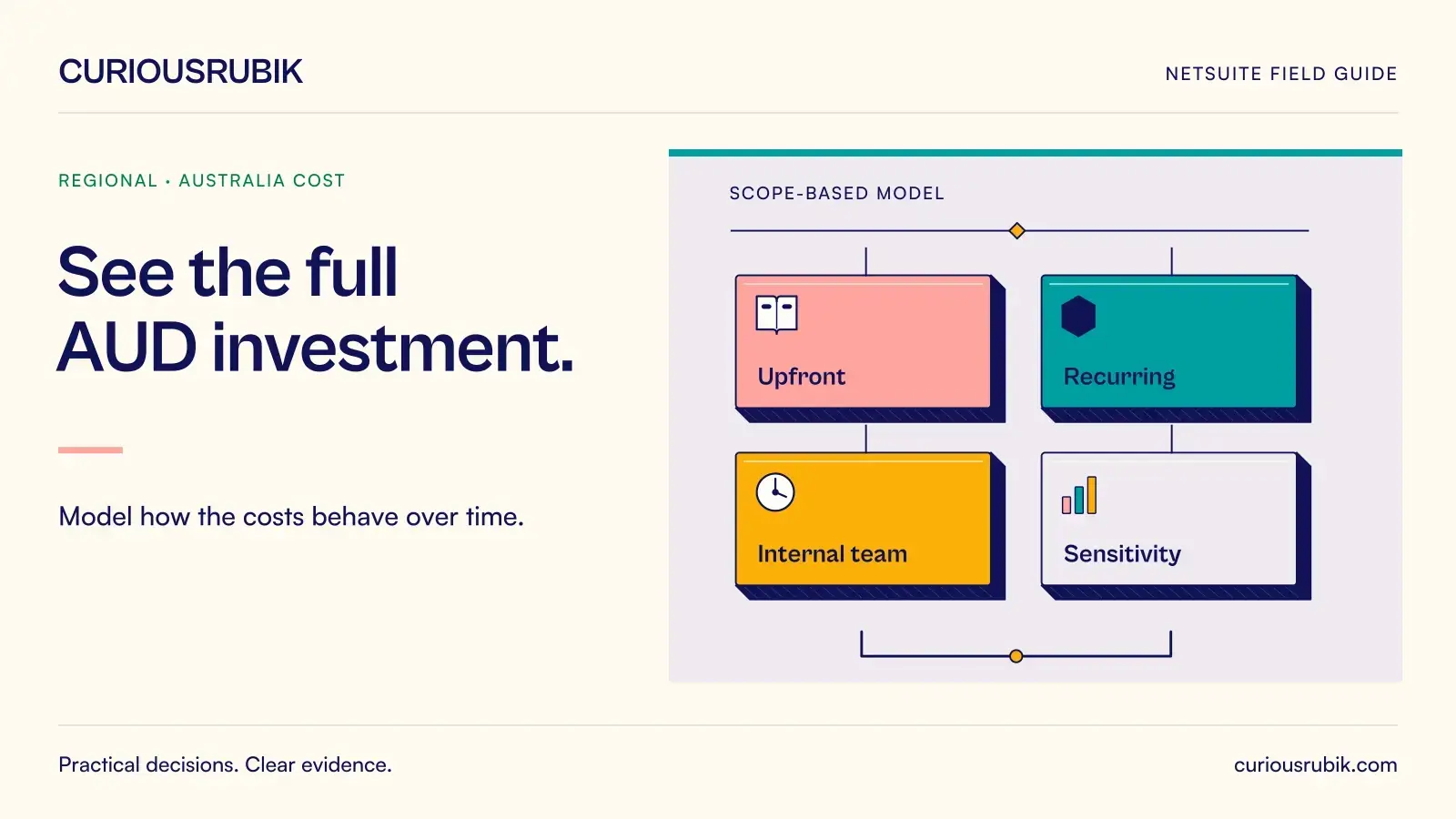
A three-year NetSuite budget should explain the business you intend to run, the project needed to get there and the effort required to keep it working. Comparing only licence and implementation totals can leave the largest ownership questions unanswered.
For an Australian business, build the model in AUD while preserving the currency and terms of every underlying quote. Separate cash funding from internal effort and show the assumptions that could change either one. The model should support a decision, not present an invented market price.
Choose the model boundary
Start with the entities, users, operating locations and processes included in the decision. Identify planned growth that is sufficiently concrete to model, such as an approved warehouse opening or a known subsidiary rollout. Keep speculative expansion in a separate sensitivity case.
Define the time horizon and how costs are recognised for the comparison. A three-year cash view will differ from an accounting view that spreads certain costs. Finance should approve the basis, including tax treatment, before totals are used in a business case.
Record the quotation date, validity period, contract term and billing currency for each purchased component. Where payment is due in a foreign currency, retain the original value alongside the AUD planning conversion. Use an explicit conversion assumption rather than silently updating different lines on different days.
Divide the costs by how they behave
One-time implementation costs include the agreed design, configuration, migration, testing, training and launch services. Separate known scope from optional work and discovery-dependent estimates. This shows which parts of the total are firm enough to support approval.
Recurring software and service costs belong in their own section. List subscriptions, support arrangements, connectivity and other selected services. For each year, state whether the amount is contracted, quoted or a planning assumption. Do not imply that an uncontracted renewal rate is guaranteed.
Internal effort should be recorded by role and activity. Finance must reconcile data and approve accounting decisions. Operations must validate real workflows. IT must address interfaces and access. Some work can be scheduled within existing capacity; other work may require backfill or a change to business priorities.
Finally, show transition costs and contingency. Temporary parallel processing, extra reporting or short-term support are identifiable work. Contingency covers uncertainty that remains after that work has been estimated. Keeping them separate makes the reserve easier to govern.
Add the Australian scope questions
The model should identify the chosen GST reporting design, payroll boundary, bank services and any electronic invoicing route. Ask which implementation and recurring costs belong to each. Avoid treating a broad localisation label as evidence that every local requirement is included.
If payroll remains with another provider, include the approved integration and reconciliation process. If the bank design requires a particular file format or connection service, show the relevant setup and ongoing costs. Confirm the support hours and escalation coverage required by the Australian team.
For a regional business, distinguish Australian responsibilities from group requirements. Local finance may need a reporting design that differs from the group close pack. Both require testing, and their costs should be visible rather than buried in a general reporting allowance.
Work through an illustrative three-year model
The following numbers are hypothetical arithmetic inputs, not NetSuite pricing, consulting rates or an Australian market benchmark. Replace them with approved quotes before making a purchase decision.
Assume one-time external implementation work of AUD 90,000 and transition work of AUD 8,000. Assume internal project effort valued at AUD 24,000. Year-one recurring software and selected services total AUD 36,000, and ongoing internal administration is valued at AUD 9,000 each year.
If the planning case holds recurring external costs at AUD 36,000 for each of three years, the total is AUD 257,000. That comprises AUD 98,000 of one-time external work, AUD 24,000 of internal project effort, AUD 108,000 of recurring external costs and AUD 27,000 of ongoing internal administration.
The cash funding total is different if internal staff costs are already in the operating budget. On that assumption, external cash costs total AUD 206,000 before any separately modelled tax cash flow. The business case should show both figures with their meaning, rather than switching between them during the approval discussion.
Now test a change. If an interface adds AUD 12,000 of setup and AUD 3,000 annually, it adds AUD 21,000 over three years. The sponsor can compare that cost with the workload or risk the interface addresses. A hidden addition to a percentage allowance would make that tradeoff harder to evaluate.
Run sensitivities that reflect real uncertainty
Useful sensitivities include additional users, a delayed rollout, more migration cycles and a different support model. Show which cost lines change and why. Avoid applying the same percentage increase to every line when the underlying causes differ.
A delayed launch might extend temporary support and internal project effort without changing a fixed implementation fee. A newly added subsidiary might affect licensing, localisation, data migration and testing at once. The model should preserve those relationships.
Currency sensitivity belongs only on the costs exposed to foreign exchange. Tax cash flow should follow the finance team's approved assumptions about recoverability and timing. Do not multiply all costs by a tax rate and call the result an ownership cost without explaining the basis.
Use the model to compare proposals
Give each supplier the same scope and ask them to classify deliverables as included, optional, excluded or dependent on further discovery. Reconcile their response to the cost model. When a proposal is lower, identify which assumption creates the difference.
Ask about acceptance, migration cycles, interface recovery, training responsibility and post-launch support. Confirm how changes are approved and priced. Keep written clarifications with the quotation so the model can be traced back to commercial evidence.
The best budget is not necessarily the one with the most detail. It is the one whose material assumptions can be challenged, updated and connected to a clear scope decision.
Questions about Australian NetSuite costs
Can this example be used as a price estimate?
No. Its figures demonstrate model structure and arithmetic. Obtain current quotes for your requirements and substitute your own internal-effort assumptions.
Should GST be included?
Show tax treatment explicitly. Your finance team should distinguish cash payments from recoverable amounts and the cost basis appropriate to the business case.
How should renewal increases be modelled?
Use contracted terms where available. Otherwise label the assumption and test a sensitivity; do not present a forecast as a supplier commitment.
Is a three-year horizon always right?
Use a period that fits your approval process and decision. The same structure can support another horizon, provided the timing and scope remain consistent.
CuriousRubik can discuss the requirements and assumptions behind your AUD model so your team can compare NetSuite proposals on a consistent basis.