Compare NetSuite Pricing in Singapore with a Consistent SGD Scope
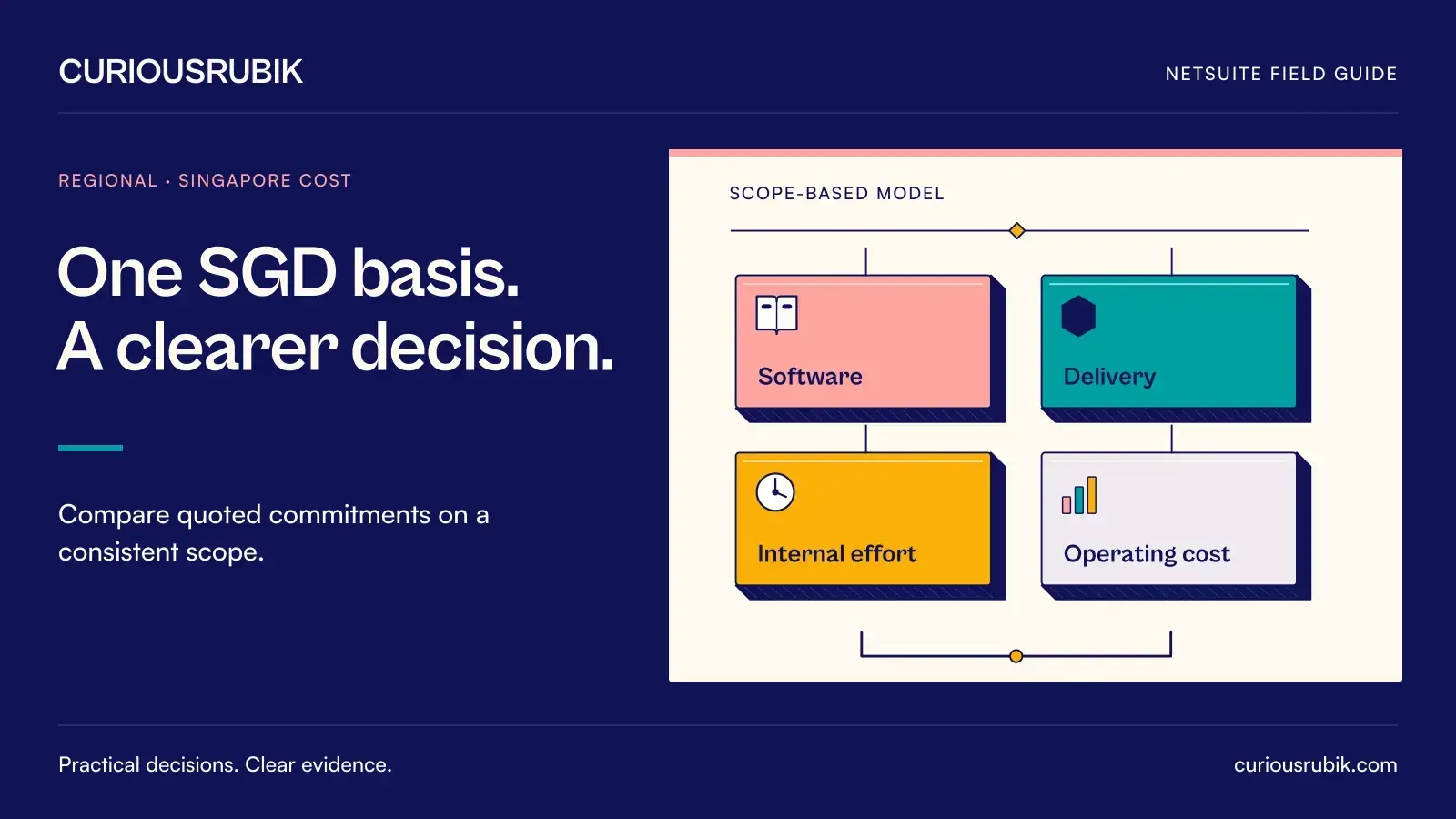
A NetSuite proposal expressed in Singapore dollars can still be difficult to compare with another SGD proposal. One may include a migration rehearsal and reporting tests; another may assume your finance team will prepare the data, design the reports and train every user. The currency matches while the work does not.
Start with a common scope and cost model showing supplier charges, internal responsibilities and assumptions that could change the budget.
Write the budget basis in plain language
Describe the business that the quote is meant to support. Count legal entities, users by role, operating locations, integrations and the transaction types that need special handling. Identify the launch date as a planning assumption rather than a promised delivery duration.
Next, define the period covered by the comparison. A first-year cash requirement answers a different question from a three-year ownership estimate. The first includes mobilisation and transition costs; the second also captures renewal assumptions, recurring support and the cost of maintaining interfaces.
For each cost line, record its billing currency, payment timing and tax treatment. Where a component is quoted in another currency, retain the original amount and the conversion assumption used for planning. A converted overseas price is not evidence of a Singapore market price.
Separate the five parts of the budget
List software products, user categories, quantities, term and contract-specific commitments separately. Verify demonstrated features against the quoted entitlements.
Break implementation fees into design, configuration, migration, integrations, testing, training and launch support, with deliverables and exclusions beside each fee.
The third section covers local and connected services. These may include invoicing services, bank connectivity, payroll interfaces or localisation work, depending on the agreed architecture. State which organisation bills each item and who maintains it.
Internal effort is the fourth section. Finance, operations and IT will make decisions, clean data, test workflows and support colleagues. Record the role, expected days and whether backfill is required. Internal time is still a project cost even when it does not produce a supplier invoice.
Finally, include transition and ongoing ownership. Temporary parallel processes, additional reconciliations, support retainers and approved improvements belong here. Keep contingency separate from known work so it remains a visible response to uncertainty.
Make Singapore scope specific
Ask how the proposal handles the entity's GST reporting design, invoice content and relevant electronic invoicing requirements. A line labelled “Singapore localisation” is not sufficient detail. Request the components, configuration responsibility, testing scope and any provider dependencies.
Banking needs similar precision. A payment file, a statement import and an automated bank connection are different deliverables. Confirm the selected banks, account types, formats and who will perform acceptance testing. Avoid treating a successful demonstration using one bank as proof for every account.
For a Singapore regional headquarters, separate domestic scope from additional country deployments. A common chart of accounts can be reused while document requirements, local approvals and interfaces still need separate work. Ask which elements are included now and which are priced for later phases.
A reusable SGD quote comparison template
Create one copy of these rows for each supplier. Keep the original quote alongside it, and use the same scope reference across every copy. The template deliberately has no fabricated price inputs.
| Quote line | Scope to record | Commercial input | Comparison control |
|---|---|---|---|
| Software | Products, roles and quantities | Quoted currency, amount and term | Confirm entitlements and start date |
| Implementation | Deliverables and acceptance | Fee basis and payment stages | Match exclusions and customer work |
| Local services | Invoicing, banking and reporting route | Setup and recurring charges | Identify separately billed components |
| Internal effort | Role and expected days | Approved internal costing basis | Keep cash and capacity distinct |
| Foreign currency exposure | Original quoted currency | Rate, source and conversion date | Retain original amount beside SGD value |
Record the quotation date, validity date and model approval date above the rows. For an illustrative arithmetic check, a foreign-currency line of 10,000 units at an assumed SGD conversion factor of 1.30 becomes SGD 13,000. That factor is hypothetical, not a current exchange rate. The working model must replace it with the finance-approved dated basis.
Compare three scope scenarios without inventing a price list
Use scenarios to reveal decisions, not to manufacture a universal implementation price. The following scenarios are illustrative planning structures; their costs must come from your actual quotes and staffing assumptions.
In the first scenario, the business launches a single Singapore entity with defined finance processes and limited interfaces. The central question is whether opening balances, open items and local reporting can be proven within the quoted scope.
The second scenario adds operational complexity, such as inventory, multiple locations or a commerce interface. The extra cost is not simply another module. It includes item data, transaction-volume tests, exception handling and staff training across a wider process.
The third scenario adds regional entities. The budget must now address local owners, currency and consolidation design, country-specific acceptance and deployment coordination. Reuse should be identified explicitly, alongside the work that remains local.
For each scenario, ask suppliers to label each line included, optional, excluded or dependent on discovery. This makes a scope increase visible before it becomes a disputed change request.
Use arithmetic that reveals the decision
Consider an illustrative internal-effort estimate. A finance lead allocates 18 days, an operations lead 12 days and an IT owner 10 days. At assumed internal planning costs of SGD 700, SGD 600 and SGD 750 per day respectively, the estimated effort costs SGD 27,300. These are hypothetical costing assumptions, not salary benchmarks or consulting rates.
If the finance allocation grows from 18 to 28 days because source data needs repair, the same model adds SGD 7,000. The question for the sponsor is whether to fund capacity, reduce scope or delay a dependent milestone. Hiding that work inside a contingency percentage would make the decision harder to see.
Keep cash costs and internal effort distinguishable. They can both support the business case, but they affect budgets and staffing differently. Do not count the same employee's effort again as purchased backfill unless both costs will actually occur.
Turn the comparison into a clarification list
Before approving the budget, identify the assumptions with the largest possible effect. Ask how many migration cycles are included, which reports will be accepted, who fixes source data and how long launch support lasts. Clarify the treatment of a delayed client decision and the process for pricing a scope change.
Record the supplier's response against the exact cost line. A verbal reassurance that “support is included” leaves unanswered which hours, channels, environments and issue types are covered.
The final approval pack should contain the common scope, comparable cost model, exclusions and open commercial questions. Preserve each quotation date and validity period. Refresh the model when a material assumption changes instead of continuing to circulate a total that no longer describes the project.
Common pricing questions
Is there one reliable Singapore implementation price?
A useful price depends on the actual scope, contract and delivery responsibilities. Obtain a written quote against a defined requirement set rather than using a broad range as an approval basis.
Should all proposals be converted to SGD?
Use SGD for your comparison if that fits the budget, while retaining original currencies and conversion assumptions. Payment exposure remains relevant when the underlying contract is in another currency.
Should GST be included in the total?
Show the supplier's stated tax treatment and your finance team's treatment of recoverable and non-recoverable amounts. Distinguish cash funding from the cost basis used in the business case.
Can internal effort be ignored if no backfill is hired?
No. People still need capacity to perform the work. Showing their effort helps the sponsor judge whether the schedule is feasible and what other work may be displaced.
CuriousRubik can help review the scope questions behind your NetSuite budget. Bring the assumptions and exclusions as well as the headline totals so the discussion can focus on a comparable decision.