NetSuite Renewal Planning Starts with a Usage and Ownership Audit
NetSuite renewal planning is easier when the business knows what it has contracted, what it actually uses and what it intends to change. A negotiation based only on the previous invoice can miss unused commitments, essential but infrequent workflows and support responsibilities that have grown since implementation.
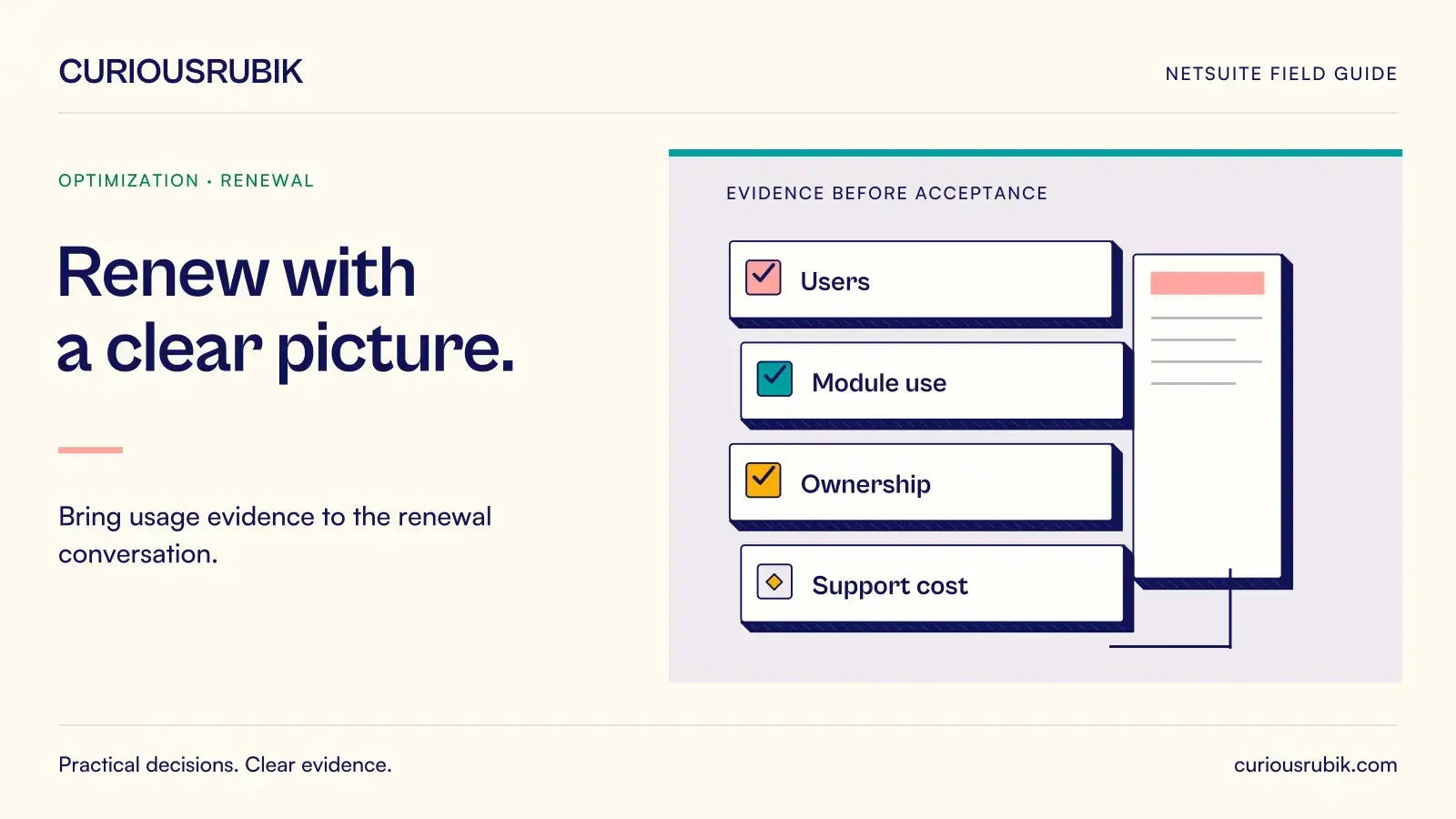
Start with a renewal-readiness inventory. Connect each user group, module and service to an owner, evidence of use and a business requirement. Then review the actual agreement and current proposal before making decisions about quantities, scope or timing.
There is no universal discount, renewal notice period or saving to assume. The useful outcome is a clear, evidence-backed position that procurement, finance and the application owner can explain.
Work backward from your agreement
Locate the current order forms, agreement, amendments and support arrangements. Have the appropriate commercial or legal reviewer identify the relevant renewal dates, notice requirements, commitment terms and options for changing scope.
Build an internal decision schedule that leaves time to gather evidence, validate requirements, review proposals and obtain approvals. Use the actual contractual dates rather than a generic countdown. Record who owns communication with each provider and who can authorize a commitment.
Include related services in the calendar. Integration tools, retained support and legacy access may renew separately. Their timing can affect the practical value of a NetSuite scope change even when they are not part of the same agreement.
Create a complete inventory
Use one record for each contracted line or service. Capture its exact name, quantity or basis, term, owner, business purpose, evidence of use, dependencies and proposed decision. Mark whether the item is confirmed, under review or awaiting clarification.
Keep commercial entitlement and technical use separate. The system may show activity without explaining the licensing terms, while a contract line may support a process whose usage is infrequent. The inventory needs both perspectives.
Reconcile the inventory to the current proposal before approval. Investigate any line that has no clear owner and any essential process whose entitlement or service coverage is uncertain.
Review user access in context
Ask the application owner to provide appropriate usage and role information through approved administrative processes. Review active employees, changed responsibilities, seasonal needs, service-related accounts and joiner or leaver records with the relevant owners.
Do not equate recent login frequency with business value. A controller may perform an important period-end activity occasionally. An integration-related account may serve a technical purpose rather than a human workflow. Conversely, regular access does not prove that a role or entitlement remains appropriate.
For each proposed change, verify operational need, access-control implications and contractual effect. Follow the organization's approval process before modifying access or subscriptions. A renewal analysis should recommend changes with evidence, not silently make them.
Examine module use through business outcomes
For each module or capability in the commercial inventory, identify the process it supports and the owner responsible for adoption. Ask which transactions, reports or controls depend on it and whether those dependencies have been tested.
Classify the current position carefully. An item may be actively used, required but underused, purchased for an approved future phase, or no longer justified. Those categories suggest different actions: retain, improve adoption, revalidate timing or explore a commercial change.
Investigate the cause of underuse. Missing training, poor data or an unresolved workflow may be the real barrier. Removing the entitlement without addressing the business need can recreate manual work or undermine a control.
A hypothetical renewal-readiness inventory
Imagine a growing business reviewing its renewal. This example is illustrative and includes no real prices or customer results.
Its inventory identifies a group of users whose responsibilities changed after a reorganization. The application owner confirms their current tasks and asks procurement to verify the commercial options. The recommendation remains conditional until both need and contract terms are understood.
A separately identified capability has little visible activity. Operations explains that it was intended for a later warehouse phase that has not been approved. The business records the adoption dependency, expected decision point and cost of keeping the commitment while waiting. It asks for written commercial alternatives rather than assuming a reduction is available.
A support service appears lightly used, but finance relies on it during the close. The controller documents those requests and the consequence of losing coverage. The team compares the actual service scope with internal capacity before recommending any change.
The result is a set of evidence-backed questions. It does not promise that every identified opportunity will produce a saving, because the agreement and operating requirements still govern the available choices.
Review the full support cost
List who handles administration, incidents, integrations, reporting changes, release testing and user training. Identify overlaps and gaps between internal staff, the implementation provider, external specialists and contracted support.
Compare responsibilities, coverage hours, response arrangements and exclusions. A lower support fee may shift more work to the internal team. A broader service may be worthwhile if the business needs capabilities it cannot maintain reliably on its own.
Separate recurring operational support from a backlog of enhancements. The two may require different commercial arrangements and approval processes. Understanding the distinction makes the renewal conversation more precise and avoids paying for a vaguely defined pool of help.
Prepare negotiation questions from the evidence
Ask for the current proposal in a form that can be reconciled to your inventory. Useful questions include:
- Which quantities, entitlements and services does each line represent?
- What has changed from the current agreement, and why?
- Which alternatives are available for the documented business scope?
- How would approved growth or a delayed rollout affect the commitment?
- Which support responsibilities and exclusions apply?
- What are the timing and contractual consequences of each option?
Record answers in writing and review material changes with the appropriate advisers. Avoid comparing only headline percentages when quantities, terms or scope differ.
Make the decision operationally complete
For every approved renewal choice, name the owner of the resulting action. A retained but underused capability needs an adoption plan. A quantity change needs access and operational validation. A service change needs a handover and a clear escalation route.
Keep a record of the assumptions behind the decision. If planned growth or rollout timing changes, the next review will have a useful starting point. Update the inventory during the year rather than reconstructing it at every renewal.
Questions application owners ask
Can we assume unused modules can be removed?
No. Verify the options and timing in the actual agreement and current proposal. Usage evidence supports the discussion, but it does not establish a contractual right to change scope.
Does low login activity justify removing a user?
Not by itself. Confirm the person's responsibilities, infrequent critical tasks, access requirements and applicable commercial terms before recommending a change.
How early should renewal planning start?
Early enough to satisfy your agreement's requirements and complete the internal evidence and approval process. Build the schedule from those real constraints rather than using a universal deadline.
Should the goal always be lower spending?
The goal is an appropriate commitment for the business. That may involve removing unnecessary cost, improving adoption or funding a justified requirement. Make the trade-off explicit.
Enter renewal discussions with a clear position
Bring your usage inventory, ownership gaps and commercial questions to CuriousRubik. A structured NetSuite renewal discussion starts with what the business needs and what the evidence shows.
Related reading