Prove NetSuite REST API Coverage Before Committing to an Integration
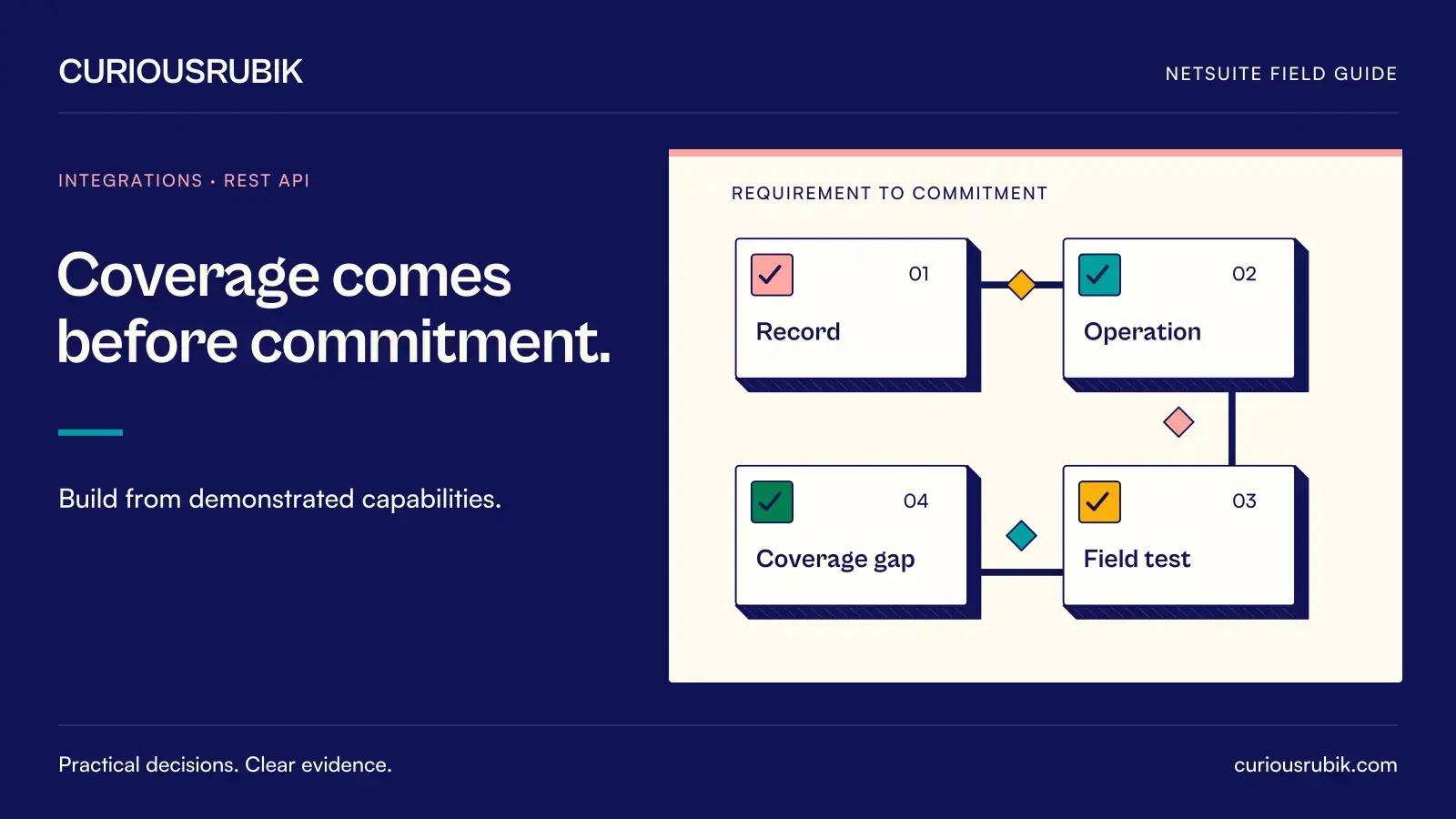
A supported record name is useful evidence, but it does not answer the implementation question. Can your intended role create that record with the required custom fields, update the right sublist line, and perform the business action your process depends on?
NetSuite REST API coverage should be assessed at the level of records, fields, operations, and account configuration. Build a capability matrix before estimating the full integration. It gives architects a practical way to distinguish demonstrated support from assumptions and helps business owners see which gaps could change the design.
Start with a record and operation inventory
Describe the business requirement before choosing endpoints. “Manage orders” should become a list of operations such as find the approved customer, create an order, retrieve its lines, change a permitted delivery field, and obtain fulfillment status.
For each operation, identify required record types, fields, references, sublists, and customizations. Include account features that influence behavior. If the process depends on tax, inventory detail, multiple subsidiaries, or specialized billing, capture that dependency explicitly rather than hiding it under a general sales-order row.
Distinguish reads from writes and actions from ordinary field updates. A query can expose data without providing the record operation needed to change it. Likewise, a record's presence in the supported-record list does not demonstrate every transformation or sublist behavior.
Use a dated discovery baseline. Record the account release, enabled features relevant to the test, role, environment, and metadata retrieval date. The matrix describes that tested configuration; it should not claim timeless support across all NetSuite accounts.
Inspect metadata using the intended role
REST resource metadata describes the account-specific API structure, including available records, fields, and operations. Inspect it under the role the integration will use. Testing with broader privileges can conceal a production access gap.
Keep the REST record metadata separate from the analytics Records Catalog. They answer related but different questions about record operations and analytical data access. Finding a field in an analytical query does not establish that it is writable through the REST record service.
Review field types, enumerated values, reference targets, required inputs, and read-only behavior. Check custom fields by their actual identifiers. Similar labels can refer to different fields, and a label change should not become an accidental remapping.
Metadata guides test construction, but it does not replace tests. Business validation, workflows, permissions, and feature interactions can affect whether a correctly structured request produces the intended outcome.
Use a capability matrix that can be copied into a test plan
The following matrix structure is suitable for a spreadsheet or test-management record. Its rows describe proposed tests for a hypothetical spare-parts business; they are not reported product results.
| Requirement | Operation to prove | Essential evidence |
|---|---|---|
| Approved customer lookup | Read and match | Correct identity, subsidiary, and restricted-access behavior |
| Order submission | Create | Required fields, custom reference, expected lines, unique outcome |
| Delivery amendment | Update | Only the permitted fields change; unrelated values remain intact |
| Line quantity amendment | Sublist update | Correct line identity and approved quantity transition |
| Downstream status | Read related records | Complete relationship and status interpretation |
| Invalid item handling | Rejected create or update | Predictable rejection, no unintended partial business result |
Add columns for test date, payload version, expected result, actual result, evidence location, owner, and status. Useful statuses are demonstrated, failed, untested, and approved alternative. “Supported” is too imprecise if it combines documentation review with successful execution.
Create a separate row when one requirement has materially different variations. An ordinary inventory item and a lot-controlled item may need different acceptance cases. The purpose is to expose complexity while the team can still make informed design choices.
Test operations in a deliberate sequence
Begin with a read of known synthetic data. Confirm record identity and field interpretation. Then create a minimal valid record in a test environment and read it back. Add required custom fields and operational variations one at a time so failures are easier to localize.
For updates, compare the before and after state. A successful response should not be the only evidence. Confirm that the intended field changed, unrelated fields remained correct, and any expected workflow or validation behavior occurred.
Include invalid references, missing required fields, unsupported values, and denied actions. Test pagination and filtering for collections where completeness matters. A request returning the first page correctly can still produce an incomplete integration if subsequent pages are ignored.
For financial or security-sensitive changes, use synthetic records and the approved test process. Production permissions, posting decisions, and corrective transactions require the relevant human review.
Give sublists and custom fields their own acceptance cases
Sublist updates deserve careful attention because line identity and update semantics affect the result. Establish whether the operation identifies a line by a stable key, replaces a collection, or follows another supported behavior. Confirm the exact semantics for the chosen record and request.
In the hypothetical business, an order has two lines for the same item but different delivery dates. A test that matches lines only by item could update the wrong line. The acceptance case must distinguish the lines and demonstrate that the unaffected line retains its original values.
Test omitted values separately from explicit clearing. Also test custom-field defaults, restricted values, and references to custom records. Document any configuration that must be deployed before the integration can operate. A mapping depending on an undeployed custom field is an environment-readiness problem as well as a coding problem.
Turn gaps into decisions
When a test fails, identify whether the cause is unsupported capability, insufficient permission, invalid data, configuration, or application logic. These categories have different remedies. Avoid broadening permissions or changing a business process before the cause is understood.
For a genuine gap, document the business consequence and evaluate a supported alternative. A bounded custom endpoint may be an option for some requirements, but it brings deployment, maintenance, testing, and security obligations. Finance or process owners must approve changes affecting transaction meaning.
The coverage review ends with a signed-off matrix, an unresolved-gap register, and a retest trigger. Changes to releases, roles, customizations, or critical workflows should trigger the relevant tests again.
Coverage questions
Does REST metadata guarantee a request will succeed?
No. It helps describe the available API contract. The actual operation must also satisfy permissions, account configuration, business validation, and any relevant customization behavior. Keep metadata evidence and execution evidence separate.
Can a query replace an unsupported write operation?
A query retrieves information; it does not automatically provide a supported write path. Use it to understand or reconcile data where appropriate, then assess the required mutation through a supported and approved interface.
How many records should the proof cover?
Cover representative variations, not an arbitrary count. Include the cases that change validation or record structure, plus negative and recovery cases. A few carefully chosen records can reveal more than a large set of identical examples.
When should the capability matrix be updated?
Update it when the target account, integration role, required business flow, or relevant customization changes. Review it during release testing for critical operations. Preserve earlier evidence so changes in behavior can be investigated.
Build from demonstrated coverage
CuriousRubik can help scope an API coverage review around one business flow. A dated capability matrix and clear gap decisions provide a stronger basis for implementation than a record list alone.