Test NetSuite Safety Stock and Reorder Points Before Changing the Buffer
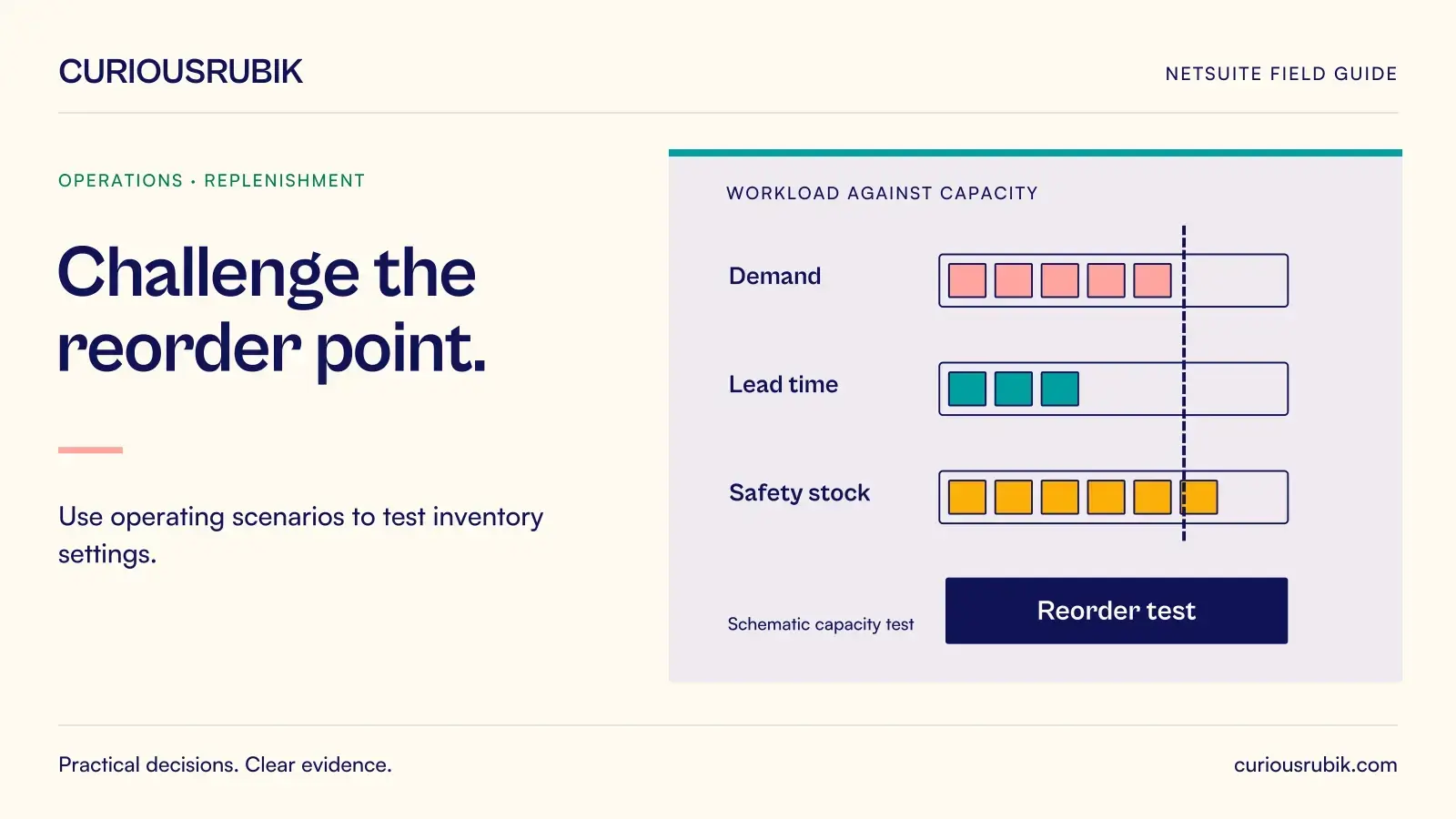
Increasing safety stock can reduce shortages, but it can also conceal an unreliable lead time or an incorrect demand history. Reducing it can release cash while making replenishment more fragile. The useful decision is how much uncertainty a particular item needs to absorb and what service outcome the business is prepared to fund.
A NetSuite safety stock and reorder point review should connect item settings to observed demand, usable supply, and a defined service measure. Start with a controlled scenario, test it against history, and agree approval boundaries before applying the change across an item range.
Describe the demand that the buffer must protect
Group items by behaviour rather than giving every item the same number of cover days. Steady demand, intermittent demand, seasonal peaks, and project-driven orders create different risks. Product life, shelf life, substitution options, and supplier minimums also matter.
Confirm which demand signal the model uses. Shipments may understate demand during a stockout. Orders may include cancellations or exceptional projects. A buffer based on either without review can respond to the wrong pattern.
Define the location and unit of measure. A reorder threshold of 100 means little if one team reads it as individual units and another as cases. Where stock can move between locations, include realistic transfer lead times and permissions rather than treating every unit in the network as immediately available.
Keep the reorder point and order quantity distinct
A simple planning model expresses the reorder point as expected demand during replenishment lead time plus safety stock. The order quantity is a separate decision influenced by order frequency, pack size, minimum quantity, and preferred stock policy.
This conceptual model is useful for review, but it should not be assumed to describe every NetSuite calculation. Verify the selected replenishment method, automatic calculation settings, demand source, location settings, and treatment of supply and commitments in the actual account.
Also define the inventory position used for the trigger. Physical stock, available stock, and stock plus eligible incoming supply can give different signals. The test must use the same definition as the intended operational process.
A hypothetical lead-time scenario
Assume an item has average demand of 20 units per working day and an expected replenishment lead time of six working days. Expected lead-time demand is 120 units. A proposed safety buffer of 30 units gives a conceptual reorder point of 150 units.
If lead time extends to eight working days while demand stays at 20, the requirement becomes 160 units. A 150-unit position at the reorder decision would leave a potential shortfall of 10 units, assuming no other supply or change in demand.
If average daily demand during that delay is 24 units, eight days require 192 units. The potential shortfall becomes 42. This does not prove that the business should carry 72 units of safety stock. It shows that a buffer chosen for a six-day average must be tested against combined demand and lead-time variation.
Before increasing stock, investigate whether late approval, delayed transport, or slow inspection creates an avoidable part of the lead time. Improving that process may reduce the required buffer without accepting more customer risk.
Use service measures that mean what they say
Cycle service level measures the share of replenishment cycles without a stockout. Fill rate measures the share of demand supplied under the chosen definition. An item can have a stockout in several cycles yet lose only a few units, or experience one severe shortage that affects many orders.
Choose the measure that supports the commercial decision and retain both where helpful. Define whether partial shipments count as service success, when a backorder becomes late, and whether substituted items satisfy demand.
Avoid translating a small backtest directly into a statistical service guarantee. A sample of ten cycles provides a limited observation, not proof that the next year will behave similarly.
Backtest two buffers using the same history
In a hypothetical ten-cycle test, total customer demand is 1,000 units. Under the existing buffer, three cycles experience shortages totalling 40 units. The observed cycle service level is 70%, and the immediate unit fill rate is 96% if all other demand is supplied immediately.
A larger candidate buffer leaves one cycle with a shortage of 10 units. Observed cycle service rises to 90%, and immediate fill rate becomes 99%. The candidate prevents 30 units of shortage in this historical sample.
Now add economics. Suppose each avoided shortage unit is assigned an illustrative consequence of 12 currency units, including expected lost contribution or handling impact. The estimated benefit is 360 for the sample. If the candidate increases average stock by 20 units costing 25 each, it ties up 500 of additional inventory value.
Those figures cannot be compared as though 500 were an expense for the same period. Apply an approved carrying-cost assumption over the same time horizon and consider expiry, obsolescence, and financing effects. The shortage consequence is also an assumption to challenge, especially when backorders are eventually fulfilled.
Identify conditions that invalidate the test
A useful backtest recreates what the planner would have known at each decision date. Do not use actual future receipts to make earlier decisions appear better. Preserve order lead times, supply disruptions, pack sizes, and minimum order constraints.
Flag structural changes: a new supplier, changed product, promotion, lost customer, or different distribution network can make earlier history less relevant. Run a scenario for the new condition rather than relying entirely on a historical average.
Check whether increasing the buffer merely transfers shortages to another item competing for constrained supplier capacity. An item-level success can create a network-level problem if shared constraints are ignored.
Roll out with limits and a review date
Start with a bounded group of items and record the old and new settings. Obtain approval for the projected inventory investment and any operational consequences. Specify which changes the planner can make independently and which require procurement or finance review.
Track service outcomes, average stock, aged stock, emergency orders, and planner overrides. Review the reasons for exceptions as well as the aggregate metrics. If demand assumptions change, reassess the policy rather than repeatedly adding buffer without diagnosis.
A reversible pilot makes learning easier. Retain the original settings and define who can restore them, while checking that open orders and existing commitments remain sensible after any reversal.
Frequently asked questions
Is safety stock the same as minimum order quantity?
No. Safety stock protects against uncertainty. Minimum order quantity constrains how much can be ordered. Both affect inventory, but changing one does not automatically solve a problem caused by the other.
Can one service target apply to every item?
A common target may simplify management, but the cost and consequences can differ sharply. Consider criticality, substitution, demand behaviour, and carrying risk before applying a universal setting.
Should automatic calculations be trusted without review?
Review their inputs, assumptions, and observed behaviour. Automation can apply a policy consistently, including a poorly chosen policy. Use exception thresholds and periodic item reviews.
When should the buffer be reduced?
Consider a reduction when evidence shows lower uncertainty, improved replenishment, declining demand, or unacceptable ageing. Test the service and cash implications first, particularly for critical or short-life items.
Make the stock decision explicit
CuriousRubik can discuss a scoped replenishment review covering selected NetSuite items, lead-time assumptions, and buffer scenarios. Use the review to agree a measurable service decision and controlled rollout boundaries.