NetSuite Segregation of Duties for Small Finance Teams
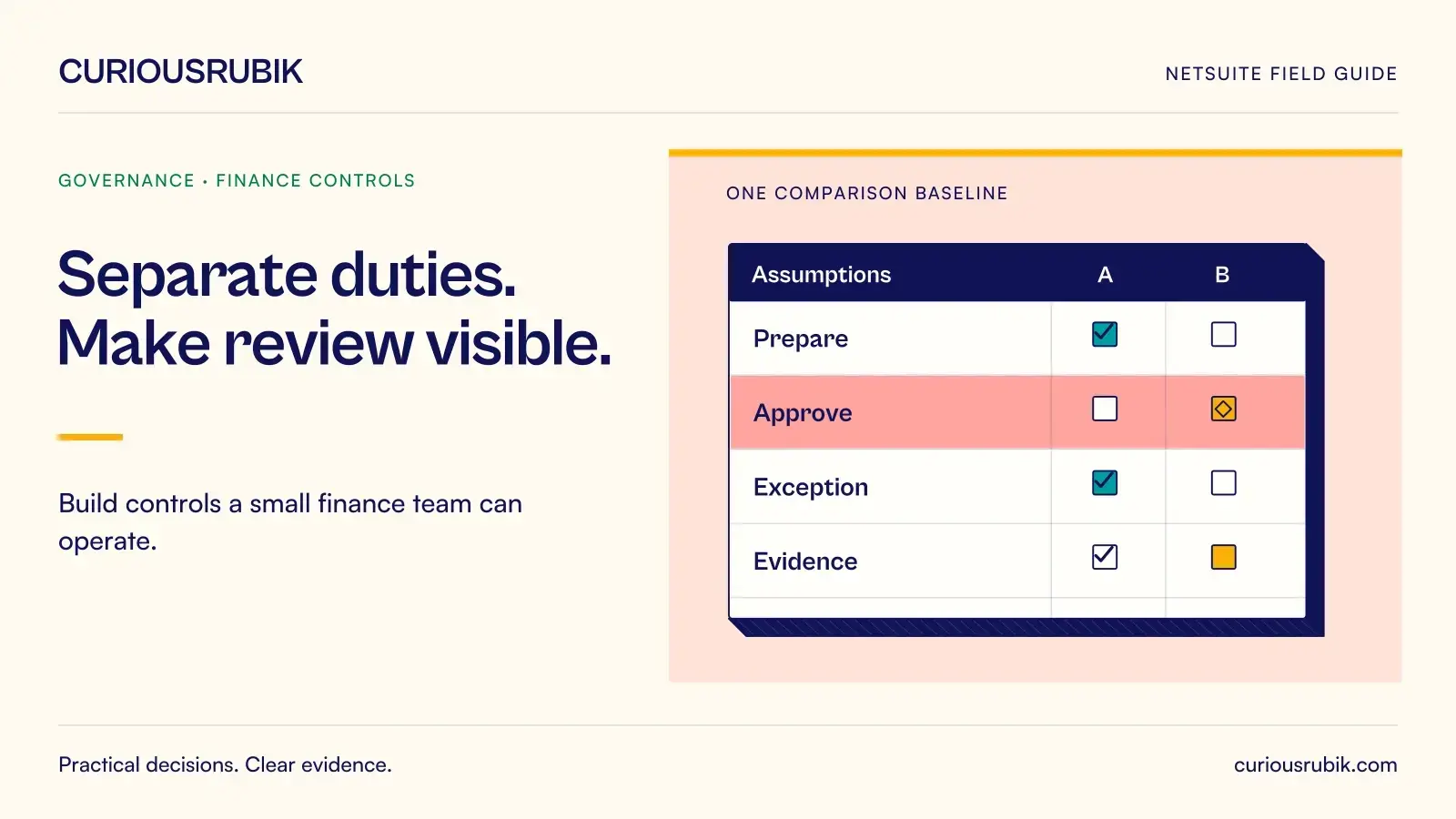
A small finance team may not have enough people to separate every transaction step. That constraint should lead to a documented control design, rather than an assumption that broad access is unavoidable and therefore acceptable.
NetSuite segregation of duties begins with incompatible activities, the actual access that enables them, and the consequence of misuse or error. Where full separation is impractical, an independent compensating review needs a named owner, timing, evidence, and an escalation path. The examples below are hypothetical design prompts for a controls specialist to assess; they do not establish compliance or replace an organization's approved control framework.
Identify conflicts in business terms
Start with activities, not role names. Creating a vendor, changing payment details, entering a bill, approving a payment, and releasing funds are distinct duties. A person can hold conflicting capabilities through several roles or through systems outside NetSuite.
Map the full process, including bank portals, integrations, spreadsheets, and emergency access. A restriction in NetSuite cannot compensate for unrestricted authority in another part of the payment chain. Likewise, an approval workflow is ineffective if the same person can alter the data after approval without detection.
For each conflict, record the people with effective access, transaction scope, potential consequence, existing preventive controls, and proposed monitoring. Distinguish a theoretical permission from a capability that is actually usable, but do not dismiss the permission without testing.
Prioritize conflicts that allow one person to create an obligation, redirect value, approve it, and conceal the result. The controls owner determines materiality and acceptable residual risk.
Establish minimum workable roles
Define the smallest practical separation between preparation, approval, and independent review. A small team may combine some routine preparation tasks while keeping consequential approval and reconciliation with another accountable person.
Use role-task tests to verify the design. Confirm that a preparer can complete legitimate work but cannot perform the prohibited approval or security change. Review subsidiary and other restrictions where relevant, and include integration identities that can alter the same records.
Avoid solving a denied task by giving everyone broad access. Investigate the required permission and the business purpose. Temporary access should have an approver, expiry condition, and activity review.
Document backup arrangements before an absence occurs. A planned cover role with explicit limits is easier to govern than an urgent, indefinite expansion made during a payment deadline.
Scenario one: vendor maintenance and payment preparation
In a hypothetical three-person finance team, one analyst maintains vendor records and prepares payment batches. This creates a risk that payment details could be changed and used without adequate independent scrutiny.
A proposed compensating design assigns the controller to review vendor payment-detail changes before approving the affected payment release. The review compares the change evidence with an independently verified vendor instruction using the organization's established verification procedure. The analyst who made the change does not perform that independent verification alone.
The proposed frequency is each affected payment run, with an additional review of changes made outside those runs. The retained evidence includes the vendor identifier, change date, preparer, verification record, reviewer decision, and related batch reference. Sensitive bank details should remain in approved restricted systems rather than being copied into general review notes.
The control fails if the reviewer sees only the payment total and cannot identify changed vendor details. It also fails if a payment can be released before the review or if changes after approval are not addressed. A controls specialist should validate the design and its enforcement.
Scenario two: journal preparation and posting authority
In the same hypothetical team, a senior accountant can prepare and post journals because there is no separate posting operator. The risk includes unsupported or incorrectly classified entries passing into the ledger without independent challenge.
A proposed control gives an independent finance reviewer a complete population of the relevant posted journals at a frequency aligned with the organization's close and materiality policy. For the illustrative design, review occurs before the close is approved, with higher-risk manual entries reviewed sooner under a defined rule.
The reviewer inspects supporting documentation, business purpose, accounts, period, amount, and preparer. The evidence records which journals were reviewed, questions raised, corrections approved, and final disposition. A tick beside a grand total does not demonstrate that the entry population was complete or the supporting rationale was assessed.
The population report itself needs validation. Confirm that it includes the intended journal types, subsidiaries, users, and periods, and that the preparer cannot silently remove their own entries from the review scope. Finance approves any corrective posting; the review does not authorize an integration to amend the ledger automatically.
Scenario three: receivables adjustments and collections reporting
A hypothetical collections lead can propose customer credits and maintain the receivables review report. This combination could allow an unsupported credit or exclusion to obscure an overdue balance.
A proposed separation keeps credit approval with the controller and gives an independent reviewer ownership of the material report criteria. The collections lead can prepare explanations and supporting evidence but cannot approve their own consequential adjustment.
For the illustrative control, the reviewer examines credits and write-off proposals at each approval cycle and reviews material report-definition changes before they are used for management reporting. Retained evidence includes the original balance, proposed adjustment, reason, approval, resulting transaction reference, and the tested report version.
The completeness check compares the review population with an independently defined source. Otherwise, an altered report could hide the very records the control is meant to examine. The controls specialist must assess whether the reviewer has enough independence, authority, and information to challenge the preparer effectively.
Make compensating review observable
A review control needs more than a named person. Specify the population, review steps, criteria for escalation, timing, evidence retained, and what happens when the reviewer is absent. Establish how completeness of the population is checked.
Retain evidence that shows the review occurred and what the reviewer concluded. Useful evidence includes exceptions investigated and their resolution, not merely a recurring calendar invitation or an unsigned export.
Test the control using synthetic exceptions. Insert an unauthorized-looking change into a safe test population and see whether the procedure identifies it. Do not create real improper transactions to test detection. Record the test result and adjust the control if the reviewer lacks the information needed to find the exception.
Govern exceptions and emergency access
Some conflicts may remain temporarily. Record the reason, affected duties, permitted scope, compensating review, accountable approver, and expiry or reassessment condition. An exception without a review date tends to become permanent through inattention.
For emergency access, define who can approve it, how use is logged, and who reviews activity afterward. The requester should not be the only reviewer of their own elevated activity. Remove the access when the approved need ends and verify that removal.
Reassess the design when team responsibilities, integrations, subsidiaries, or payment processes change. A previously effective review can become incomplete when new transaction types bypass its population.
Questions from small finance teams
Can a compensating control remove every risk?
No. It can reduce a defined risk when designed and operated effectively. The accountable controls owner must assess residual risk and decide whether the arrangement is acceptable.
Does an approval workflow prove segregation of duties?
Not by itself. Test who can prepare, approve, modify after approval, change the workflow, and access related systems. The effective process matters more than the presence of an approval status.
Who should review the reviewer's own transactions?
An appropriately independent and authorized person should be assigned. Small teams may need a senior owner or another qualified reviewer outside the immediate preparation chain. Document the arrangement explicitly.
What is the most useful first deliverable?
A duty-conflict matrix tied to actual access, followed by a short control description for each material conflict. Include owner, frequency, population, retained evidence, and exception handling so the design can be tested.
Document the control you can actually operate
CuriousRubik can help organize the access and process evidence for a scoped segregation-of-duties review. Have your controls specialist approve the proposed compensating controls before relying on them in daily finance work.