Design NetSuite for a Singapore Regional Headquarters with Clear Local Ownership
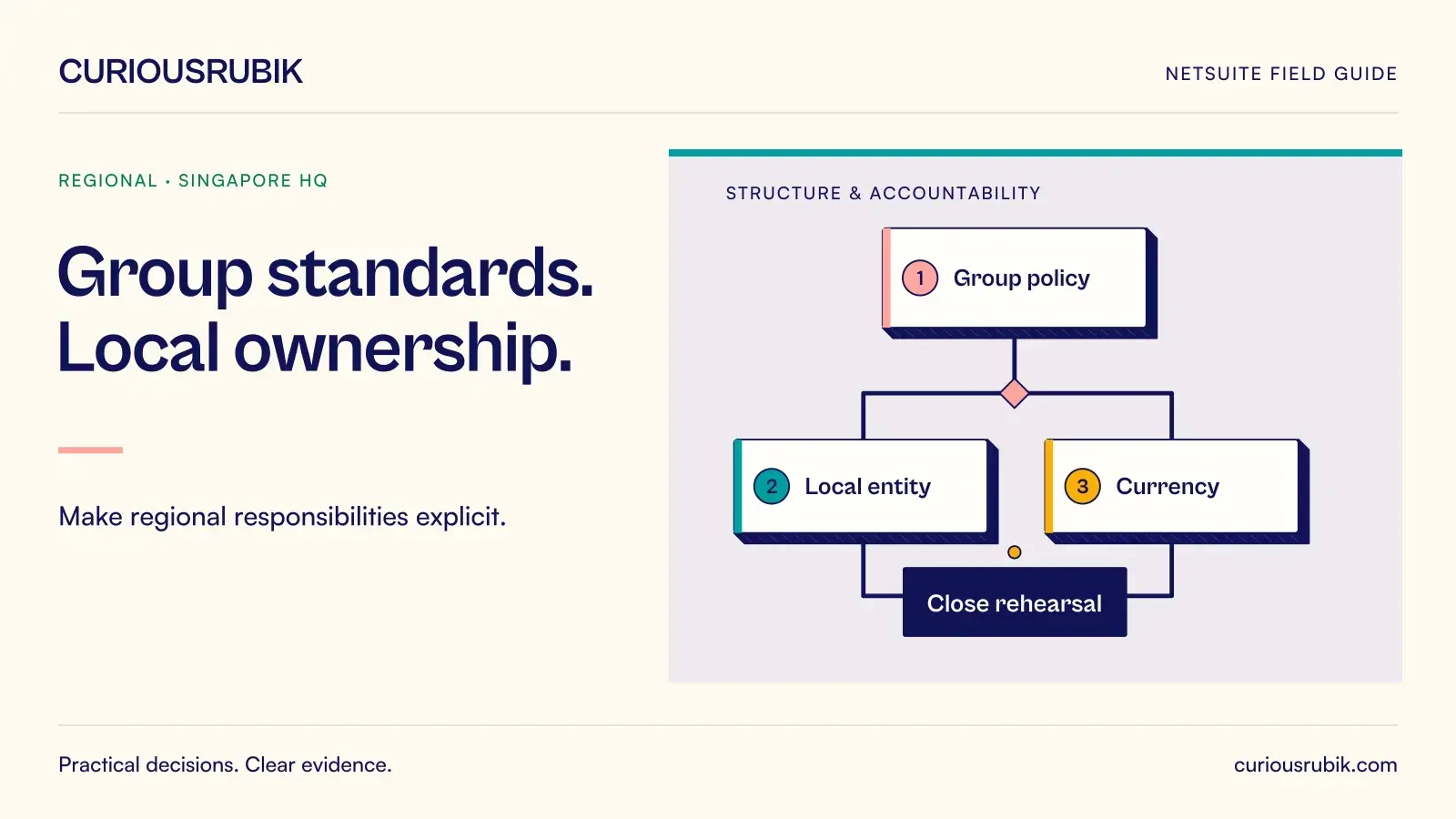
A Singapore headquarters can close its own books on time and still struggle to produce a dependable regional result. The problem often appears at the handoffs: one subsidiary uses a different account mapping, another submits late intercompany adjustments, and a third cannot explain how its local report relates to the group pack.
A regional NetSuite design should make those handoffs explicit. Decide which rules belong to the group, which responsibilities remain local and what evidence each subsidiary must supply. A shared system becomes useful when people can trace a regional number back to an accountable local process.
Draw three boundaries before creating the structure
Start with legal entities. Establish which entity contracts with customers, holds inventory, employs staff and settles liabilities. Confirm the intended subsidiary structure with the group's accounting and legal advisers. Operational reporting preferences should not silently redefine legal ownership.
Next, map management reporting. The headquarters may want results by country, product, business unit or customer segment. Those dimensions do not all require separate subsidiaries. Design reporting classifications around the questions management needs to answer while preserving the legal-entity model.
The third boundary is local compliance. Tax registrations, statutory documents and local reporting responsibilities need their own map. A tax grouping arrangement and an ERP subsidiary hierarchy answer different questions. Keep their relationship documented instead of forcing one structure to stand in for the other.
Use a regional example to expose missing decisions
Consider an illustrative group with a Singapore headquarters, an Australian sales subsidiary and a Thai manufacturing subsidiary. The Thai entity produces goods, the Australian entity sells locally, and the Singapore team coordinates group reporting.
Before configuration, ask who owns the goods at each stage, which entity invoices the customer and how intercompany charges are approved. Then ask how each entity handles its local invoices, purchases, bank activity and reporting. Those decisions determine the transaction design more reliably than the country name alone.
Suppose the group wants a common product-margin view. The Thai team may track manufacturing variances, while the Australian team needs freight and local fulfilment costs. The group can standardise the reporting definition of margin without requiring identical operational processes. It must specify which costs enter the measure and how local accounts map into it.
This is also where missing ownership becomes visible. Someone must approve the product classification, someone must maintain the mapping and someone must investigate differences at close. Naming those roles early prevents a shared reporting requirement from becoming an unresolved local burden.
Define a small set of group standards
Group standards should cover the elements needed for reliable consolidation and comparison. These commonly include account mapping principles, intercompany identification, reporting dimensions, close evidence and change approval.
Write a reason beside each standard. A compulsory department field might support cost ownership. A common customer category might support regional analysis. When the reason is unclear, the field can become data entry that nobody trusts or uses.
Also define permitted local variation. A subsidiary may need additional accounts, document fields or approval steps. Establish how it requests a variation, who assesses reporting impact and how the change is tested. A controlled extension is easier to maintain than a local workaround hidden in a spreadsheet.
Avoid making every local design decision a headquarters approval. Reserve central review for changes with group impact. Let local owners approve routine operations within the agreed model, with evidence that the group can inspect when necessary.
Plan currency and reporting together
Document each subsidiary's base currency and the group's reporting requirements. Distinguish transaction-currency amounts, local book results and translated group figures. A number can differ legitimately across those views; the report should make its basis clear.
Use test transactions that create real interpretive questions. An intercompany invoice recorded in one period and credited in the next exposes cutoff and currency assumptions. A purchase in a foreign currency followed by a later payment tests whether finance can explain the resulting differences.
Do not let a successful consolidated total end the test. Inspect the contributing subsidiary balances, mapping and elimination behaviour within the configured design. The team should be able to identify whether a difference comes from timing, classification, exchange treatment or an incomplete transaction.
Give each localisation handoff an acceptance record
A localisation handoff should contain more than a component name. For Singapore, Australia and Thailand, record the local requirement, intended solution route, configuration owner, local reviewer and acceptance evidence. Separate document generation from electronic transmission and local reporting.
A practical handoff might state that the local finance lead approves representative sales documents, the integration owner proves the message flow, and group finance checks the ledger impact. These approvals address different risks and should not be merged into a single technical sign-off.
Where payroll or another local service remains outside NetSuite, specify the interface boundary. Define the period, entity, account and reporting dimensions expected in the incoming data. Decide what happens when the local provider corrects a previously posted period. A balanced journal alone does not establish that the regional result is correct.
Run a regional close rehearsal before rollout approval
Choose a representative month and rehearse the entire regional sequence. Local teams complete their reconciliations and identify exceptions. The headquarters reviews the handoff pack, reconciles intercompany balances and explains the consolidated result.
Measure the time spent waiting for decisions separately from the time spent running reports. If the group cannot close because nobody can approve a disputed charge, improving report performance will not solve the bottleneck.
For every exception, record the originating entity, financial effect, owner and intended resolution. Agree which exceptions block group reporting and which can be carried with explicit approval. Keep local and group materiality decisions within the accounting governance process.
After the rehearsal, change the rollout plan where the evidence requires it. A subsidiary with unresolved document design may need further preparation even when the central finance configuration is ready.
Questions regional teams ask
Should every country use the same chart of accounts?
Aim for comparable group reporting and controlled mapping. Whether one detailed chart is appropriate depends on the legal and operational requirements. Preserve necessary local detail without making the regional view inconsistent.
Can Singapore headquarters approve all local tax requirements?
Headquarters can coordinate the process, but local requirements need appropriately qualified review. The approval record should show who evaluated each jurisdiction's treatment and documents.
Is a common dashboard enough to prove regional readiness?
No. Trace selected dashboard figures to subsidiary balances and underlying transactions. Then test the corrections, timing differences and intercompany exceptions that occur during close.
What should be rolled out first?
Choose a sequence based on dependencies and readiness. A smaller entity is not automatically the safest pilot if its processes differ greatly from the rest of the group.
CuriousRubik can discuss your regional entity map and close handoffs to help define a NetSuite rollout scope with clear local and group responsibilities.