NetSuite SOAP to REST Migration with Proven Coverage and a Safe Cutover
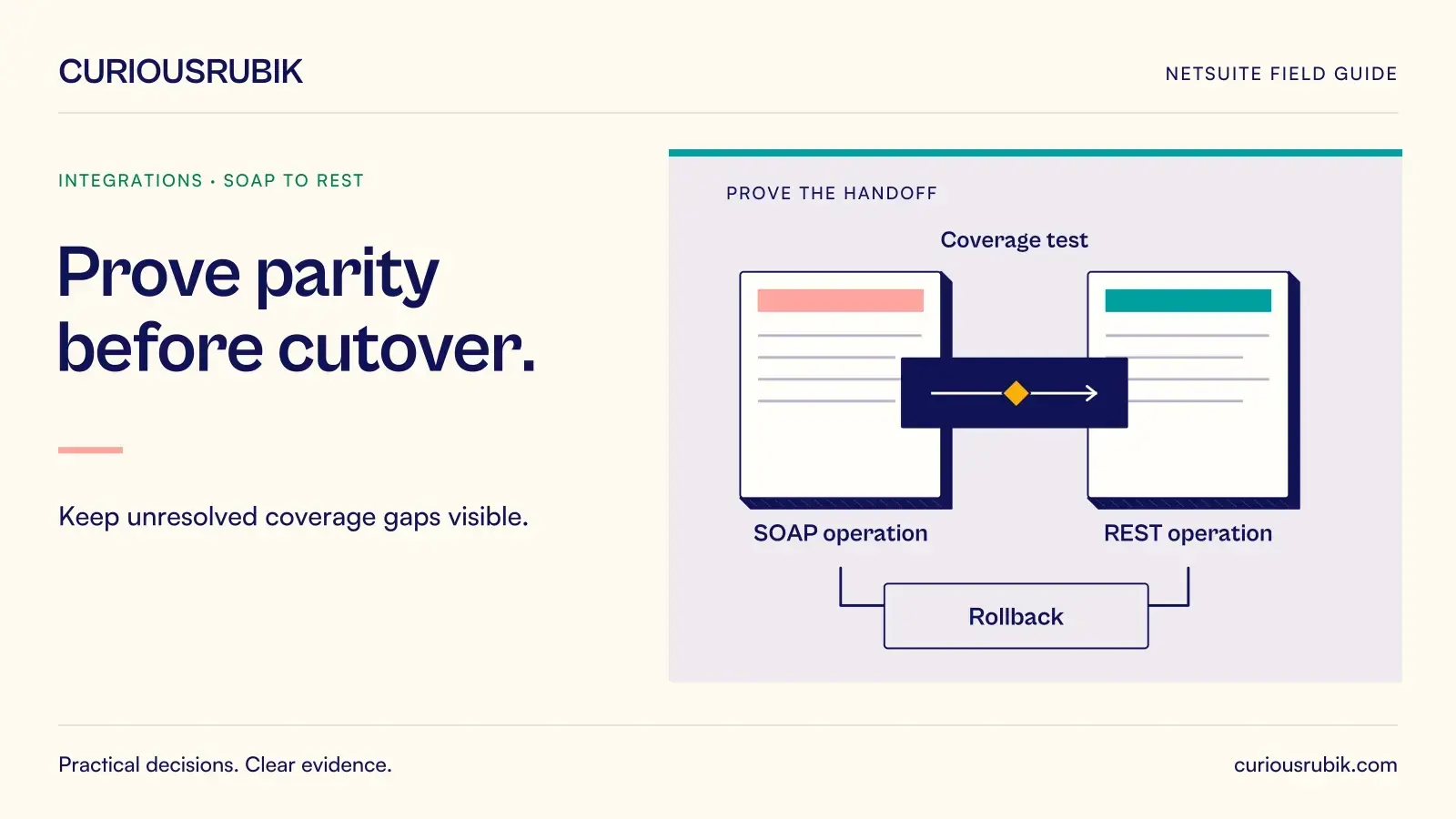
A NetSuite SOAP to REST migration is complete when the replacement supports the business process and the old route can be retired safely. Converting request formats is only part of that work. Record coverage, authentication, search behavior, custom fields, error handling, and recovery may all require separate decisions.
Start with an inventory of what actually runs, then prove replacement coverage operation by operation. This keeps a modernization project from reaching cutover with an undocumented tax dependency, an untested transformation, or an external application still calling SOAP behind the scenes.
Inventory callers and business dependencies
List every application, scheduled job, integration platform, reporting extract, and partner-managed service that communicates with NetSuite. Ask providers to identify their protocol and endpoint version. A modern user interface does not reveal the API used underneath it.
For each SOAP dependency, record the owner, purpose, records, operations, search patterns, custom fields, processing volume, business deadline, and recovery method. Include infrequent activity such as annual updates and month-end routines. A short observation window may miss the integration that becomes important only during close.
Inspect configurations and authorized operational logs rather than relying entirely on recollection. Capture evidence without retaining credentials or unnecessary transaction detail. Mark dependencies as observed, owner-confirmed, or still unverified so uncertainty remains visible.
Prioritize by business consequence and replacement uncertainty. A low-volume process that posts a critical financial transaction may deserve attention before a high-volume, read-only export with straightforward coverage.
Use release milestones carefully
Oracle's published removal plan, reviewed on 7 October 2026, identifies the 2025.2 endpoint as the final planned SOAP endpoint, with later endpoints possible only if necessary. The plan schedules complete SOAP removal for NetSuite 2028.2. These are release milestones, not a universal calendar date on which every account changes.
Oracle also directs new integrations toward REST with OAuth 2.0 and describes restrictions on new SOAP integrations beginning with 2027.1. Endpoint support status and endpoint availability are separate questions. Check the current removal FAQ, endpoint support information, and your account's release schedule before approving a project deadline. Resolve any conflicting documentation with the relevant product support channel.
Give the migration an internal completion date that leaves time for failed tests and external dependencies. Do not use the final removal milestone as the first realistic production test. A provider's roadmap statement is also insufficient without a tested replacement plan for your integration.
Build a parity matrix around operations
A useful parity matrix has one row for each required business operation, not one row for each record name. Suggested columns are:
- Source SOAP operation and business purpose
- Candidate REST record, query, action, or transformation
- Required fields, sublists, and customizations
- Account features and permissions
- Expected result and comparison method
- Test evidence and remaining gap
- Decision owner and approved alternative
For a hypothetical order integration, separate customer lookup, customer creation, sales-order creation, line amendment, fulfillment-status retrieval, and invoice lookup. Passing one row does not pass the others.
Inspect the current REST metadata under the intended integration role. Validate actual operations in a suitable test account. A field that can be read may have different write behavior, and the presence of a record does not guarantee support for every operation previously performed through SOAP.
Tax deserves explicit attention. Current REST guidance identifies a SuiteTax requirement for taxation and does not support legacy tax features. Treat this as a dependency to assess with finance and the account's technical owner. A broader tax change requires its own approved scope; it should not become an incidental integration workaround.
An illustrative parity and gap register
These synthetic entries show how to make the inventory testable. All execution results are untested; candidate routes require metadata, feature and role verification before they become implementation decisions.
| Business operation | Candidate replacement to verify | Expected acceptance evidence | Status and owner |
|---|---|---|---|
| Find approved customer CUST-TEST-01 | REST record read or supported query using the stable customer key | Exactly the approved identity and subsidiary; excluded customer denied | Untested; integration lead |
| Create order MIG-TEST-01 | Supported REST sales-order create with required references and custom field | One correct order after read-back; duplicate delivery creates no second business effect | Untested; order-process owner |
| Amend line L2 on MIG-TEST-01 | Supported REST update using verified line identity and semantics | Only approved quantity changes; L1 and unrelated fields stay intact | Untested; integration lead and operations |
A sample unresolved record is GAP-01: the required custom line-field write has not yet been verified for the selected account and role. Evidence is pending a metadata review and synthetic before-and-after test. Consequence: automated amendments remain blocked from cutover. The integration lead owns investigation; the process owner must approve any alternative. Review GAP-01 before cutover sign-off, and close it only with execution evidence or an explicitly approved scope change.
Separate authentication migration from functional parity
OAuth 2.0 configuration introduces its own roles, integration settings, and credential lifecycle. Prove access with the least privileges required for the chosen operations. A successful token request establishes authentication, not permission to perform every required record action.
Keep production, sandbox, and Release Preview configuration distinct. Document who can provision, rotate, and revoke credentials, and how the integration behaves when authentication is unavailable. Use secure credential storage and never put private keys or tokens into migration spreadsheets, screenshots, or support tickets.
Include denied-action tests. The replacement should complete approved work while rejecting records or actions outside its scope. Security sign-off should review actual permissions and observed behavior rather than accepting a successful administrator test as sufficient evidence.
Maintain an unresolved coverage register
Every gap needs a specific description, evidence, consequence, owner, and next decision. “REST does not work” is not actionable. “The required sublist amendment failed under the target role in the test account” gives the team something to investigate.
Possible responses include redesigning the business flow, using a supported alternative, or evaluating a bounded RESTlet where appropriate. A custom alternative carries maintenance and security responsibilities. Record those responsibilities and obtain approval before expanding scope.
Do not close a gap because a future capability has been announced. Mark it as dependent on future availability until it is present in the relevant account and passes the agreed test.
Prove parity and define the rollback boundary
Compare business outcomes using synthetic or approved test data. Include ordinary transactions, custom fields, missing references, restricted records, duplicate delivery, partial completion, and timeout after commit. Reconcile destination identities and financial or quantity totals where applicable.
Consider a hypothetical cutover at event MIG-500. The SOAP route processes events through MIG-500. New events pause while the team reconciles that boundary. The REST route begins with MIG-501 after acceptance. If MIG-501 creates an order but loses its response, reverting traffic to SOAP without checking the destination can create a duplicate.
The rollback plan therefore distinguishes unprocessed work from completed or ambiguous work. Pause new writes, preserve queues and identifiers, reconcile uncertain outcomes, and obtain approval for any corrective financial action. Returning to an older transport does not undo business transactions already committed.
Migration questions worth resolving early
Can a SOAP integration be converted by changing its URL?
No. Request structures, authentication, record operations, query patterns, and error behavior must be evaluated. Some business logic may transfer, but it needs fresh acceptance evidence through the replacement channel.
Does a supported REST record prove complete SOAP parity?
No. Test the exact fields, sublists, actions, transformations, and account features the business needs. Coverage should be demonstrated at operation level with the intended role and realistic data variations.
Can both integrations run during testing?
They can sometimes run in a controlled comparison, especially for reads. Parallel writes require strict ownership and duplicate prevention. Never send the same financial instruction through both routes merely to compare responses.
What proves the old integration can be retired?
All scoped flows have accepted replacements, unresolved outcomes are reconciled, dependent providers have completed their changes, and monitoring shows no required SOAP caller remains. Credential revocation and configuration removal then follow approved change procedures.
Scope the migration before committing to a cutover
CuriousRubik can help organize a dependency inventory, operation-level parity matrix, and cutover rehearsal. Start with the highest-risk flow and use its evidence to establish the remaining migration scope and review gates.