Map NetSuite Thailand Localisation into a Testable Delivery Scope
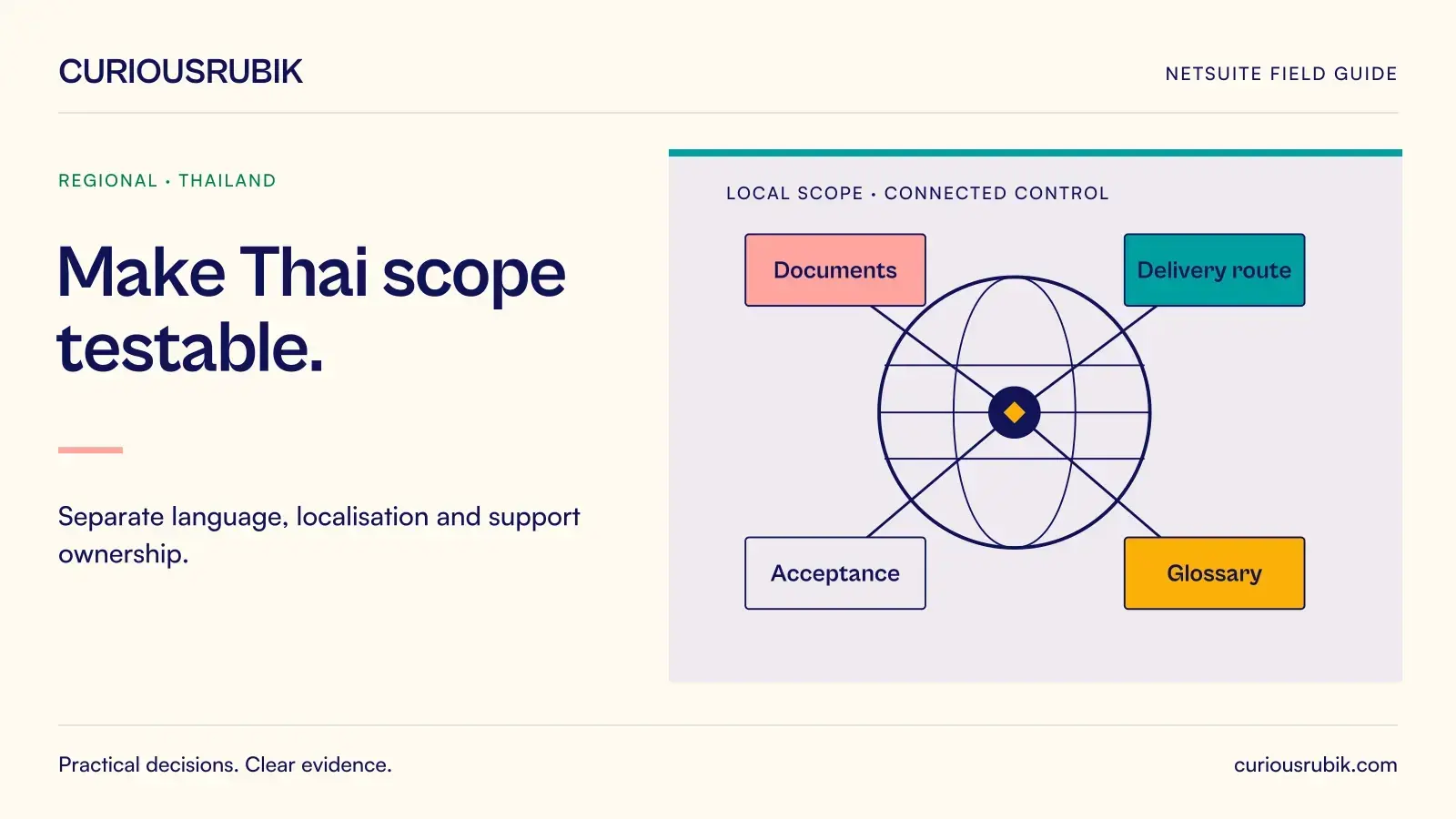
“Thailand localisation included” is too broad to serve as an implementation requirement. It could refer to document templates, selected fields, tax reporting components or a separate service. Your finance team needs to know which requirement each part addresses and how the result will be tested.
Build the scope from the local business process upward. Record the required outcome, the proposed NetSuite route and the person who will approve the evidence. This makes it easier to distinguish a supported feature from configuration, an additional SuiteApp or custom work that someone must maintain.
Begin with the documents and decisions
Ask the Thai finance team to identify the documents it issues, receives and uses to complete reporting. Use approved sample documents with sensitive information removed. Include ordinary transactions and the corrections that occur during a real month.
For each document, identify the issuing entity, recipient, language, currency, numbering process and relevant branch information. Record who confirms the legal content and who approves the business layout. Those may be different reviewers.
Include processes that do not end in a printed document. Withholding, reporting, payment preparation and electronic transmission may have separate requirements. A correctly printed invoice is useful evidence for the invoice template; it does not prove the other processes work.
Give every requirement a delivery route
Use four practical categories in the requirements register: configuration of available features, an additional supported component, an external service or interface, and custom work. A requirement may involve more than one category, but the responsibility for each part should remain visible.
For example, a branch identifier may be held on a customer record, copied to a transaction and displayed on an invoice. Test all three stages. The presence of a master-data field does not establish that historical transactions and corrected documents will display the intended value.
Where a SuiteApp is proposed, confirm the account prerequisites, supported transaction types and limitations. Record the version or configuration baseline used for acceptance. A product name in a proposal is not evidence that the relevant feature is installed and working in your environment.
For custom work, ask why it is necessary and what simpler supported options were evaluated. Document the maintenance owner, change process and regression tests. A small template change can still require careful testing if it controls tax or branch information.
Use a shared glossary without pretending translation is approval
A small Thai-English glossary helps regional project teams discuss the same documents. Useful starting terms include tax invoice, ใบกำกับภาษี; credit note, ใบลดหนี้; head office, สำนักงานใหญ่; and branch, สาขา.
Have the Thai-speaking finance reviewer confirm terminology in the context of the actual process. A technically correct translation may still be unfamiliar to users or unsuitable for a particular document label. Store the approved wording with the template and training material.
A sample Thai English requirements matrix
The following four rows are an illustrative workshop matrix. They describe proposed controls and acceptance evidence, not a complete statement of Thai legal requirements.
- Tax invoice, ใบกำกับภาษี. Proposed route: the selected supported invoice template plus approved entity and customer fields. Owner: local billing lead. Evidence: invoice TEST-101 displays the approved issuer, customer and branch values and reconciles to its transaction. The qualified local reviewer approves the required particulars.
- Credit note, ใบลดหนี้. Proposed route: the supported correction transaction and selected template. Owner: accounts receivable lead. Evidence: credit TEST-C01 identifies TEST-101, reduces the intended balance and appears in the reviewed reporting population. Any electronic correction route is tested separately.
- Head office, สำนักงานใหญ่. Proposed route: approved entity or customer master data copied through the intended transaction fields. Owner: master-data steward. Evidence: a head-office test displays the approved designation and preserves the historical meaning after a later address change.
- Branch, สาขา. Proposed route: the configured branch fields and document mapping. Owner: local finance lead. Evidence: branch test B1 displays the correct buyer and issuer context; a deliberately missing branch value is detected through the agreed control before issuance.
Add columns for the installed component, prerequisite, test reference, result and reviewer when transferring these rows into your project register. A blank result means the requirement is untested. A component's presence alone should never change that result to accepted.
Separate printed output from electronic submission
If electronic tax documents or another submission service is in scope, describe the complete route. Identify the source record, transformation, validation, transmission and returned status. Confirm who handles onboarding, credentials, certificates and service changes through the authorised security process.
The acceptance test should show what happens when a required field is missing or a message is rejected. Retain the original document reference and the correction history. Do not treat a PDF attached to an email as proof that a separately required structured electronic process has been completed.
Test a compact local scenario pack
Consider an illustrative Thai trading entity that sells through its head office and a branch. Build a rehearsal containing a normal invoice, a branch-specific invoice, a foreign-currency transaction and a credit note linked to an earlier sale.
For each scenario, the local finance reviewer checks the approved document content. The system team verifies the source fields and transaction behaviour. Finance then reconciles the accounting effect and any relevant reporting output. If electronic transmission is included, the integration owner provides its separate result.
Now change the customer's branch information. Test whether the change affects new documents as intended and whether prior documents remain understandable. The approved process should preserve the historical meaning of issued documents rather than silently rewriting their context.
Include a long Thai address and a multi-line item description. Layout defects often appear with realistic text length, even when short demonstration data looks correct. Review the printed and electronic outputs that users will actually handle.
Assign acceptance to the right person
A practical acceptance record names the requirement, result, evidence and reviewer. The implementation consultant can demonstrate behaviour. The business owner confirms operational usability. A qualified local adviser confirms tax or legal treatment within their remit.
Do not ask one reviewer to approve the entire localisation scope with a single signature. Separate the decisions so an unresolved legal question is not obscured by a successful technical test. Record which issues block launch and which have an authorised resolution plan.
Retain the approved templates, glossary and test data as the starting point for future changes. When a component or requirement changes, the team can rerun affected scenarios instead of reconstructing what “localisation complete” meant months earlier.
Keep support responsibilities visible
After launch, someone must own document defects, tax mapping questions and failed submissions. Set a routing rule that sends each issue to the right owner while preserving a single business reference across the investigation.
Common localisation questions
Does a Thailand template cover all local requirements?
No single template proves the full scope. Validate document content, reporting, payment and transmission requirements separately for the entity and processes involved.
When is custom work justified?
When an approved requirement cannot be met adequately through the selected supported route. Record the gap, maintenance responsibility and regression tests before approving the change.
Should the glossary be treated as legal wording?
No. It is a coordination aid. A qualified Thai-speaking reviewer should approve wording and treatment in the actual business and document context.
What should be tested first?
Start with one ordinary invoice and one correction using realistic local data. Trace the source fields, output and accounting result before expanding the scenario pack.
CuriousRubik can help organise a Thailand NetSuite requirements workshop around these delivery boundaries. Local legal and tax decisions should remain with the qualified reviewers responsible for your business.