NetSuite Three Way Match Exceptions and Release Evidence
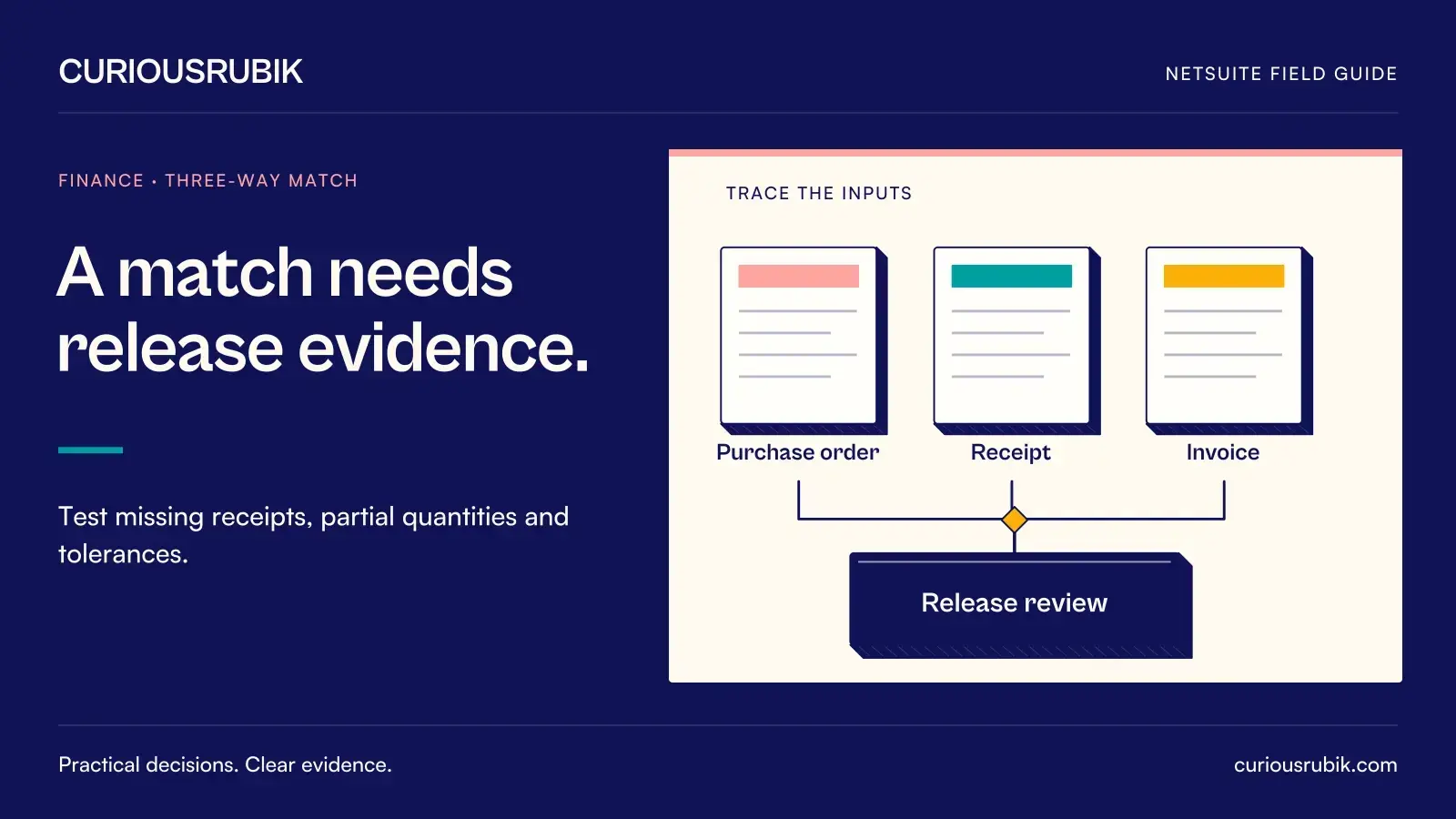
Three-way matching compares the commercial order, receiving evidence and supplier bill. The difficult cases occur when those records do not describe the same completed event: only part of an order has arrived, a receipt is missing or a supplier bills a quantity that was already invoiced.
For NetSuite three way match design, begin by identifying the exact workflow in use. The documented NetSuite Approvals Workflow SuiteApp includes a three-way approval workflow, but it has a limitation for partially received item receipts. A partial-receipt process therefore needs explicit design and testing rather than an assumption of standard coverage.
This guide gives AP and procurement leads an exception framework and hypothetical test cases. The release rules below are proposed control objectives, not claims that every account implements them automatically.
Define which invoices belong in the matching population
Not every supplier bill has a purchase order and physical receipt. Separate ordinary inventory purchases from services, non-PO expenses, prepayments and other approved procurement patterns.
For the selected population, define the expected links between purchase order, receipt and bill. Confirm whether users create bills from the relevant records or enter them independently, and how the relationship is preserved.
Document the installed SuiteApp, enabled features, preferences and customizations. Two accounts can have a similar approval screen while executing different checks. In particular, preferences related to billing before receipt can affect receipt validations.
The process owner should know which invoices receive automated checks, which require manual evidence and which are outside the workflow. An excluded population still needs a control owner.
Use an exception matrix with an evidence requirement
Create a row for each recurring exception category. The minimum fields are receipt status, comparison basis, tolerance, business owner, accounting owner and evidence required for release.
For a missing receipt, the receiving team owns confirmation of the physical event. Release evidence may include the correctly recorded receipt or an approved alternative treatment for the transaction type.
For a price variance, procurement owns the commercial explanation and finance reviews the accounting consequence where necessary. Release evidence should establish the agreed price or approved correction.
For a quantity variance, the warehouse or service owner confirms what was delivered, while AP checks what has already been billed. For a duplicate concern, AP verifies invoice identity and prior processing before any release.
Use the matrix to route work to the person who can resolve the underlying fact. Repeatedly forwarding every exception to the controller creates delays without improving evidence.
A filled exception review example
The following hypothetical control matrix is a workshop starting point. Its tolerances and evidence requirements need policy approval and testing in the selected solution; it does not describe automatic standard-workflow coverage.
| Exception and receipt status | Illustrative tolerance or release rule | Accountable owner | Required release evidence |
|---|---|---|---|
| Missing receipt; zero recorded | No automatic release for the selected stock-purchase population | Receiving lead and AP reviewer | Authorized receipt linked to delivery, or finance-approved alternative treatment |
| Partial bill; 60 of 100 received | Current 60 plus prior billed zero must not exceed verified 60 | Receiving lead and AP reviewer | Receipt and cumulative bill schedule; separately tested route for partial receipts |
| Price variance; all received | Review any unit-price difference in this example | Procurement approver | Approved price or supplier correction, plus finance review where needed |
| Duplicate candidate; receipt exists | Hold the candidate pending identity review | AP reviewer | Source invoice compared with prior record; documented distinct obligation or duplicate disposition |
A duplicate alert never removes an obligation by itself. Record the reviewer, decision date and evidence identifier for every released exception.
Test the missing-receipt case without inventing stock
A hypothetical purchase order requests fifty units at 20 currency units each. The supplier submits a bill for 1,000, but the system has no receipt.
The first question is whether the goods physically arrived. If they did, the receiving owner should investigate why the authorized receipt process was not completed. If they did not, the bill needs the treatment defined by the organization's purchasing and accounting policies.
AP should not enter a receipt solely to pass a matching check. Doing so can create false stock and distort downstream operations. Equally, the absence of a receipt does not justify ignoring a genuine accounting obligation; finance must assess the facts through the approved process.
The test passes when the workflow exposes the missing evidence and routes it correctly, with a traceable resolution.
Treat partial receipts as a separate design case
Suppose a hypothetical order is for one hundred units, sixty have arrived and the supplier bills sixty. A business may regard that bill as commercially reasonable, but the documented standard three-way workflow limitation means the proposed system route must be verified rather than assumed.
Test both the first partial bill and the later bill for the remaining forty units. Also test a supplier billing the full hundred before the balance arrives. The control must distinguish ordered, received, previously billed and currently billed quantities.
If a configured or additional solution is proposed, ask it to demonstrate cumulative behavior across multiple receipts and bills. Comparing the current bill only with the original order can miss an overbilling that emerges across several documents.
Where the selected standard workflow is unsuitable, document an approved alternative control. That may involve a different supported design or a deliberate manual review while a suitable solution is evaluated. Label the route honestly in training and acceptance criteria.
Set tolerances with clear units and precedence
Percentage tolerances and absolute quantity differences measure different things. Record the unit, denominator and comparison records for each rule. Do not copy a numeric value between fields without checking its meaning.
In a hypothetical policy, a small price variance might be acceptable while any unreceived quantity requires review. That policy should be tested with invoices just below, exactly at and just above each threshold.
Consider overlapping rules. A tolerance may appear permissive while another enabled criterion still routes the bill for approval. This can be correct behavior, but users need to understand which rule applies.
Do not use tolerances to hide recurring supplier or master-data problems. Review the causes of frequent exceptions before relaxing controls.
Challenge duplicate detection separately
A matching bill can still be a duplicate. Use a hypothetical invoice submitted twice, once with punctuation in its reference and once without. Add a second case where two legitimate invoices happen to have the same amount and date.
The review should distinguish duplicate candidates from confirmed duplicates. Supplier identity, invoice reference, document date, amount and prior record relationships all contribute evidence. No single weak signal should automatically erase a legitimate obligation.
Check every entry channel, including manual creation and imported or captured bills. Confirm whether the configured behavior warns, blocks or permits an override. An alert is only useful if the operating process explains who investigates it.
Require release evidence and retest after changes
The approver should see the original exception, supporting facts, correction and remaining risk. Preserve the reason for any override and the authority under which it was granted.
After a material bill change, verify whether the intended validations and approval steps run again. Test this behavior directly in the proposed configuration. Do not assume an approved status means later edits received equivalent review.
Keep payment authorization separate from exception release. A bill can be commercially and financially valid while still awaiting the organization's payment approval process.
Questions about matching exceptions
Why is a bill held when its total looks correct?
The workflow may compare quantities, terms, locations, receipt relationships or other configured criteria. Inspect the specific exception rather than relying on the total alone.
Can a tolerance solve a missing receipt?
A tolerance does not create receiving evidence. Investigate the physical event and apply the approved process for that transaction population.
What proves partial billing works?
A tested sequence of multiple receipts and bills, including cumulative overbilling and correction cases, in the exact proposed solution. Standard workflow coverage should not be assumed.
Who should approve release?
Use the authority defined by policy, supported by the owner who can establish the missing fact. Procurement, receiving and finance may each contribute different evidence.
Test your exception matrix
CuriousRubik can help scope a review of NetSuite matching exceptions, partial-receipt requirements and release evidence. Bring the purchase order, receipts and bills together so the complete sequence can be assessed.