Test UAE NetSuite Electronic Invoicing Through Rejection and Recovery
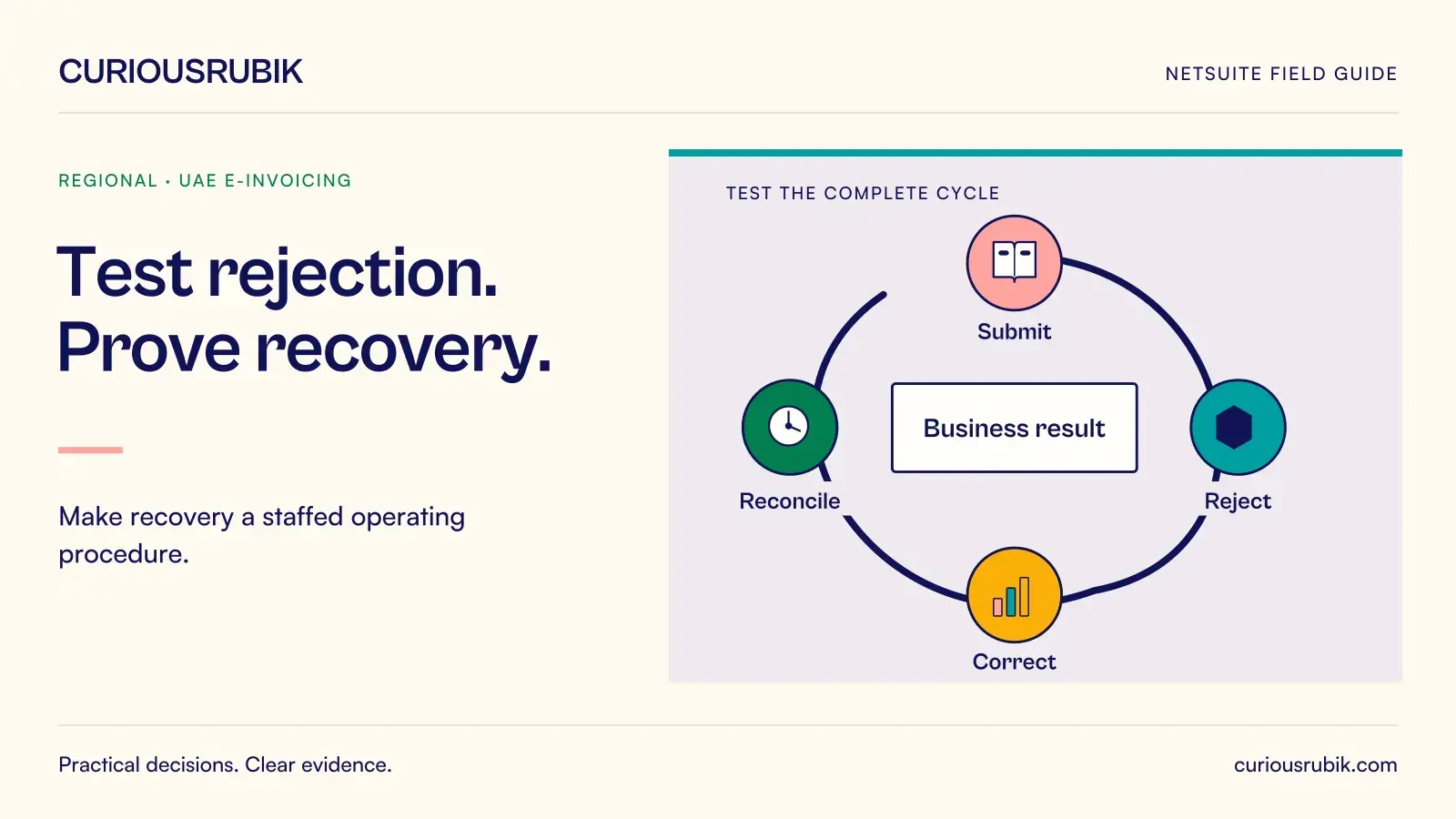
A successful invoice is an incomplete go-live test. The more revealing questions are what happens when a buyer identifier is wrong, a response arrives late or a credit note must correct an earlier transaction. Those events test whether finance can recover control without creating duplicate documents or losing the explanation for a balance.
Build UAE electronic invoicing acceptance around a small, repeatable evidence pack. Each scenario should connect the NetSuite business document, the provider message, the relevant exchange and reporting outcomes, and the resulting finance record. The objective is to prove that named people can recognise and resolve exceptions before real customer collections depend on them.
Establish the exact environment being tested
Record the NetSuite account, integration build, provider environment, specification version and participating test identities. Confirm what the provider's test service actually supports. A local validation tool, a simulated response and an end-to-end provider environment prove different things.
Use a coverage column for each scenario: internally validated, provider-tested, downstream outcome demonstrated or still untested. Never mark an entire journey complete because a simulator returned a successful response. If a downstream step cannot yet be exercised, document the limitation and the approved plan for completing the evidence.
Keep production credentials, real recipients and live transaction posting outside the test route unless a separately authorised production verification requires them. The test manager should be able to show which controls prevent synthetic documents from becoming real customer or reporting events.
Prepare synthetic data that behaves like your business
Use invented companies, identifiers and commercial transactions permitted by the test environment. Preserve the characteristics that matter: document type, currency, item units, tax treatment, discounts and references to earlier invoices. A test built only from one-line domestic invoices leaves multi-line, foreign-currency and correction behaviour unexplored.
Have the finance reviewer approve the expected tax treatment in each scenario. Then freeze the expected amounts before execution. Changing the expected answer after seeing the system output turns a test into a demonstration.
Give each test a unique case identifier and retain these items:
- Original source data and approved expected result
- NetSuite document and integration message identifiers
- Payload version and dispatch timestamp
- Returned statuses and error details
- Correction, retry and final reconciliation evidence
The pack should be understandable by someone who did not attend the test meeting.
Use five scenarios that expose operational gaps
An ordinary invoice completes every expected step
Create a representative valid invoice and verify its source values, transmitted content and accounting outcome. Record exchange and reporting outcomes separately. A successful local HTTP response or a provider intake acknowledgement does not establish every later milestone.
Confirm that a finance user can retrieve the evidence through the agreed operating process. If only the developer can interpret the logs, the support design remains unfinished.
A required buyer value fails validation
Remove or invalidate a value that the chosen profile requires. Verify whether the defect is caught before dispatch or returned by the provider, and make the expected control explicit.
The error should identify the affected document and responsible data owner without exposing unnecessary confidential content. After correction, prove that the approved source record and the outgoing document agree. Retain the failed attempt rather than erasing its history.
Exchange and reporting reach different states
Use the supported test method to represent an invoice whose exchange completes while its reporting outcome remains unresolved, or the reverse where that state is supported. Verify that monitoring displays the outstanding step accurately.
The operator should know which service to investigate and when to escalate. A single green “sent” label hides this distinction and makes reconciliation unreliable.
A credit note refers to the correct invoice
Test a partial correction against a previously completed invoice. Confirm the original-document reference, approved reason, amounts and tax treatment. Check that finance can connect the documents and explain the remaining receivable.
Have the local reviewer confirm the permitted correction process. Deleting an issued invoice, editing its history and issuing a credit note are different actions; the test should follow the approved process for the specific event.
A timeout creates uncertainty without duplication
Interrupt the response path after the provider may have received a document. The operator now has an unknown outcome, rather than a confirmed failure. Test how the system checks existing status before deciding whether to retry.
The agreed duplicate-prevention design should preserve the business-document identity and distinguish repeat transport attempts from new invoices. A retry that creates another receivable is a failed test even if the second message is accepted.
Reconcile a worked invoice and credit sequence
Consider a hypothetical invoice for 40 units at AED 250 each. With no discounts or additional charges, net sales are AED 10,000. Assume the approved treatment for this example applies 5% tax, giving AED 500 and an invoice total of AED 10,500.
The customer subsequently returns four units. Under the example's approved correction process, a credit note has a net value of AED 1,000 and tax of AED 50, reducing the receivable by AED 1,050. Before any payment, the remaining receivable is AED 9,450. Net sales are AED 9,000 and net tax is AED 450.
Now make the credit note's original-invoice reference invalid. The test should expose the defect at the expected validation stage. Correct it through the authorised process and repeat the permitted submission step. There must still be one invoice and one credit note in the business-document population, with the final receivable of AED 9,450.
Multiple message attempts can legitimately exist in the integration history. They must not become multiple credits in the ledger. Reconcile business documents and message attempts separately, then show how they connect.
Make recovery a staffed operating procedure
For each error category, identify who can investigate, who can change data and who approves a consequential correction. Define escalation thresholds in business terms, such as customer collection impact or a reporting obligation at risk.
During the rehearsal, give the support team an exception without explaining the answer. Ask them to locate it, classify it, recover it and retain evidence. Measure the elapsed time as an observation about that rehearsal, not as an invented service commitment.
Also test an unavailable provider. Confirm how documents queue, how their age becomes visible and how the team reconciles the backlog after service returns. Any alternative issuing process must be approved for the applicable obligations before it becomes a fallback instruction.
Set evidence-based cutover gates
Release should require more than a pass percentage. All material document types need coverage, high-risk defects need resolution or an explicit authorised decision, and support must demonstrate recovery. Finance should sign the amount reconciliation; the integration lead should sign message traceability.
Keep a separate list of evidence that cannot be completed until onboarding or an external test service is available. A sponsor can then see the genuine dependency rather than receiving a misleading “testing complete” label. Recheck the business's applicable programme requirements when setting the final cutover date.
Testing questions
Is a provider sandbox always available?
Confirm availability and coverage with the selected provider. Use internal tests where useful, but state clearly which external outcomes have not been demonstrated.
Should a rejected invoice be recreated automatically?
Use the approved correction and retry rules for that failure. Automatic recreation can duplicate documents or break references, so prove the identity controls first.
Does technical acceptance prove the tax treatment is correct?
No. Technical checks and finance review address different risks. Retain evidence of both, including approval of the expected treatment used in testing.
What should block cutover?
Examples include unexplained amount differences, untraceable statuses, duplicate-producing retries or no workable owner for material failures. Set the final gates around the business's actual risks and obligations.
Use these scenarios to assemble your first test pack. A scoped CuriousRubik review can focus on the unresolved NetSuite, provider and finance handoffs, while the appropriate local specialists approve compliance-sensitive correction and cutover decisions.