Test a NetSuite UK Subsidiary Rollout Across Local and Group Reporting
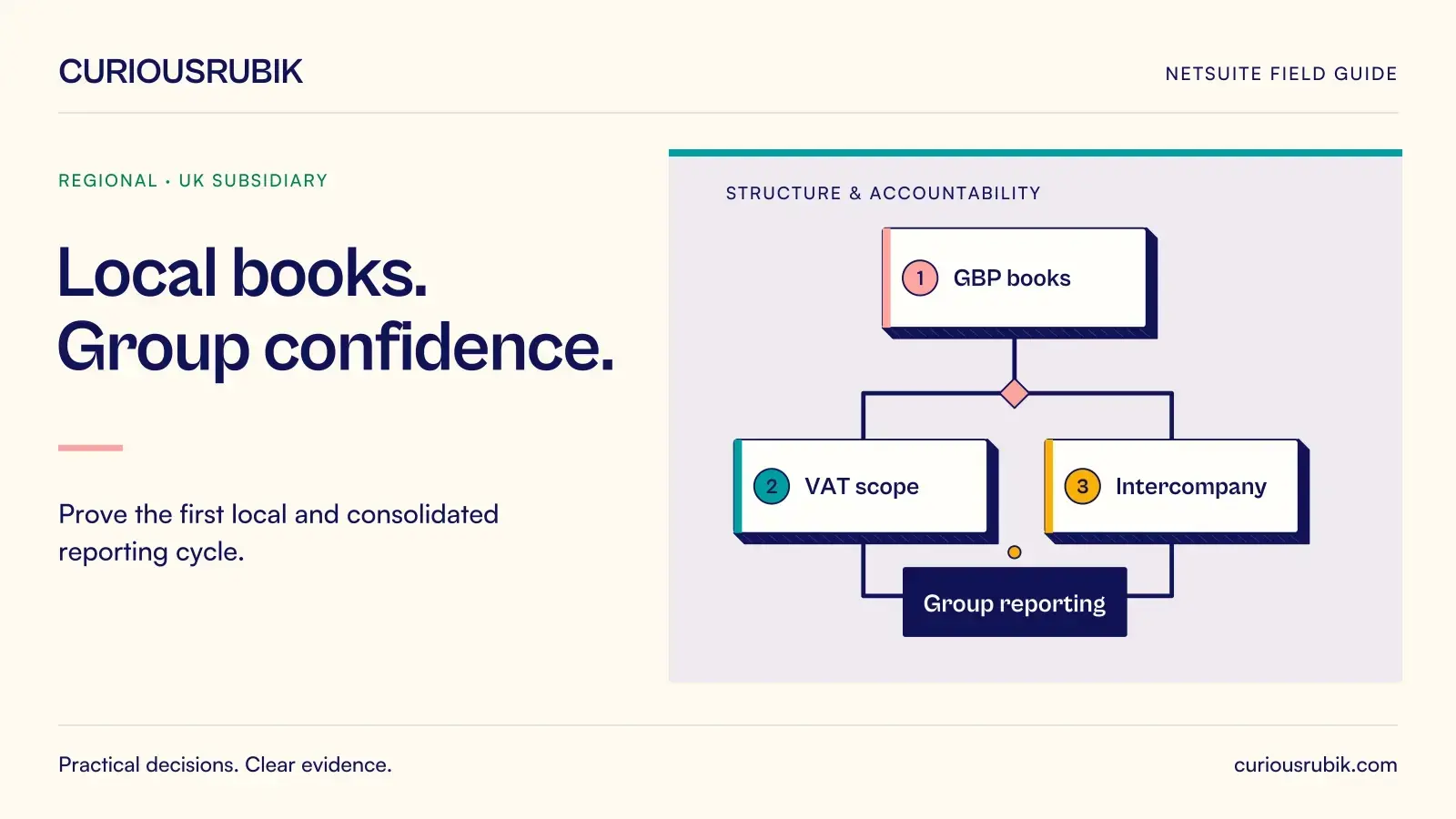
A UK subsidiary rollout succeeds when the local controller can explain the books and the regional CFO can trust the group view. Those outcomes depend on several boundaries being correct: legal entities, VAT registrations or groups, accounting currencies, intercompany relationships and consolidation scope. A shared chart of accounts does not resolve all of them.
Use a representative close rehearsal to test those boundaries together. The rehearsal should start with local transactions, produce the UK reporting evidence and finish with an explainable group result. This turns an international template into a design the UK finance team can accept on its own merits.
Separate the legal entity map from the VAT map
List each UK legal entity, its business activity, accounting owner and relationship to the international parent. Record which entities and branches are represented in the rollout and which remain outside the new system. Keep the effective dates of structural changes visible.
Build a separate VAT scope register. Identify individual registrations, any VAT-group membership, the representative member and the return-preparation responsibility. Have the UK tax adviser confirm the approved perimeter and relevant transaction treatment.
A corporate group can contain entities that are outside a particular VAT group. Conversely, the VAT return may require contributions from entities using different accounting systems. Configuring a parent-child relationship in NetSuite does not establish the right tax-return population.
Give every entity a clear place in both maps. Where the boundaries differ, write the reconciliation or data-transfer requirement explicitly. This prevents the rollout team from using the consolidation hierarchy as a shortcut for tax design.
Agree what the GBP books need to show
Confirm each entity's functional and reporting currency requirements with the responsible accounting advisers. Do not assume that a UK address alone answers every currency question. Where GBP is the approved local accounting basis, make that basis explicit in migration, transaction entry and close testing.
Specify the opening balances, open receivables and payables, bank accounts, fixed assets and historical detail needed for local operations. Reconcile migrated subsidiary balances to the approved opening trial balance, with a clear treatment for transactions that straddle cutover.
For foreign-currency transactions, test initial recognition, settlement and period-end treatment under the approved accounting policy. Preserve the transaction currency, local carrying amount and supporting exchange-rate information. A group-currency report should not conceal an unexplained difference in the underlying GBP ledger.
Assess whether additional accounting books are genuinely needed. Different local and group reporting requirements may call for mapping, adjustments or a separate book depending on the design. Confirm the supported account features and requirements before treating any option as automatic.
Map local accounts to the group reporting outcome
Start from the information each audience needs. The UK controller may need local expense detail, while the parent needs a consistent group category. Preserve useful local detail and define how it rolls into the group structure.
Test the mapping with actual transaction types rather than account names alone. A recharge, deferred balance or exceptional item can be misleading when mapped solely because its account label resembles a group category.
Record the owner of each mapping and the effective date of changes. When group finance introduces a new reporting category, identify the affected historical comparatives, budgets and local reports. The acceptance pack should explain which views change and which local records remain the source of truth.
Rehearse intercompany activity before consolidation
Choose at least one intercompany charge, settlement and period-end outstanding balance. Agree the counterparty identifiers, account treatment, document references and reconciliation ownership. Both sides should be able to identify the same business event without relying on matching descriptions by eye.
Confirm the VAT treatment independently. Membership of the same international corporate group does not, by itself, determine whether a transaction is within a UK VAT group or how every supply should be treated. The tax decision and the consolidation elimination solve different questions.
Test mismatches deliberately. Post the two sides in different periods, use an incorrect counterparty or vary an amount. Verify that the close process exposes the difference and assigns an owner before group reporting is approved.
Work through a hypothetical two-entity close
Consider two UK entities, Trading and Services, owned by an overseas parent. The figures below are illustrative, in GBP, and exclude VAT. Tax-group membership and tax treatment would be reviewed separately for a real business.
Trading records £100,000 of external revenue and a £15,000 intercompany charge to Services. Its total revenue is £115,000 and its expenses are £65,000, producing profit of £50,000.
Services records £40,000 of external revenue and £30,000 of expenses, including the £15,000 charge from Trading. Its profit is £10,000.
Before elimination, combined revenue is £155,000 and combined expenses are £95,000. The group removes the £15,000 intercompany revenue and matching expense. External group revenue becomes £140,000, expenses become £80,000 and profit remains £60,000. That profit agrees to the two local profits of £50,000 and £10,000.
If the charge remains unpaid, Trading should be able to support its £15,000 intercompany receivable and Services its corresponding £15,000 payable. The group eliminates the matching balance; the local entities retain the records needed for their own accounts and settlement process.
This example provides three acceptance checks: both local results reconcile, the elimination removes only the internal activity, and group profit remains explainable. A correct group total achieved through an unsupported manual adjustment is insufficient evidence.
Test currency translation as a separate layer
Suppose the hypothetical parent presents in USD. For a simplified arithmetic test only, applying one illustrative rate of USD 1.25 per GBP would translate £140,000 revenue to USD 175,000, £80,000 expenses to USD 100,000 and £60,000 profit to USD 75,000.
A real consolidation needs the approved rate policies for the relevant accounts, periods and balances. The single-rate example does not replace those policies or address all translation effects. Test the actual configuration with the group accountant and explain differences between local-currency and consolidated results.
Keep translation differences separate from intercompany mismatches. A balance mismatch can arise from timing, amount or counterparty errors even when the exchange rates are correct. Conversely, consistent local balances can require a properly explained currency treatment at group level.
Sign off the first local and group reporting cycle
Prepare a close pack that contains the opening-balance reconciliation, local trial balance, VAT scope and return evidence, intercompany reconciliation, mapping checks and consolidated output. Identify who approves each part and how unresolved differences affect release.
Confirm the NetSuite reporting route used for UK VAT separately from the consolidation process. The selected tax configuration, permissions and digital record journey need their own acceptance. Do not infer VAT readiness from a successful consolidated financial statement.
Have the UK controller perform the local close and the regional team perform the group review using the operating instructions they will receive. Capture missing access, unclear adjustments and unsupported reports as defects. The rehearsal should prove that the teams can operate the design after the implementation specialists step back.
UK subsidiary rollout questions
Does a NetSuite subsidiary hierarchy define our VAT group?
No. Maintain an independently approved VAT scope register and connect it to the relevant accounting populations and source systems.
Must all UK entities use identical local accounts?
Use the structure that supports local requirements and consistent group reporting. Where local detail differs, maintain an approved mapping and test it with representative transactions.
Can intercompany balances simply be removed from local books?
Consolidation elimination and local settlement are separate processes. Preserve the local receivables, payables and supporting records required by the approved accounting design.
What is the most useful rollout acceptance exercise?
Run a complete representative close across local books, VAT scope, intercompany activity and group reporting. Require explanations for differences at each boundary rather than checking only the final consolidated total.
Bring your legal-entity map, VAT scope and one close pack to a scoped CuriousRubik rollout workshop. Use it to identify the local and group decisions that must be resolved, with UK tax and accounting advisers approving the relevant treatments.