API-first architecture means agreeing and testing the interface consumers need before implementation choices make that interface expensive to change. The business value lies in clarifying capabilities, responsibilities, and failure behavior early. Publishing an API after an application is built does not, by itself, establish those qualities.
For a product or business-platform leader commissioning a booking capability, the decision is whether to fund a shared contract that several channels can use or allow each channel to implement its own interaction. A shared API can create a useful boundary, but only if the organization owns its meaning, capacity, security, support, and evolution. Treating it as a collection of endpoints understates the commitment.
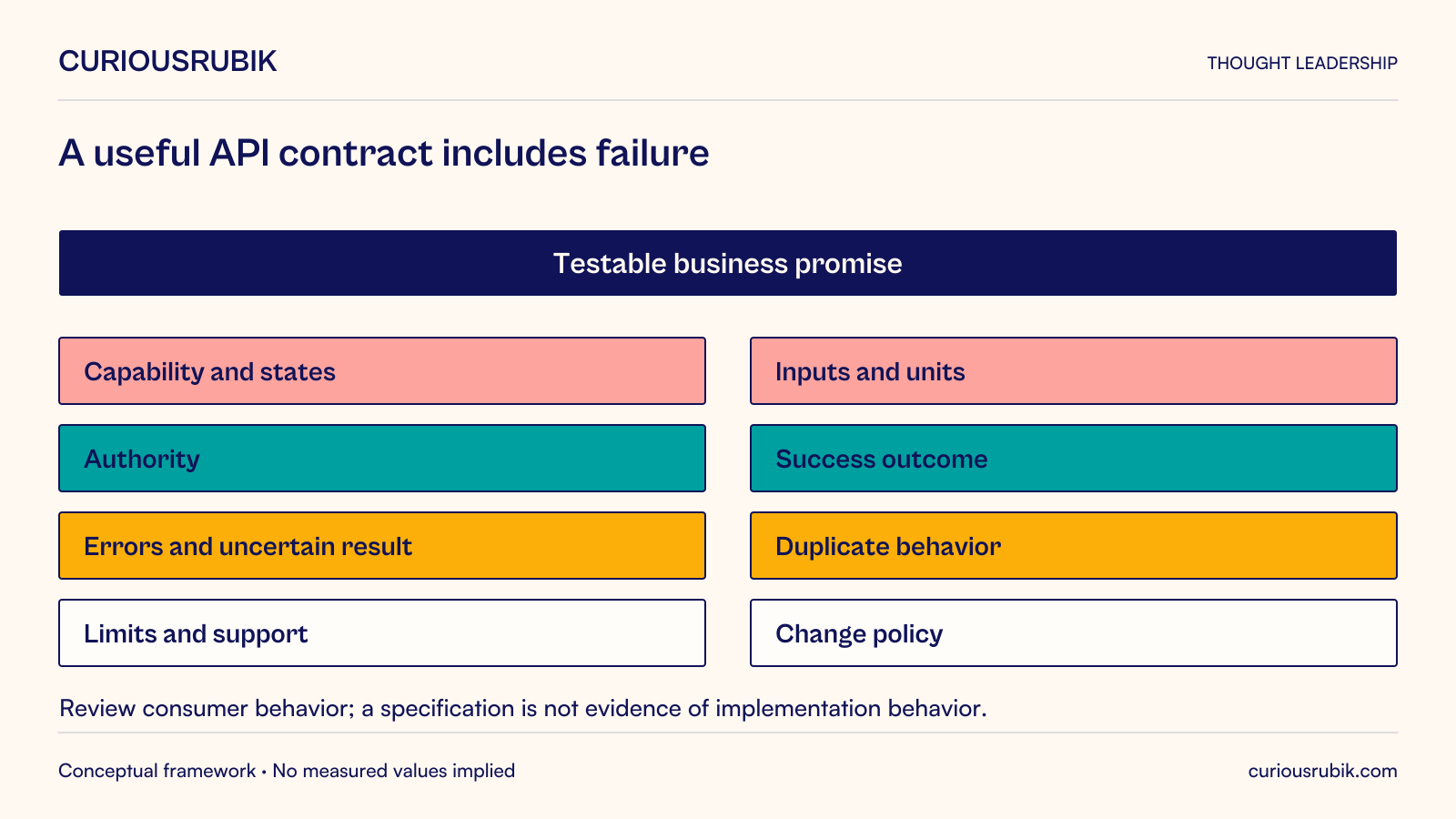
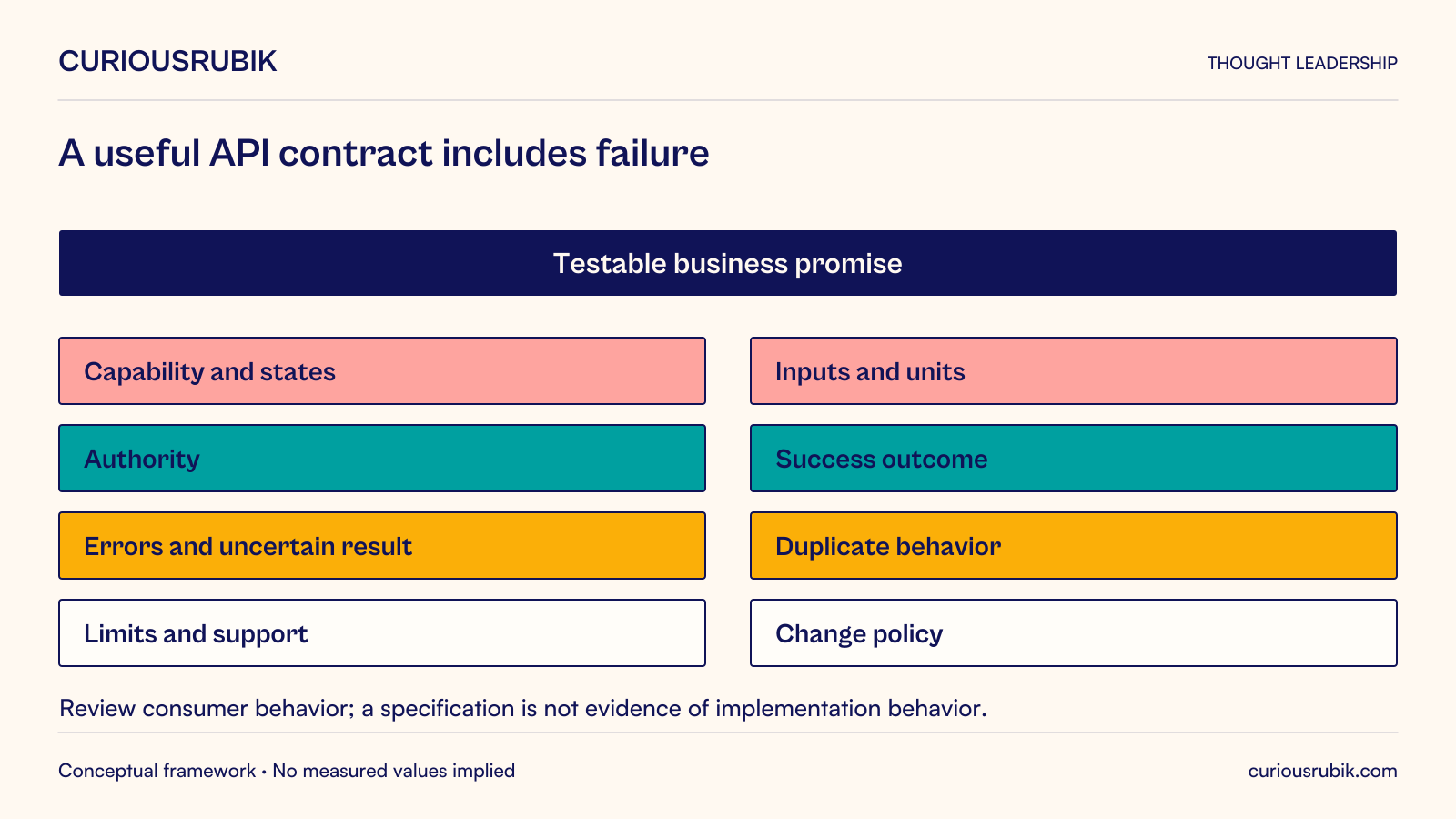
The first deliverable should be a reviewed capability contract with examples. It should explain what the consumer can ask, what the provider commits to do, how the result is identified, which authority is required, and how uncertain or failed outcomes are resolved. The technical specification records that agreement; it cannot replace it.
Define a capability rather than exposing the database
A database table describes how one application stores information. A consumer-facing capability should describe the business interaction. A booking consumer needs to find eligible appointments, request a booking, establish whether it was accepted, and understand permitted changes. It should not need to update several internal tables in the provider’s required sequence.
The provider should retain responsibility for the invariants it owns. An invariant is a condition that must remain true, such as no more than one confirmed booking occupying an exclusive slot. If every consumer must independently enforce that condition, a new channel can easily violate it.
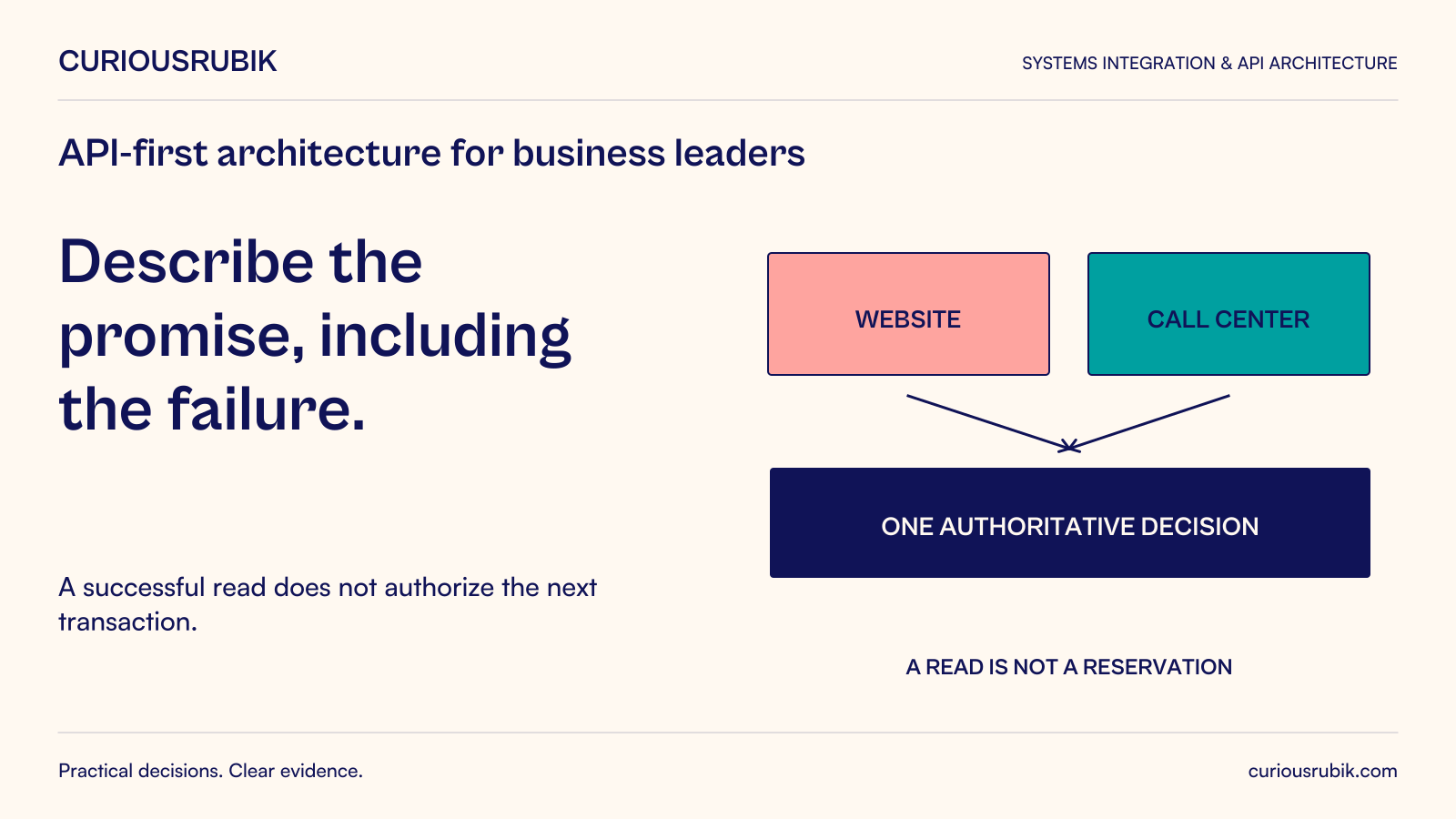
Distinguish reading from acting. An availability response is an observation at a point in time. A booking request asks the authoritative service to change state. The contract must explain whether an available slot is reserved, how long any hold lasts, and what happens when another request arrives first.
Define business states in plain language. “Pending” could mean awaiting payment, awaiting staff confirmation, or accepted but not yet delivered. Consumers need to know which state permits them to tell a customer that an appointment is confirmed. Avoid status names that appear simple while transferring interpretation to every channel.
Review the contract with real consumers
Bring the provider team and at least two materially different consumers into design review when those consumers exist. A website and a call-center application may share booking operations but differ in identity, permissions, accessibility needs, and the information available during an interaction.
Use examples to test the proposed contract. Show a successful request, a missing required fact, an unavailable slot, an unauthorized action, a timeout, and a duplicate submission. Ask the consumer team to explain what it would display or do next. If the answer requires guessing, the contract is incomplete.
OpenAPI 3.1.0 supplies a standard description format for HTTP APIs, including operations, request and response structures, and security schemes. It can support documentation and tooling. It does not establish that the described service is correctly implemented or that business rules are complete. OpenAPI Specification 3.1.0, Introduction and Schema
Mock responses can expose misunderstandings before the service is finished. They are particularly useful for testing consumer behavior and language. They cannot prove transaction isolation, production performance, or recovery from a partial failure, so include those questions in later implementation tests.
A hypothetical last-slot booking
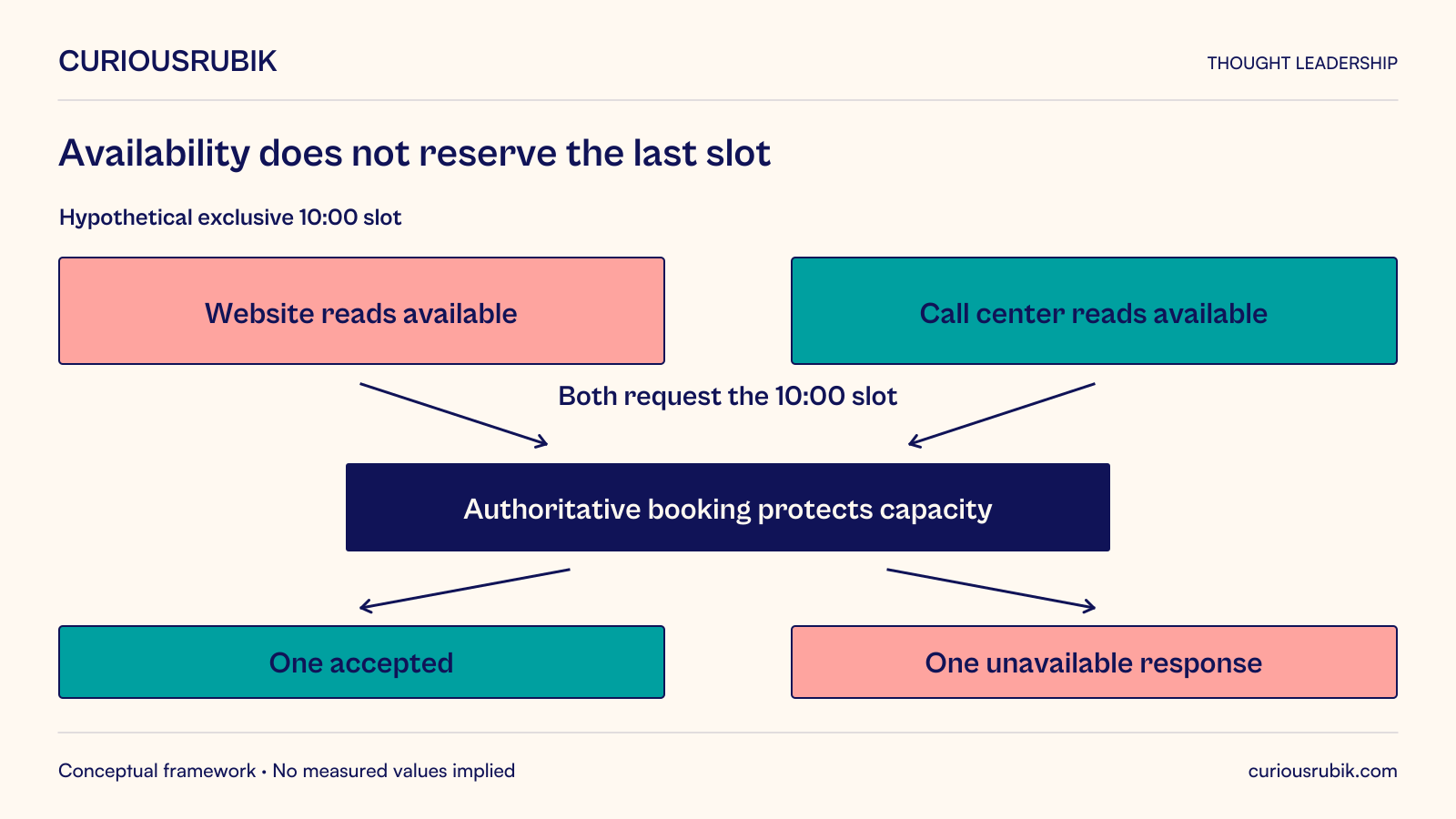
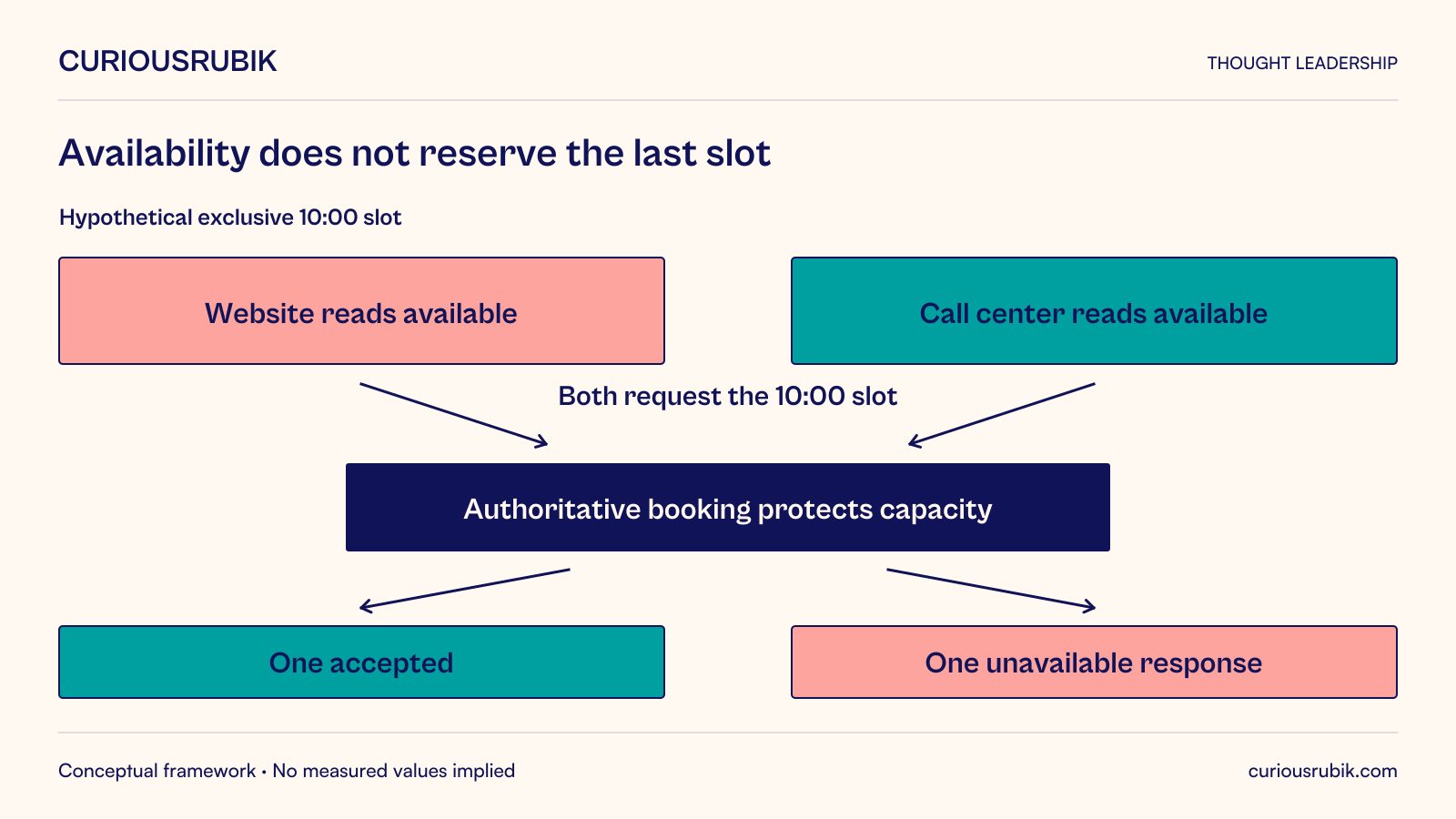
Suppose a hypothetical service business offers one remaining appointment slot at 10:00. The website and call center both retrieve an availability response showing the slot as open. They then submit requests for different customers almost simultaneously.
A weak design lets each channel write a booking record based on its earlier observation. Both can believe they succeeded. A stronger design sends both requests to the authoritative booking operation, which atomically checks and commits the relevant capacity condition using a suitable implementation. One request is accepted; the other receives the contract’s defined unavailable response or an explicitly supported alternative.
Now assume the website’s successful request times out before the response reaches it. The customer presses the button again. The contract needs an application-level mechanism, such as a stable operation identifier with defined duplicate behavior, that lets the consumer establish the original outcome without creating another booking.
The identifier’s scope matters. State whether it is unique per customer, caller, or provider; how long results are retained; what happens if the same identifier is reused with different input; and how an in-progress request is reported. A field named “idempotency key” is not enough unless the server’s behavior supports the promise.
HTTP defines idempotence in terms of repeated requests having the same intended server effect. Its semantics caution against automatically retrying non-idempotent requests without knowledge that doing so is safe or that the original was not applied. A booking POST therefore needs explicit application behavior rather than blind retry. RFC 9110, Section 9.2.2
This example does not prescribe a database, deployment model, or exact status-code scheme. It shows the business questions an API-first review should settle: who owns capacity, what acceptance means, and how a consumer recovers when the result is uncertain.
Include the inconvenient parts of the contract
Error responses should distinguish invalid input, insufficient authority, unavailable capacity, temporary service failure, and uncertain operation state where applicable. Give consumers stable machine-readable reasons and enough safe detail to choose the next action. Avoid exposing confidential internal information in error messages.
For list operations, specify pagination and consistency expectations. A consumer reading several pages needs to know whether records can change between pages and how to avoid omissions or duplicates for its use case. An administrative browsing screen and a completeness-critical export may require different contracts.
Define time and units explicitly. Appointment timestamps need an unambiguous representation and business interpretation, including the relevant time zone for display and scheduling. Quantities need units; monetary values need currencies and precision rules where used. Technical validation that a value is a string or number does not settle its meaning.
Specify limits and operational expectations. Consumers need to understand request-size limits, rate limits, appropriate retry behavior, and support arrangements. Avoid promising a response-time objective that the provider cannot observe or sustain. A service-level target should identify the measured population and conditions rather than hiding exceptions in an undefined “normal load.”
Security needs both identity and authorization. Recognizing a caller does not establish which customer’s appointment it may inspect or modify. The provider should enforce permissions for the requested resource and action, rather than assuming that a trusted channel has already checked everything correctly.
Make compatibility an operating practice
An API-first program needs a clear policy for changing contracts. Removing a field or operation is an obvious breaking change. Changing the meaning of a status, adding an enum value that consumers cannot handle, or tightening validation can also break actual use.
Keep a record of consumers and the behavior they rely on. Provider tests should cover the agreed contract; consumer tests should check their own assumptions against the implementation. A valid OpenAPI document cannot reveal every semantic incompatibility or undocumented dependency.
For incompatible changes, provide a transition plan with support responsibilities and an explicit retirement condition. The old and new versions may coexist, but the organization must fund that period and know which consumers remain. A version number is a label, not a migration strategy.
Measure actual usage before retirement. An undocumented integration may still call an older operation. Investigate the dependency and resolve it through the responsible owner instead of assuming silence means abandonment. Conversely, indefinite support for unused versions increases operating burden and can preserve obsolete behavior unnecessarily.
Budget for the API as a service
Assign an owner who can make decisions about scope, meaning, support, and evolution. Technical operation needs monitoring, incident response, capacity management, access controls, and tested recovery. Consumer onboarding needs usable documentation, examples, and a way to resolve questions.
A shared API is not always the right investment. A one-off export between stable systems may be simpler and sufficient. A highly specialized consumer may need a tailored interface rather than an overgeneralized shared one. API-first should mean deliberate contract design where an API is appropriate, not forcing every interaction into synchronous HTTP.
Evaluate the program through concrete outcomes: whether a new consumer can integrate without discovering hidden rules, whether releases preserve agreed behavior, and whether failures can be investigated from request to business result. These are more meaningful than the number of endpoints published.
Require a traceable acceptance test for each important promise. For the booking service, test two concurrent callers, the same operation identifier submitted twice, a repeated identifier with changed input, and an unauthorized cancellation. Specify the expected persistent state as well as the HTTP response. Two successful-looking responses should not conceal duplicate bookings, and a failed response should not be treated as proof that nothing changed. These tests connect the business contract to observable implementation evidence and give future releases a concrete regression baseline.
Before commissioning the next API, run a contract workshop around one difficult interaction. Use the last-slot example as a model: competing requests, uncertain response, duplicate submission, and a consumer that lacks authority. Approve implementation only when the teams can explain the intended outcomes and their responsibilities. The strongest API-first discipline makes the business promise testable before it becomes a production dependency.