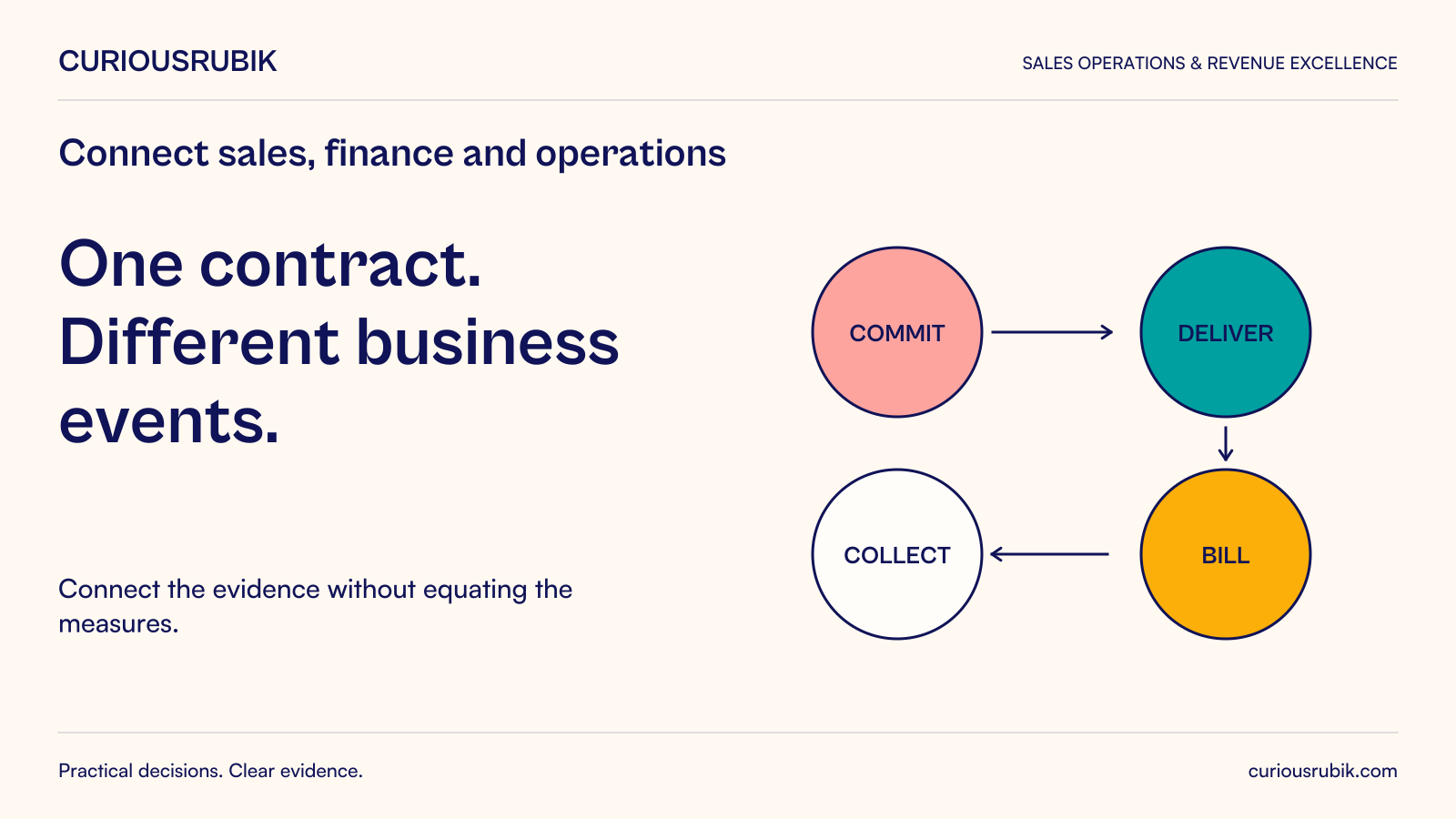
Sales and finance can agree on the value of a deal and still plan different businesses. Sales expects a signature next month. Finance expects an invoice after delivery. Operations cannot begin delivery until a specialist becomes available. The customer expects to pay only after an acceptance milestone. Each view can be internally reasonable while the combined plan is wrong.
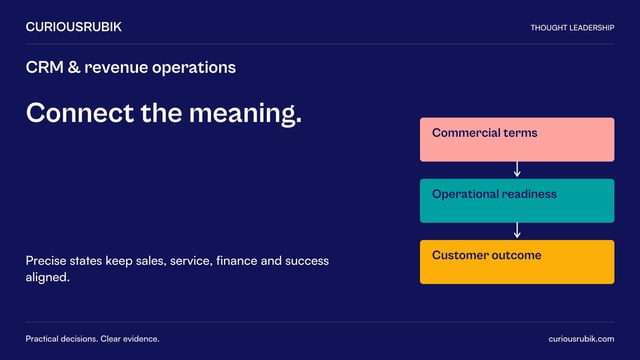
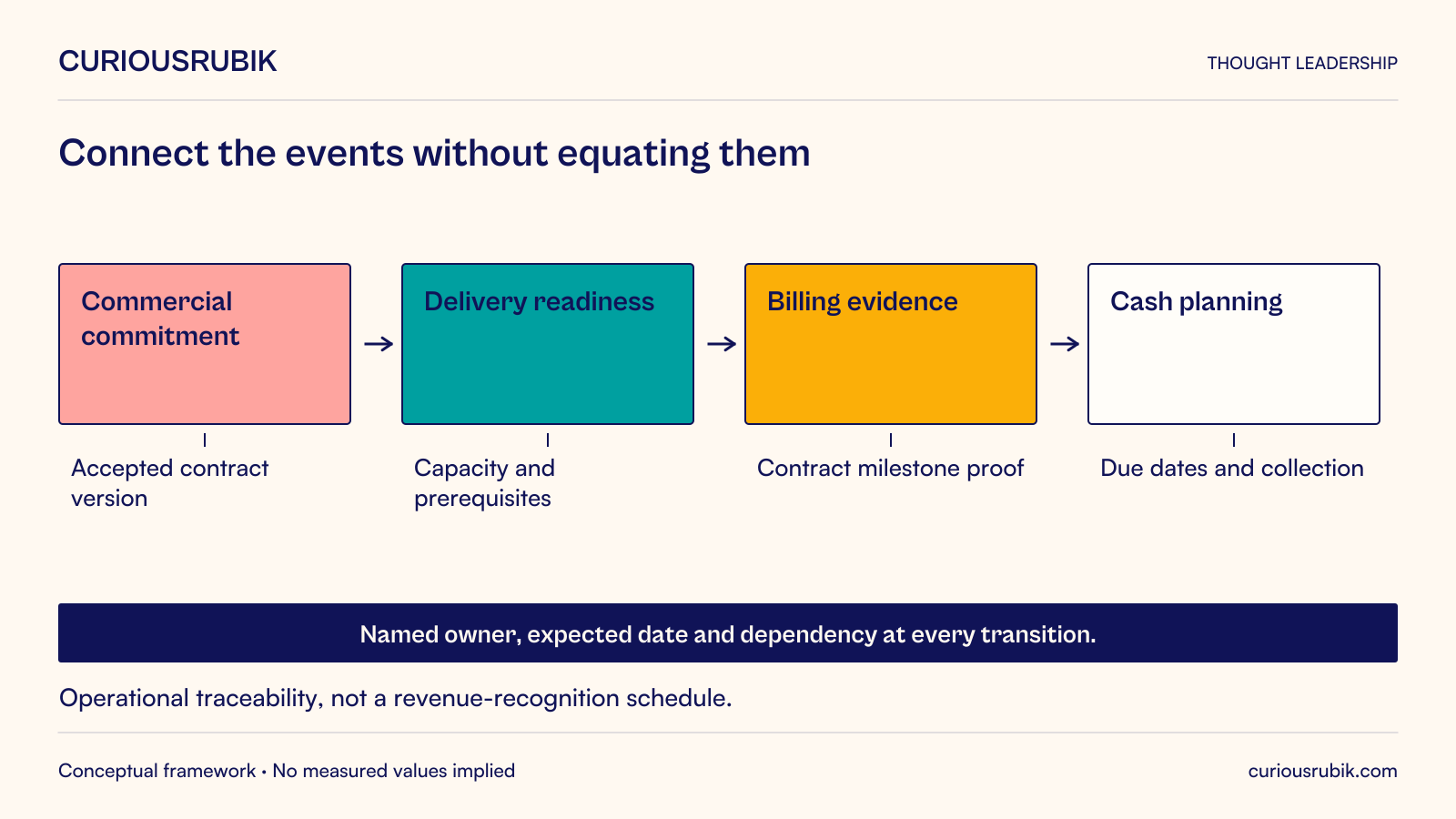
A more predictable revenue operation connects those events without pretending they are identical. Its central artifact is a shared bridge from commercial commitment to operational delivery, billing and collection, with an owner and evidence at each transition. This gives the CFO and revenue leader a practical way to discuss timing, constraints and interventions before differences appear in the financial results.
Predictability here means explainable expectations that can be revised promptly. It does not mean guaranteed revenue, a perfectly smooth quarter or a forecast immune to customer decisions.
Give each team its own measure and a shared connection
Bookings describe commercial commitments under a company-defined policy. Delivery measures describe performance of the promised work. Invoices request payment according to the arrangement. Collections record cash received. Recognized revenue follows the applicable accounting framework and the substance of the contract. These views need reconciliation, not forced equality.
For example, the IFRS Foundation’s overview of IFRS 15 explains that revenue recognition reflects the transfer of promised goods or services and the satisfaction of performance obligations. The fact that a contract is signed or an invoice is issued does not by itself answer every recognition question. The finance team must determine the appropriate treatment for the actual contract. IFRS 15 overview.
The shared connection is a set of explicit relationships: which contract version authorizes the order, which order authorizes delivery, which evidence supports billing readiness, and which invoice a receipt settles. Do not use a customer’s name as the only join between these records. Customers can have multiple contracts, sites, legal entities and amendments.
A common identifier does not require one application to perform every function. It requires each system and team to preserve enough reference information to trace the same commercial obligation through its lifecycle.
Build an event bridge rather than another consolidated number
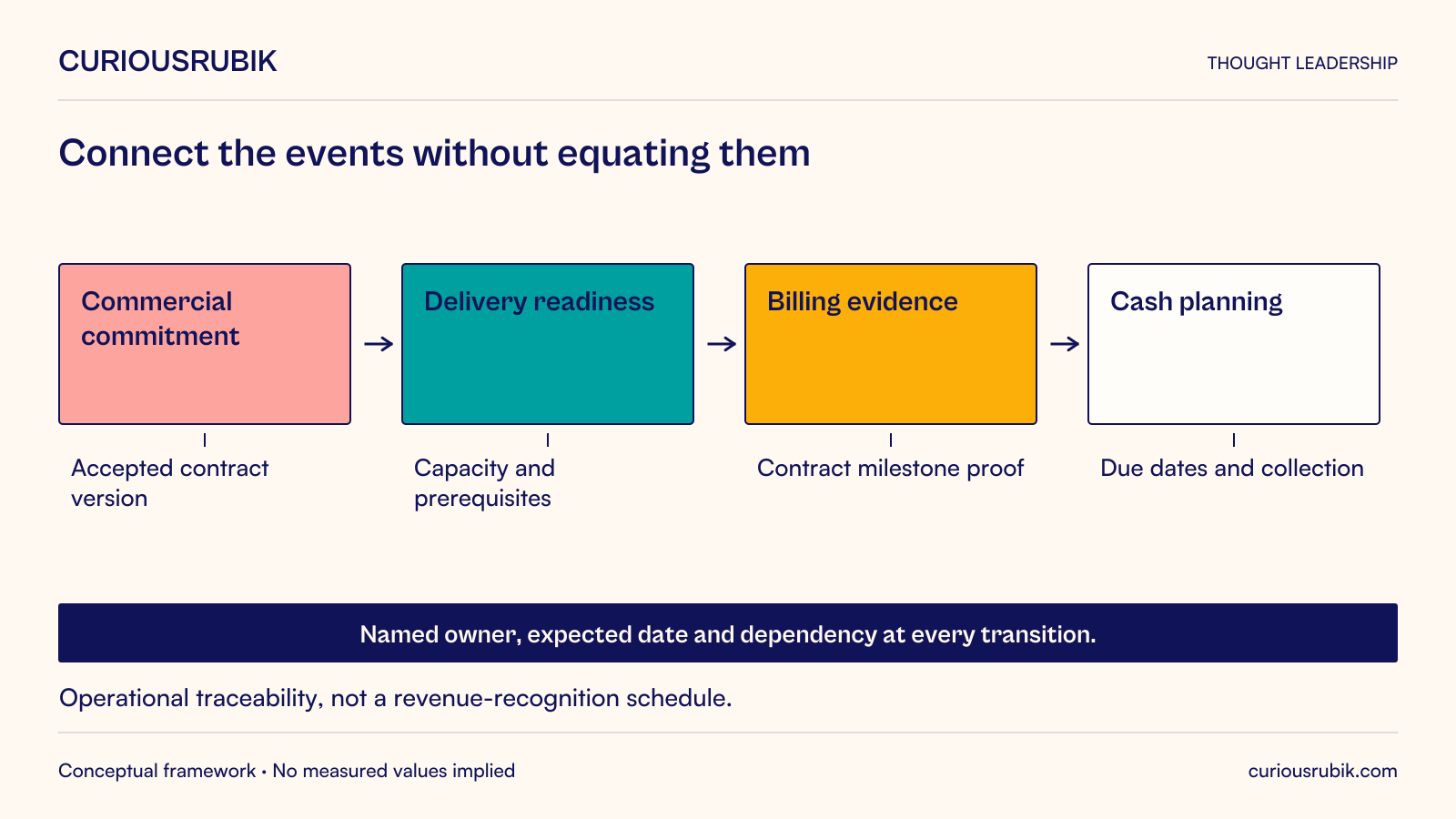
Start with the business events that change a planning decision. A professional-services business might track contract acceptance, staffing confirmation, delivery start, milestone completion, customer acceptance, invoice issue and cash receipt. A product business will need different events. Choose them because they release work, create evidence or change an expectation.
For each event, record an expected date, actual date when known, responsible owner, evidence requirement and unresolved dependency. Where the business needs an amount, specify the meaning and currency. A contract’s total value and a month’s expected invoices should never occupy the same undifferentiated field.
The bridge should show the last trustworthy event and the next blocking dependency. A green status that hides a missing customer approval is less useful than an honest exception with a named owner. Conversely, do not require every team to update every record. Define who changes the authoritative value and how the other views receive it.
This is a proposed operating design, not a standardized revenue-maturity score. Its value comes from making a specific transaction and its next action explainable.
Work through a contract before designing the dashboard
Consider a hypothetical engineering-services firm signing a $120,000 project. The figures and terms are invented for explanation. Its agreement provides for three $40,000 invoices at specified contractual milestones: project initiation, delivery of a design package and customer acceptance of the completed work. Payment terms are assumed to be 30 days from invoice for this example. Actual contracts can differ.
Sales expects signature on April 10. The delivery manager can assign the required specialist on April 24. The project plan therefore cannot simply reuse the signature date as its delivery-start date. The finance team also needs to know what satisfies the first billing milestone, rather than assuming signature is sufficient.
Suppose the contractual initiation requirement is met on April 24, and the first invoice is issued that day. The operational cash plan uses the agreed payment terms to establish an expected due date, while recognizing that due date and actual collection may differ. No conclusion about revenue recognition is being made by this illustrative billing schedule.
The second milestone depends on customer data needed for design. If that data arrives late, the bridge shows a dependency affecting delivery and the expected invoice date. Sales can help obtain the missing input; operations can revise the work sequence; finance can revise the cash expectation. Without the bridge, each team may discover the delay in a separate meeting.
Now imagine an approved $15,000 scope addition. The bridge must identify the amendment, the delivery effect and the billing terms. Adding $15,000 to a CRM opportunity while leaving the project plan and invoice instructions unchanged does not create a connected process. The change must propagate through controlled relationships, with any accounting implications reviewed by finance.
Make planning conditional where reality is conditional
A single date can conceal an assumption. “Invoice on May 31” may really mean “invoice on May 31 if customer data arrives by May 10 and the design is accepted within five working days.” Record those conditions in a form the responsible teams can act on.
Not every dependency deserves a probabilistic model. A small firm may gain more from a clear list of blocked milestones than from assigning unsupported percentages. For concentrated project revenue, scenario planning can be more transparent: expected timing if dependencies hold, delayed timing if a named condition changes, and the action available to reduce that risk.
Keep scenarios coherent. If a delivery delay moves an invoice, it may also move related subcontractor work or change resource availability. A cash forecast that changes the receipt but leaves every associated assumption untouched may be internally inconsistent. Finance should decide which relationships belong in its model and document exceptions.
Separate a management action from an external assumption. A staffing decision within the company’s authority can have an owner and deadline. A customer’s acceptance decision requires evidence and communication, but cannot be guaranteed by an internal target.
Establish a short exception-led planning rhythm
The shared meeting should concentrate on material changes since the last review. Begin with newly committed business that has no feasible delivery path, then delivery milestones with missing prerequisites, then billing-ready work that has not been invoiced, and finally collection issues requiring commercial help.
Define materiality in the context of the business. A small contract can matter if it consumes a scarce specialist or creates a sensitive customer obligation. A large contract can be routine if its conditions and capacity are already established. Amount alone is not the only useful priority rule.
For each exception, leave the meeting with a decision, owner, next evidence and review date. “Sales to follow up” is weak because it does not say what information is needed. “Account owner to confirm the customer’s data-delivery date and attach the agreed schedule” is actionable.
Keep the underlying records authoritative. If the meeting creates a separate spreadsheet that no one reconciles, it becomes another competing version. A lightweight shared view is acceptable, but its inputs, update timing and corrections need ownership.
Set boundaries on commercial flexibility
Sales needs room to negotiate. Finance and operations need to know when a negotiated term changes their commitments. Establish a small set of term changes that require review: unusual acceptance provisions, nonstandard billing milestones, extended payment arrangements, resource-intensive service promises or delivery dates outside known capacity.
The review should answer a commercial question, not merely produce an approval stamp. Can the business deliver the promise? What evidence will demonstrate completion? Can the billing team administer the arrangement? Who owns any continuing manual work? Legal and accounting specialists should assess issues within their responsibilities where needed.
Standard alternatives can make the process faster. If a customer wants a different billing pattern, provide a small set of supported options with known implications. Preserve an exception route for valuable arrangements that do not fit those options. A rigid rule that rejects profitable, manageable work is not a successful control.
Measure connection failures directly
Choose measures that reveal gaps in the bridge: committed projects without confirmed resources, completed milestones awaiting billing evidence, amendments not reflected in delivery plans, or receipts awaiting allocation. Define the denominator and aging rules so the figures can be compared over time.
Avoid treating every delay as a defect. Some milestones intentionally await customer action. Some invoices are held because the required evidence is incomplete. The meaningful distinction is between a known, owned dependency and a record that has disappeared between teams.
Measure the effort to resolve exceptions as well as their count. A process can reduce the number of open items by bundling them into fewer, harder cases. Pair aggregate measures with review of representative records to understand whether the work has actually improved.
The revenue engine becomes more predictable when the next transition is visible, its conditions are understood and someone can act before it stalls. Start with one offering and trace several real contracts from commitment to collection. Reconcile the definitions with finance, map the dependencies with delivery and remove one recurring break. A shared explanation of how revenue turns into work, invoices and cash is a stronger foundation than another forecast number that each department interprets differently.