Continuous operations does not mean pretending an application will never fail. It means understanding which business activities must remain available, which can pause safely and how the organization will restore correct service when a failure occurs.
Resilience therefore includes more than redundancy. The application needs to detect degraded behavior, limit the spread of a problem, preserve trustworthy state and support a recovery process the operating team can execute.
For a business owner and technology lead, the most useful question is whether the service can continue or recover within agreed limits without creating a larger problem. A server that is running again is only part of that answer.
Identify the business service that must continue
Define the activities the application supports and the consequences of interruption. Include the people, data and external dependencies needed to complete them.
Different activities may have different tolerance for delay. Users might be able to view existing work while new submissions are paused. A nonurgent report may wait while a transaction-processing path receives priority. These choices need business agreement rather than an improvised technical response.
Specify what correct operation means during a degraded condition. A read-only view must not appear to accept changes. A pending submission must not be presented as a completed commitment. Essential authorization and integrity controls should remain enforced.
Document the minimum useful service and the conditions under which even that service must stop. Continuing an unsafe or misleading operation can be worse than an explicit pause.
Distinguish recovery time from recoverable data
Recovery time describes how quickly a service must be restored under the agreed scenario. Recovery point concerns the point in time to which data must be recoverable, and therefore the potential data-loss interval the business is prepared to address.
These are different requirements. A service restored quickly from an old backup may still leave unacceptable missing work. A current data copy may be unusable if the application, identity or operating procedures cannot be restored promptly.
NIST’s contingency-planning guidance links business impact, recovery priorities, strategies, exercises and plan maintenance. Its formal context is federal information systems, but the distinction between business requirements and tested recovery capability is useful more broadly. NIST SP 800-34 Revision 1, updated November 2010.
Agree the requirements with the service owner and test the actual design against them. A configured backup interval or a provider’s infrastructure promise does not establish the recovery result for the complete application.
An assignment system needs more than a working login
Consider a hypothetical commercial translation agency whose application accepts client projects, assigns linguists and records deliveries. An outage prevents coordinators from seeing the latest assignment state.
The business may choose to pause new assignments until it can determine which work is already committed. A stale read-only view could help answer some enquiries, but it should show its limitations. Otherwise, coordinators might assign the same job twice or tell a client that work has not arrived when the record is simply unavailable.
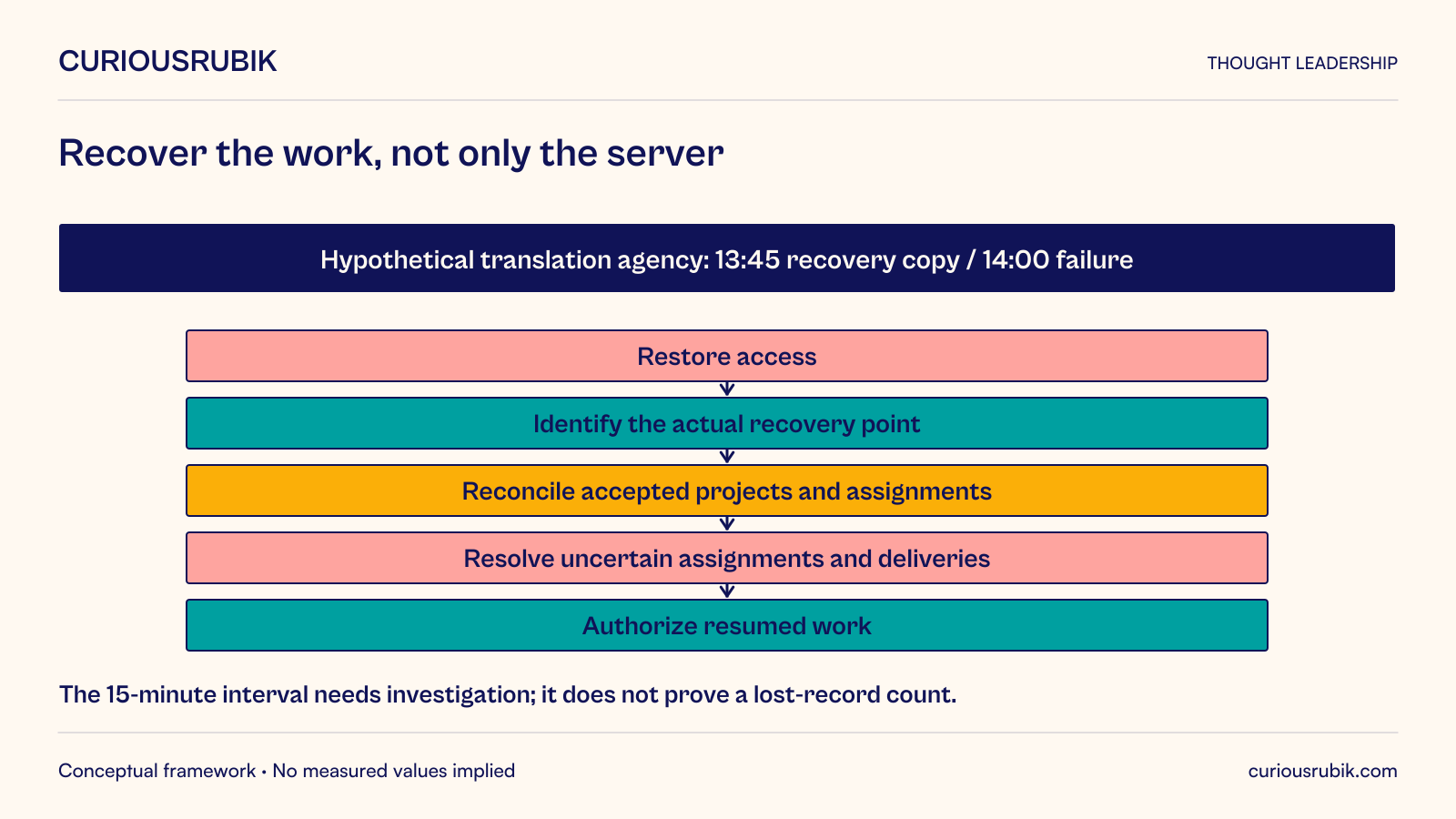
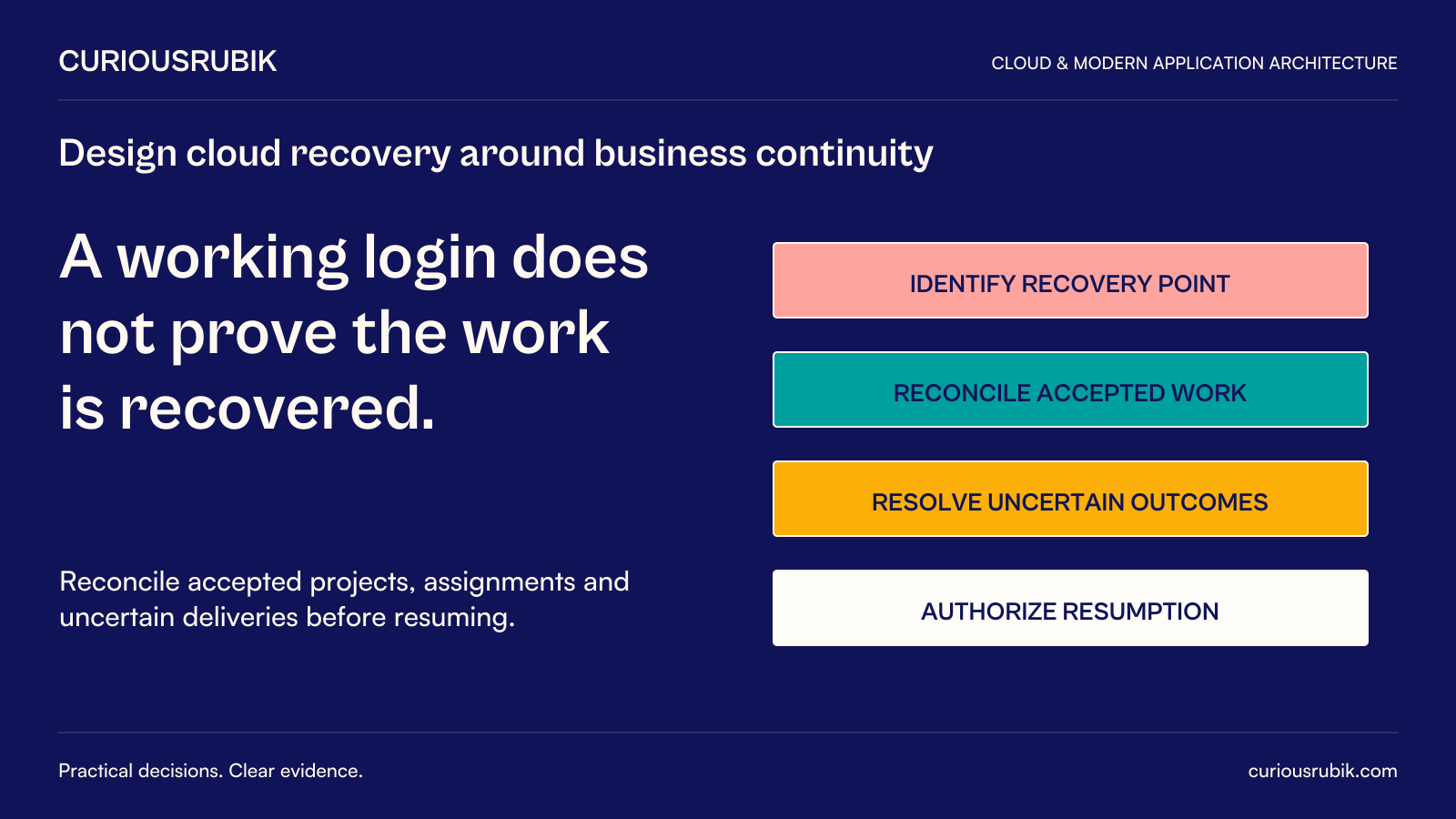
Suppose the most recent usable recovery copy is from 13:45 and the failure occurs at 14:00. The fifteen-minute gap identifies a period whose changes may need reconciliation; it does not tell the team how many projects or assignments were affected, nor prove that all missing changes can be reconstructed.
Recovery must establish the status of work accepted during that interval using trustworthy evidence available under the organization’s procedures. It must also account for activities that continued outside the application, such as a delivery received through an approved alternate channel.
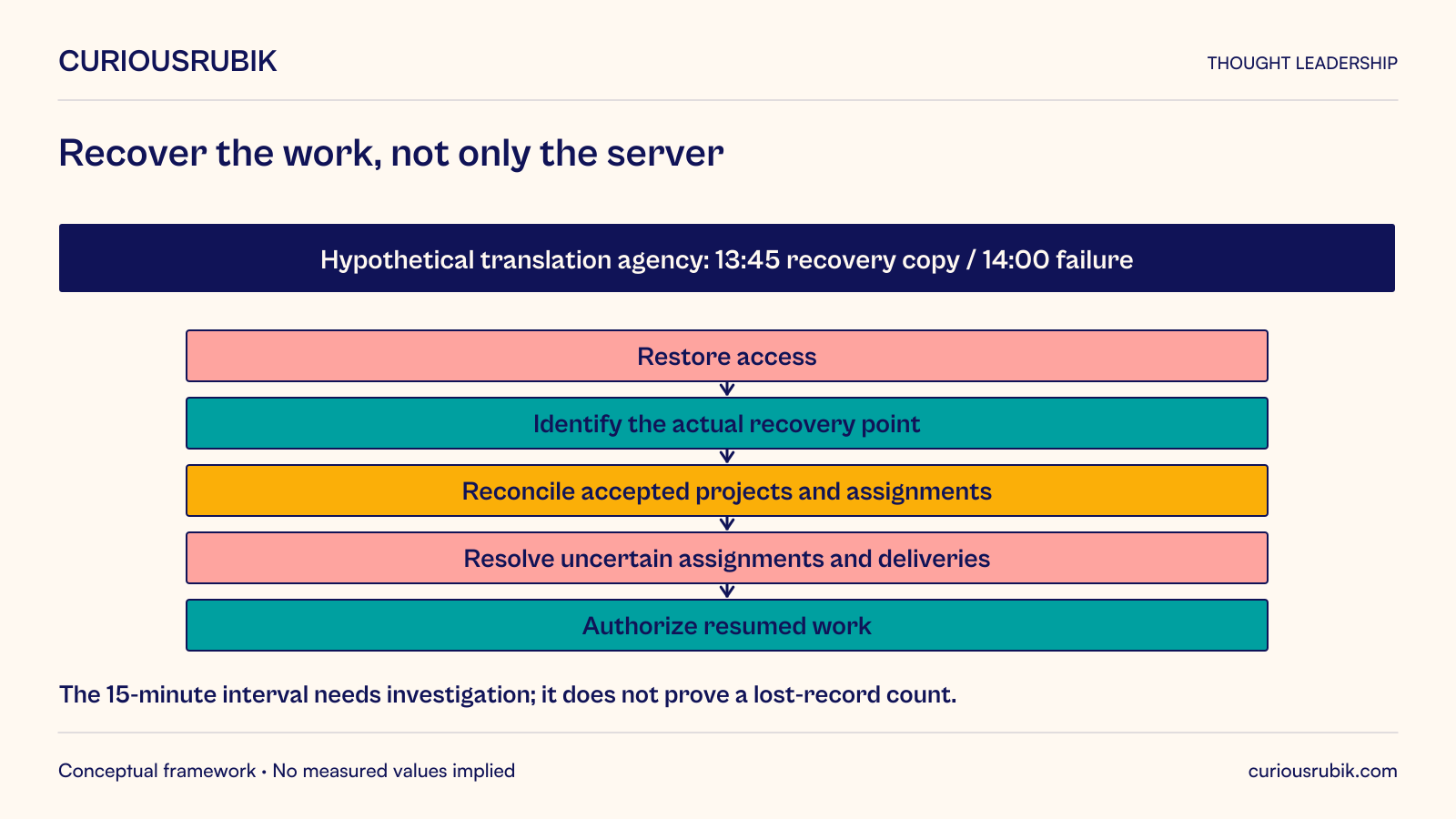
The example illustrates why recovery acceptance belongs to both technical and operating owners. They need evidence that the service is usable and that its critical state can be trusted.
Map dependencies that can defeat redundancy
List the dependencies required for the critical journey: identity, name resolution, configuration, secrets management, databases, storage, queues, network paths and external services. Include the people and permissions needed during recovery.
Two application instances may still depend on one unavailable data service or one erroneous configuration. Multiple locations can share a deployment process that distributes the same defect everywhere.
Distinguish infrastructure failure from application or data failure. A replica can help when one component becomes unavailable, but it may also reproduce an incorrect update. Recovery from corruption may need a different path from failover after an outage.
Evaluate the consequences of a slow dependency as well as a failed one. Long waits can exhaust connections or worker capacity and spread the problem into otherwise healthy components.
The map should support concrete failure scenarios, not simply document the normal architecture. Ask what remains usable when each important dependency is unavailable, delayed or returning an invalid result.
Limit the spread of a failure
Use controls appropriate to the architecture to prevent one problem from consuming the whole service. These can include bounded concurrency, timeouts, isolated resource pools and limits on queued work.
The control needs a defined business response. If an external service is unavailable, does the application reject the request, accept it for later processing or offer a limited alternative? The user and support team should be able to distinguish those outcomes.
Retries need limits and a safe interpretation of uncertain results. A missing response can occur after an operation has already taken effect. Repeating it blindly can create duplicate commitments or additional load.
Prioritize critical work deliberately. Deferring a nonessential analytical job may protect the main service, but deferring a required validation can undermine correctness. The priority policy should reflect consequences rather than technical convenience.
Test how the service returns from degraded mode. A backlog released all at once can overwhelm a recovering dependency and cause another interruption.
Prepare an alternate operating path where it is justified
Some services can continue limited work through an approved manual or alternate channel. Others should pause because the risk of conflicting or unauthorized actions is too high. Decide this before an incident.
For an alternate path, define the permitted scope, required information, responsible roles and how actions will later be reconciled. Protect confidential information and preserve evidence of what was accepted or changed.
In the translation example, an alternate intake process might record a request without promising an assignment until current commitments are known. That is a different service from normal automated acceptance and should be communicated as such.
Avoid an undocumented spreadsheet becoming a second unrestricted system of record. Temporary workarounds need access controls, ownership and an end condition.
Exercise the handback. The difficult step may be merging alternate-channel work into the restored application without duplication or loss, rather than operating the temporary process itself.
Make recovery procedures executable
A useful procedure identifies prerequisites, actions, decision points, validation and escalation. It should be available to the people who need it even when the affected system is unavailable.
Check access and dependencies in advance. Recovery may require credentials, backup catalogs, deployment artifacts or vendor support. Those resources need protected, governed access and a way to remain usable during the relevant failure.
Use clear roles rather than assuming one named specialist will always be available. Another qualified operator should be able to follow the procedure and understand when to stop or escalate.
Record the expected evidence at each stage. A database restore completing without errors is useful, but the team also needs application checks and business validation appropriate to the scenario.
Keep the procedure current when architecture, permissions or supplier arrangements change. A previously successful recovery path can become invalid without any obvious change to the main user interface.
Exercise recovery and controlled failure
Rehearse representative scenarios in an authorized, controlled environment, with safeguards proportionate to the service. Define the purpose and stopping conditions before introducing a failure.
Test more than the simplest outage. Include an unavailable dependency, an erroneous release, a damaged data state and loss of the usual operating specialist where those are relevant risks.
Measure elapsed recovery time and the correctness of recovered work. Record manual intervention, unexpected dependencies and assumptions that proved false. A rehearsal that exposes a weakness is useful evidence, not a reason to redefine success after the event.
Business participants should validate the recovered service. For the assignment application, that includes checking that work is associated with the right project, that uncertain assignments are visible and that resuming intake will not create conflicting commitments.
Repeat exercises when significant conditions change. The objective is maintained capability, not a one-time demonstration filed away at launch.
Treat backlog recovery as part of service restoration
Even after the application is available, accumulated work may keep the business below its normal service level. Determine whether processing capacity can clear that work while new demand continues.
Prioritize the backlog according to business rules and consequences. Do not silently discard older work or process everything in arrival order if another policy is required. Make delayed and uncertain items visible to their owners.
Communicate the distinction between application availability and operational recovery. Users may still experience delays after technical restoration, and they need realistic information about what remains affected.
Monitor for secondary failures during catch-up. Higher processing rates can stress downstream systems, while repeated manual corrections can introduce new errors.
Define the evidence that allows the incident to close. It should include the agreed business recovery conditions, not only a return to green infrastructure indicators.
Learn from failures without normalizing workarounds
After an incident or exercise, identify contributing conditions and corrective actions with owners. Distinguish immediate restoration from the changes needed to reduce recurrence or improve recovery.
Review whether alerts detected the problem at the right level, whether decisions were clear and whether users received accurate information. Technical fixes alone may leave the operating weakness unchanged.
Track corrective actions to demonstrated completion. A revised procedure should be tested; a new alert should be shown to detect the relevant condition; a redundancy change should address the intended failure path.
Resilient enterprise applications support continuity by making failure manageable and recovery trustworthy. The strongest designs combine appropriate technical safeguards with clear business limits, practiced procedures and evidence that the organization can restore correct work when the unexpected happens.