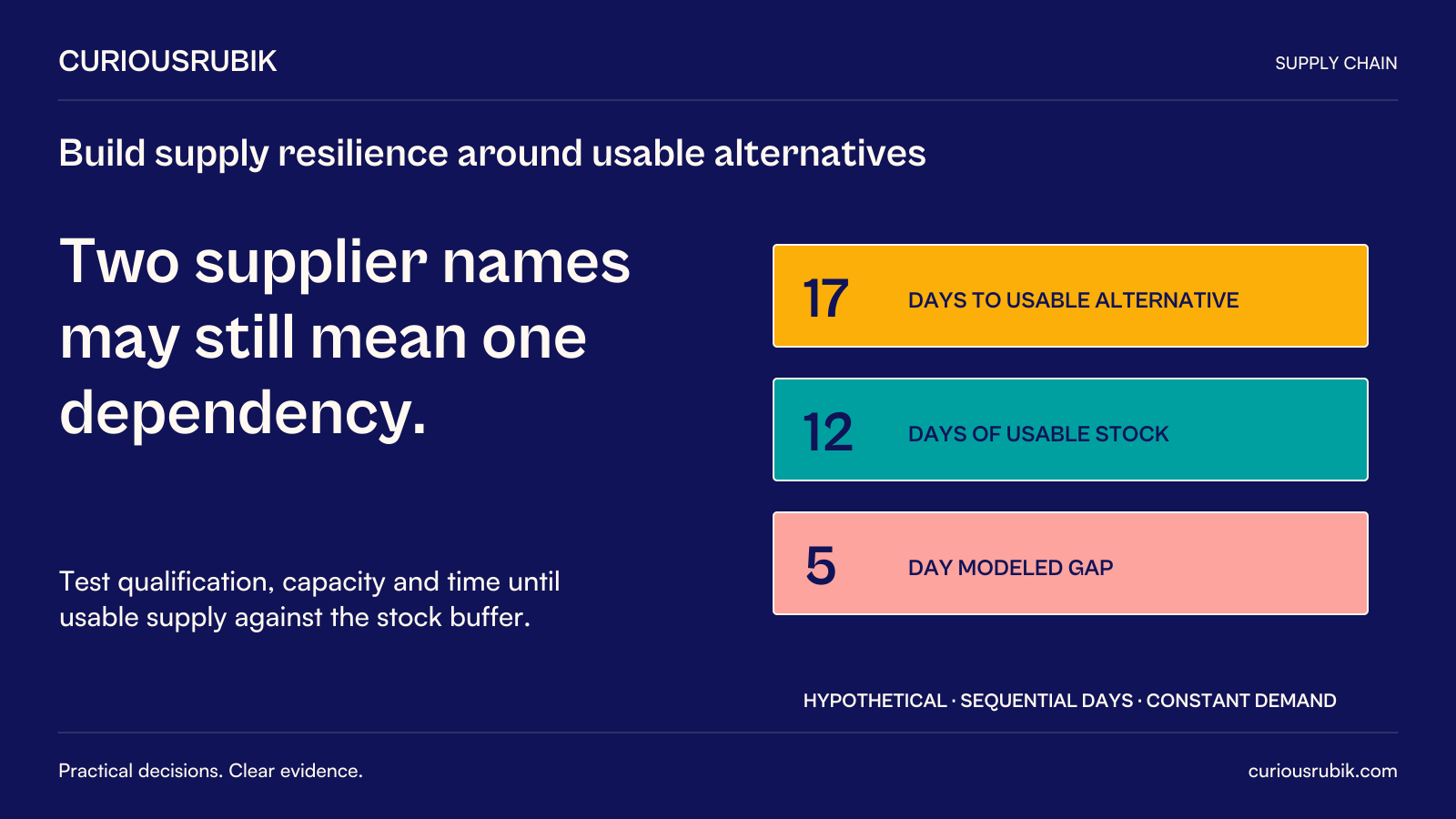
Two approved suppliers can still represent one point of failure. They may depend on the same upstream producer, transport route or scarce component. A supplier count does not reveal that dependence, and a live tracking feed cannot remove it.
Better data contributes to resilience when it changes the options available before and during a disruption. It can expose a shared dependency, show how long a buffer can sustain the operation and establish whether an alternative can become usable in time. The important result is a credible response, not a more elaborate risk dashboard.
That distinction changes the questions leaders should ask of a supply-chain data program: which failure would this information help us prepare for, what action could we take and what evidence shows that the action is feasible?
Map the dependency that can stop the outcome
Begin with a critical product or service outcome and trace the inputs needed to deliver it. Include the components, facilities, tools, skills and logistics that cannot readily be substituted.
The map should go beyond the name of the direct supplier where the consequence justifies deeper investigation. A supplier may use several sites with different capabilities, or several suppliers may share an upstream source. The relevant dependency is the capacity and capability the business actually needs.
Distinguish confirmed information from assumptions and unknowns. A supplier’s general statement about diversification may not establish independence for the particular item. Record the source, scope and date of evidence, along with who will update it.
OECD’s 2021 analysis of global value chains identifies concentration and upstream bottlenecks as factors in exposure to shocks and discusses mapping and stress testing for preparedness. Its economic analysis does not provide a firm-specific guarantee or a universal sourcing rule. OECD, Global Value Chains: Efficiency and Risks.
Use the map to identify a decision, such as validating an alternative source or revising a continuity plan. Collecting every possible supplier fact without a use can create a large maintenance burden while leaving the critical uncertainty unresolved.
Test whether the alternative is usable in time
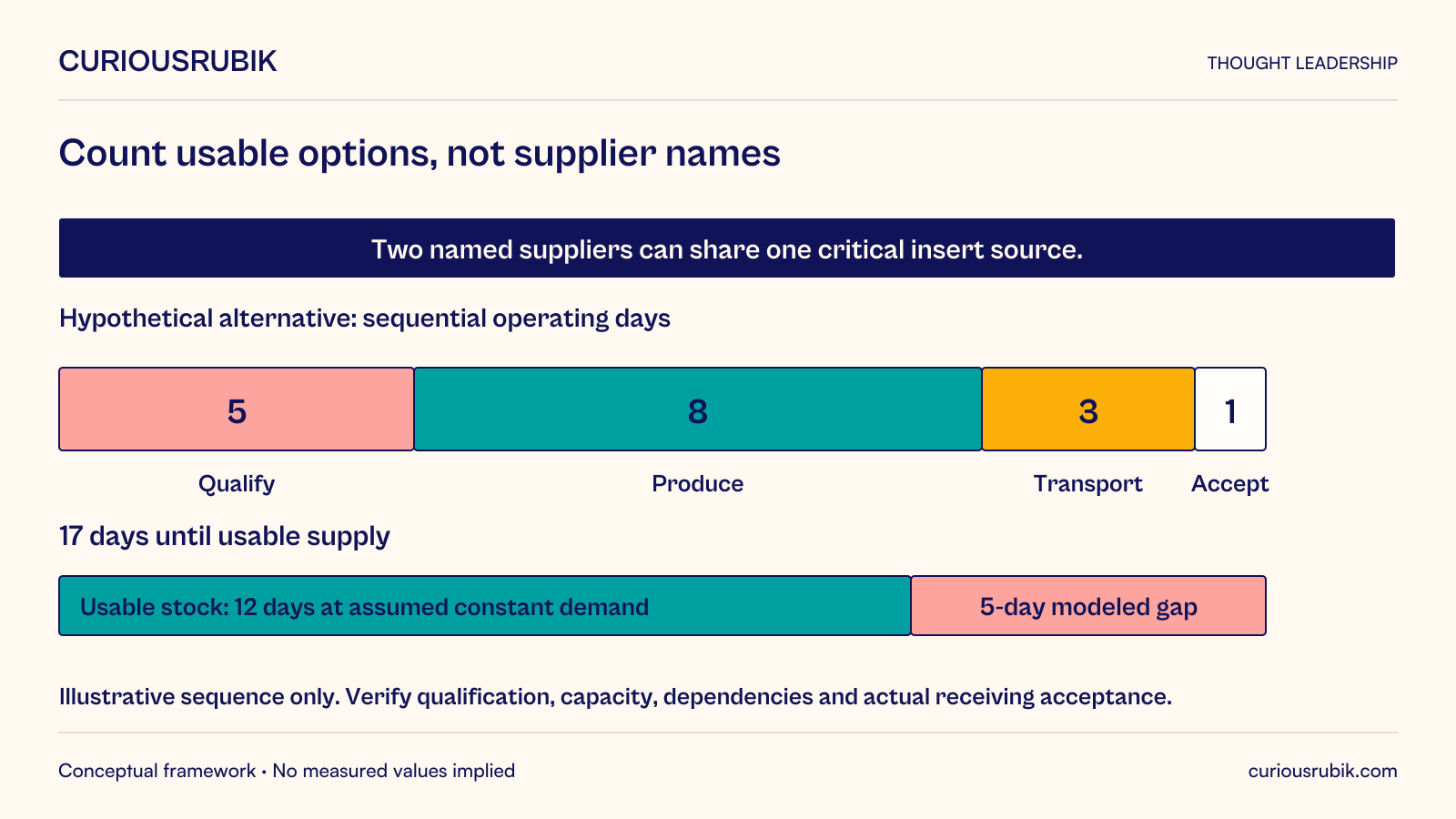
Consider a hypothetical manufacturer buying custom housings from two approved suppliers. Both depend on the same specialist insert. A disruption at that upstream producer affects both supply routes.
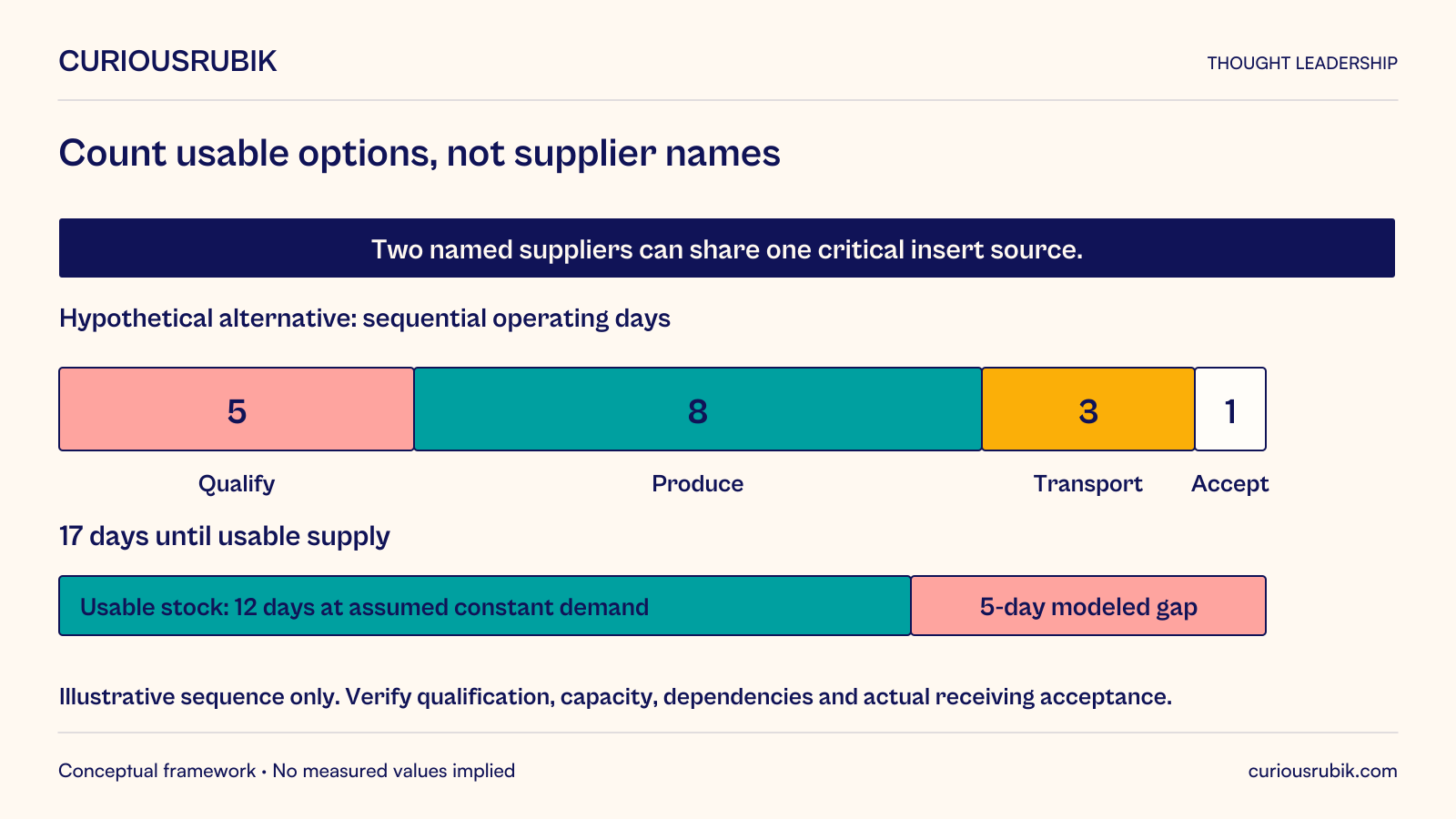
A third supplier can propose an alternative, but it is not yet ready to supply the required configuration. Assume, purely for illustration, that the route requires five operating days for qualification, eight for production, three for transport and one for receiving acceptance. If these stages are sequential and begin at the disruption point, usable supply arrives after seventeen operating days.
Suppose the manufacturer has twelve operating days of usable stock at the assumed constant consumption rate. The simplified scenario exposes a five-day gap. A database entry saying backup supplier available conceals that gap unless it includes the steps and capacity needed to activate the option.
The figures are not a benchmark or a forecast. Actual demand, yield, overlap between stages and transport conditions could change the result. The qualification and acceptance requirements must be determined by the responsible business and technical owners, not shortened casually to make the plan fit.
The business can now examine real options: qualify earlier, hold an appropriate buffer, adjust commitments or develop another technically acceptable route. Each option has cost and constraints. Better data makes the choice explicit; it does not make every option available.
Build a small, decision-ready evidence set
For each material dependency, capture the information needed to evaluate exposure and response. A useful working set includes:
- The affected products or services and their criticality
- The confirmed source, site and important shared dependencies
- Usable inventory and the assumptions behind consumption coverage
- Alternative capability, available capacity and activation prerequisites
- The time and authority required to make the switch
- Evidence age, uncertainty and the next review trigger
This is a practical planning aid, not a validated risk standard. Adapt it to the decision and avoid treating completeness of the form as proof that the chain is resilient.
Pay attention to the word usable. Stock may be reserved, restricted, obsolete or unsuitable for the affected configuration. An alternative may have nominal capacity that is already committed to other customers. A transport route may exist without capacity available during a widespread disruption.
Separate normal lead time from disruption lead time. Historical averages measured under stable conditions may be a weak guide when many customers seek the same scarce capacity simultaneously.
Keep the assumptions visible to the decision-maker. A range with an explanation can be more useful than a precise number whose basis nobody can inspect.
Use scenarios to expose limits, not to predict every shock
Choose scenarios that challenge the critical dependencies: loss of a site, an upstream component shortage, a transport interruption or a sudden change in demand. Include combinations where they are credible and consequential.
For each scenario, trace the response through time. What can the business continue to produce? Which commitments become unsupported? When does a buffer run out, and when can an alternative provide usable output?
Do not assign arbitrary probabilities simply to create an expected-loss number. Some scenarios are useful because they reveal an important dependency even when the likelihood cannot be estimated reliably.
Test the response assumptions with the people who would execute them. Procurement may know an alternate supplier, while engineering knows the qualification work and operations knows the receiving constraint. A plan assembled from isolated estimates can miss the dependency between those steps.
Include recovery to normal operations. A temporary alternative can create backlogs, different packaging, changed data or customer commitments that need reconciliation after the original supply returns.
The scenario should produce a decision and an owner. If every exercise ends with a general recommendation to improve visibility, the analysis has not yet reached an actionable level.
Preserve flexibility without buying unnecessary complexity
Additional suppliers, inventory and logistics options can provide resilience, but they also create cost and operating obligations. The right balance depends on the product, consequence and evidence.
A second source may require continuing qualification, minimum volumes or tooling. A buffer ties up capital and storage capacity and may become obsolete. A different route may increase lead time or handling. These are tradeoffs to evaluate, not reasons to reject every resilience investment.
Conversely, concentration can have operational advantages such as specialized capability or consistent quality. The decision should compare those benefits with the consequence and recoverability of the dependency.
Avoid assuming that local supply is automatically independent or that distant supply is automatically fragile. Examine the actual sites, inputs and routes. Geographic labels alone can conceal both shared risks and useful diversification.
Document which options the business is paying to preserve and when they will be tested or reviewed. An unused backup that has not been exercised or maintained may provide less protection than its name suggests.
Turn early warning into a prepared response
A warning is useful only if it arrives with enough time and authority to act. Define the signals that would trigger investigation or a planned response, and identify the owner of each decision.
The signal might concern a supplier’s confirmed capacity change, a delayed milestone, an aging inventory position or a newly identified shared dependency. Distinguish reliable observations from unverified reports and forecasts.
Specify what evidence is needed before making a consequential change. A concerning report can justify contacting the supplier or reviewing a scenario without automatically authorizing a large order or a customer commitment.
Keep the response plan connected to current data. If inventory coverage or alternate capacity changes, the trigger and options may need to change as well. A static plan can become misleading even while its contact list remains current.
Record what happened after an alert. Did the team validate the issue, activate an option, change a plan or determine that no action was needed? That history helps improve both the signals and the response process.
Maintain the evidence through the supplier relationship
Suppliers may have legitimate confidentiality concerns about upstream sources and capacity. Agree the purpose and scope of information sharing, and protect the data appropriately. In some cases, a bounded assurance or verified capability test may be more practical than access to every detail.
Make requests proportionate and useful. Asking a partner to maintain a large questionnaire that nobody reviews can weaken cooperation. Focus on information that changes a specific preparedness decision.
Assign internal ownership for updates. Procurement, engineering, operations and risk teams may each hold part of the evidence, but someone must coordinate the critical dependency view and resolve conflicting assumptions.
Review it when products, suppliers, sites or service commitments change, and after incidents or exercises reveal a gap. A past qualification or a historical capacity statement should not be treated as permanent evidence.
Supply-chain resilience is built from prepared choices. Better data helps the organization see where those choices are limited, establish which alternatives are real and act before uncertainty becomes an unsupported promise. The most useful data program is the one that makes a specific response more credible, not the one that produces the largest collection of risk indicators.