Does Your Customer Portal Match Your ERP Data? Test stock, order and delivery information against its source.
Every customer-facing statement in a portal should have an operational basis. “Available,” “confirmed,” “shipped,” and “canceled” need defined meanings, authoritative source events, and behavior for the moments when the underlying information is incomplete or late.
Design those meanings with operations and customer service before polishing the interface. The portal should communicate what the business can support at that point in the transaction, including uncertainty. A fast refresh does not by itself establish that a promise is safe.
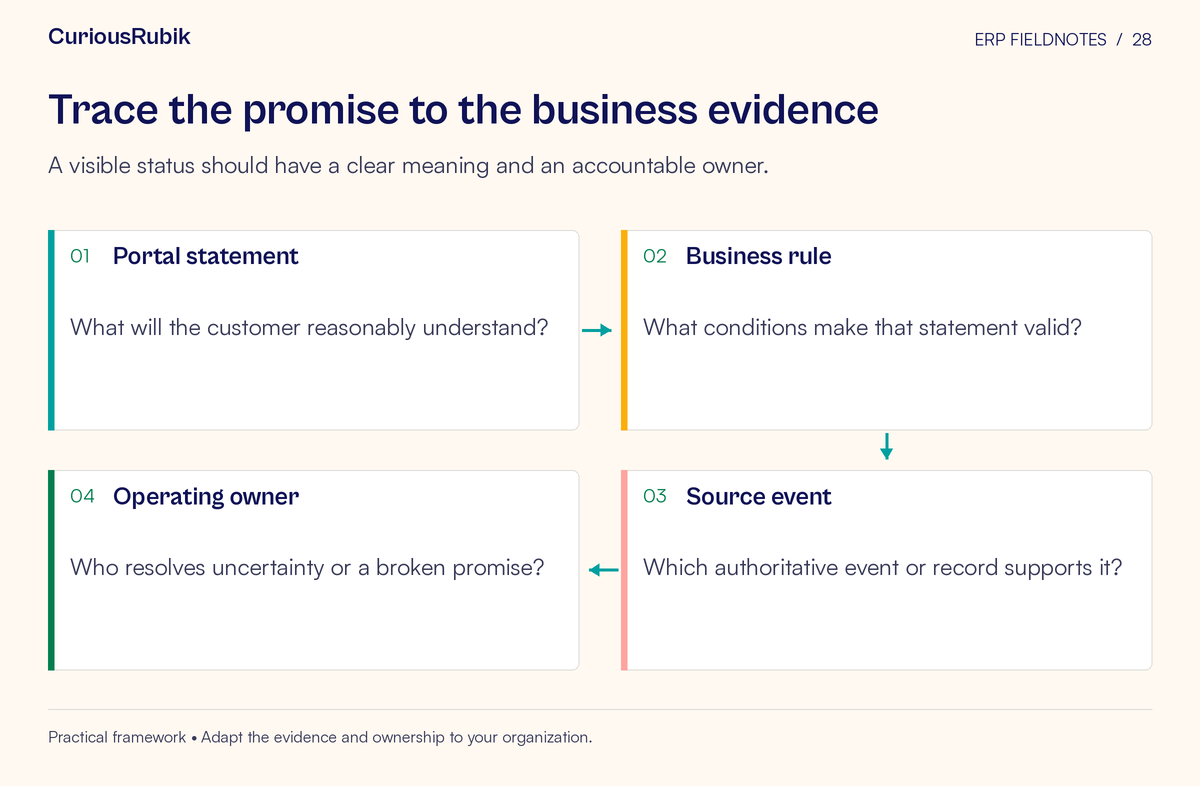
The practical starting point is a promise-to-source matrix. It connects the words customers see to the business evidence required to display them and the action the portal should take when that evidence is missing.
Inventory the promises customers can act on
Walk through the customer journey and collect every statement that could influence an action. Include product availability, customer-specific price, delivery estimates, order acceptance, allocation, dispatch, returns, credits, and cancellation.
Look beyond the main screen. Confirmation messages, downloadable documents, email notifications, and customer-service scripts can make different promises about the same event. A qualified status on the portal can be undermined by an automatic message that says the order is fully confirmed.
For each statement, ask what a reasonable customer is likely to understand. “In stock” may be read as “you can buy this quantity now,” even if the number actually means physical stock before reservations, quality holds, and site restrictions.
The business needs to choose its wording and commitments deliberately. Commercial and legal reviewers should assess terms or messages with contractual significance. The design team should not infer legal acceptance from a technical processing status.
Build a promise-to-source matrix
Use one row for each meaningful customer promise:
- Customer-facing statement and channel: ______
- Business meaning and permitted customer action: ______
- Authoritative source event or calculation: ______
- Entity, site, item, account, and transaction scope: ______
- Business owner responsible for the promise: ______
- Required data freshness and completeness evidence: ______
- Additional validity rules, including holds or approvals: ______
- Behavior when the evidence is stale, uncertain, or unavailable: ______
- Customer-service view and exception owner: ______
- Evidence needed to test the promise end to end: ______
The validity rules matter as much as freshness. A recent stock balance can be accurate and still be unsuitable for a particular customer, site, delivery method, or order quantity. A current price may still depend on quantity, currency, effective date, or an unapproved exception.
Write the source event precisely. “ERP status” is too vague. Identify the event that establishes the business fact and the mapping that converts it into the portal’s language.
Separate receipt from acceptance
An order submission often passes through several business states. The portal may receive the request before pricing, credit, availability, shipping conditions, or other required checks have finished.
Give those states distinct meanings. A possible design is:
- Request received: the submission has been recorded and can be referenced
- Accepted: the organization’s defined acceptance checks have succeeded
- Allocated: the approved process has assigned the required supply or capacity
- Dispatched: the defined shipping event has occurred
- Completed: the relevant completion conditions have been met
These are illustrative labels, not a universal order model. A business may need different states or combine some of them. The important point is that each label is supported by the correct event and does not imply that later conditions have already been satisfied.
A message such as “Request received. Availability is being checked” may be appropriate while checks are pending. Do not add a response-time promise unless the operating team can support it and has approved the commitment.
Give the customer a stable reference and a way to inspect progress. Customer service should see the same submission and its current processing state, rather than asking the customer to submit it again because it has not yet appeared as an accepted order.
Test availability with competing demand
Consider a hypothetical stock position: twelve units physically present, eight already reserved, two unavailable because of a quality hold, and two eligible for a new order under the scenario’s rules.
The physical stock count is twelve. The illustrative eligible quantity is two. Publishing the first number as immediately available would misrepresent the defined promise even if the source refreshed moments ago.
Now imagine two customers each requesting those two eligible units at nearly the same time. Both may have viewed a valid earlier availability display. The acceptance and reservation process must determine which commitments the business can actually support.
The implementation team should test this competition in the intended architecture and define the customer response when the requested quantity is no longer available. The answer might be a backorder choice, an alternative location, a revised quantity, or a request for service assistance. It should not be an unexplained failure after a confident confirmation.
This scenario shows why freshness and commitment are separate design questions. A portal display describes information available at a moment; an authoritative acceptance process establishes what the business has agreed to fulfill.
Design the degraded behavior before launch
For each promise, define the acceptable response to three conditions.
Stale information. The last known value exists, but it is outside the business’s approved freshness boundary. The portal might show it with a clear qualification, restrict a dependent action, or request a fresh check.
Uncertain information. A source is available, but the required business checks are incomplete or conflicting. The portal may need a pending state or human review even when all messages are recent.
Unavailable information. The required source or processing service cannot provide a usable result. The portal needs an honest explanation and an appropriate route to wait, retry safely, or obtain help.
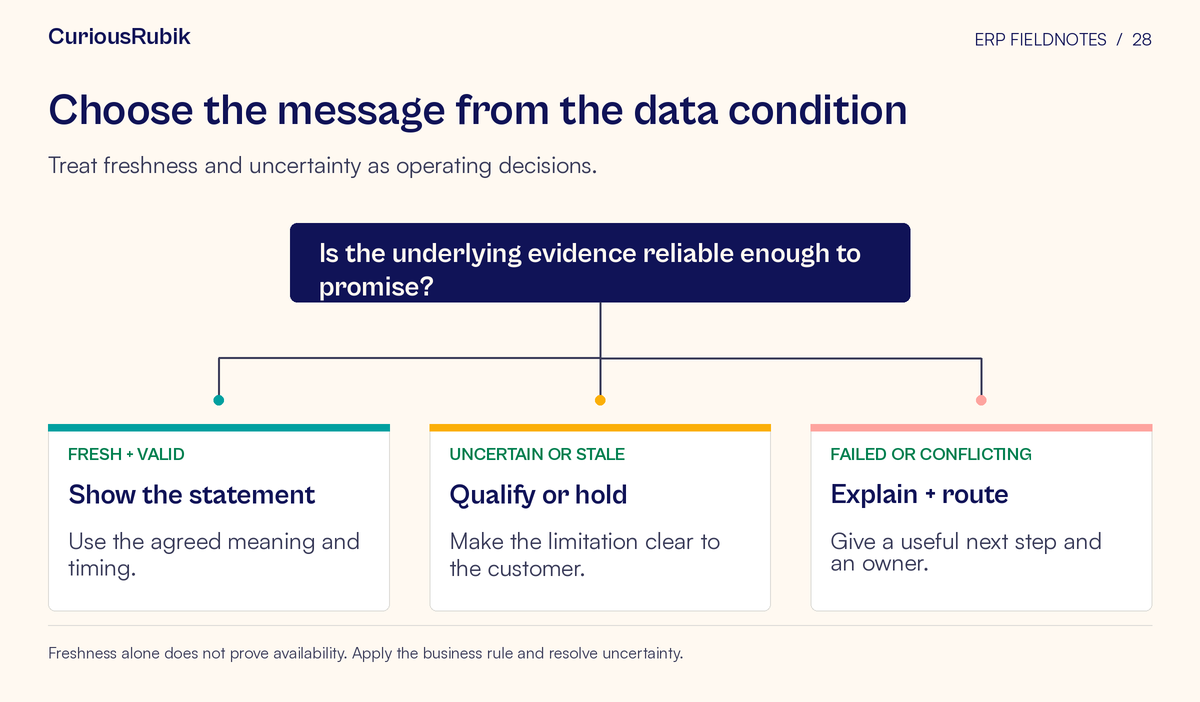
The choice should depend on the consequence of a wrong promise. An approximate historical usage chart may tolerate a visible delay. A firm delivery commitment or account-specific price can require a different response. There is no universal acceptable age for ERP data.
Keep the communication specific enough to help without exposing internal security or system details. If the portal cannot confirm availability, say that. Avoid a generic success message that hides an unresolved operational decision.
Make retries safe for the customer
A customer may press submit again because the screen did not receive a response. The original request may have failed, succeeded, or still be processing. The customer should not have to infer which state applies.
Design a stable submission reference and a supported means of checking status. Have the technical team verify how repeated submissions, delayed responses, and reconnection are handled in the actual implementation. Confirm that the business outcome is correct and that duplicate orders or notifications are detected and resolved as designed.
Do not promise that a particular retry mechanism provides universal protection. The complete path includes the portal, its integration, the ERP transaction, and any downstream processing. Test the relevant failure points and preserve enough evidence to connect a retry to the original request.
Customer service needs a recovery procedure for ambiguous cases. It should explain how to determine whether an order exists before creating another one, who may correct the state, and what the customer should be told.
Give amendments and cancellations their own state model
A customer pressing “cancel” does not necessarily mean the underlying order has been canceled. Fulfillment may already have progressed beyond the point where the request can be applied automatically.
Define when a cancellation is a request, when it is accepted, and how partial fulfillment affects the result. Use similarly precise rules for quantity changes, address amendments, substitutions, and returns.
Test changes that cross in transit. A dispatch update may arrive after a cancellation request. An older status message may arrive after a newer one. The implementation must apply the approved business-state rules rather than presenting whichever message happened to arrive last.
Give users a clear view of the accepted result. If six units were dispatched and four canceled in an illustrative ten-unit order, the portal should preserve both facts under the relevant process rules. A single “canceled” label could obscure the dispatched portion and create avoidable confusion.
Put customer service on the same evidence
The service team needs the promise history as well as the current status. Record what the portal displayed or committed where it matters, the supporting event, and any subsequent change or exception.
Define which team owns each queue: pending acceptance, uncertain availability, failed amendments, delayed fulfillment updates, and unresolved duplicate submissions. Customer service should know whether it can resolve the issue or must route it to another accountable owner.
Avoid creating a private service workaround that contradicts the portal’s rules. If an authorized employee can make an exception, capture the decision and ensure the resulting state returns to the customer-facing view.
This is also a training requirement. Service staff should understand the difference between request receipt, business acceptance, and fulfillment commitment so their explanation remains consistent with the system.
Release the promise only after testing the failure
For each high-consequence promise, retain evidence from a normal transaction and at least the relevant failure conditions. Useful cases include a stale stock feed, simultaneous demand, a pending approval, a source outage, a repeated submission, a partial shipment, and an amendment arriving too late.
Judge the customer outcome, not merely whether the integration returned successfully. Did the portal communicate the correct state? Could service identify the same transaction? Was the next action clear? Did the process prevent an unsupported commitment?
Monitor the resulting exception populations after launch. Review where customers repeatedly contact service because a portal state is unclear, where pending work ages without ownership, and where accepted commitments change unexpectedly. Use those findings to improve the rules and operating process.
Start with the strongest promise on the portal, usually a statement about availability, price, or delivery. Trace it to its source, test the uncertainty, and agree what the customer should see when the business cannot yet be certain.