A customer calls about a promise made three weeks ago. The account manager is unavailable. The colleague who answers can find the customer’s contact details and purchase history, but cannot establish what was promised, why an exception was agreed, or who has authority to resolve it.
The organization has stored customer data without preserving the relationship’s working context. The immediate problem is inconvenience. The larger problem is that the company’s commitments become difficult to honor whenever one employee is absent, changes roles, or leaves.
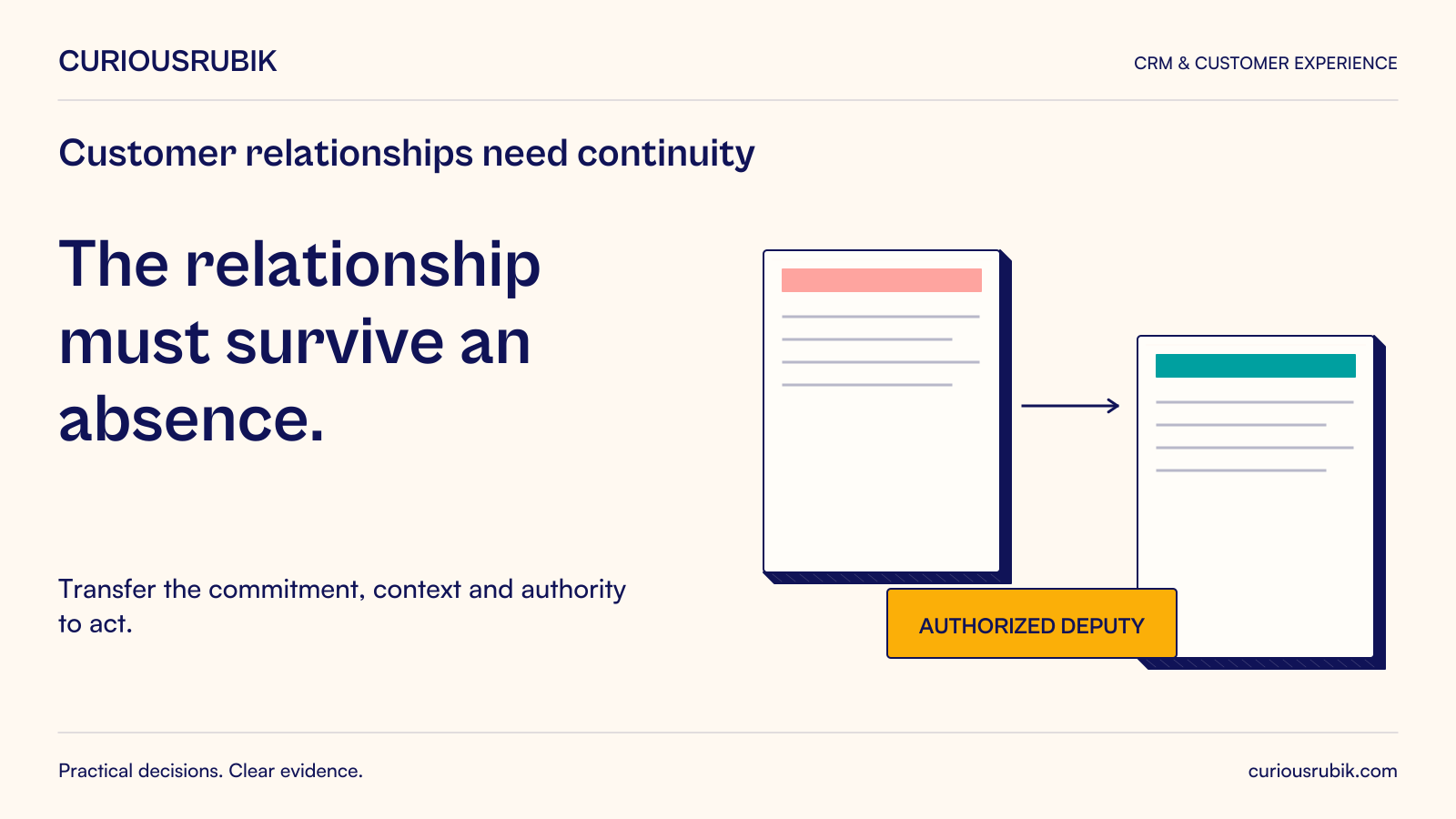
Personal trust remains central to many customer relationships. The management objective is to support that trust with institutional continuity: another authorized person should be able to understand the current position, meet an existing obligation, and explain the next step. Achieving this requires deliberate handoffs and decision records, not an indiscriminate archive of everything an employee has ever said.
Separate relationship strength from dependency
An experienced employee may understand a customer’s commercial priorities, informal buying process, and tolerance for operational disruption. Some of that knowledge is tacit and develops through repeated interaction. Attempting to convert every nuance into a database is unrealistic and can damage the quality of the relationship.
Dependency becomes a business risk when essential facts or authority exist only in one person’s memory. The renewal date, an unresolved complaint, a promised service credit, or a customer’s preferred escalation route should remain available to appropriately authorized colleagues.
The distinction helps avoid a common overreaction. Leaders sometimes respond to key-person risk by demanding exhaustive notes or copying broad groups into customer correspondence. That creates noise, increases exposure of personal information, and makes the important obligation harder to find.
Preserve the minimum context needed to continue responsible service. Retain personal judgment where it adds value, while making material commitments visible, attributable, and actionable.
Identify what must survive an absence
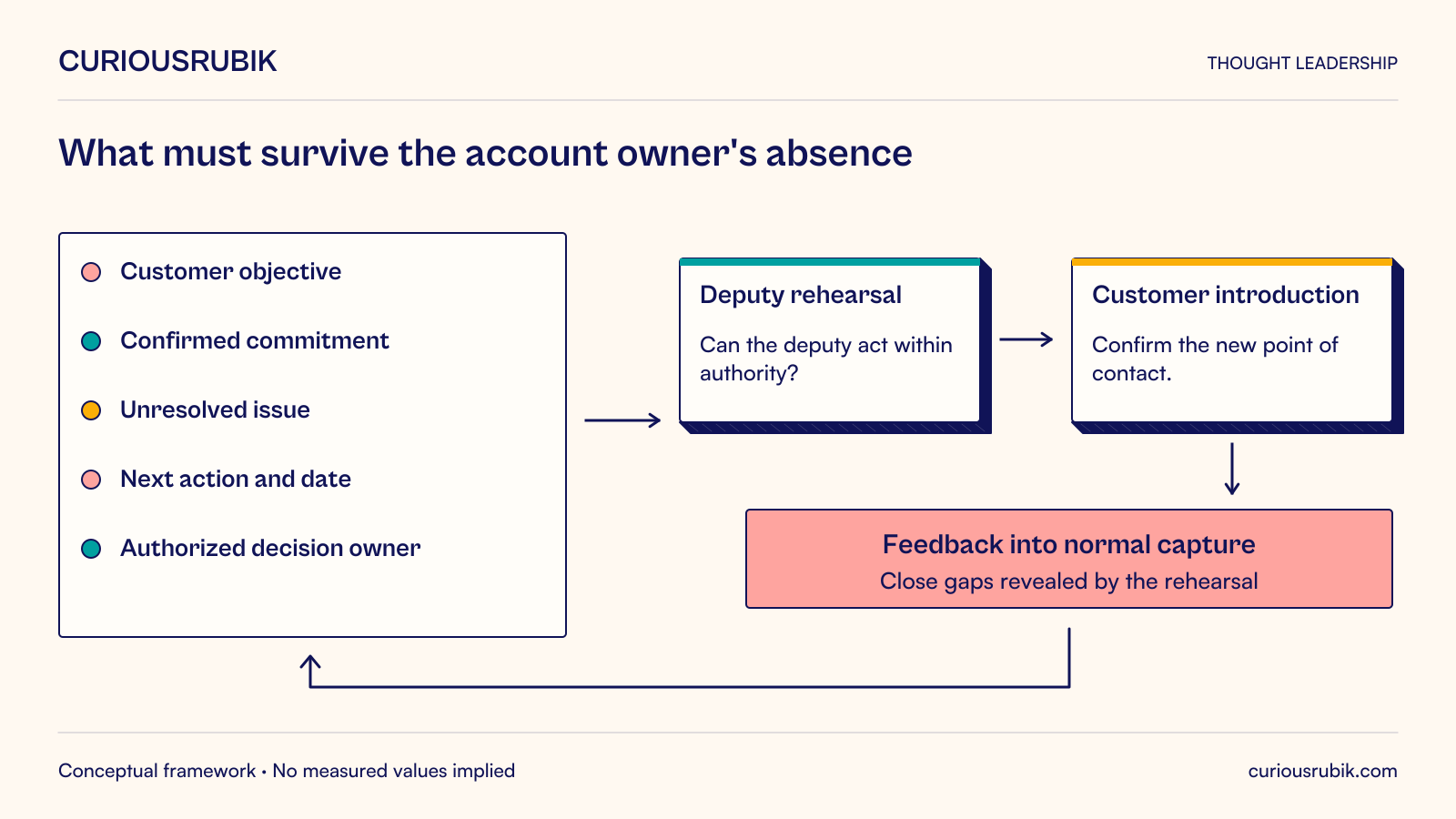
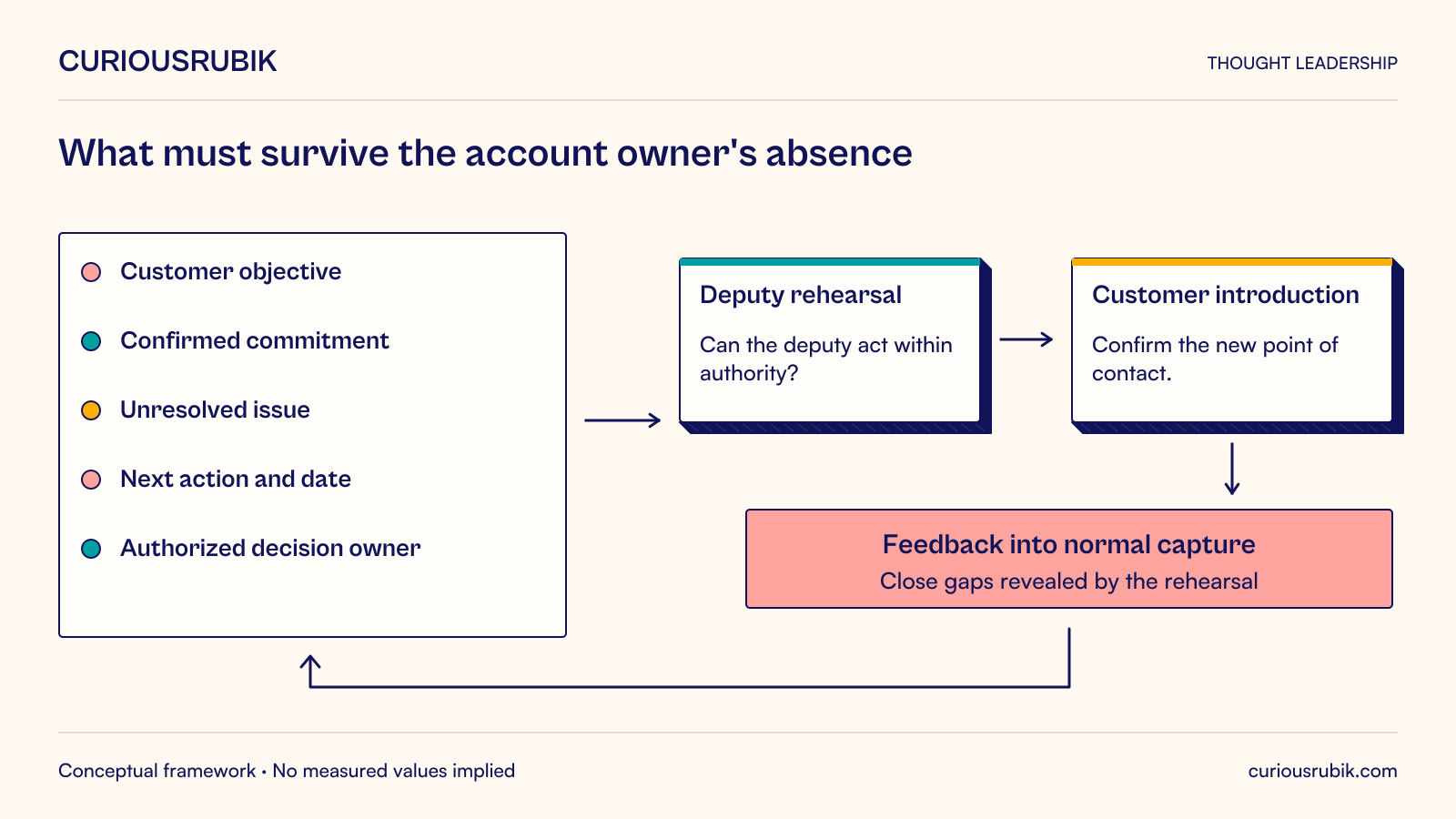
Use an absence test on a representative set of active accounts. If the primary owner were unavailable tomorrow, could a deputy answer the following questions from authorized records?
What is the customer trying to achieve? What has the business committed to deliver? What remains unresolved? What event or date requires the next action? Who can make a decision if circumstances change?
These questions form a working heuristic for continuity, not an industry standard. They deliberately focus on operating context rather than the quantity of stored information.
An account record should distinguish confirmed commitments from proposals and internal opinions. “Customer expects installation in June” is ambiguous. “Customer requested June installation; operations has not confirmed capacity” helps the next employee avoid repeating an unapproved promise.
Include source and timing. A note from a conversation six months ago may no longer describe the current position. Link to the relevant approved agreement or case, record who confirmed the information, and identify what should cause it to be reviewed. Summaries are helpful when they lead back to evidence rather than replacing it.
Capture decisions at the point they matter
Information decays when capture is deferred until handover. Employees reconstruct discussions from memory, search through message threads, and make assumptions about what a successor already knows.
Create capture points around consequential events: an agreed exception, a change in scope, an unresolved complaint, a revised renewal plan, or a handoff to another team. Keep ordinary interaction notes concise. Require more detail when a commitment changes cost, timing, risk, or service expectations.
A useful decision record includes the issue, the agreed action, the authority behind it, the affected customer or contract, the owner, and the next review point. Where a formal approval or signed agreement is required, a CRM note should reference that evidence rather than imply that the note itself grants approval.
Automated capture can assist, but it creates its own review burden. A transcript may contain incomplete statements, irrelevant personal details, or ideas that were never agreed. Give a named person responsibility for confirming the actionable summary. Do not turn inferred sentiment or conversational speculation into an established customer fact.
A professional-services handover exposes a missing obligation
Consider a hypothetical engineering advisory firm. A senior account lead takes extended leave shortly before a client’s annual planning cycle. The CRM contains the contract and a healthy opportunity forecast. It does not show that the lead agreed to provide a technical options paper before the client sets its budget.
The delivery team knows about the paper but believes the account lead is coordinating the deadline. The deputy account manager sees no active task and prepares a renewal conversation instead. Each team has part of the information; nobody has a complete responsibility record.
The firm introduces a bounded continuity review for accounts with active commitments. For this client, it records the options paper’s purpose, the approved scope, the delivery owner, the customer sponsor, the agreed date, and the dependency on a site survey. It links the record to the engagement file and identifies who may approve a scope change.
The deputy then rehearses the next customer conversation. They must explain what is due, what information remains outstanding, and what they can decide without escalating. The original lead reviews gaps while available. This tests whether the record supports action rather than merely appearing complete.
The firm does not ask the deputy to impersonate the lead’s relationship. It introduces the deputy to the customer and explains the continuity arrangement. Technical specialists retain their direct working relationships, while one person remains accountable for coordinating commitments.
A later tabletop exercise assumes the survey is delayed and the account lead cannot be contacted. The team discovers that nobody has authority to offer an alternative deliverable. It resolves that authority gap before the actual absence. The example’s value lies in the uncovered dependency; it makes no claim about realized retention or revenue improvement.
Design deputy coverage as an operating role
A deputy needs access, context, capacity, and authority. Merely naming a backup in the CRM is insufficient if that person is already fully occupied or cannot approve any useful action.
Set the coverage boundary. A deputy may handle routine status questions and coordinate existing commitments while commercial exceptions remain with a sales director. Another role may need broader authority because the service operates continuously. Match coverage to the consequences and response times involved.
Review access before an absence, especially where customer documents sit in separate systems. Use role-appropriate permissions rather than copying all material into a widely accessible account record. A continuity plan should not bypass confidentiality arrangements, professional obligations, or contractual restrictions.
NIST’s contingency-planning guidance emphasizes planning for disrupted operations and recovery. Although it concerns information systems, its disciplined treatment of responsibilities and exercises offers a useful analogy for customer-service continuity. The people-coverage method here is the article’s recommendation, not a NIST requirement. NIST SP 800-34 Revision 1.
Make the customer-facing transition explicit
An internal handover does not automatically create customer confidence. Decide who will explain the change, when they will do it, and what the customer needs to know.
For an important account, an introduction should establish the successor’s role, the commitments that remain in place, and the escalation route. Avoid promising that nothing will change if service arrangements genuinely are changing. Equally, do not burden the customer with internal organizational detail that has no practical consequence for them.
Ask the successor to confirm their understanding of immediate obligations with the customer when appropriate. This can reveal differences between internal records and customer expectations. Record any correction as a new confirmed position, preserving the reason for the change where necessary.
Continuity should also work when the customer contact leaves. Maintain relationships with the relevant roles, subject to appropriate communication permissions, rather than assuming one named contact represents the entire organization forever. Distinguish the contracting organization, operational users, sponsors, and purchasing contacts so a personnel change does not erase the account’s structure.
Protect privacy while preserving context
Customer continuity is not a justification for unlimited collection or access. Records can contain personal opinions, sensitive information, or details unrelated to the service. Define what belongs in the account record, what requires restricted handling, and what should not be retained.
The NIST Privacy Framework provides a voluntary enterprise-risk approach to identifying and managing privacy risk. It does not prescribe the exact CRM fields a business should use. Its relevance is to treat information use and exposure as design decisions alongside commercial usefulness. NIST Privacy Framework Version 1.0.
In practical terms, keep an approved service accommodation where needed, but avoid spreading unnecessary personal explanations. Record a customer’s communication preference without adding speculative character assessments. Give employees a clear route to correct inappropriate or inaccurate notes.
Retention requirements differ by record type and jurisdiction. Coordinate CRM retention with the authoritative contract, complaint, and service records rather than keeping permanent duplicates by default. Obtain specialist advice where legal or professional duties apply.
Measure continuity by the ability to act
The strongest test is a structured rehearsal. Give an authorized deputy a real account scenario, with appropriate safeguards, and ask them to identify the next action, evidence, decision owner, and escalation path. Record what is missing and how long clarification takes.
Track overdue commitments discovered during handover, accounts lacking workable coverage, and cases where customers must repeat information already provided. Use these measures to improve the process, not to reward long notes or penalize every unfamiliar detail.
Sample accounts according to risk. A large complex engagement may need a deeper review than a stable low-touch account. Include recently transferred accounts and those with unresolved disputes, since clean routine accounts can make the process look stronger than it is.
After a genuine handover, review what the successor still had to reconstruct. Feed those gaps into capture practices. If the same missing information appears repeatedly, change the normal workflow rather than adding another end-of-employment checklist.
Avoid creating a second bureaucracy
Continuity has a cost. Excessive review meetings, redundant account plans, and universal deputy assignments can consume time without materially reducing risk. Prioritize active obligations, high-consequence decisions, and relationships where service interruption would matter.
A small business may need a shared commitment register and clear cover arrangements rather than a sophisticated knowledge platform. A regulated professional firm may need stricter access boundaries and formal evidence. The appropriate design follows the relationship and obligation, not company size alone.
When buying CRM or consulting services, ask for a live handover demonstration. Can a new authorized owner distinguish an approved commitment from an informal note? Can they find the relevant evidence, identify the decision maker, and act within their authority? Can the system restrict sensitive context without hiding essential operational instructions?
Strong customer relationships should benefit from the judgment and care of individuals while remaining dependable through ordinary changes in staffing. The organization earns that dependability by preserving commitments, giving successors workable authority, and testing continuity before a customer has to test it for them.