Human oversight is effective when a person can understand the proposed change, examine the evidence that matters, compare credible alternatives, and intervene before the consequential action occurs. A required approval is only one component. If the reviewer sees a recommendation without its dependencies or lacks time and authority to challenge it, the workflow has recorded consent without establishing meaningful control.
For a merchandising director introducing AI-assisted assortment planning, the decision is how to design the review task around the judgment the model cannot responsibly settle alone. The reviewer may need to assess product dependencies, local service commitments, and consequences for adjacent categories. That requires more than checking whether the recommendation’s arithmetic is correct.
This article develops a human-review design for a hypothetical hardware retailer. It concentrates on evaluating a proposed multi-item plan and its alternatives, rather than validating fields extracted from a document. The suggested review methods are working design choices to test, not a claim that one interface guarantees sound judgment.
Specify the judgment the person contributes
Name the question the reviewer must answer. “Approve the assortment” is too broad. A more useful task is to determine whether a proposed removal creates an unacceptable gap in a supported product bundle, conflicts with a current customer commitment, or depends on evidence that is too weak.
Separate that judgment from checks software can perform reliably under approved rules. The system can verify identifiers, calculate space totals, and flag known bundle dependencies. The reviewer should not spend scarce attention repeating arithmetic while missing the commercial consequence that requires their expertise.
Define the reviewer’s authority. A category manager may adjust a proposal within a range but need another owner to change a cross-category commitment. The interface should route those cases rather than invite the reviewer to approve a plan outside their remit.
Also state what review cannot establish. A person examining one proposal cannot validate the model’s entire statistical behavior or prove that future demand will match a forecast. Model evaluation, operating monitoring, and plan approval are complementary responsibilities with different evidence.
A hypothetical hardware assortment proposal
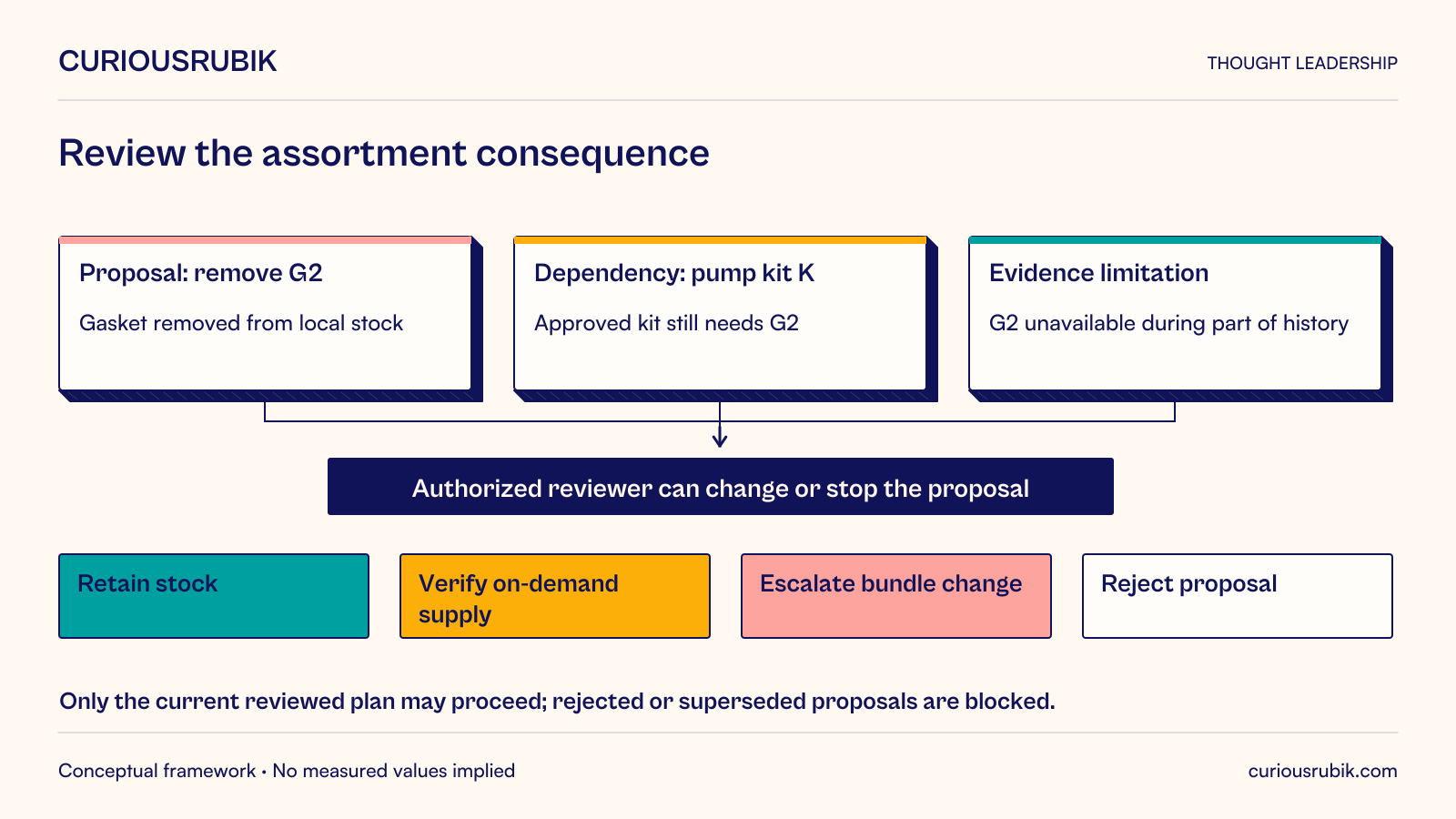
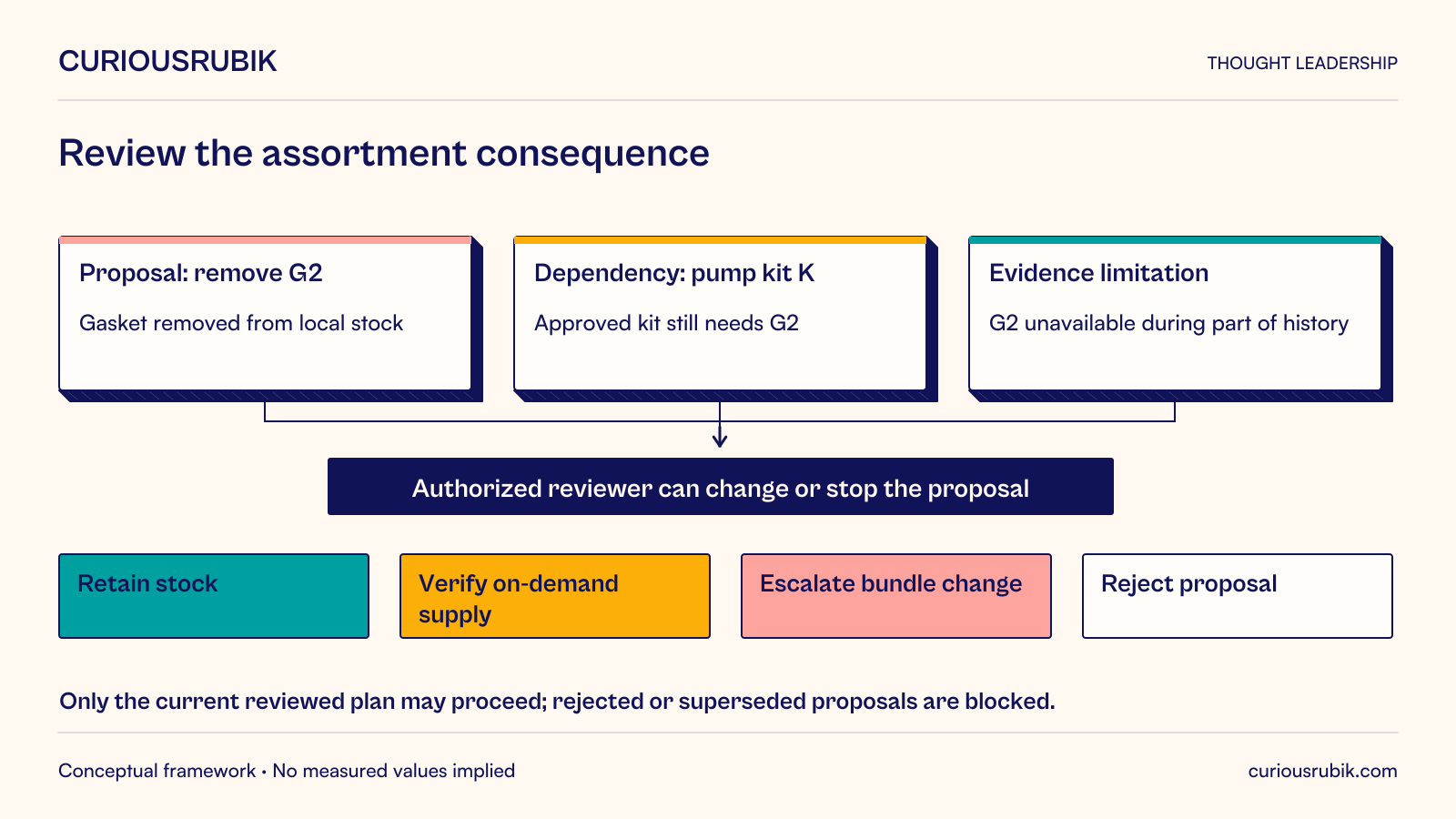
Imagine a hypothetical hardware retailer reviewing an AI-generated branch assortment proposal. The system recommends removing a slow-selling gasket, G2, to free shelf space for a faster-selling item. The sales history supports the observation that G2 has low recorded unit sales.
The proposed review packet also shows that G2 is an approved component of a service bundle involving pump kit K. This relationship is an explicit assumption of the example, not real product advice. The branch has committed to supporting that bundle, and an alternative supply arrangement has not yet been confirmed.
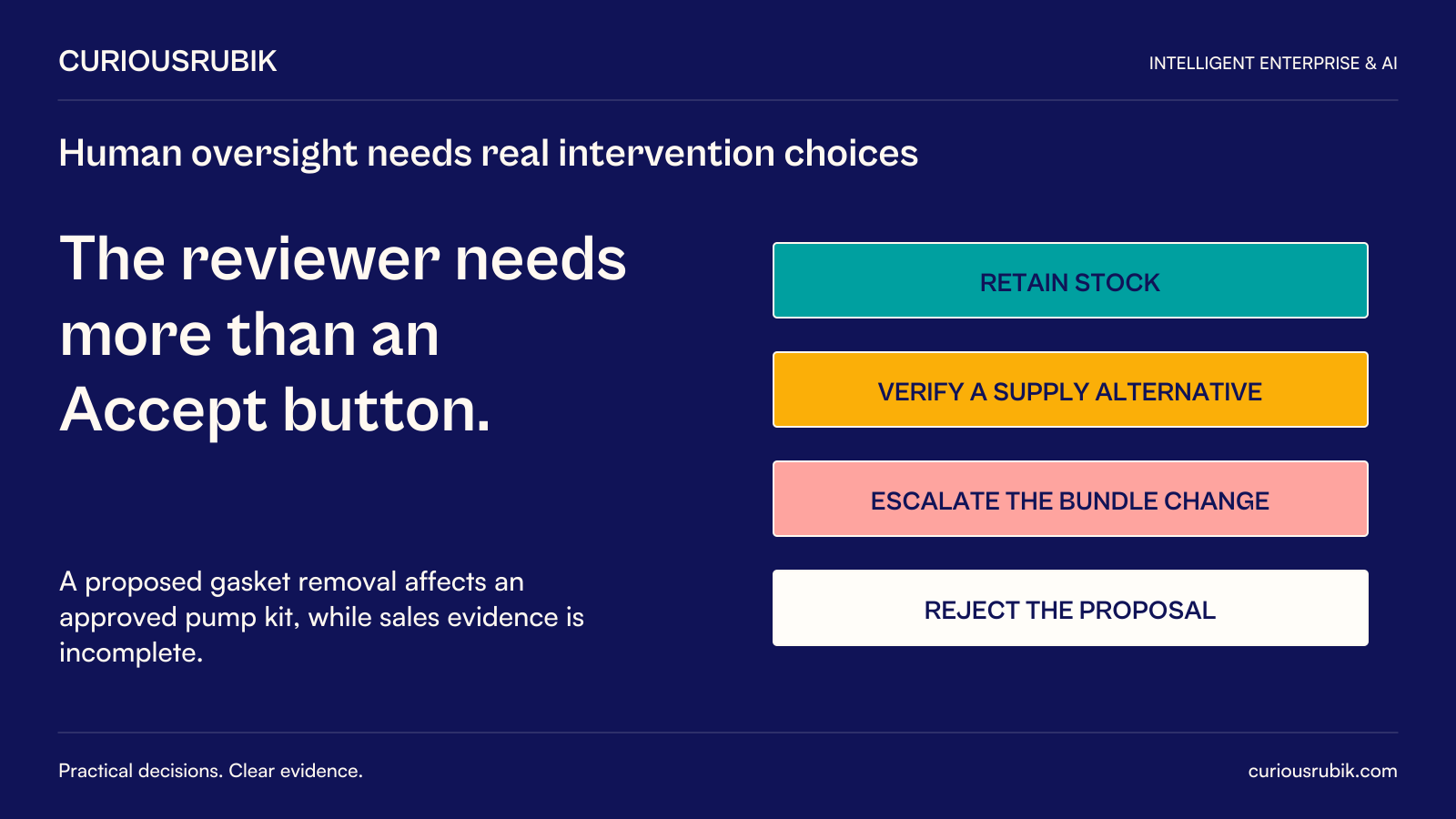
The reviewer therefore faces several options: retain local stock, arrange a verified on-demand supply route, revise the bundle offering through the authorized process, or reject the proposed removal. A single recommendation with an Accept button would conceal the actual decision.
A further complication appears in the evidence. G2 was unavailable for part of the sales-history period. Low recorded sales may therefore reflect lack of availability as well as low demand. The review packet should show that limitation rather than present the sales count as a complete measure of customer need.
The manager asks for a revised plan that preserves the bundle until the supply option is established. The system records the decision, affected items, and reason, then prevents the superseded proposal from reaching implementation. The correction must change the downstream plan, not merely add a comment beside the old one.
This hypothetical case illustrates the reviewer’s contribution: evaluating the consequence of a proposed change under incomplete evidence and cross-item dependencies. It does not claim that human review always detects such problems or that the model should infer undocumented commitments.
Present the change before the justification
Show what will change in the business state. For an assortment plan, that means additions, removals, quantity changes, affected locations, and implementation timing. A long generated rationale can distract from a small but consequential removal.
Provide a before-and-after view and the relevant dependencies. Highlight which assumptions are verified, which are inferred, and which are missing. The reviewer should be able to inspect the source for a material claim without leaving the decision context or reconstructing the analysis manually.
Display alternatives at the level needed for judgment. The purpose is not to generate an unlimited list of options. It is to show the credible choices and their known tradeoffs so the reviewer can avoid treating the model’s first proposal as the only feasible plan.
Amershi and colleagues’ human-AI interaction guidelines address communicating capability limits, supporting correction, and providing user control. These are useful design considerations; their application still needs testing in the specific review task. Guidelines for Human-AI Interaction, 2019, Table 1
Make uncertainty specific to the decision
A generic confidence score rarely explains which part of a multi-item plan is uncertain. The demand estimate, product relationship, supply lead time, and customer commitment may each have a different evidence quality. Expose the uncertainty that changes the reviewer’s choice.
Use plain descriptions where they are more informative than a number. “Sales history includes an unavailable period” helps the reviewer understand a limitation. “Confidence 82” may not, unless the score has a defined and validated interpretation for that decision.
Distinguish missing information from a negative finding. An absent bundle link may mean no dependency exists, or it may mean the relevant master data is incomplete. The workflow should identify which interpretation is supported and whether the missing evidence blocks the proposed removal.
Allow the reviewer to request evidence and defer the decision. A process that requires either acceptance or rejection before the necessary information can be obtained encourages guessing. Define who supplies the missing fact and how the pending plan remains controlled.
Design intervention to affect execution
A reviewer needs practical options: revise, request information, choose an alternative, escalate, reject, or stop the affected scope. The appropriate set depends on the task. Make the consequences of each choice explicit so a request for clarification is not mistaken for permission to proceed.
Bind the decision to a version of the plan and its material evidence. If the proposal changes after review, determine whether the prior decision remains valid. An approval for one store and one item should not silently extend to a larger rollout or a substituted product.
Ensure the execution system consumes the reviewed version. Test what happens when an older message remains queued, a concurrent editor changes the plan, or the implementation step partially completes. Human judgment provides little protection if downstream systems act on a superseded recommendation.
State the reversal limits. A plan may be easy to revise before shelf changes and supplier commitments occur. After implementation, recovery can require physical work and customer communication. Place the necessary review before the consequential boundary, and preserve an owned recovery route afterward.
Give reviewers a feasible workload
Estimate review demand by complexity, not only by count. A routine addition within an established category differs from a removal that affects several bundles and locations. Route work according to the skill and authority required.
Set queue controls before rollout. If review demand exceeds available capacity, narrow the eligible automatic preparation, defer implementation, or add qualified cover through the approved operating plan. Quietly reducing review depth to maintain throughput changes the control and should not happen by accident.
Avoid incentives that reward agreement or speed alone. Reviewers should not be penalized for a justified request for information or a decision to stop a weak proposal. Otherwise, the nominal control can become a routine approval service.
Maintain competence through feedback and practice. Show reviewers what happened after their decisions, including supported errors and unexpected outcomes. Provide opportunities to evaluate representative cases without depending on the model’s recommendation as the starting answer.
Test the human and system together
Use realistic plan reviews, including a hidden dependency, incomplete availability history, a plausible but unsupported explanation, and a proposal outside the reviewer’s authority. The test should establish whether the combined workflow detects and handles these issues.
Compare interface choices where the consequence warrants it. For example, test whether showing the proposed change and source evidence before the generated rationale helps reviewers identify a dependency. Additional steps can also impose burden, so evaluate rather than assume a universal best arrangement.
Measure incorrect acceptance, unnecessary rejection, quality of revisions, appropriate escalation, and total effort. Inspect accepted cases as well as overrides. A low override rate can reflect good proposals, weak review, or pressure to agree; the rate alone cannot distinguish them.
Preserve independence in the test’s expected outcomes. The same model should not be the sole judge of whether its own plan and explanation were appropriate. Use qualified reviewers, approved policy, and traceable source evidence to establish the reference assessment.
Turn oversight into an operating responsibility
Assign owners for review design, reviewer training, queue capacity, and changes to the model or policy. Each owner should know which evidence would trigger a redesign or suspension. The business should not discover after an incident that everyone assumed another team owned review quality.
Start with one consequential proposal type and write the reviewer’s job as a concrete decision. Provide the evidence, alternatives, authority, and time needed to perform it, then rehearse a case where the correct response is to change or stop the proposal. Human oversight becomes credible when the person can materially improve the outcome and the system reliably respects that intervention.