Connecting Finance and Maintenance Asset Records. Agree how financial assets relate to equipment and components.
Ask finance and maintenance to identify an asset on the factory floor. Finance may point to a capitalized investment. Maintenance may identify the assembly that can fail, the component that can be replaced, or the equipment position where work is performed. Each answer can be useful for a different purpose.
An ERP asset model needs to preserve those purposes while keeping the records connected. Forcing both teams into identical lists can hide important operational detail or create an unsuitable financial structure. Leaving the lists unrelated makes lifecycle events difficult to reconcile.
The practical task is to agree definitions, identifiers, relationships, and event ownership. The workshop and mapping approach below helps organize that work. Finance must determine applicable accounting treatment, including recognition, measurement, depreciation, transfers, and disposal, under the organization's policies and reporting framework. This article addresses operating design rather than prescribing that treatment.
Start with questions each team needs to answer
Finance needs records that support its approved accounting and reporting responsibilities. Operations needs records that help locate, inspect, maintain, replace, and understand equipment. Begin the workshop by listing the decisions and evidence each team requires.
For finance, the questions might concern the investment represented by a record, its responsible entity, the relevant dates, and the evidence supporting a lifecycle change. For maintenance, they might concern physical location, installed components, service history, condition, and work responsibility.
Do not assume that every requested field belongs in both registers. A shared model can establish links while preserving purpose-specific attributes and access. The question is which facts must agree, which can legitimately differ, and who resolves a conflict.
Choose one representative asset family for the first workshop. A production line, vehicle fleet, or building system can provide a manageable boundary. Avoid attempting to define every asset class in a single session.
Define the objects before assigning identifiers
Agree the meanings of the objects you need. These may include a financial asset record, an equipment item, a serviceable component, a functional location, and a project or acquisition reference. The exact vocabulary should fit the organization.
Use concrete examples to expose ambiguity. Does “pump” refer to a physical unit, the position where a pump operates, or a financial record? If a unit is removed for repair and another installed, which identifier follows the unit and which remains with the location?
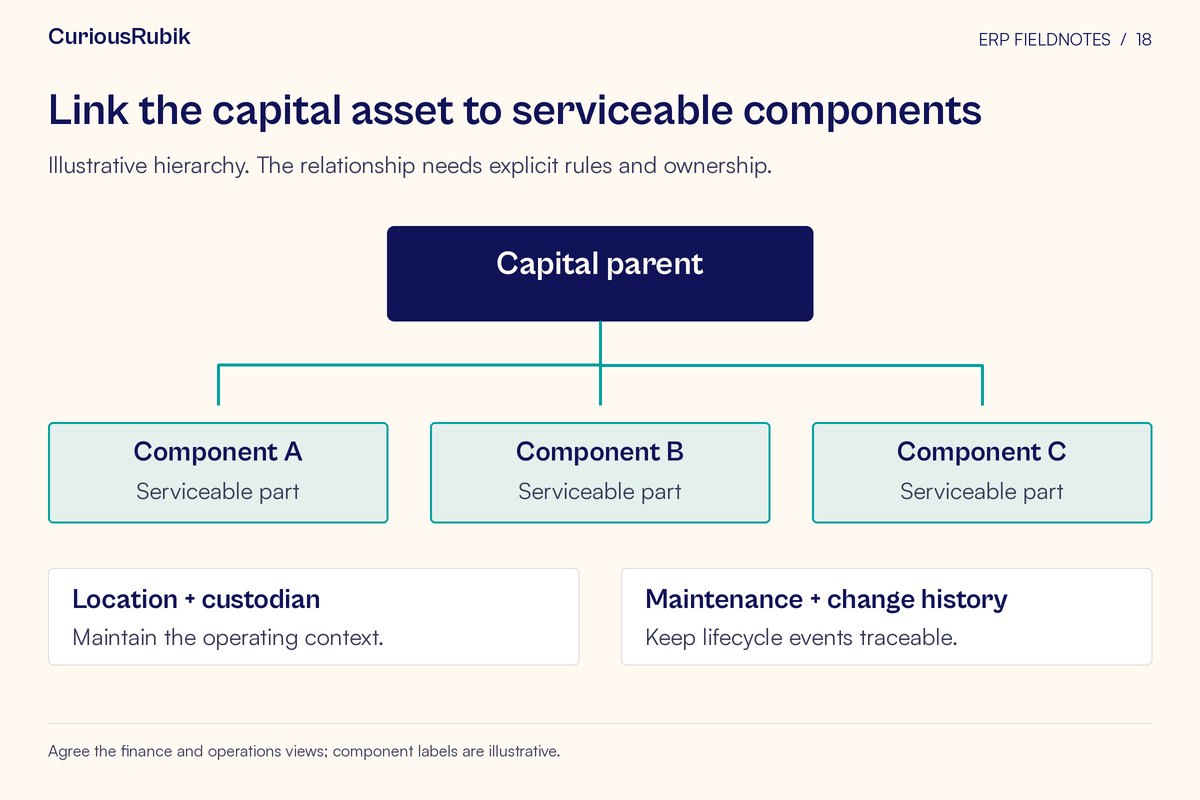
In a hypothetical processing facility, finance records an approved investment structure for a packaging line. Maintenance tracks the line, its drive assemblies, and individual replaceable units. The two views may require different granularity. The shared design should establish which relationships are needed without asserting that every maintenance item must be a separate financial asset.
Write definition examples and exclusions. A spare unit in storage may be operationally important but require different financial treatment depending on applicable policy. Resolve the treatment with finance rather than allowing the data model to decide it implicitly.
Build a mapping that respects different granularity
Identify the relationships between the financial and operational views. Some may be one-to-one; others may connect a financial record to several equipment records or require a more detailed mapping. Confirm the allowed patterns for each asset class.
Keep a stable identifier for each object and an explicit relationship record where needed. Avoid relying solely on descriptions, serial numbers, or location names that can change or be duplicated. Decide which identifier is the primary reference for each type of event.
A useful mapping record can include the linked identifiers, relationship type, effective start and end dates, responsible owner, and supporting evidence. Effective dates matter when components move, investments are reorganized, or equipment is replaced. A relationship that was correct last year may be wrong today without either original record being invalid.
Do not use the mapping to allocate financial values automatically unless the appropriate finance policy and design explicitly support that behavior. Linking records and determining accounting amounts are separate decisions.
Walk through the lifecycle one event at a time
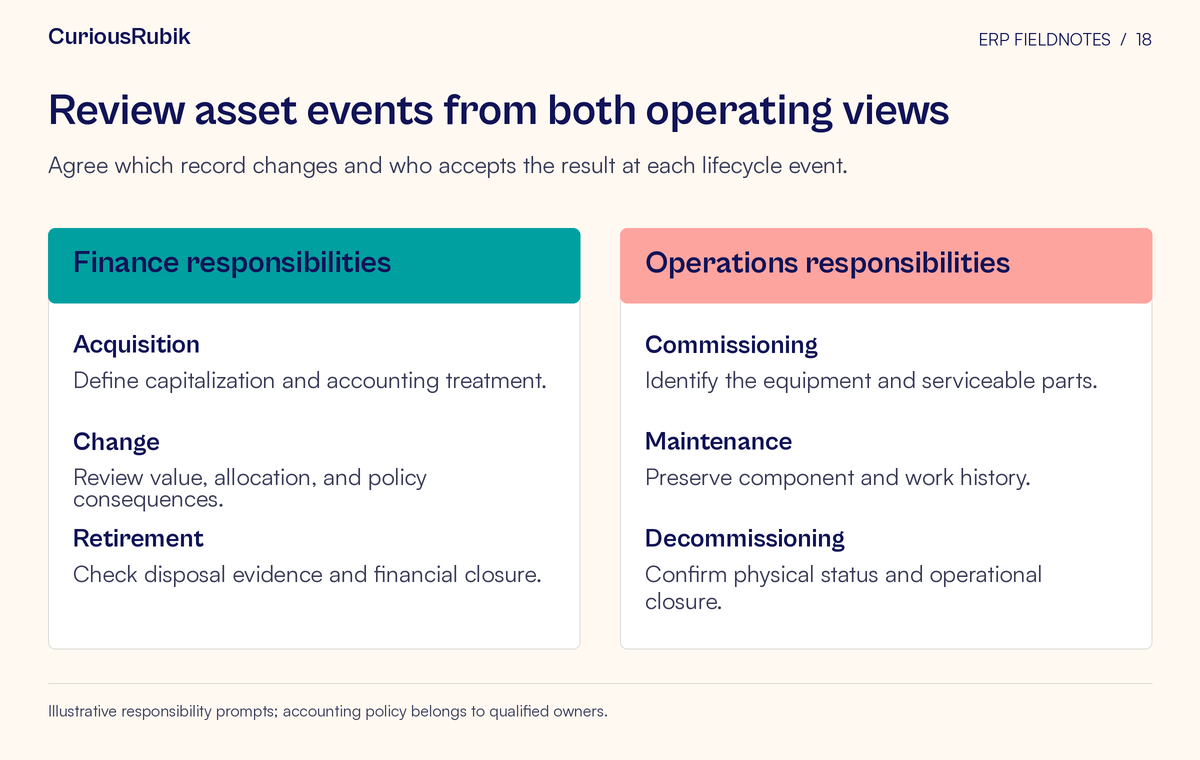
Use an event matrix to decide what each team must update, what evidence it needs, and how the updates stay aligned. Begin with acquisition, installation, commissioning, relocation, component replacement, transfer, and disposal. Add events relevant to the chosen asset class.
For each event, distinguish the physical fact, the operational status, and the financial determination. They may occur at different times and require different approval. A delivery date, installation date, operational acceptance date, and accounting date should not be treated as interchangeable simply because a system offers one convenient field.
Ask who observes the event first. That team may supply evidence without having authority to make every downstream change. For example, maintenance may confirm that a unit was removed, while finance determines the required accounting action. The model should support that handoff.
Record the expected sequence, permitted timing differences, and the owner of unresolved items. A temporary mismatch can be legitimate if its reason, duration, and recovery are controlled. An unexplained mismatch should enter an exception process.
Assign update authority by fact
Avoid giving one team blanket ownership of an entire shared record merely to simplify governance. Different fields can have different authoritative owners, while one process owner coordinates the complete lifecycle.
Define who can establish identity, change location, revise the equipment hierarchy, update operational status, determine financial attributes, and authorize disposal. Identify the supporting evidence and any approval required for each change.
Also define who can correct an error. A correction should preserve appropriate history and distinguish an originally wrong value from a genuine later event. If an asset was recorded at the wrong location, the recovery may differ from a physical transfer that occurred after commissioning.
Where updates move between systems or teams, specify acknowledgment and rejection. The originating team needs to know whether the receiving record was updated or whether the event remains unresolved. An event that was sent successfully can still be incomplete from a business perspective.
Test replacement and partial change explicitly
Simple acquisition and full-disposal scenarios will not prove the model's most difficult relationships. Test events that change only part of the asset structure.
In the hypothetical packaging line, a drive assembly is removed and replaced. Maintenance needs the service history of the removed unit, the identity of the replacement, and the current installed relationship. Finance needs enough evidence to determine the appropriate treatment under its policy. The test should demonstrate that neither view silently overwrites the history the other needs.
Try relocation of a unit between lines, temporary removal for repair, and disposal of a component while the larger system remains in use. Include a correction to an incorrect relationship and an event reported after the normal processing period.
For each scenario, define the expected records before and after, the required approvals, and the reconciliation result. Where the financial treatment is still unresolved, mark the scenario as incomplete rather than inventing an expected posting.
Reconcile meaningful differences
A reconciliation should compare facts that are supposed to agree. Counting the same number of records in both registers may be inappropriate when their granularity differs by design.
Check relationships and lifecycle consistency instead. Examples include operational items with no required financial link, financial records with no expected operational reference, installed components linked to the wrong parent, and disposed items that remain active in a dependent view. Which checks are necessary depends on the approved model.
Classify exceptions. Some are timing differences with a known event in progress. Others are missing mappings, conflicting facts, or unresolved policy questions. Each category needs an owner and a recovery route.
Set review timing according to the business event and consequence. A discrepancy that could affect a maintenance decision may require prompt operational attention. Financial reporting differences follow the organization's approved close and control requirements. A single monthly report may not meet both needs.
Leave the workshop with a usable agreement
The output should be a compact set of approved definitions, a cross-register relationship model, and an event-ownership matrix. Add representative test scenarios and a reconciliation design that distinguishes valid differences from errors.
Before closing the design, ask both teams to trace one real type of asset from acquisition through a component change and eventual disposal. They should be able to identify the relevant records, explain which facts each team owns, and show how a disagreement would be resolved.
The shared model succeeds when finance can trust the operational evidence it depends on and operations can use equipment records without distorting their purpose to fit a financial list. Clear relationships and event ownership make that cooperation possible across the asset's whole life.