Tracking ERP Benefits After the Project Ends. Keep benefit owners, meaningful comparisons and next actions.
An ERP project can close with its original benefits register still describing a future that nobody has been assigned to deliver. Capabilities are available, the implementation team has moved on, and the business case contains targets whose definitions no longer match the work.
Benefits need an operating owner after project closure. They also need an evidence trail: what changed, which result was observed, what else influenced it, and what action is needed when the expected improvement does not appear.
A benefits review ledger provides that continuity. It preserves the investment thesis while allowing leaders to challenge its assumptions using current evidence. Its purpose is to support decisions about operating change and resources, with appropriate caution about attribution, rather than to produce an unqualified success story.
Reopen the original benefit definition
Start with the benefit as it was approved. Identify the intended business result, its baseline, target, timing, population, assumptions, and accountable executive. Then ask whether those elements remain meaningful after implementation.
Broad labels need to become observable outcomes. “Better visibility” might mean that a specific planning decision can use reconciled information by a defined time. “Efficiency” might mean less avoidable effort on a particular task, with quality maintained. “Improved control” needs an identifiable control outcome and evidence that it is operating.
Record changes to the definition instead of silently rewriting the original promise. A revised scope, acquired business, discontinued process, or changed operating model may justify a new target. Keep the original, the revision, the reason, and the approval together so the organization can understand what happened.
Assign a business owner with authority over the process that creates the result. The technology team may own an enabling capability, but it cannot alone deliver a benefit that depends on purchasing policy, staffing decisions, or customer behavior. Name those dependencies explicitly.
Trace the chain between capability and outcome
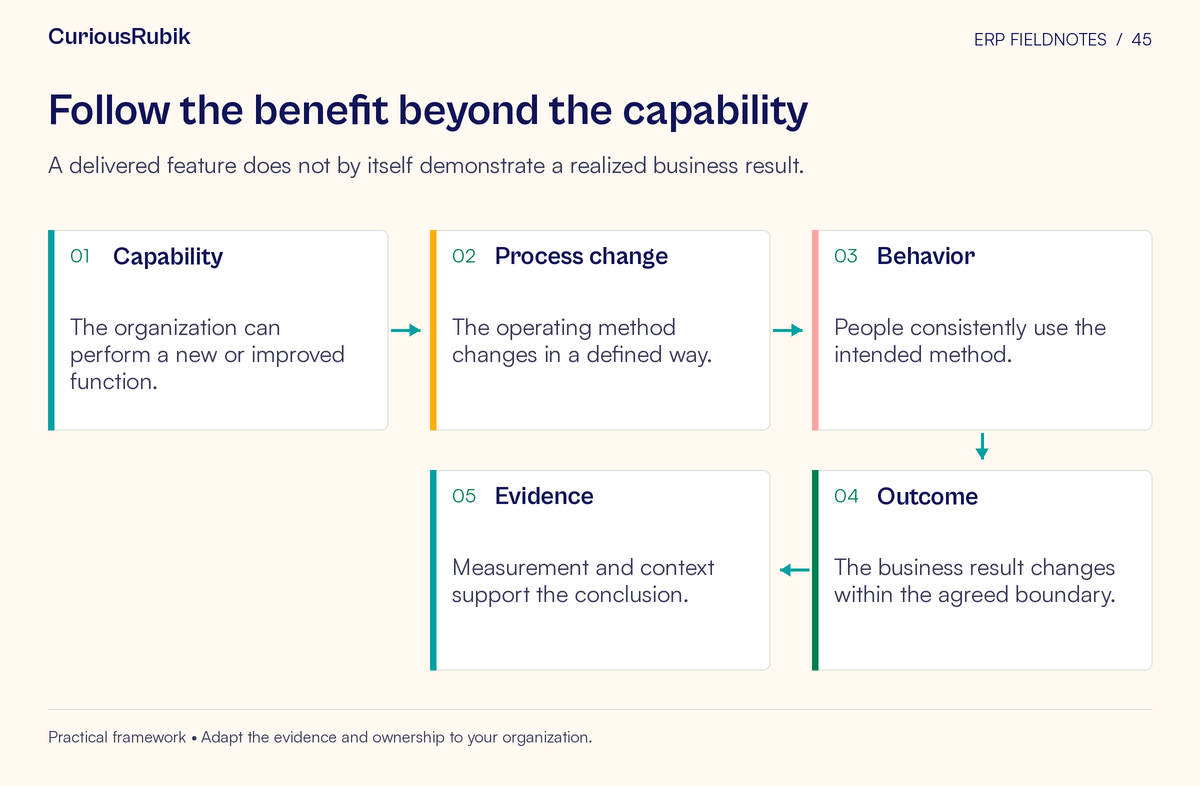
Map each benefit through five linked questions:
- What capability is now available?
- What process change must use that capability?
- What behavior must people consistently perform?
- What operating result should follow?
- What evidence will show whether that result occurred?
This chain helps distinguish work completed from benefits realized. A configured approval workflow is an enabling capability. Consistent use of the correct approval route is a behavior. A reduction in preventable purchasing exceptions is an outcome that requires measurement and interpretation.
Look for missing links. A new planning report may be accurate but unavailable before the weekly planning meeting. An automated match may work, while upstream data quality prevents many transactions from being eligible. The capability exists, but an enabling condition still limits the benefit.
Record these conditions as owned work. They should not disappear behind a status such as “benefit delayed.” The ledger should identify which process decision, data repair, learning activity, or staffing action is needed and who can authorize it.
Compare equivalent work across periods
A before-and-after comparison is useful only when its boundaries are understood. Check transaction population, volume, complexity, seasonality, staffing, service expectations, and measurement method. A faster process may reflect easier work; a slower one may be handling more demanding exceptions.
Preserve the baseline source and calculation. If the original estimate came from interviews or a short observation period, say so. Do not present it later as a precise historical measurement. Where a baseline is missing, create a current operating measure and explain the limits on comparing it with the past.
Show both total demand and normalized measures where they answer different questions. Total effort matters for capacity planning. Effort per comparable transaction can help assess process performance. Neither should be read without quality evidence and the mix of work involved.
Keep measurement changes visible. If the new ERP records more exceptions than the previous process, the reported count may rise because the organization can now see them. The review should investigate the underlying work rather than automatically treating the increase as deterioration.
Use a consistent observation window, but allow the benefit owner to explain unusual periods. Record excluded periods and the reason for exclusion so favorable results are not selected after the fact.
Distinguish capacity, cash and other forms of value
Time released from a task can create useful capacity without immediately reducing expenditure. The business may use it to handle growth, improve review quality, reduce overtime, or move people to another responsibility. Record what actually happened rather than automatically converting every estimated hour into cash savings.
Similarly, lower inventory, fewer delays, improved visibility, and stronger controls describe different types of value. Avoid adding unlike measures into one total without an approved method and a clear explanation of assumptions.
Where a financial conversion is appropriate, have finance review the calculation, timing, costs, and potential overlap. Include sustaining costs and the effort needed to obtain the benefit. A process improvement that requires ongoing manual support has a different net effect from one that can operate independently.
Do not force every important result into currency. Some benefits are better tracked through service, risk, or decision-quality measures. The ledger can retain those outcomes with clear evidence and an accountable owner without inventing a monetary estimate.
Make attribution and double counting visible
The operating result may have several causes. An ERP change can coincide with a new supplier arrangement, revised policy, different demand, staff changes, or another improvement initiative. Record those influences alongside the measured result.
Use cautious attribution language that matches the evidence. The organization may have observed an improvement after implementation and have a plausible explanation for the ERP's contribution. That does not prove the system caused the entire change. Stronger causal claims require an appropriate evaluation design and sufficiently reliable evidence.
Check for overlap between benefits. Reduced processing effort and avoided hiring may describe the same capacity change. Faster billing and improved cash timing may share part of the same mechanism. Keep a cross-reference and a clear ownership rule so one underlying effect is not counted repeatedly.
Where multiple programs contribute, agree how the result will be reported. It is often more useful to show a shared operating outcome with identified contributions than to force an unsupported allocation among projects.
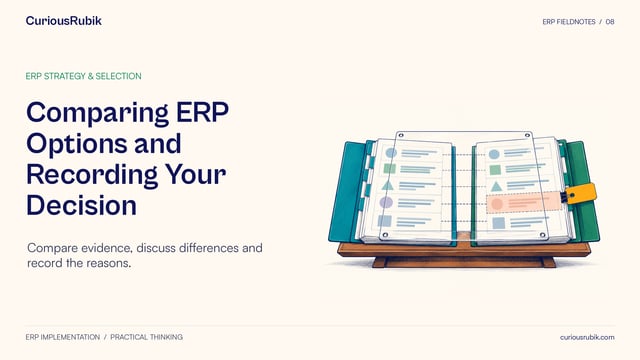
Use a ledger that leads to a decision
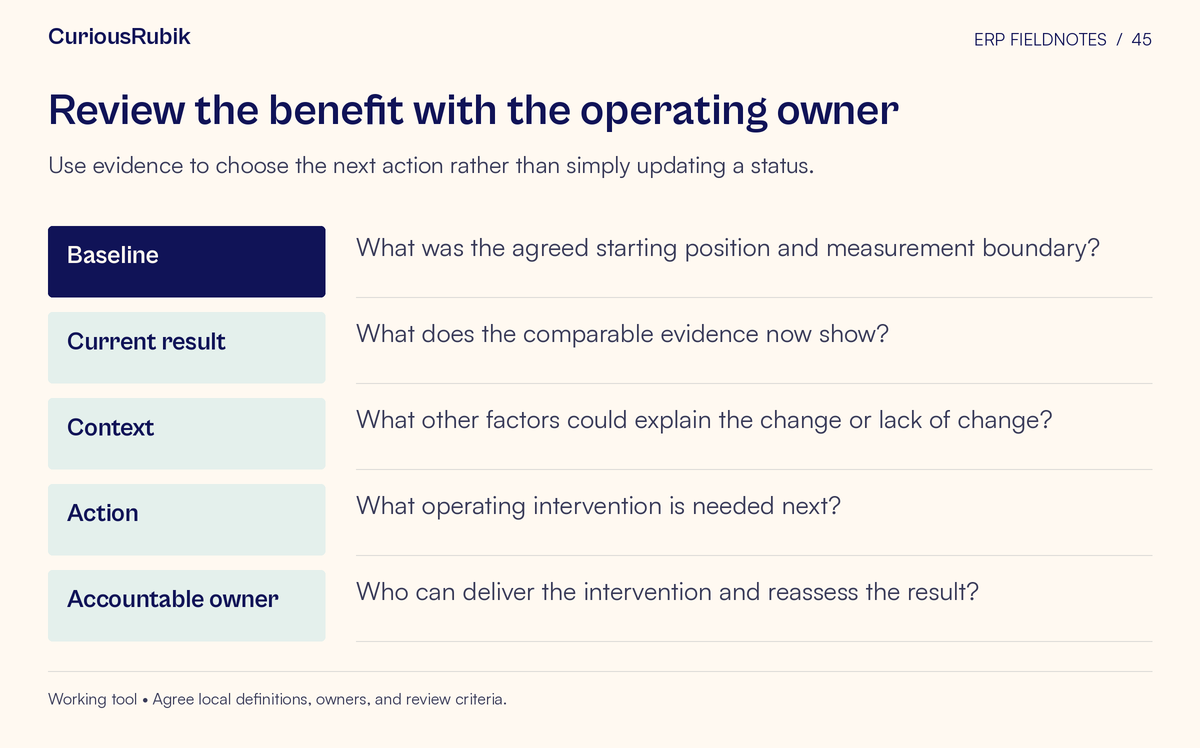
A practical review record should include:
- The original benefit, current definition, and accountable business owner
- Baseline, target, actual result, population, period, and calculation source
- The enabling capability and remaining process or behavior changes
- Quality checks, outside influences, and limits on attribution
- Any financial conversion, cost assumptions, and overlap with other benefits
- The current explanation, corrective action, action owner, and review event
- The decision to continue, revise, complete, or retire the measure
Attach enough supporting evidence for another reviewer to reproduce the calculation. Keep interpretation separate from the observation. “Processing effort increased” is an observation; “the increase reflects more complex transactions” is an explanation that needs evidence.
A hypothetical benefit that needs a different action
Consider a hypothetical distributor that expected automated invoice matching to release accounts-payable capacity. After go-live, the automated match works for eligible invoices, but total team effort remains high.
The benefits owner examines the chain. The capability is available and users follow the intended process. However, many invoices cannot enter the automated route because receipt information arrives late. The team spends substantial effort investigating those exceptions.
A broad training campaign would not address that condition. The operations owner must improve receipt recording, while finance and purchasing clarify exception ownership. The ledger records the enabling work, the affected invoice population, and the evidence that will show whether the change makes more invoices eligible.
At the next review, the team should compare equivalent work and check both effort and quality. If capacity is released, the business owner must decide how to use it. The original benefit remains under review until the operating result is demonstrated; enabling work completed is recorded separately.
Bring the register into ordinary management
Transfer benefits review into the business's normal operating rhythm with named owners and a defined decision forum. Choose a cadence that matches when meaningful evidence becomes available. A frequent meeting adds little value if the underlying process has not completed another relevant cycle.
Prioritize benefits with a significant gap, a changed assumption, or a decision requiring resources. Stable outcomes can move into routine performance management. Preserve the evidence and ownership even when the project-specific measure is retired.
If a benefit is no longer achievable or worthwhile, record that conclusion and its implications honestly. Continuing to report an unrealistic target consumes attention and weakens trust in the rest of the register.
Begin with the largest benefit still described as “expected.” Ask its owner to show the current result, the comparison basis, and the next decision. That review will reveal whether the organization is managing value after implementation or simply carrying the original promise forward.