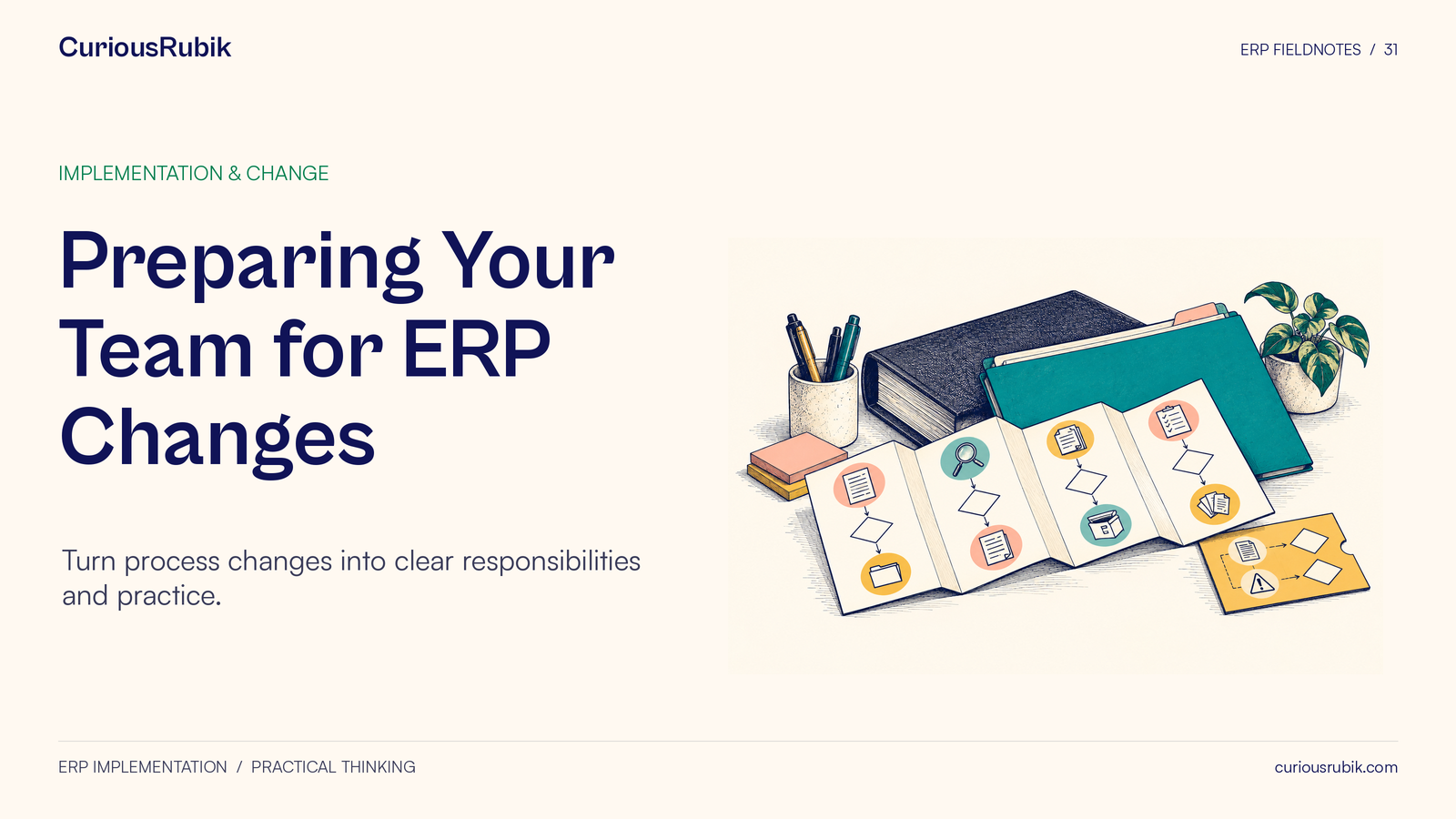
Preparing Your Team for ERP Changes. Turn process changes into clear responsibilities and practice.
An ERP change impact assessment becomes useful when a manager can use it to organize tomorrow's work. “Purchasing will adopt a new approval process” identifies a topic. It does not tell a buyer what to stop doing, who may release an urgent order, or how much time to reserve for resolving incomplete requests.
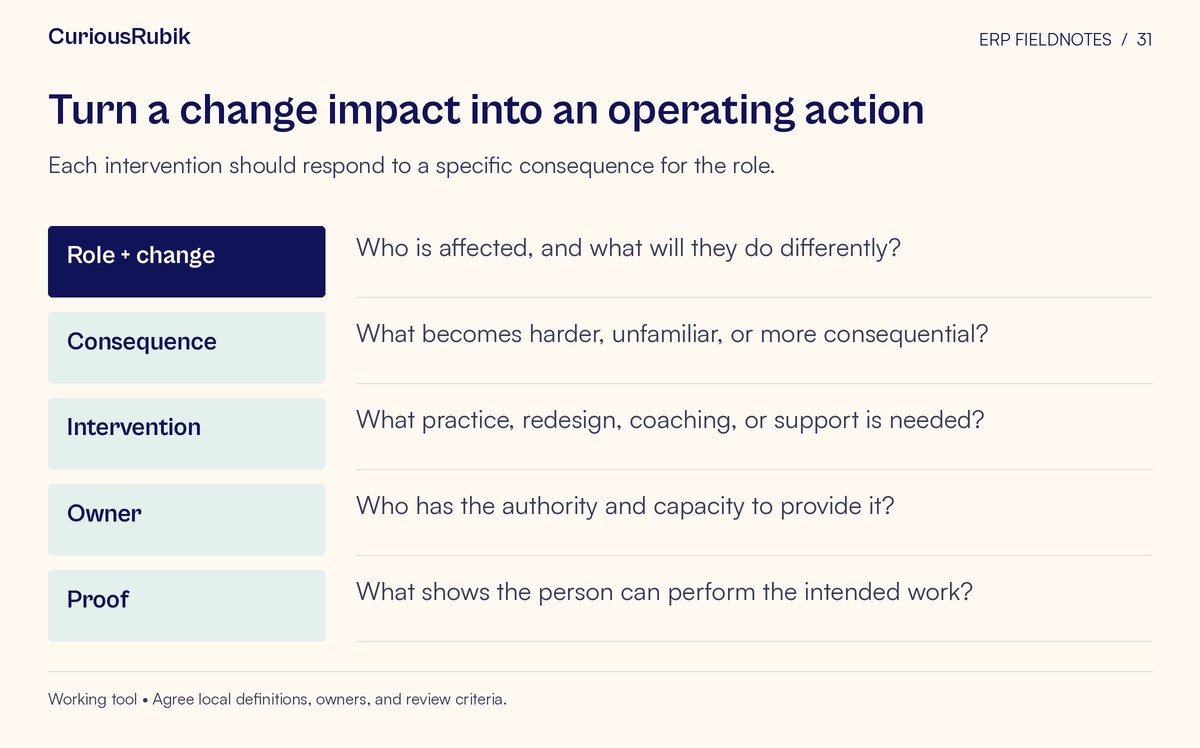
Translate each material impact into a role-level operating plan. The plan should connect a specific change in work to an operating consequence, an intervention, an accountable owner, and evidence that the intervention works. Training is one possible response. Changes to authority, staffing, policy, and handoffs may be equally important.
The practical unit is a role impact card. Build one for a coherent set of responsibilities in a defined operating context. A job title alone may be too broad: the same title can involve different decisions at a small branch, a central service team, and a night shift.
Start with work people actually perform
Observe or walk through representative tasks with the people who perform them. Ask for the input that starts the work, the decision involved, the output produced, and the next person who depends on it. Include work done outside the current application, such as checking an exception list, chasing missing information, and translating a policy into a local judgment.
Distinguish the approved current process from the actual practice. A workaround may hide a system limitation, an unclear policy, or a genuine operating need. Recording it does not endorse it. It gives the design team a concrete question to resolve before the workaround disappears.
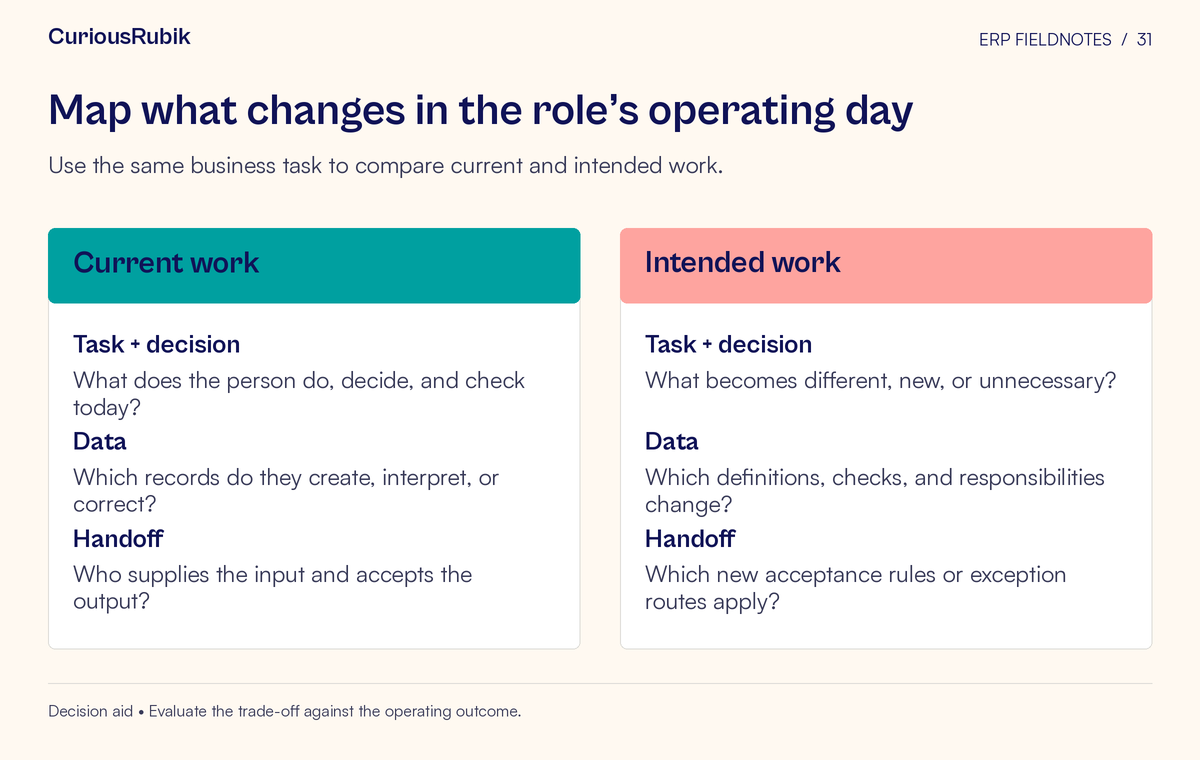
Then describe future work at comparable detail. “Use the new screen” says little about the change. “Review requests in a shared queue, return incomplete requests to the originator, and escalate urgent exceptions to the duty approver” reveals tasks, dependencies, and decisions that can be checked.
Avoid assuming that every affected person needs a separate card. Group roles when their work, authority, and support needs are genuinely alike. Split a group when the differences require a different intervention or readiness decision.
Inspect four kinds of change
Compare current and future work through four lenses.
- Tasks: What starts, stops, moves, or changes sequence? Which tasks become less frequent but more consequential?
- Information: What must the role capture, interpret, or verify? Where does the authoritative information come from?
- Authority: Which choices can the role make independently? What requires approval, and who is available to give it?
- Handoffs: Who supplies the prerequisites, receives the output, and resolves incomplete or disputed work?
Keep these lenses connected. If a buyer must reject incomplete requests, the requester needs a clear completeness rule and a route to correct the request. Otherwise the buyer receives new responsibility without the surrounding process that makes it practical.
Also identify work that disappears. Removing a reconciliation or local spreadsheet may free capacity, but only when its underlying purpose is covered elsewhere. Ask who relied on that output and what evidence demonstrates the replacement. A retired activity with an unexamined purpose can reappear as an urgent manual task after launch.
Record the consequence before selecting a response
An impact card should explain why the change matters. A new field may be easy to enter but important to downstream fulfillment. A familiar approval may move to a role that is unavailable during part of the operating day. A consolidated queue may improve visibility while concentrating exception work in a small team.
Describe the consequence in observable terms. “More resistance” is a weak diagnosis. “Supervisors must review exceptions during a period already used for shift handover” identifies a capacity conflict. “Users lack confidence” is less actionable than “users cannot tell whether a rejected request was returned or canceled.”
Assess consequence, reach, timing, and uncertainty separately. A change that affects few people can still interrupt a critical activity. A widespread change may be simple to support. Avoid collapsing these differences into a single color that hides the reason for concern.
Where the design is unsettled, mark the impact as provisional and name the decision it depends on. This permits preparation without presenting assumptions as settled instructions. Assign a date for resolving the uncertainty before dependent training, access, or staffing decisions become expensive to revise.
Build the role impact card
Use a compact record with links to detailed process and training material. Include:
- Role, location or operating context, and accountable functional manager.
- Task or decision being changed, with the current and future practice.
- Start, stop, and continue instructions, including retained controls.
- Information sources, required access, and upstream prerequisites.
- Authority boundaries and the escalation route for exceptions.
- Handoff responsibilities and the receiving role's acceptance conditions.
- Consequences for effort, timing, service, and control execution.
- Required interventions, their owners, and the latest useful completion dates.
- Readiness evidence, reviewer, and any conditions on independent work.
- Design version, unresolved questions, and the next review trigger.
Use the card to make decisions rather than to collect every conceivable detail. If a field does not change an intervention, an owner, or a readiness judgment, consider whether it belongs in the supporting process documentation instead.
Keep accountability explicit. The change lead can facilitate the assessment and maintain consistency. The functional manager confirms what the role can reasonably absorb. Process and control owners approve changes within their authority. Nobody should interpret completion of the card as automatic approval of a new operating policy.
Choose interventions that address the cause
Match the response to the actual obstacle. A knowledge gap calls for explanation, practice, and accessible job aids. An authority gap needs a decision about delegation or approval coverage. A workload gap may require resequencing, temporary capacity, or a reduction in other duties. Conflicting rules need policy resolution.
Several responses may be necessary. If supervisors inherit a new exception queue, teaching queue navigation will not create time to review it. The operating plan also needs a review window, backup coverage, an escalation route, and clarity about which exceptions can wait.
State the tradeoff when choosing an interim arrangement. Additional launch support can help a role perform unfamiliar work, but it creates a dependency that must eventually be removed. A temporary manual check can protect an important control while increasing effort and reconciliation needs. Give each temporary measure an owner, a review condition, and an exit test.
Connect intervention dates to the activity they protect. Access must exist before practice. Approved policy must exist before job aids are finalized. A manager must agree staffing before scheduling people for training that takes them away from operations.
Work through an illustrative impact
Consider a hypothetical manufacturer introducing a shared purchase-request queue. Today, requesters email a local buyer, who fills gaps through informal conversations. In the future process, requesters submit complete requirements and buyers return incomplete requests through a recorded workflow.
The requester's impact card identifies new responsibility for item detail and required dates. Its intervention combines a completeness guide, practice with an ambiguous request, and a clear contact for uncertainty. Evidence requires the requester to submit an acceptable request and explain how to correct a returned one.
The buyer's card identifies a changed decision: distinguish an incomplete request from an urgent exception that requires authorized handling. The buyer needs the rule, the exception route, and agreement on queue coverage. Evidence includes handling both situations without bypassing required approval.
The supervisor's card identifies a new workload at the approval boundary. The manager must decide who covers absences and how urgent requests are recognized. The scenario shows why one general announcement and a navigation class would leave important operating questions unanswered.
This is an illustrative design exercise, not a report of a company's results. The relevant roles and controls will vary with the organization's operating model.
Verify readiness through observed work
Ask people to demonstrate representative tasks using the approved process and suitable practice data. Observe whether they identify the right information, exercise only their permitted authority, complete the handoff, and recover appropriately when a prerequisite is missing.
Record the support required. Someone who succeeds with a facilitator providing the next action has demonstrated guided performance. That may support a supervised launch arrangement, but it is different evidence from independent execution. Let the accountable business owner determine the acceptable level of support for the task's consequence.
Check the receiving side of a handoff too. A person can perform their own steps correctly while leaving the next team without usable information. Readiness evidence should follow the output far enough to confirm that the intended work can continue.
When performance is weak, revisit the diagnosis before assigning more training. The cause may be inaccessible information, conflicting rules, unsuitable permissions, or a design problem. The operating plan should capture the necessary correction and the next demonstration.
Keep the cards aligned with design changes
Give each material design decision an impact-review step. Ask which roles, job aids, permissions, practice scenarios, and staffing assumptions it changes. Update linked cards together so that one team does not prepare for an obsolete process while another receives the latest instructions.
Review cards again when support demand reveals unexpected work after launch. A recurring exception can expose a missing rule or an unrealistic workload assumption. Feed that evidence to the process owner and revise the operating plan rather than allowing temporary workarounds to become invisible permanent duties.
Start with one high-consequence process and its connected roles. If every changed responsibility has an owner, a workable operating arrangement, and credible evidence of performance, the assessment is helping managers run the business. Expand the method from there.