Defining Team Handoffs in Your ERP Project. Agree what each team sends, accepts and does when work is incomplete.
Take a completed transaction and ask each team where its responsibility ended. Then ask the next team when responsibility began. Any gap between those answers deserves a place in your ERP process design.
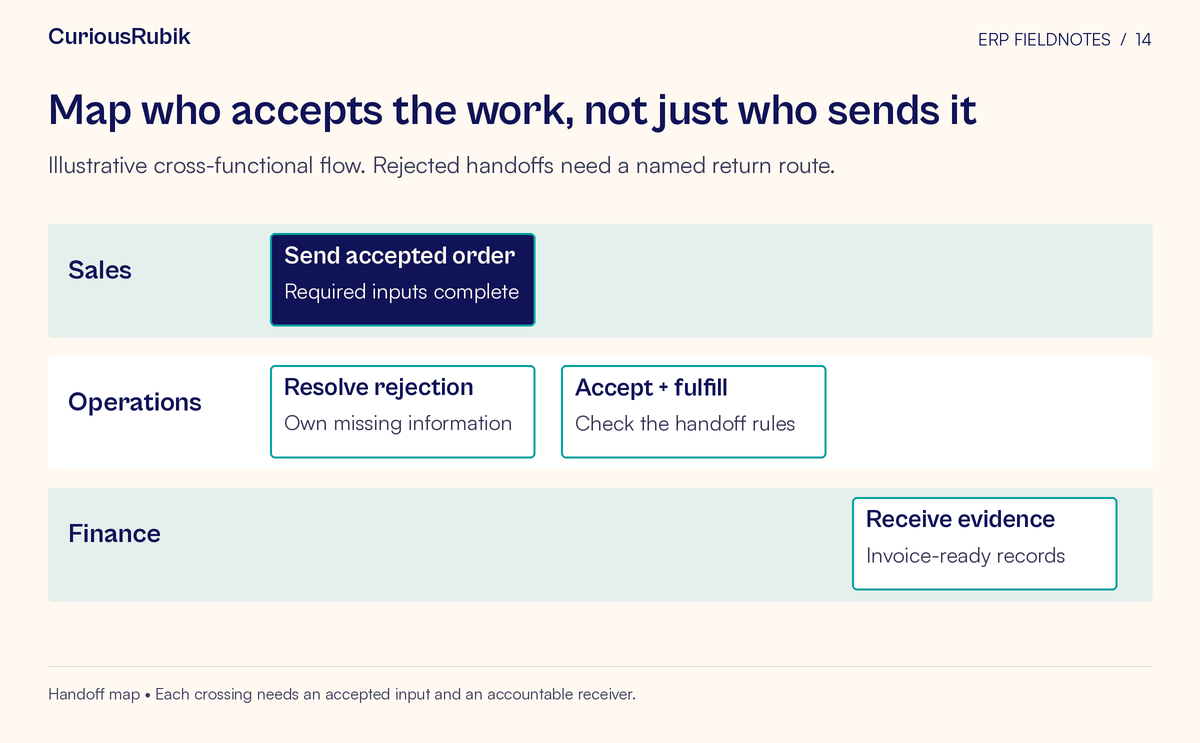
A process map can show every major activity and still leave that gap unresolved. An arrow labeled “send to finance” says little about what finance receives, whether it can reject the work, or who owns an incomplete item overnight. The boundary needs a working agreement that can be tested.
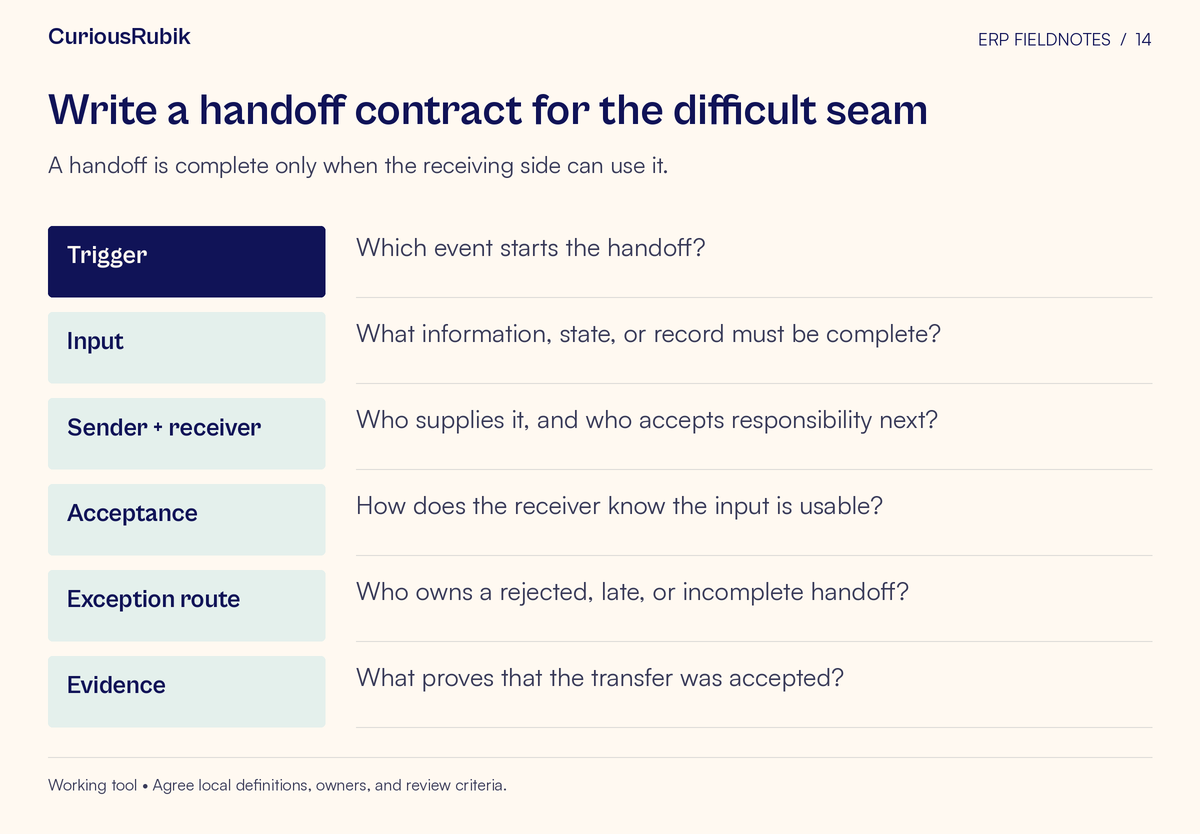
A handoff contract is a practical way to write that agreement. It defines the trigger, inputs, acceptance criteria, authority transfer, rejection route, and evidence of completion. The term describes an operating design tool, not a legal agreement. Use it selectively for consequential boundaries between teams or systems.
Begin with one business event
For a workshop, choose an event that crosses several functions and has a recognizable end. Examples include receiving an ordered item, changing a customer delivery commitment, returning damaged goods, or commissioning equipment. Limit the first exercise to one event and one meaningful variation.
Bring the people who perform and receive the work, along with the process owner and any relevant control specialist. A manager can explain policy, but the people handling exceptions can reveal how incomplete work is actually recovered.
In a hypothetical receiving process, warehouse staff record a delivery, purchasing resolves a discrepancy, and finance matches the transaction for payment. The initial map may suggest a clean sequence. Following one short delivery might reveal that purchasing is informed by a separate message while the financial record appears complete. That disagreement is the workshop's useful finding.
Write what happened and what evidence supports it. Avoid turning an individual workaround into an approved requirement merely because somebody currently uses it.
Mark three kinds of boundary crossing
At each arrow on the map, ask whether information, control, or ownership changes. These transfers may occur together, but they do not always occur at the same moment.
An information transfer makes a fact available to another team. A control transfer gives somebody authority to approve, release, reject, or change the transaction. An ownership transfer makes a person or team responsible for progressing the work.
For the short-delivery example, recording the physical quantity informs other teams. It may not authorize payment for a disputed amount. It also may not establish who must contact the supplier. Treating all three transfers as one completed handoff can conceal an open obligation.
Mark each transfer explicitly. Where responsibility is shared, specify what each party must do and who coordinates the unresolved item. “Both teams own it” needs a practical meaning that a person on a late shift can follow.
Let the receiving team define usable input
Ask the receiving team to describe what makes an item actionable. “All required fields populated” may be necessary but insufficient. The values must be meaningful, internally consistent, appropriately approved, and connected to the correct business event.
A receiving team might need an identifier, quantity, effective date, status, supporting evidence, and the reason for any exception. It might also need to know whether a prior version has been superseded. Define these requirements in business terms before deciding how to implement them.
Then test the requirements with the sender. Can the sending team genuinely know each value at that point? Is the information already available elsewhere? Does asking for it create duplicate entry or encourage guessing? Acceptance rules that demand unavailable information can cause people to bypass the process.
Where an input can be incomplete temporarily, define the permitted interim state. Say which work may continue, which decisions are blocked, who completes the information, and how long the item can remain there before escalation.
Write the handoff contract
Create a concise record for the selected boundary. Use the following fields as a starting point:
- Business trigger: the event that initiates the handoff.
- Sender and receiver: roles with responsibility, including backup coverage.
- Required input: the information, approvals, and evidence needed.
- Acceptance criteria: conditions under which the receiver accepts the work.
- Acknowledgment: how the sender knows responsibility has transferred.
- Rejection reasons: specific conditions that prevent acceptance.
- Recovery route: the owner, permitted corrections, and resubmission behavior.
- Timing: expected response, escalation point, and any operating calendar.
- Completion evidence: the record that proves the agreed outcome occurred.
- Change authority: who can revise the contract and its related controls.
The acknowledgment deserves particular attention. Sending, receiving, and accepting are different events. A message reaching a destination does not prove that the receiving process can act on it. Choose an acknowledgment that matches the business consequence.
For lower-consequence work, a visible accepted status may be enough. For a critical release, the design may need explicit approval evidence. Have the appropriate process and control owners decide what is proportionate.
Design the rejected path in full
A rejection should tell the sender what is wrong and who must act. “Validation failed” leaves the recovery process to interpretation. “Delivery reference does not match an open receipt; purchasing review required” gives the team a usable next step, assuming that responsibility matches local policy.
Distinguish correction from business approval. A clerk may be able to correct an incorrectly entered reference. They may not have authority to accept a commercial discrepancy or alter an approved amount. The recovery design should preserve that boundary.
Decide what happens after correction. Does the same work item resume, or is a new item created? How is a duplicate prevented or identified? Can a later version overtake the earlier one? Which record shows the history? These questions belong in the process workshop because their answers affect business behavior.
Also define what remains visible while recovery is pending. The sender should not assume acceptance, and the receiver should not silently discard work. A shared exception state with an owner can prevent each team from believing the other is handling the problem.
Stress the agreement with ordinary constraints
Run the proposed handoff through situations the operation could plausibly face. Use representative, permitted examples rather than sensitive live data where possible.
Try a partial quantity, an out-of-sequence update, a changed reference, an unavailable approver, and an item arriving near the end of a shift. Add a repeated submission and an amendment after the receiver has already acted. Include any location or language constraints that matter to the actual operation.
Ask the participants to describe their next action without help from the design team. If they disagree about responsibility or authority, refine the contract before configuration begins.
Do not use the exercise to demand a fully automated answer for every exception. A controlled manual recovery may be appropriate for a rare, complex situation. Its workload, evidence, access, and ownership still need to be designed. An exception is not resolved simply because it has been labeled manual.
Turn the contract into requirements and tests
Each acceptance criterion should translate into a requirement and observable test result. If a receiver must reject an unapproved change, the test should show the attempted change, the rejection, the unchanged accepted record, and the owner who receives the exception.
Link the test to the handoff contract so later revisions remain traceable. The process owner can then see whether the agreed operating behavior was proved rather than merely checking that a screen or interface exists.
For the hypothetical short-delivery process, useful test evidence could include the physical receipt quantity, the discrepancy status, the purchasing assignment, and the financial transaction that the applicable policy permits. The finance owner determines the accounting treatment; the handoff test checks whether the approved treatment and operational status remain consistent.
Include a recovery test. A process that rejects correctly but cannot resume safely is incomplete. Verify the resubmission, the final acknowledgment, and the absence of unintended duplicate work.
Keep ownership after implementation
The handoff contract should remain attached to an end-to-end process owner. A team may change its own steps later without realizing that another team relies on a field, status, or timing assumption. Reviewing changes at the boundary makes that dependency visible.
After release, inspect rejected items and aging exceptions. Look for unclear reasons, repeated corrections, missing acknowledgments, and work that moves between teams without progressing. Use those observations to improve the contract and its supporting design.
A useful first deliverable is one completed contract for a boundary that currently creates rework. It should tell a new team member when to accept the work, when to reject it, what they own, and how to recover. Once that agreement is clear, the process map's arrows carry a meaning the organization can actually operate.