Preparing Support to Take Over ERP Integrations. Test monitoring, recovery, ownership and support coverage.
An ERP integration can pass its project tests and still arrive in operations without a workable support model. The interface transfers data correctly, but nobody knows who checks a delayed acknowledgment, who may replay a failed batch, or which budget pays for a change in the receiving system.
The handover decision therefore needs to examine the service around the interface. Can the receiving team detect a problem before the business deadline, recover without creating duplicate activity, and prove that the intended business result occurred? Can it do so with the people, access, funding, and external support that will actually remain?
An interface service card and a business-led handover drill make those questions testable. Together, they turn technical documentation into an operating commitment that both business and support owners can evaluate.
Describe the business obligation of each interface
Begin the inventory with the result the business depends on. “Outbound shipment file” identifies a technical object. “Accepted shipment confirmations available for invoicing before the billing cutoff” identifies an operating obligation. Keep both descriptions, but use the second to determine priority and recovery decisions.
Record the source and destination, direction of movement, triggering event or schedule, expected acknowledgment, relevant transaction identifiers, and dependent processes. Describe what happens if the interface is late, partly successful, duplicated, or apparently successful with incomplete data.
A technical success signal may prove only that a message was accepted by the next component. The business needs evidence that the receiving process used it correctly. Decide where that end-to-end confirmation comes from and who reviews exceptions.
Include quiet interfaces. A connection used only for an occasional activity can be critical when it is needed. Conversely, a high-volume feed may tolerate a delay if another controlled process preserves the business outcome. Support priorities should reflect consequence and recovery opportunity, not just message count.
Build a service card the receiving team can use
Keep one service card for each materially different support obligation. Related interfaces may share a card when they have the same owners, operating window, recovery rules, and business consequences. Avoid bundling unrelated flows simply because they use the same technical platform.
The card should capture these fields:
- Purpose and boundary: The business outcome, affected population, connected services, and explicit exclusions
- Operating window: When data is expected, when it becomes late, and the downstream deadline that matters
- Health evidence: Technical monitoring, business reconciliation, acknowledgment checks, and where to find them
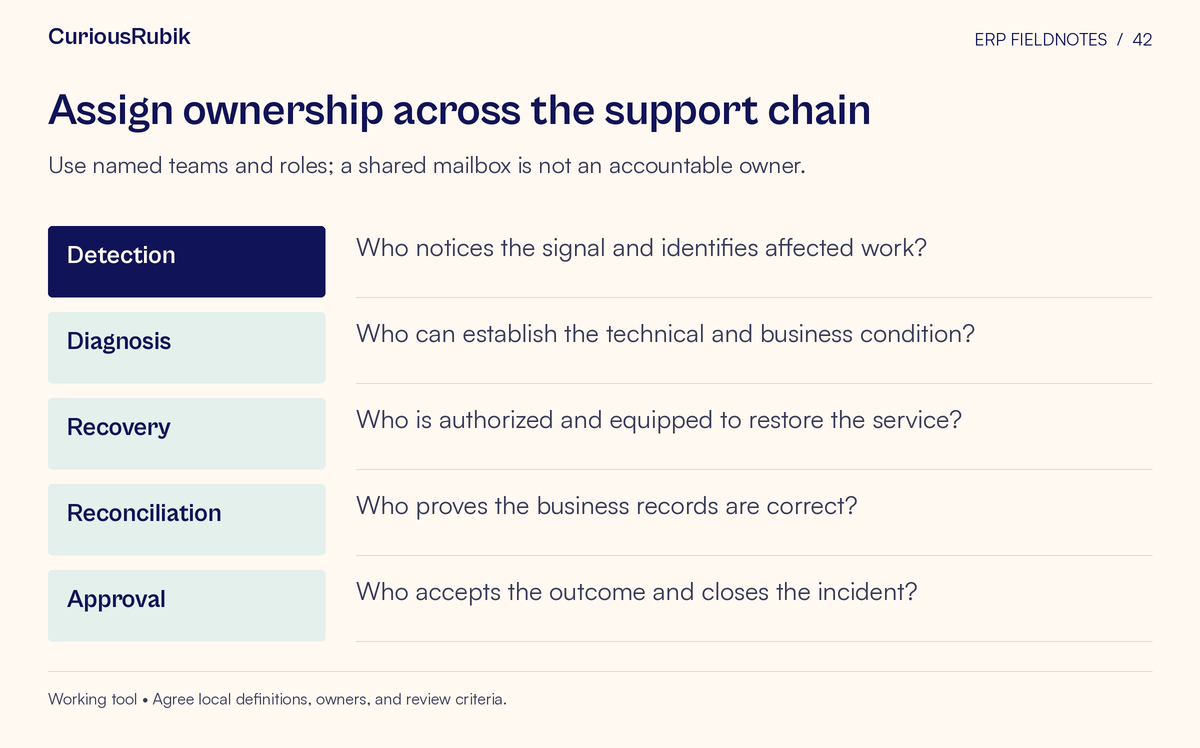
- Ownership: The service owner, business process owner, technical resolver, data steward, and backup contacts
- Response model: Coverage hours, severity definitions, escalation route, and dependencies on external support
- Recovery authority: Who may pause, replay, correct, reconcile, or approve an interim process
- Sustaining resources: Expected support effort, monitoring costs, maintenance obligations, and change funding
- Acceptance record: Drill evidence, open risks, receiving-owner decision, and next review event
Link detailed runbooks rather than compressing every command into the card. The card should help a qualified responder understand the situation and locate the correct procedure. The runbook should explain exact execution steps and required safeguards.
Version both records with the interface. A card describing a retired schedule or an obsolete approval route can be more misleading than a clearly missing document because it appears authoritative.
Separate recovery permissions from technical access
Someone may have the access needed to rerun an interface without having the authority to decide that a rerun is safe. Make that distinction explicit.
For a partially processed batch, the responder needs to know which records were accepted, rejected, or left uncertain. A blanket replay could repeat a business event if the receiving process does not reliably identify duplicates. The runbook should explain how to establish the transaction state and when to stop for a business decision.
Also define who can correct source data, change mapping rules, or make a compensating business transaction. These actions have different consequences and may require different approvals. Avoid a single unrestricted “integration administrator” role becoming the default answer to every exception.
External support responsibilities need the same precision. Establish which party investigates each boundary, the evidence it requires, the hours it covers, and the route when two parties disagree about ownership. An internal service owner should still coordinate the end-to-end outcome. A customer order should not remain unresolved while support teams exchange ownership arguments.
Confirm that the receiving team can obtain approved access through the normal route. Do not treat shared credentials or continuing use of a project account as a handover shortcut. Access arrangements should follow the organization's security requirements and remain reviewable.
Budget the service under plausible operating conditions
Estimate ongoing effort by activity rather than placing one unexplained support amount in the budget. Separate routine monitoring, exception investigation, data correction, reconciliation, maintenance, release testing, and changes in business volume or scope.
Use observed project and early-operating evidence where available. Record the population, period, assumptions, and limitations behind the estimate. If an interface has not yet experienced a busy operating cycle, identify that uncertainty rather than turning a quiet week into an annual staffing forecast.
Distinguish capacity that is continuously required from specialist capacity that can be called on when needed. A business-critical interface may need reliable first-response coverage even when deep technical intervention is infrequent. The staffing model must provide both without assuming that the same person is always available.
Discuss the trade-off between internal capability and external support openly. Internal ownership requires time for learning and backup coverage. External support requires clear boundaries, usable escalation routes, and retained business knowledge inside the organization. Neither arrangement removes the need for a named accountable owner.
The budget owner should approve the sustaining model, including how an unplanned redesign will be evaluated. A vague promise to absorb future work can disguise a capacity gap until the first important change.
Run the drill from alert to business closure
Choose a safe test environment or a tabletop exercise supported by representative records. Introduce a scenario that tests the operating model, such as a missing acknowledgment combined with a partly accepted transaction set. The drill should be designed and authorized so it does not create unintended live business activity.
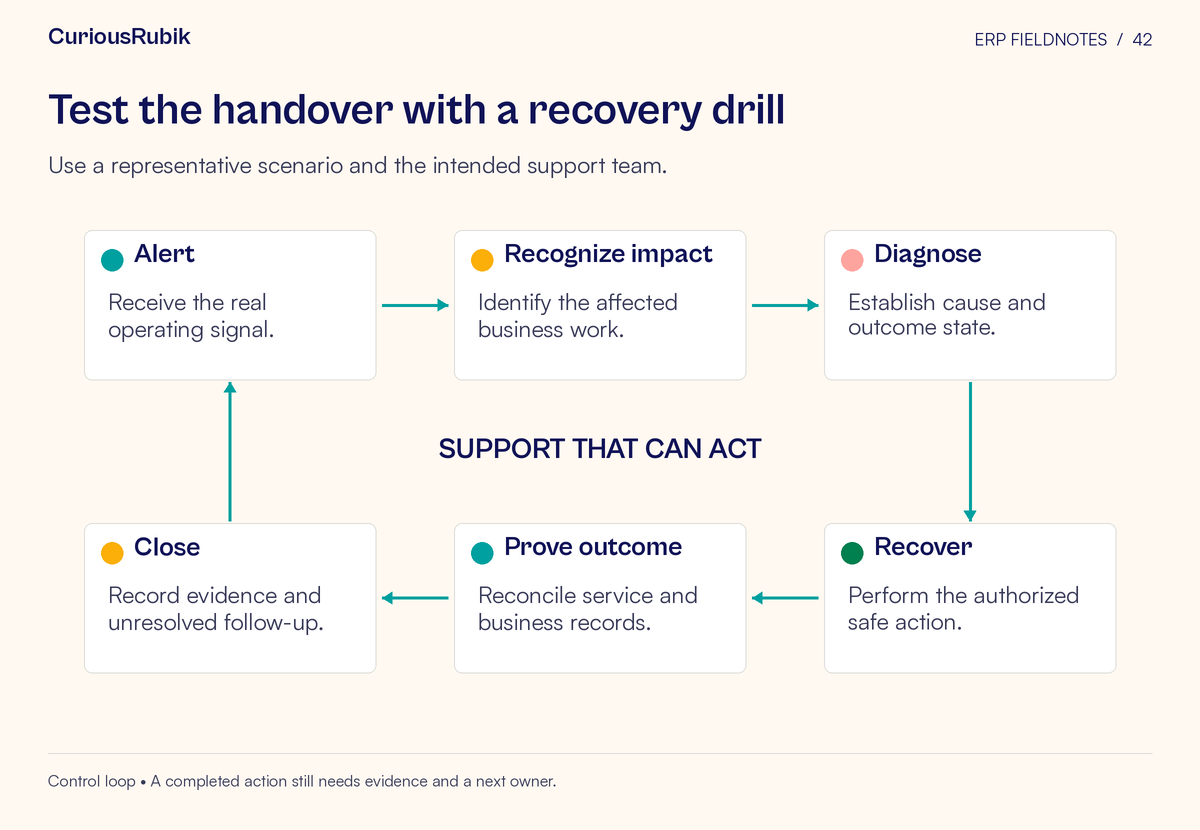
Let the receiving team lead through six steps:
- Detect the condition using the monitoring and reconciliation available after handover.
- Identify the affected business activity, population, deadline, and immediate containment need.
- Diagnose the state of transactions across the boundary using traceable identifiers and evidence.
- Select and authorize the recovery path, including any required business decision.
- Execute the safe recovery or simulation and verify the receiving business outcome.
- Close the incident with evidence, a record of remaining issues, and any required learning update.
The build team should observe and answer through the agreed escalation route. If it quietly performs the difficult steps, the exercise measures the project team's capability rather than the receiving service's readiness.
Record elapsed time by stage, but interpret it against the business deadline and exercise conditions. A tabletop can expose unclear ownership; it cannot prove production throughput. A technical replay test can demonstrate recovery behavior; it may leave out an unavailable business approver. State those limits in the result.
A hypothetical interface that appears healthy
Imagine a hypothetical company whose warehouse sends shipment confirmations into its ERP. Monitoring reports that the nightly transfer completed, but several confirmations were rejected by a validation rule in the receiving process. The transport layer is healthy while invoices remain unavailable.
In the handover drill, the service desk initially checks only whether the file arrived. The business reconciliation reveals missing shipment identifiers, and the team identifies the rejected records. A data steward can correct the underlying reference data, but the draft runbook says only “rerun the file.”
The business owner asks whether successful records would be processed again. The team cannot yet demonstrate safe replay behavior. It pauses the drill at that decision, records the gap, and defines a narrower recovery procedure that identifies affected records and verifies their final state.
The next exercise must prove that procedure with the receiving team leading. The handover also gains a reconciliation check tied to the invoicing cutoff. The outcome is a clearer operating commitment, not a claim that one successful test eliminates future failures.
Accept the service with visible limitations
Close the handover with decisions from the business owner and service owner. The business owner accepts the supported outcome and any temporary exposure. The service owner accepts the coverage, skills, access, documentation, and resources needed to deliver it.
Open items should say whether they block acceptance, require a bounded interim arrangement, or belong in ordinary improvement work. For conditional acceptance, identify the owner, due event, evidence needed, and escalation if the condition persists.
Schedule review when the interface changes, a consequential incident exposes a gap, or the business obligation changes. The service card should remain a living reference rather than a project archive.
A useful first step is to select the interface with the least obvious ownership boundary. Ask its future support team to lead one realistic exception from detection to reconciled closure. Any point where the team must rely on an undocumented favor is a concrete handover issue worth resolving before the builders leave.