
Planning Your Team’s Time for an ERP Project. Allow for project work and the day-to-day business.
The project calendar says a process owner is needed for a six-hour design workshop. Their operational calendar already contains a full week. The workshop is accepted anyway, preparation moves into the evening, and the decisions remain unfinished afterward.
The missing budget is internal capacity: the time, expertise, and authority the business must supply to make delivery possible. A project can have approved funding and a fully staffed implementation partner while still lacking this essential input.
Build that budget by role and week, then reconcile it with operating commitments. A percentage allocation at the program level is too coarse to reveal the specialist who must validate data, approve a design, and support the monthly close in the same period. The useful question is which work can actually be completed by the people qualified to do it.
Start with outputs, then identify contributions
Ask the delivery leads for the business contributions required to finish each near-term output. Workshop attendance is only one contribution. Others include gathering examples, clarifying policy, reviewing a design, correcting source records, preparing tests, investigating failures, accepting results, and explaining changed responsibilities to colleagues.
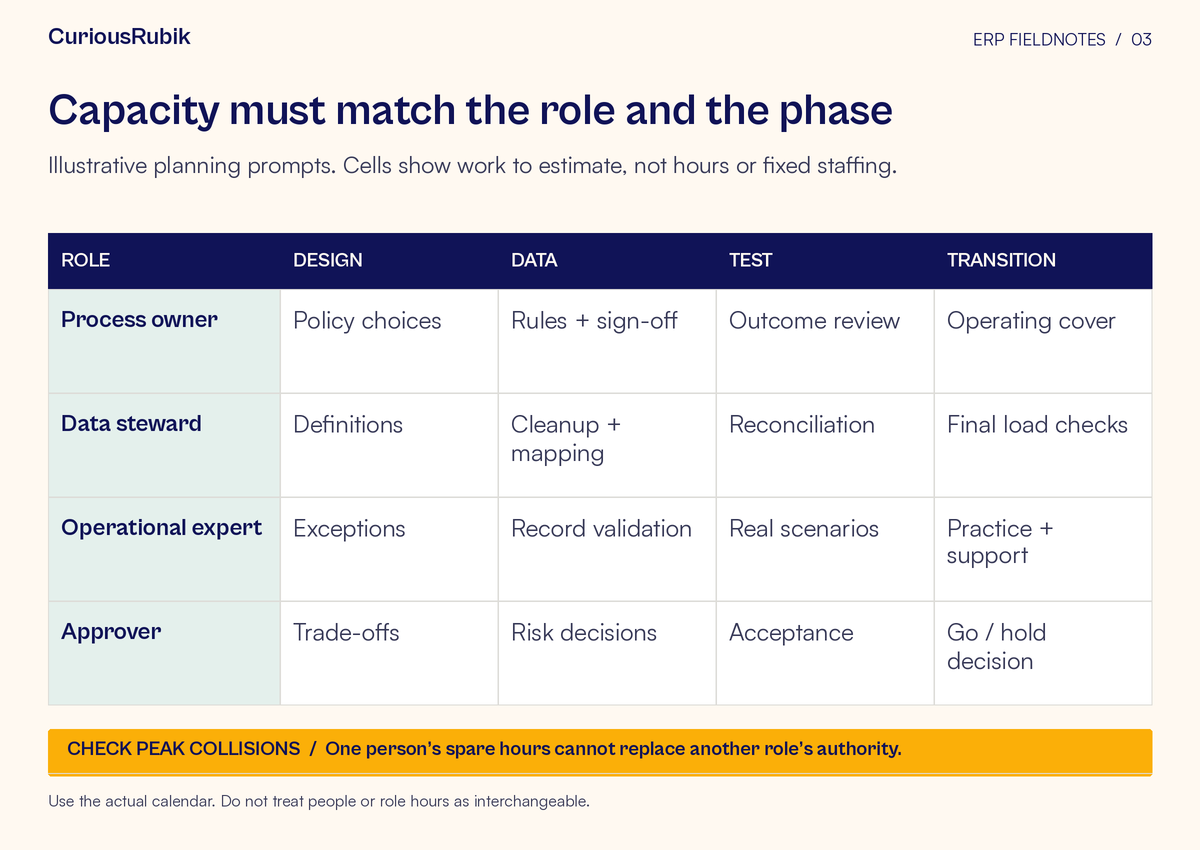
For every contribution, record who performs the work and who makes the decision. A knowledgeable analyst may prepare an excellent recommendation without holding authority to approve it. Counting the analyst's hours as a substitute for the approver's availability creates a schedule that is staffed on paper and blocked in practice.
Separate effort from elapsed time. A two-hour review may require three working days because the reviewer needs input from another function. The schedule must allow that dependency, while the capacity budget accounts for the actual work. Otherwise, the team may reserve too many hours for waiting and too little for the decision itself.
Use actual named people for the next planning window where possible. For later phases, role-level estimates can be appropriate, provided unresolved staffing is visible. “Business team” should never conceal work with no owner.
Calculate usable capacity without assuming perfect weeks
Start with scheduled working time. Subtract essential operating work, leave, other committed initiatives, and an explicit allowance for foreseeable disruption. The remainder is usable project capacity. Estimate these deductions from the person's work pattern and manager's knowledge, then revise them as actual evidence accumulates.
The disruption allowance is a planning choice, not a universal percentage. A service manager handling unpredictable customer escalations may need a different allowance from a specialist with stable processing duties. Hiding the allowance inside every task can double-count it; omitting it assumes uninterrupted weeks the organization may rarely experience.
Do not subtract project meetings from capacity and also count the same meetings as project demand. Choose a consistent accounting convention. It is usually clearer to put every project activity, including governance and status preparation, on the demand side, while keeping operating obligations on the capacity side.
Compare demand with capacity for each person or genuinely interchangeable role pool. Hours available in one department do not solve another department's shortage if the knowledge or decision authority cannot be transferred. Nor can spare capacity next month compensate for a decision needed this week without changing the schedule.
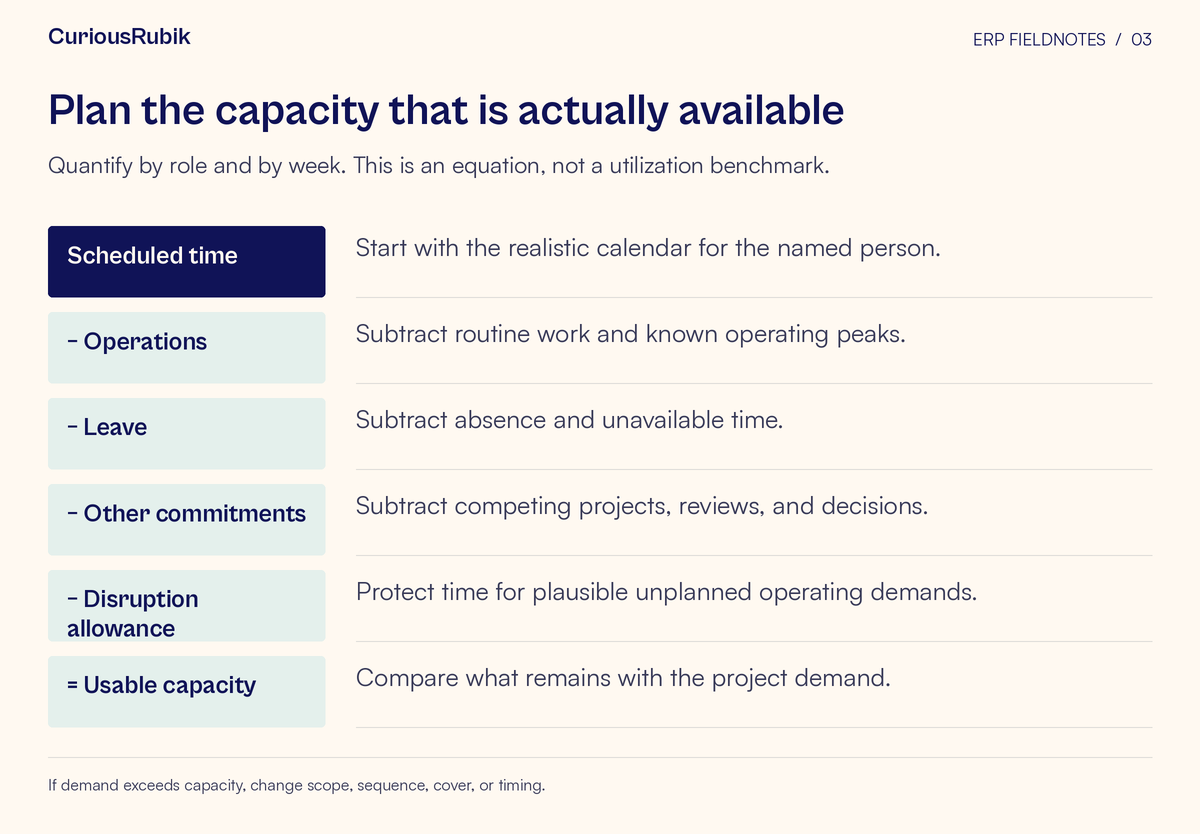
A worked week exposes the real choice
Consider a hypothetical finance process owner with a 40-hour scheduled week. Essential operating work requires 24 hours, another committed initiative requires four, and the manager reserves four for likely operational interruptions. There is no planned leave. Usable project capacity is therefore eight hours.
The ERP plan needs six hours of design sessions, two hours of preparation, three hours of design review, and two hours of expected follow-up and correction. Demand totals 13 hours. The shortfall is five hours, even though the visible workshops fit inside the original eight-hour allocation.
These figures are illustrative assumptions, not recommended workloads or industry benchmarks. Their value lies in making a choice visible. The manager could transfer suitable operating tasks, reduce the competing initiative, move part of the design work, or change the project sequence. Simply retaining the schedule creates an unapproved dependence on overtime or unfinished work.
Suppose the manager proposes backfilling six operating hours. In the first week, the replacement needs three hours of instruction from the process owner. Net capacity released that week is three hours, leaving a two-hour shortfall. Later weeks may improve once the handover is complete. A capacity budget that ignores the transition would report a solved problem too early.
Now suppose an operational incident consumes six hours rather than the four reserved. The additional two-hour demand is new evidence. The team should update the remaining week and decide which project commitment moves. Quietly borrowing from next week's availability can create a backlog nobody has approved.
Build the worksheet managers will actually review
Use one row per person, week, and material work package. Retain a separate summary by person and week so duplicate bookings can be detected. The worksheet needs enough detail to support a choice without becoming a second time-recording system.
Record these fields:
- Named contributor, required skill, and decision authority
- Week or operating period, including relevant business peaks
- Scheduled time and deductions for operations, absence, other commitments, and disruption
- Project preparation, execution, review, decision, and expected correction effort
- Dependency and date by which the contribution is needed
- Capacity gap, confidence in the estimate, and proposed response
- Line manager accepting the allocation and project lead accepting the delivery consequence
Include an evidence reference where it matters: a confirmed operational calendar, a workload sample, a draft test inventory, or a manager-approved coverage plan. Early estimates can be rough. They should become more specific as the team learns how much review and correction the work really requires.
Maintain ranges for uncertain activities rather than concealing uncertainty in an exact total. For example, data correction effort may depend on profiling results. Identify what evidence will narrow the range and which scope decision is exposed if the upper estimate proves credible.
Find the bottlenecks before adding people
The most constrained contribution may be a decision that only one person can make. Adding analysts can increase the volume of material waiting for that decision. First inspect the flow: what is waiting, why it is waiting, and whether every item genuinely needs that person's authority.
Some decisions can be delegated within explicit limits. Some can be grouped into a scheduled review with a clear recommendation and supporting evidence. Others require the specialist's direct attention. The capacity response should match the constraint rather than treating every backlog as a shortage of generic labor.
Map coverage for critical roles. A deputy needs access to the relevant context, permission to act, and practice doing the work. Naming a backup who has never seen the process provides little protection when the primary owner becomes unavailable.
Also inspect collisions across phases. Data preparation may continue during testing. Retesting may coincide with training preparation. Transition planning may require the same operations lead who is resolving test failures. A sequence shown as separate phases can still draw on the same people simultaneously.
Choose the response with its costs attached
A capacity gap usually leads to one or more of four decisions: release time through coverage, reduce work, resequence work, or move the commitment date. Each has consequences worth documenting.
Backfill or coverage works best when a defined body of work can be transferred safely. Specify the tasks, competence required, onboarding effort, supervision, and control responsibilities. Funding a replacement does not prove the replacement is available or able to take over by the required date.
Scope reduction helps only if it removes real work. Deferring a report may save little if the underlying data and controls are still required. Removing a location may create additional interfaces or temporary reconciliation. Ask the delivery leads to show the net effect on the constrained roles.
Resequencing can protect scarce expertise, but check downstream consequences. Moving a decision later may force configuration to proceed on an assumption. If that assumption could produce significant rework, the apparent schedule improvement may be fragile.
Delay can be the most coherent response when the work is inseparable and staffing cannot change. Explain which capacity condition the new date resolves. A later date without a changed staffing or workload assumption simply relocates the same problem.
Overtime may be available under the organization's policies and employment arrangements, but it should be an explicit, bounded decision. Include its cost, approval, and impact on sustainable work. Do not build the baseline plan around indefinite extra hours that nobody has agreed to provide.
Use triggers that lead to decisions
Agree overload triggers with functional managers. Examples include demand exceeding confirmed capacity in a critical week, an approval missing the date needed by dependent work, a new initiative taking protected time, or an essential contributor losing their coverage arrangement.
The trigger should identify an action and an owner. A project lead can re-plan within delegated limits. A line manager can change operating coverage. A sponsor must resolve competing priorities that neither can move. Establish how quickly that decision is needed based on the affected dependency, rather than choosing an arbitrary response period for every issue.
Track unfinished reviews and unmade decisions as outstanding work. They should remain in the next forecast until completed or explicitly removed. Otherwise, a plan can appear healthy because each week's missed contributions disappear when the calendar advances.
Compare actual effort with estimates selectively. Sample important work packages and investigate meaningful differences. The aim is better planning, not surveillance of every minute. If preparation repeatedly takes longer than assumed, adjust future demand and examine whether the team receives sufficiently usable inputs.
Reconcile capacity at every meaningful change
Refresh the budget when scope changes, a phase begins, major defects require retesting, staff availability shifts, or an operational peak approaches. The program lead should bring the delivery view; functional managers should bring the operating view. Neither can approve the complete trade-off alone.
Start with the next four to six weeks if that is a useful window for your operating rhythm. Choose the period that captures the upcoming decisions and known workload peaks. Build the detailed view for the handful of roles most likely to constrain progress, then expand where the evidence warrants it.
Before confirming the next milestone, ask each manager one concrete question: “What work has changed to make this person's project commitment possible?” If the answer is nothing, the capacity budget has identified an unresolved decision. Resolve that decision while there is still time to choose, rather than expecting the individual to absorb the conflict privately.