Procurement can appear efficient at one stage while the complete process remains slow and difficult to control. A request is approved quickly but lacks the information needed to order correctly. A purchase order is issued on time but receiving cannot identify it. An invoice enters the system promptly but waits because the evidence of delivery or service acceptance is missing.
Redesigning the process means connecting these decisions and records from the original need to the authorized payment outcome. The objective is not simply to move each document faster. It is to reduce avoidable clarification and waiting while preserving the controls that make the commitment valid.
For a procurement and finance leader, the useful starting point is the whole purchase journey, including the exceptions that create most of the rework.
Clarify the need before routing approval
A purchase request should describe the business need, relevant specification, quantity, timing and delivery or service context. The required detail depends on the purchase; it should be sufficient for the next decision without turning every request into a burdensome questionnaire.
Help requesters distinguish a desired outcome from a preferred product. Procurement may be able to reuse an existing item, use an agreed supplier or suggest another way to meet the need. That opportunity disappears when the process starts with an unexplained supplier invoice.
Identify information that can be reused safely from existing records, such as an authorized delivery location or an approved item description. Make units and significant assumptions visible so that a familiar name does not conceal the wrong packaging or service scope.
Resolve ambiguity before commitment where practical. Passing an incomplete request through several approval levels can create the appearance of control while leaving the substantive question unanswered.
Separate the decisions within the process
Approval of a business need, authorization of expenditure, selection of a supplier, issuance of an order, acceptance of delivery and release of payment are related but distinct decisions. Their owners and evidence requirements should be clear.
Some decisions may be combined under an organization’s policy, while others require separation. The design should make that choice explicit rather than assume that one approval covers every subsequent action.
The 2014 GAO Green Book organizes internal control around objectives, risk, control activities, information and monitoring. Its federal-government scope is distinct from a private company’s procurement policy, but it illustrates why controls should respond to defined risks and responsibilities rather than exist as an unexplained sequence of signatures. GAO, 2014 Standards for Internal Control.
Use that discipline to ask what each step establishes. If two reviews examine the same evidence without adding a distinct judgment, the process may contain avoidable duplication. If an important decision has no competent owner, removing delay alone will not fix it.
A research commission needs a usable acceptance basis
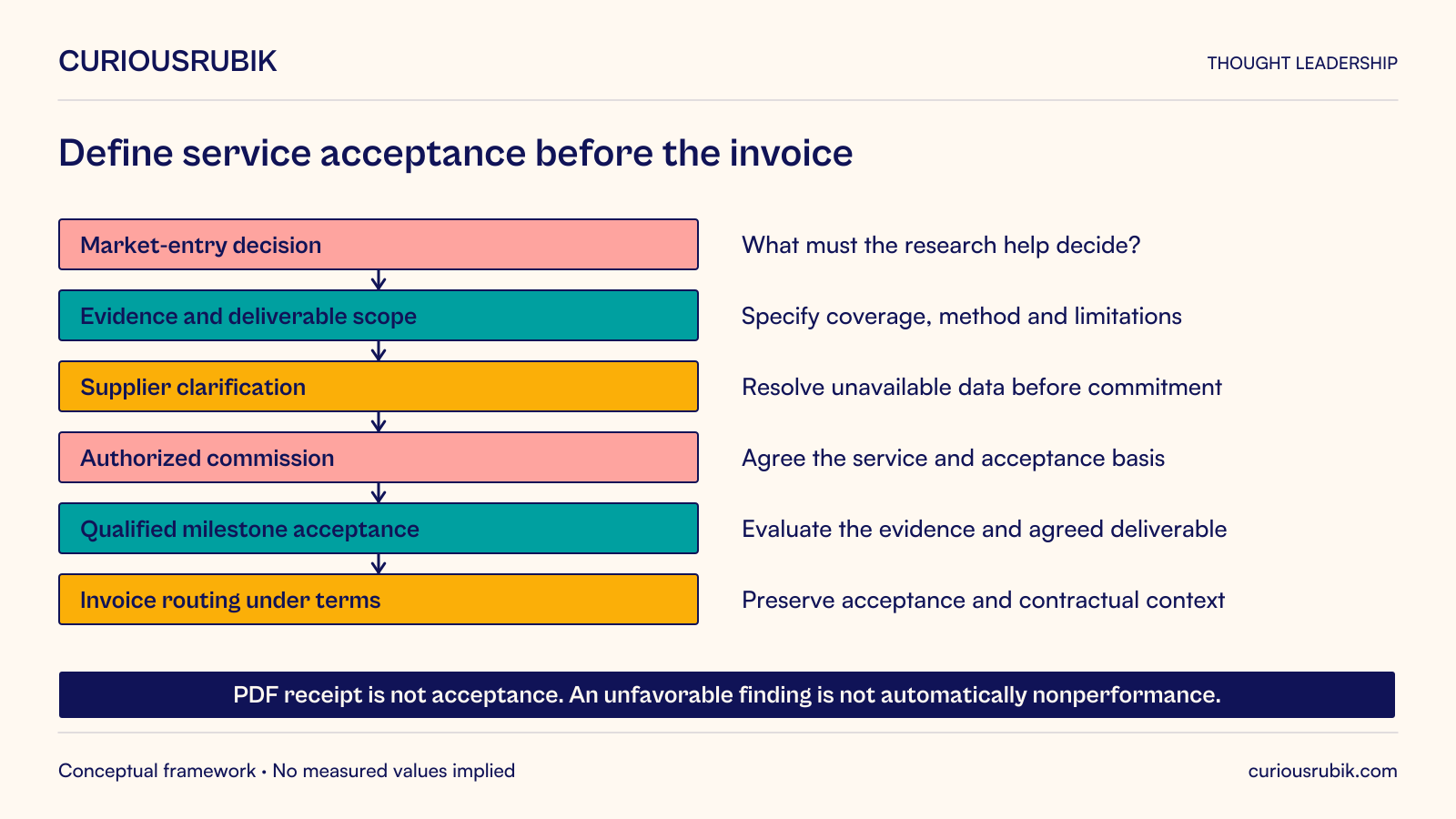
Consider a hypothetical industrial-services company considering entry into a new regional market. A requester asks procurement to buy a market report. That phrase does not establish which decision the work must support, which customer groups matter or what evidence the supplier is expected to provide.
Before ordering, the business owner and a suitably qualified research reviewer clarify the brief: the decision questions, intended audience, required source transparency, agreed methods and deliverables, known limitations and review process. These are illustrative contract requirements, not a universal research-quality standard or a guarantee that the study will identify an attractive opportunity.
During supplier clarification, the parties discover that a requested competitor-price dataset is not available through the proposed lawful research approach. The business can accept a narrower evidence basis, authorize additional work or reconsider the commission. Leaving that issue unresolved would transfer the ambiguity to delivery and invoice review.
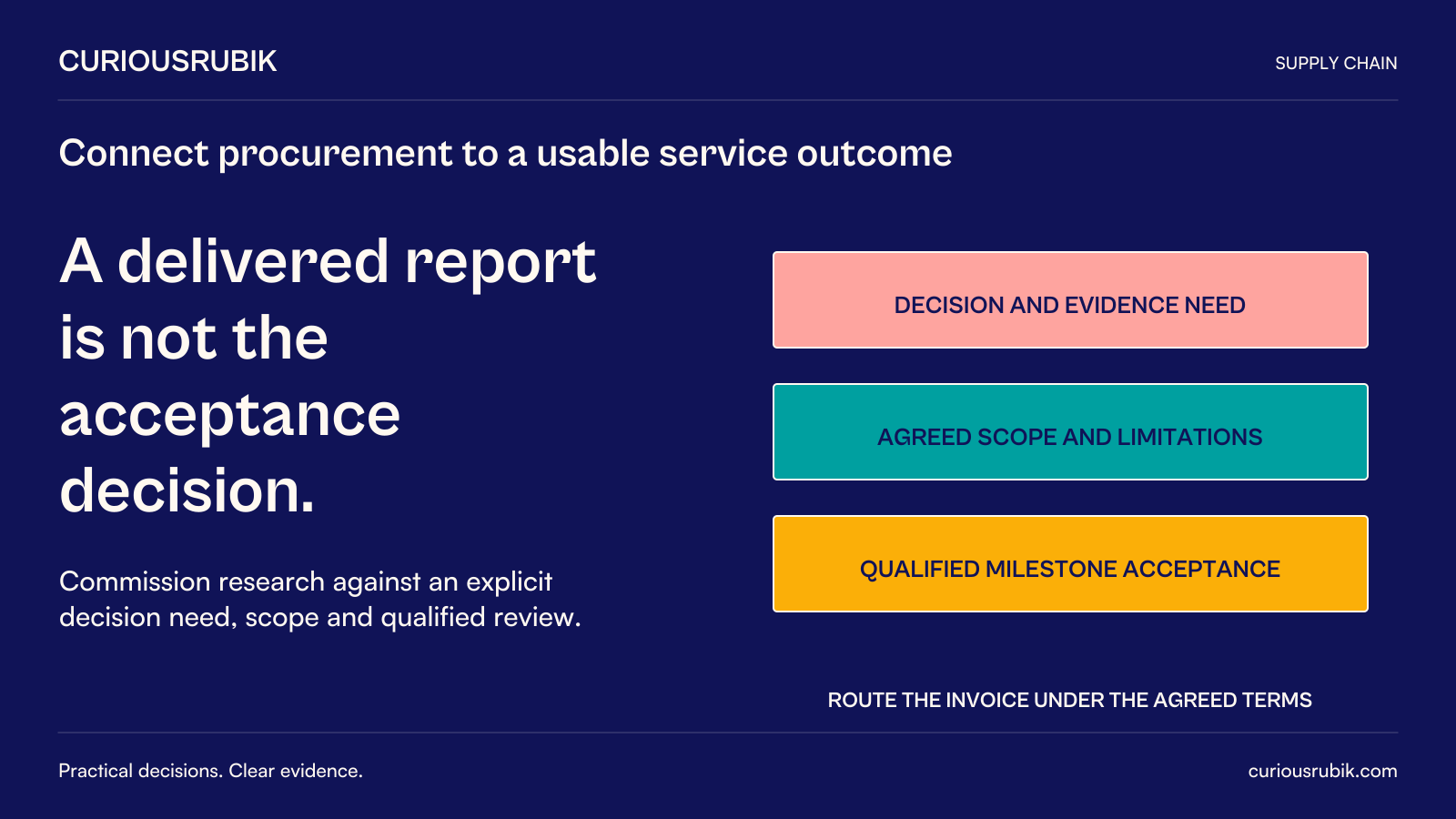
Suppose the agreement includes a milestone for an accepted interim findings package. When the supplier submits it, the qualified business reviewer checks it against the agreed scope and evidence requirements. Receipt of a PDF does not by itself establish acceptance. Equally, an unfavorable or uncertain commercial conclusion is not automatically a failure to deliver the agreed research.
Finance then needs the relevant agreement, milestone invoice and recorded acceptance or exception. Payment timing and any treatment of disputed work follow the actual terms and the organization’s authorized process. Procurement and finance should not be expected to invent research acceptance criteria after the invoice arrives.
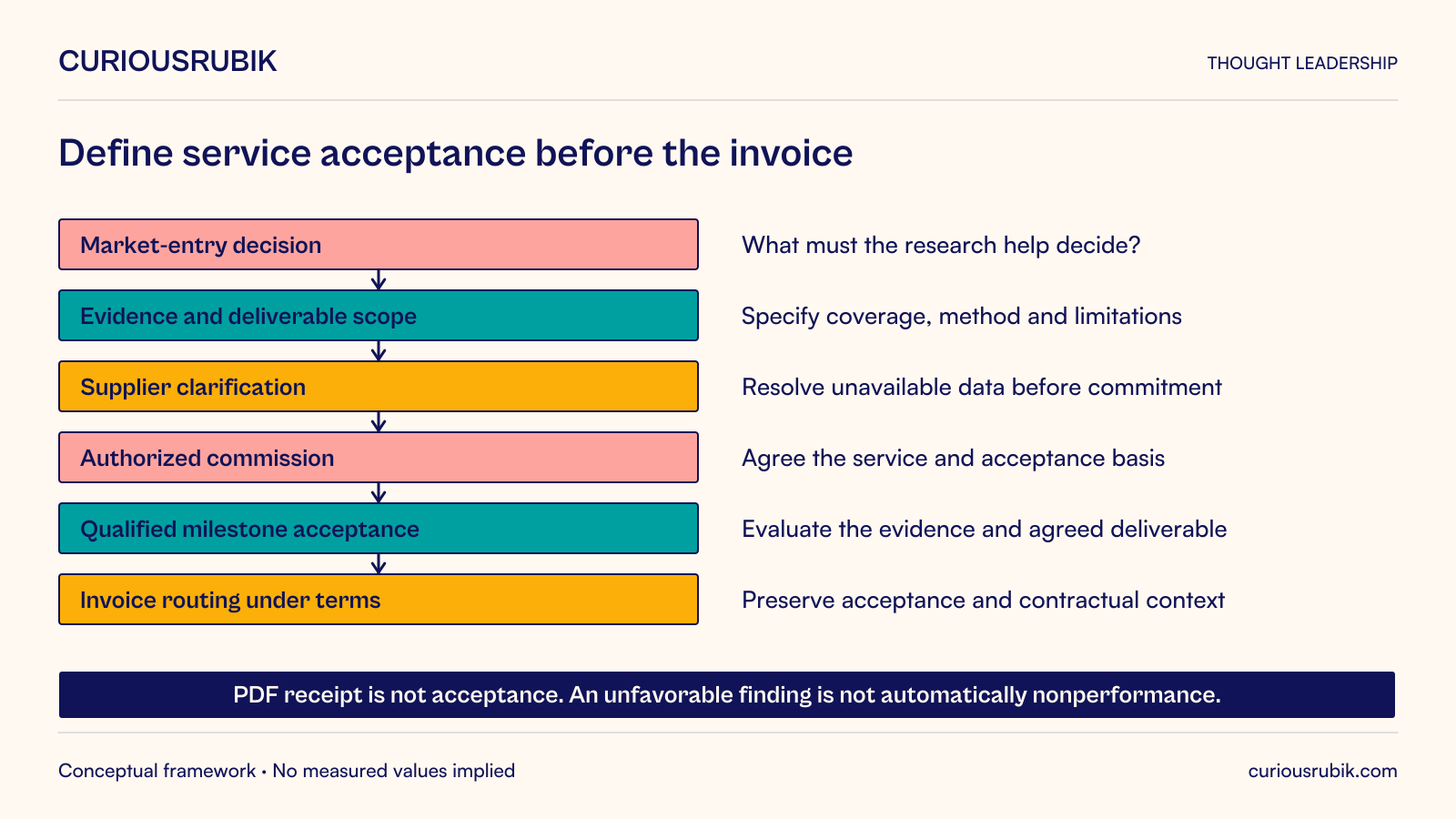
The example is an operational illustration, not accounting, tax or legal advice. Its purpose is to connect the original decision need to an inspectable deliverable and the evidence required for a valid payment decision.
Design the normal path and the exception path together
A well-understood routine purchase may support a streamlined route using approved suppliers, terms and controls. The organization should still define which conditions take a transaction out of that route.
Examples include an unrecognized supplier, changed payment details, an unexpected price or quantity, a disputed receipt or an invoice without the required supporting record. Different exceptions need different owners and evidence.
Avoid sending every exception to a generic procurement inbox. The team should be able to see the reason, affected record, next action and responsible role. Finance should not be expected to resolve a technical specification dispute it cannot evaluate.
Define how a corrected transaction returns to the normal process. Preserve the evidence and decision rather than hiding the exception by overwriting the original record.
A process that handles the routine case quickly but leaves exceptions unowned can still perform poorly overall.
Keep the supplier and item records trustworthy
Supplier identity, authorized contact information, payment instructions, item definitions and units support many downstream decisions. Errors in these records can create repeated problems across otherwise well-designed transactions.
Assign ownership and controlled change procedures. A request to alter a payment destination should receive the verification required by the organization’s risk policy, rather than being accepted solely because it arrived through a familiar channel.
Make item and service descriptions specific enough for ordering, receiving and invoice review. Different teams may need different detail, but they should be able to connect their view to the same intended purchase.
Do not solve a master-data problem through repeated local workarounds. If receiving regularly interprets an ambiguous unit or finance repeatedly corrects the same supplier reference, investigate the shared source and its maintenance process.
The goal is fewer preventable exceptions, not simply faster handling of the same errors.
Reduce waiting without bypassing judgment
Measure active work and waiting separately. A request that takes several days to approve may require only a few minutes of review but spend most of its time unassigned, awaiting missing information or sitting with an unavailable approver.
Use clear routing, bounded delegation and visible queues to address those delays. Delegation should preserve the required authority and separation of responsibilities. An escalation timer does not create approval rights.
Provide decision-ready information to reviewers. They should be able to understand the need, relevant policy conditions and consequences without reconstructing the request from attachments and email threads.
Parallelize genuinely independent work where appropriate. Do not run dependent decisions in parallel if one can materially change the basis of the other.
The objective is a shorter, more predictable path to a valid decision, not an approval count optimized in isolation.
Connect the records through stable references
The process needs a reliable relationship among the request, order, revisions, receipts, invoices, exceptions and payment status. Stable references help teams and systems trace the same purchase without relying on similar descriptions.
Support partial fulfillment and multiple invoices where the business uses them. An order can remain partly open while some lines are complete. The data model should represent that reality rather than force one status onto the whole transaction.
Preserve versions of material changes. An invoice should be evaluated against the applicable authorized commitment, not whichever order value happens to be visible after an unrelated edit.
Handle duplicate or repeated submissions deliberately. A supplier resending an invoice because it has not received an acknowledgement should not create a second payable obligation. The system needs suitable identity and review controls for the actual business process.
Technical integration should expose processing failures and unresolved states. A message delivered successfully does not prove that the receiving system accepted the transaction.
Make receipt and service acceptance practical
Receiving staff need enough information to identify the purchase and record what occurred. The process should fit their actual environment, including partial deliveries, damaged items and missing references.
For services, define evidence of completion or acceptance appropriate to the arrangement. A physical goods-receipt screen may not fit a milestone-based service. The responsible business owner should know what they are confirming and what remains unresolved.
Avoid pressure to record acceptance merely to clear an invoice queue. If evidence is missing, the exception needs a visible owner and resolution path. If the policy allows a particular alternative control, document and apply it deliberately.
Give requesters and receiving teams feedback about downstream consequences. Understanding that an incomplete receipt record can delay a valid supplier payment helps connect local actions to the whole process.
Measure the complete purchase outcome
Use measures that reflect both service and control: time to a usable commitment, clarification effort, receipt discrepancies, invoice exception age, duplicate handling and the time to an authorized payment outcome.
Segment the results by purchase type and exception reason. Routine catalog purchases and complex services should not be compared through one average without context.
Include rework across departments. A faster procurement stage that transfers correction effort to receiving or finance is not necessarily an end-to-end improvement.
Review whether controls are operating as intended. A low exception count can mean cleaner transactions, but it can also mean that checks are missing or bypassed. Interpret the measure alongside evidence from actual cases.
Use the findings to improve upstream definitions, records and responsibilities rather than treating every problem as a reason for another approval step.
Redesign one coherent flow before scaling
Choose a purchase category with a clear business need and representative exceptions. Map its decisions, records, owners and waiting points with the people who perform the work.
Test the redesigned flow with partial delivery, changed terms, missing evidence and a disputed invoice as well as the routine case. Confirm that users understand the current state and the next responsible action.
Then extend the proven patterns where they fit, while preserving differences required by other categories. A single rigid workflow should not force all purchases into the same evidence model.
Procurement works better when the organization connects need, commitment, receipt and payment through clear authority and trustworthy information. The result is a process that can move faster because less ambiguity is carried forward, while the decisions that protect the business remain visible and accountable.