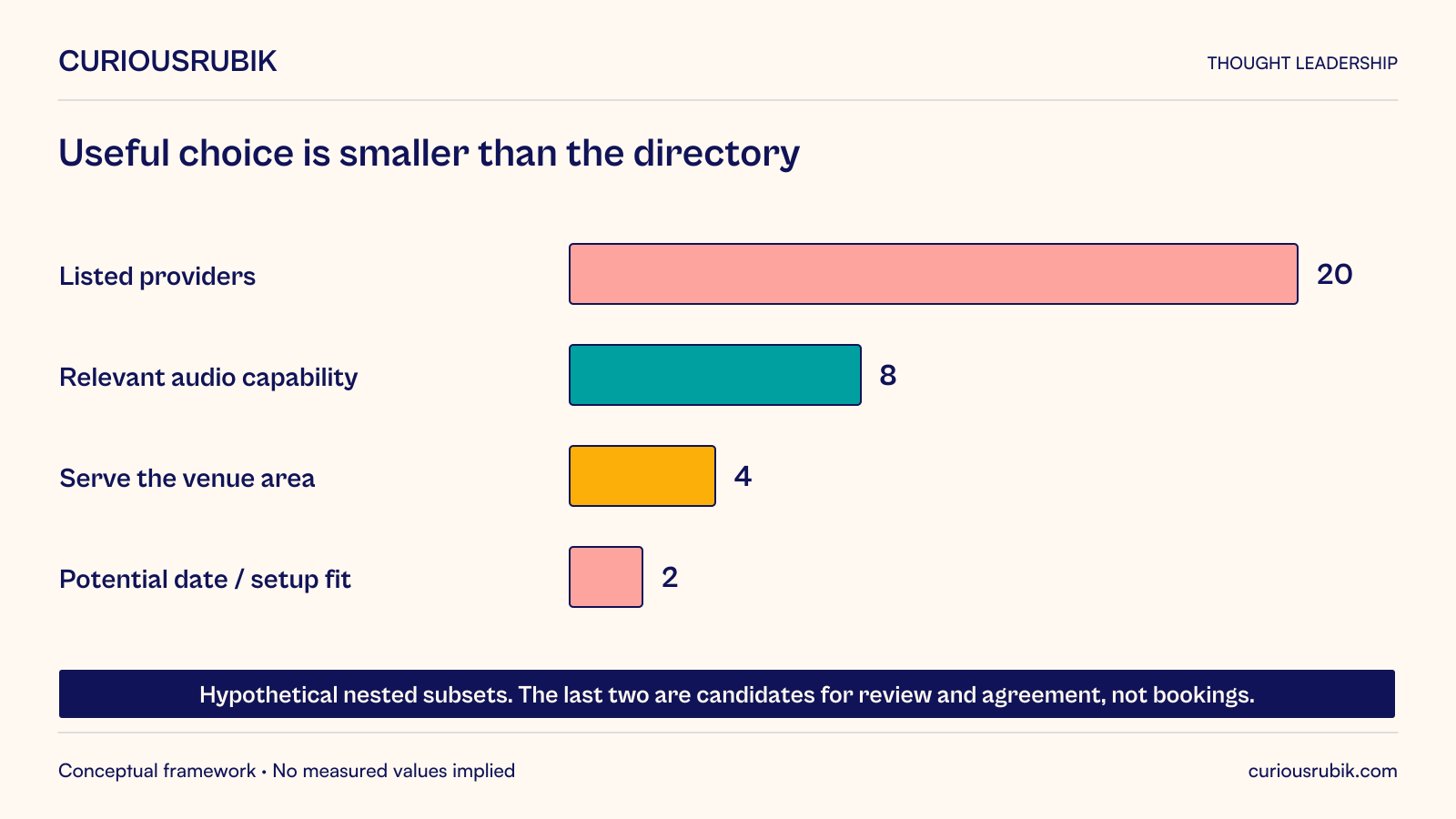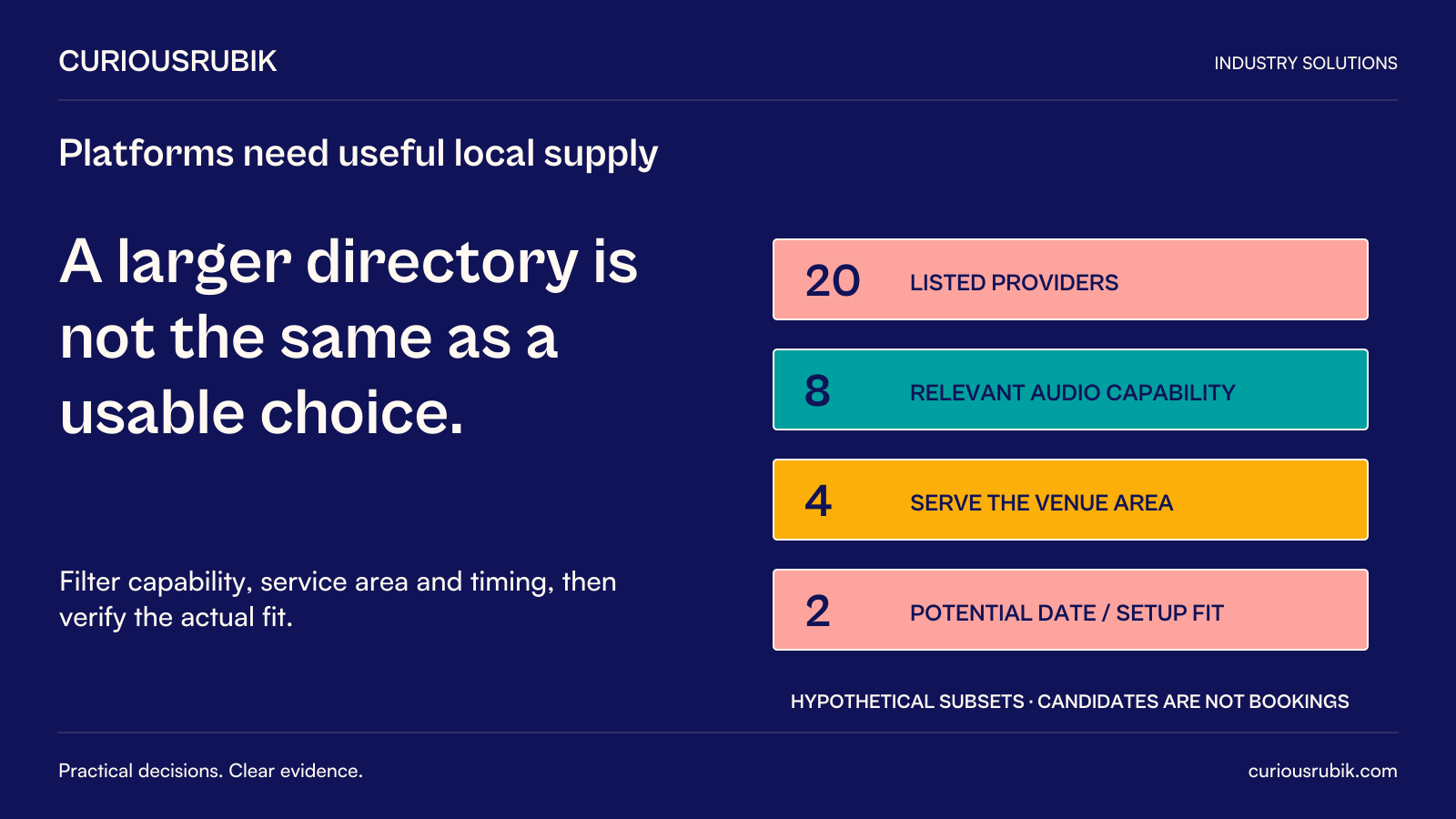
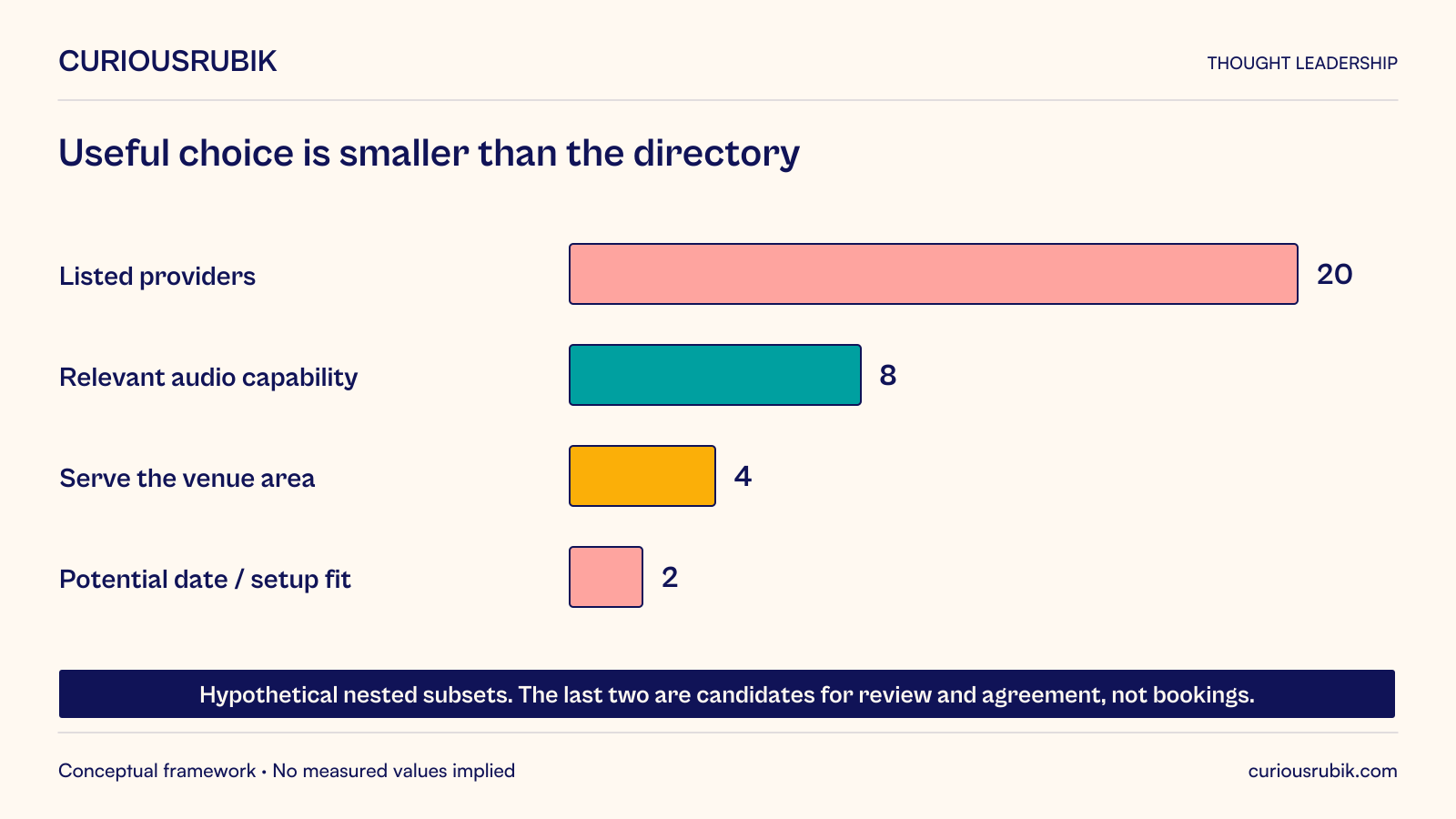
A venue manager finds 20 providers on an event-support platform. Only two appear potentially able to supply the required audio skills, work at the venue on the requested date and meet the agreed setup conditions. The platform has created a large directory, but the customer’s useful choice is much smaller.
That distinction matters when a service business considers a platform strategy. Digital access can widen discovery and simplify coordination, yet the valuable unit is a workable service relationship. More registrations or listings do not automatically create more service capacity that customers can actually use.
A platform can change how service demand and supply find each other, agree terms, coordinate delivery and resolve problems. The business opportunity lies in improving those interactions while being explicit about the responsibilities the platform accepts and those retained by its participants.
Decide which relationship the platform is meant to improve
The OECD’s 2019 introduction to online platforms describes them as digital services enabling interactions among distinct, interdependent user groups. Its analysis also emphasizes their diversity. That framing is useful because a service platform is not simply a company’s existing booking form with a new name. OECD platform report.
A business may instead need a better internal operating system or a direct customer portal. Those can be valuable investments without creating a marketplace. Establish whether independent providers and customers will interact through the service, what each group contributes and why both would continue to participate.
For an event-support platform, customers may value finding a suitable team without making many separate inquiries. Providers may value well-defined requests, credible demand and less administrative effort. A design that makes customer search easy by sending vague requests to every provider can shift rather than remove the work.
Specify the interaction that needs improvement. Is it discovery, qualification, scheduling, agreement, evidence of delivery or problem resolution? Starting with one costly interaction can be more realistic than attempting to own the entire service lifecycle immediately.
Also define the platform’s role in the promise. Introducing two parties is different from committing to deliver a staffed event service. Marketing, interface labels and support behavior should reflect the actual arrangement. Appropriate commercial and legal review is needed for the model chosen; the interface should not accidentally imply obligations the business has not assessed.
Build useful local supply before celebrating scale
Return to the hypothetical venue manager. Assume 20 providers are listed, eight offer the relevant audio capability, four of those eight serve the venue’s area, and two of those four can support the requested date and setup conditions. These are nested filters for this example, not independent populations to add together.
The result is two potentially suitable candidates, not 20 available teams. Even those two still need to review the actual brief and agree the engagement. A profile match is evidence for a conversation, not a confirmed booking or proof of technical suitability.
The platform should make this narrowing useful. Capture the conditions that genuinely affect a match, explain material uncertainties and avoid showing a provider as available merely because its general profile is active. Providers need a manageable way to keep their service scope and capacity information current.
A marketplace can appear well supplied in aggregate while being weak in a particular area, time window or specialty. Evaluate the combination relevant to customers. Adding more providers in an already well-served category may do little for customers whose requests consistently fail elsewhere.
There is also a provider-side cost to poorly targeted demand. Repeated unsuitable inquiries consume attention and may make the platform less attractive. Track whether requests are sufficiently defined to receive a meaningful response, rather than rewarding message volume alone.
Turn the request into something both sides can evaluate
A service brief often contains assumptions that are obvious to one participant and invisible to the other. For the event example, access times, equipment responsibilities, venue restrictions, setup expectations and the scope of on-site support may affect whether a provider can commit.
The platform can help users identify those questions without pretending to make every specialist judgment. Use structured information where it improves comparison, with room for context and clarification. A mandatory field is useful only if its meaning is clear and the answer can be relied on for the decision.
Preserve the agreed version of the brief and the accepted changes. If the customer later adds a second room or changes the setup window, make the implications reviewable. A message saying “small change” should not silently amend capacity, price or delivery responsibility.
Keep proposed terms, accepted terms and observed delivery separate. A provider’s initial response may be conditional on an inspection or additional information. A customer viewing the response should be able to recognize that condition rather than mistake it for a final commitment.
Good design reduces avoidable ambiguity before work starts. It also gives both parties a shared reference if a disagreement arises. The platform should not need to infer the agreed service from scattered messages after the event has already taken place.
Make trust claims specific and supportable
A badge labeled “verified” can mean identity checked, a document reviewed, a reference obtained or a particular skill assessed. Those are different claims. State what was checked, by whom where relevant, and the limits or date of that evidence.
A historical positive review does not prove suitability for a new technical scope. A profile may be accurate but incomplete. Give customers the information needed to evaluate the engagement rather than using a general trust label as a substitute for the specific evidence that matters.
Review systems also need a fair operating process. Distinguish feedback about a completed engagement from an unverified allegation or a disagreement over scope. Participants need a way to report errors and challenge consequential decisions. The precise policy depends on the platform and applicable requirements, but it should be designed before disputes accumulate.
Protect information according to the interaction. A customer may need to share detailed venue access instructions with the selected team without exposing them to every registered provider. Providers may need to disclose availability for a request without publishing their entire schedule.
As the platform gains influence over discovery and work allocation, its rules become more consequential. Explain material ranking or eligibility factors at an appropriate level, monitor for unintended outcomes and preserve accountable review. Automation should not turn incomplete evidence into an unexplained permanent exclusion.
Design the difficult part of the service relationship
Cancellations, late changes, nonattendance and disputed completion are part of the operating model. A platform that makes booking easy but leaves both sides without a usable resolution path has improved only the beginning of the relationship.
Define what evidence is needed when a provider cannot attend. A replacement suggestion is not automatically an equivalent service; the customer may need to review capability, timing and changed conditions. If no feasible replacement exists, the platform should communicate that clearly rather than leaving a booking status that implies delivery is still assured.
Payment handling and dispute resolution need their own authorized rules and qualified review. Do not let a delivery checkbox invent a payment entitlement or refund decision. The platform’s workflow should implement the arrangement the parties have actually accepted and route exceptions appropriately.
Support staff need access to the relevant agreement, changes and communications, with boundaries around unrelated information. They also need a clear scope of authority. An agent may coordinate evidence and options while a different role decides a disputed commercial remedy.
Measure the effort required to resolve problems. A service marketplace can grow transactions while quietly accumulating support work, unresolved claims and participant frustration. Those effects belong in the operating assessment, not outside it as unfortunate edge cases.
Choose economics that support useful interactions
The platform’s revenue model should be tested against participant behavior and the cost of operating the service. Subscription, transaction and other charging arrangements create different incentives and information needs. There is no universally superior choice.
If the business earns revenue only when an engagement is recorded through the platform, ask what ongoing value encourages participants to keep using it. A useful agreement record, coordination service or dependable support may matter more than trying to make contact inconvenient. Do not assume that acquiring the first interaction establishes a durable relationship.
Include provider onboarding, request clarification, trust checks, support and dispute handling in the cost model. Software distribution can be inexpensive relative to the human work required to make a service interaction dependable. Separate estimated staff capacity from cash expenditure and state the assumptions behind projected growth.
Pilot a bounded market with enough relevant demand and supply to observe the actual interaction. Track qualified requests, meaningful responses, agreed engagements, completed services and unresolved problems using clear definitions. Do not combine those stages into a single success count.
Expansion is justified when the model creates useful outcomes for both participant groups and the business can operate the associated responsibilities. Digital platforms can reshape service industries by making relationships easier to form and manage. Their lasting value depends on the quality of those relationships, not simply the size of the directory that introduces them.