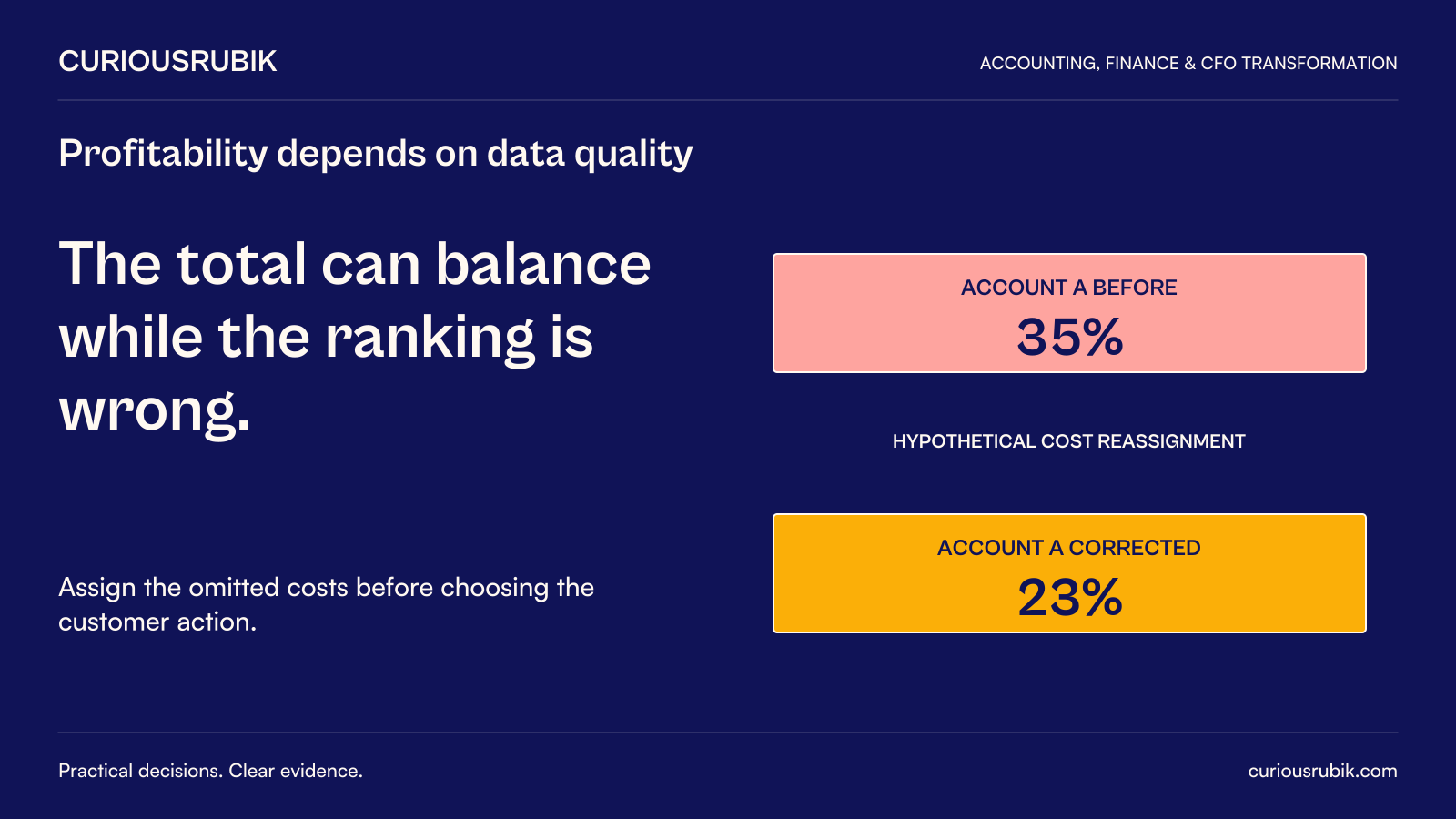
Financial data quality should be judged partly by whether an error can change the decision being made. A perfectly reconciled company total can still mislead an executive if costs are assigned to the wrong customer, a forecast mixes different periods, or a profitability view excludes an important population. The finance leader’s task is to connect data defects to specific decisions and prioritize the repairs that matter.
This requires more than publishing a general accuracy percentage. Different defects have different consequences. An incorrect descriptive label might be harmless in one report and decisive in another. Missing costs can distort pricing analysis without causing an obvious imbalance in the general ledger. A late transaction can matter greatly at a decision cutoff and have little effect once the period is complete.
For an FP&A leader preparing a customer-pricing review, the practical question is whether the evidence can distinguish an economically weak account from an incorrectly measured one. The answer determines whether to change a commercial arrangement, investigate operations, or first repair the information.
Trace the decision back to its economic ingredients
Begin with the action the executive is considering. Suppose the decision is which customer contracts warrant a pricing or service-scope review. Identify the financial measure used, its relevant comparison, and the operational evidence that could change the conclusion.
A customer contribution measure might include revenue less defined delivery and support costs. The team must state whether it includes allocated overhead, one-time setup costs, financing effects, rebates, or disputed items. There is no universal management definition that resolves these choices. The definition should fit the decision and remain consistent enough to compare cases honestly.
Next, trace each ingredient to a source and transformation. Revenue may come from the ledger, support activity from a service system, and delivery cost from time or inventory records. A correct ledger extract does not prove that the service system uses the same customer identity. A consistent mapping does not prove that all relevant activity was recorded.
Keep the raw source and the interpreted financial view distinguishable. If finance estimates unrecorded support effort, the estimate should be visible, with its basis and owner. Concealing it inside an apparently precise cost number prevents the executive from understanding how much confidence the comparison deserves.
Distinguish arithmetic agreement from fitness for use
Reconciliation tests whether specified populations agree after defined adjustments. It is indispensable, but its scope must be understood. If all customer costs add up to the correct company total, costs can still be assigned to the wrong accounts. If two reports use the same incomplete source, they can agree perfectly and both omit the same activity.
Use several checks tailored to the decision. Completeness asks whether the relevant population is present. Classification asks whether values are attached to the appropriate entity, product, or customer. Timing asks whether they belong to the intended period. Definition consistency asks whether comparisons use compatible measures. Lineage asks whether a reviewer can reproduce the transformation.
The 2014 GAO Green Book’s discussion of quality information considers reliable sources and the processing of data for intended use. It is a historical federal control framework, not a universal business reporting rule. Its distinction between obtaining data and producing usable information is relevant to this design problem. GAO-14-704G, Principle 13
Checks should challenge plausible failures. A fixed list of customer codes needs a test for new customers. A support allocation needs a comparison with the source activity population. A margin trend needs a test for changes in cost definitions. Generic validation that a field is nonblank cannot establish that it contains the right meaning.
A hypothetical pricing review that changes direction
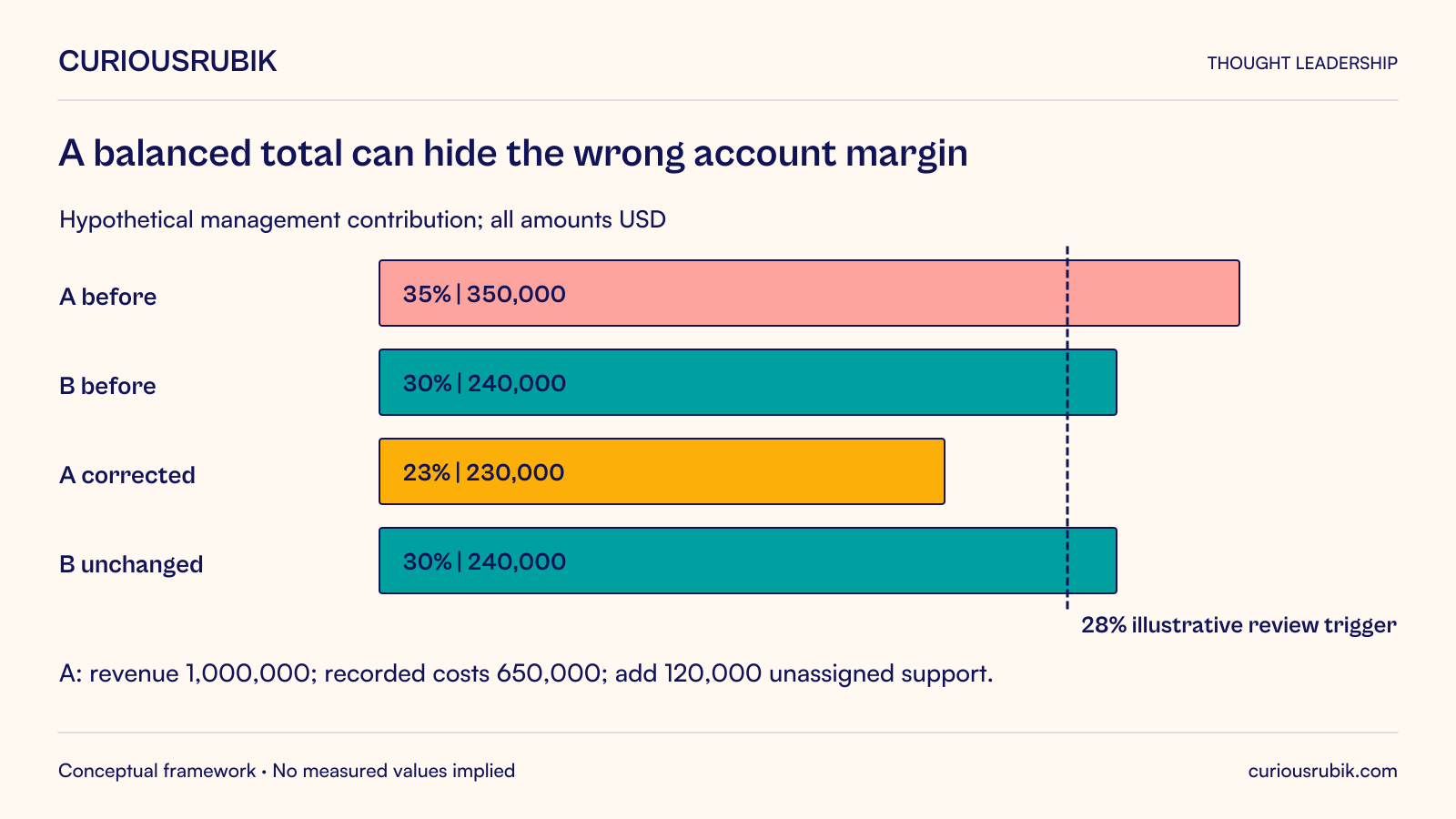
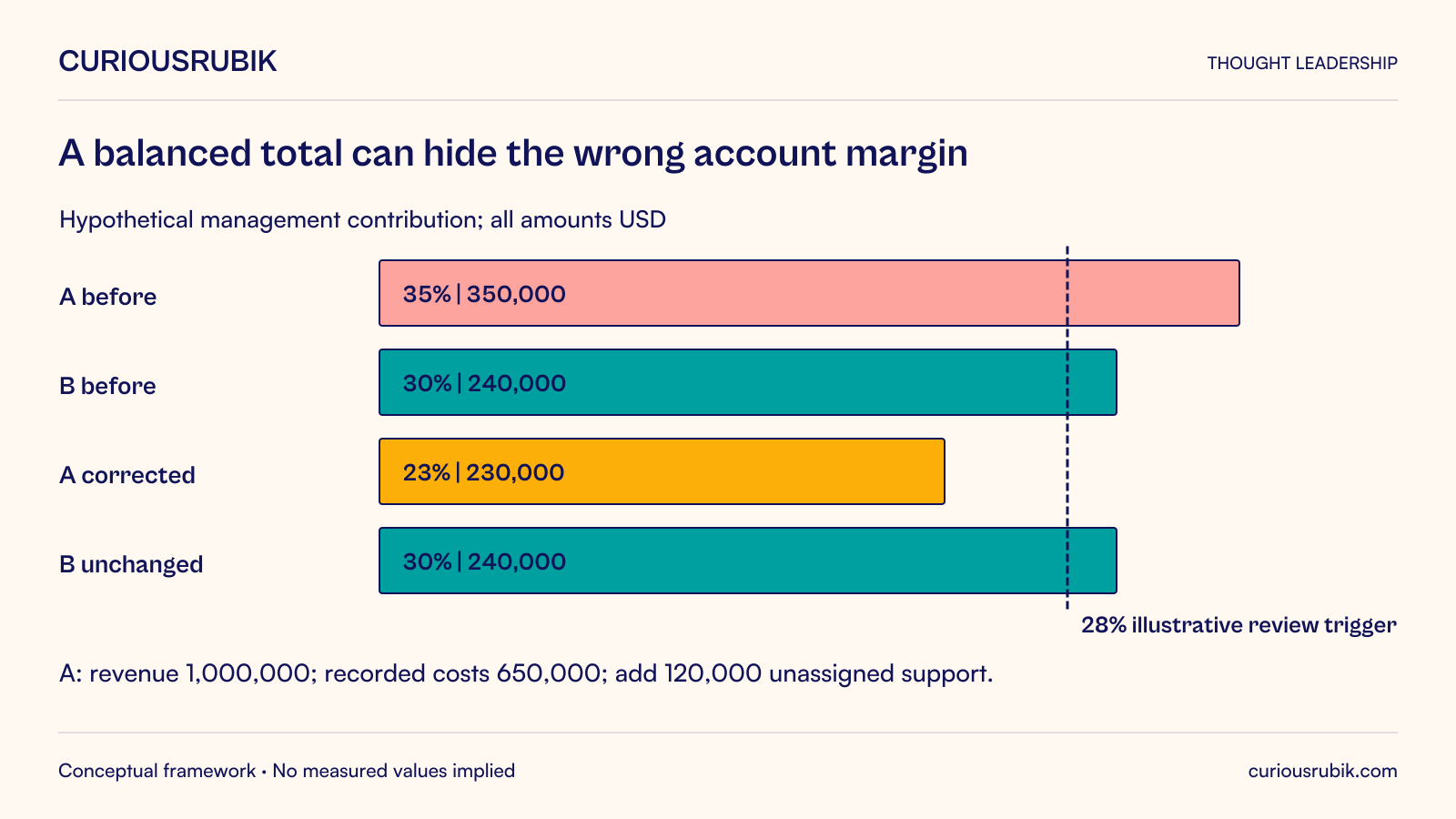
Consider a hypothetical services business comparing two accounts. Account A has USD 1 million of revenue and USD 650,000 of recorded delivery and support costs, producing USD 350,000 of contribution, or 35 percent. Account B has USD 800,000 of revenue and USD 560,000 of comparable costs, producing USD 240,000, or 30 percent.
Management uses a 28 percent contribution threshold to trigger investigation in this example. This is an invented internal review rule, not an industry benchmark or a pricing recommendation. On the initial report, neither account triggers review, and A appears stronger.
An examination of support activity finds USD 120,000 of costs for A classified in an unassigned pool. The company-level cost total was correct throughout. Reassigning those costs changes A’s contribution to USD 230,000, or 23 percent. B remains at 30 percent. The error changes both the ranking and the review decision.
The correct response is not automatically to raise A’s price or end the relationship. The team still needs to determine whether the support cost is recurring, whether it is avoidable, whether the contract includes recovery mechanisms, and what operational change could reduce it. A contribution view is a prompt for analysis; it is not a complete commercial decision model.
The data repair should therefore deliver two things: a corrected customer view and an explanation of why the support records became unassigned. If the cause is a missing identifier in a new service workflow, repairing the historical report without fixing capture allows the same distortion to return next month.
Prioritize uncertainty that can reverse the choice
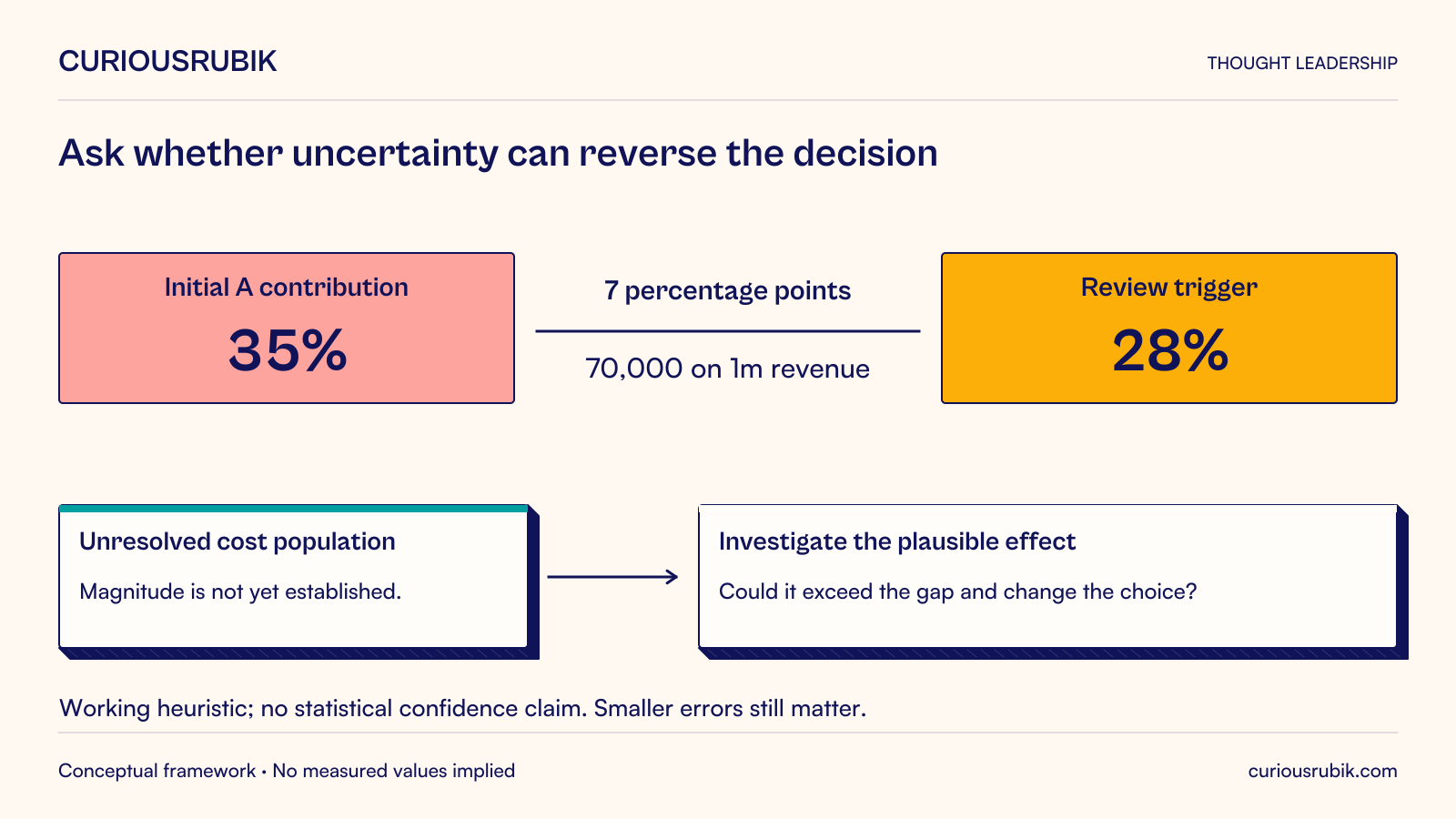
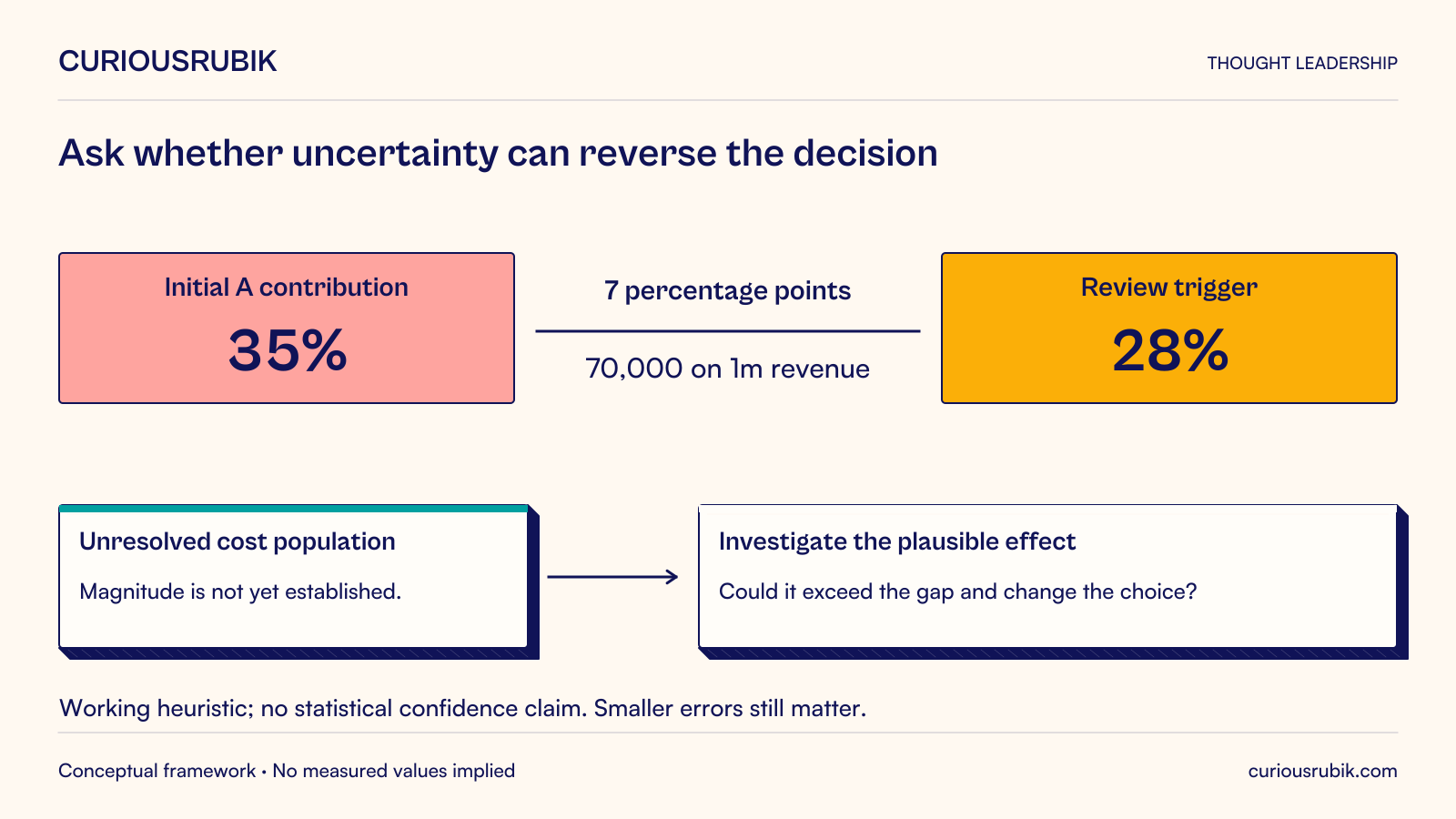
A useful working heuristic is to compare the plausible effect of unresolved data with the distance to the decision threshold. The result is an investigation priority, not a statistically validated confidence score.
In the hypothetical example, A’s initial 35 percent contribution is seven percentage points above the 28 percent trigger. On USD 1 million of revenue, that gap is USD 70,000. An unresolved support-cost population plausibly larger than USD 70,000 deserves attention before management treats the account as safely above the trigger.
This does not mean smaller errors can be ignored. Several may accumulate, affect other decisions, or reveal a serious control weakness. The heuristic helps decide where to investigate first under time pressure. Legal, accounting, contractual, and external-reporting considerations may require a different assessment and should be handled by the responsible specialists.
Where the uncertainty cannot be resolved in time, show its direction and plausible bounds if those can be supported. Avoid inventing a numerical interval to create an appearance of rigor. Sometimes the honest label is “cost population incomplete; ranking not suitable for this decision.” That statement is more useful than an unsupported confidence percentage.
Put ownership where the defect can be prevented
Finance often discovers the error but cannot prevent it alone. A customer identifier may be selected by service staff, a receipt recorded by a warehouse team, or a contract amendment entered by sales. Assign a business owner who can change the point of capture and a finance owner who can assess the downstream effect.
Create an issue record that includes the affected decision, defective population, economic consequence, immediate correction, preventive action, and verification method. “Clean customer data” is not a complete task. “Require a valid customer identifier when support cases are created, route exceptions to the service operations lead, and reconcile unassigned costs before the pricing review” is implementable.
Avoid punishing the team that surfaces defects. A metric based only on the number of reported issues can encourage concealment. Track how quickly important issues are understood, how often they recur, and whether the preventive action works on newly created data.
Preserve the distinction between correction and policy change. Reassigning a wrongly mapped cost applies the existing definition correctly. Deciding to allocate a different category of overhead changes the management measure. Both can change a margin, but executives need to know which occurred to interpret the trend.
Establish an evidence release for executive reports
Before releasing a decision-critical view, have a named finance owner confirm its definition, population, reconciliation status, important estimates, and unresolved limitations. The confirmation should reference the actual version the executive receives.
Use concise notes beside the relevant measure rather than a page of generic caveats. A note that “Account A excludes unresolved support activity from the new service channel” tells the reader what could change. “Data may contain errors” does not support any useful action.
Retain a bridge between the previous and revised view when a material correction occurs. Separate business performance changes from data repairs, mapping changes, and altered definitions. This prevents executives from rewarding or penalizing operating teams for movements created by the reporting process.
There are costs to stronger release discipline. It can slow exploratory analysis and create unnecessary bureaucracy if applied to every ad hoc calculation. Use lighter controls for clearly labeled exploration and stronger evidence for recurring reports that drive consequential decisions. The transition between those uses should be explicit.
Keep a small set of deliberately challenging records for regression testing. A new customer, a merged customer, an activity posted after cutoff, and a support case with no valid account should each produce a known outcome. Run these checks when mappings or extraction logic change. This makes a previously discovered defect part of the future control, rather than an anecdote that disappears when the analyst moves roles.
The next pricing review is a practical place to start. Select one account whose apparent performance will influence management action. Reproduce its contribution from source records, test for omitted and misassigned activity, and ask whether any unresolved uncertainty could reverse the conclusion. That exercise turns data quality from an abstract cleanup initiative into a focused responsibility for better decisions.